Feeds:
Posts
Comments

The answer to this question  is not  easy  , as   one  would tend to believe . In fact this question , takes it for granted     revascularisation  will  improve the LV dysfunction in patients  with severe LV dysfunction.

The truth is , we  are not sure   about the mechanisms . How   revasculariastion  will have an effect  on  chronically dying or dead myocardium  ? (Acutely dying myocardium is a different story, where revascualrisation has a profound effect , that is called salvaging the myocardium )

This  issue is  of great clinical significance  in end stage ischemic heart disease  .A typical  myocardial segment in ischemic cardiomyopathy  has millions of  the dead cells  interwoven with dying cells  with  occasional  clusters if live cells scattered all over .Once the process of myocardial apotosis sets in ,  myocardial cell death does not result  in segmental destruction  instead  an universal cell death.(Paracrine signals of  cell death that spills over to adjacent segments  )  The current standards of revascualrisation (PCI and CABG) aims to provide blood flow  in a segmental fashion. Even if the blood flow is restored in an obstructive vessel it is not clear , how it is going to enter the chronically atrophied myocytes.

Meanwhile , many studies are available   suggesting  coronary revascularisation does indeed improve LV dysfunction. These  evidence has never been  conclusive .Real world experience would also  confirm this  simple fact , that   angina relief is definite following revascularisation but not dyspnea  relief  in patients  with LV dysfunction .

So ,  when seeking the  guidelines  for revascularisation  ( PCI or CABG )  in patients  with CAD one need to ask  this  specific  question

Does the patient has

A.Angina alone

B.Angina and dyspnea

C.Only  dyspnea

If the answer is C ,  assess the patient again , rule out systemic causes of dyspnea (Anemia, renal function etc)  rethink  or postpone  revascularisation.If primary  or secondary LV muscle dysfunction has set in revascularisation has little value.

Also read

Viable myocardium

Coronary collateral circulation is the God’s gift to mankind.It has potential  benefits  ( and  of course real benefit !)  both during acute and chronic coronary syndrome.

Collaterals in CCS

The classical role of coronary collateral is in patients with chronic stable angina.It is quiet common to see patients with totally occluded  LAD or RCA with normal  LV function maintained  by extensive collaterals .

Collaterals during ACS.

An intact and functional  collateral circulation can prevent an NSTEMI  from converting into STEMI.In fact many of the patients with unstable angina patients carry on with viable myocardium just because thaey have good collaterals.It gives us a time window to intervene .Some times the col laterals are good enough and help us avoid a revascularisation in toto.

Collateral’s in  STEMI.

This is not well understood. Some  researchers  reported opening up of collateral channels very early after a STEMI. Logic would suggest , anatomically patent functionally closed collateral channels are  always available at time of crisis. But not every one is blessed with such rescue mechanism.

What determines  the native collateral channel development in human cor0nary circulation ?

When  the answer is unknown , it moves to  the  genetic domain also called  – God’s domain .

Our ignorance in decoding coronary collaterals is vast.

The chief cause of this ignorance is we always  tend , not believe things which we don’t see.

Coronary collaterals channels need to atleast 1mm  to be visualised by CAG.There could be a vast network of micro collaterals out there within the myocardium invisible to current imaging methods. (In fact , this has a link with outcome  of the COURAGE study )

Is coronary collaterals have all the three layers of an artery ?

Yes .But the media lacks muscle.

Is coronary collateral less prone for spasm ?

May be.

The drugs we give , Calcium blockers , betablockers, and nitrates have same  hemodyanmic effects  as in native coronary circulation ?

We don,t know as yet. Nitrates are supposed to improve collateralisation

How common is atherosclerosis to involve the coronary collaterals ?

How often is an ACS precipitated by an collateral occlusion ?

May be more common than we think.

Can we stent a  2mm wide  collateral to maintain  the patency in case of a CTO  ?

A question need to be answered by current generation interventional cardiologists.

Is coronary collateral gives protection against primary VF ?

In one sense ,  the number one killer of mankind is  in fact not STEMI but the VF that follows it .

Why only a few develop a VF following an MI ? What determines the arrhythmic response to ischemia ?

Some anecdotal observation  of     suggest a role for early coronary collateral  opening in the prevention of VF .

Diagnostic issues in cardiac failure : A  febrile pleural effusion in a patient with LV dysfunction .

Is it a transudate or exudate ?  How to confirm the pleural effusion is primarily cardiac failure related ?

When the classical protein criteria is inadequate or prone for errors

Try this more specific marker  within the pleural fluid

N-Terminal Brain naruretic peptide

Pleural fluid NT-proBNP is very useful in establishing the diagnosis of HF-associated effusions, and it confirms this diagnosis . The measurement of NT-proBNP rather than serum to pleural protein gradient is recommended for identifying mislabeled cardiac transudates.

Reff :Biomarkers of Heart Failure in Pleural Fluid. Chest. 2009 Apr 10.

Radial access  for both diagnostic  coronary angiogram  and  PCI has been increasing steadily.Many centres have adopted an  exclusive radial approach. Newer ,  radial specific  hard ware  is  being produced.(Link) .It is surprising , radial approach has  gained momentum  primarily outside  USA (Europe , Japan, India ).The advantages of radial access is primarily , patient comfort, less local site complication.

Prerequisite for radial approach.

The importance of  pre procedural Allen test to document dual blood supply is  well established but the less  appreciated  concept is  preprocedure  radial artery size  assessment . It  could be as important as Allen test .

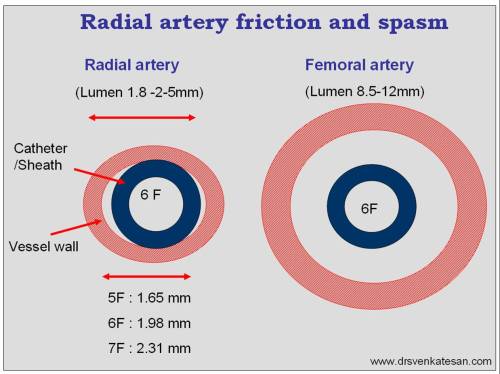
The normal diameter of radial artery lumen is 2.4mm (Range 1.8-3.0) .Some population have still smaller radial lumen(India KA.Sambasivam et all mean 1.8mm). Compare femoral artery (8.5mm diameter, 4 times bigger )

Imagine this  situation ,  a 1.65 mm (5 F) diameter catheter trying to enter a 1.7mm radial artery !

Is it not a futile excercise ?   Many of the failed radial access is due to  radial artery /catheter mismatch .
radial-artery-spasm

There has been occasions , when the radial sheath is larger than radial artery itself !

So the size of the radial artery becomes vital in planning radial CAG.

What are ways one can estimate the size  of the radial artery ?

  • Volume of pulse (Still Useful , but can fool us some times!)
  • Thick radial walls (Monckeberg,s sclerosis)
  • Ultrasound imaging

Radial artery spasm

Radial artery has more medial  smooth muscle and further the fibres  criss cross the artery. Further , the radial artery is richly innervated by sympathetic  nerve terminals.

The major factor that determines likely hood of spasm is

  • Pain  intensity.
  • Amount of free space between sheath and vessel wall
  • The frictional force between sheath and artery wall is the powerful trigger for spasm and pain.

What is the biochemical mediators of radial artery spasm ?

It is logical to believe all  vascular  spasm are due to calcium .But it is not. Calcium blockers have  no definite relief for  spasm.Nor adrenaline mediated alpha receptor stimulation  has a major contribution for RAS. Phentolamine is useful

Is there a objective and quantitative method to assess radial artery spasm ?

Removal of the radial  requires some force.  Kiemeneij ( Measurement of radial artery spasm using an automatic pullback device. Catheter Cardiovasc Interv 2001;54:437–441.) demonstrated if one require > 1kg force to remove a sheath it correlates with clinically significant spasm.

What are the serious sequel of radial artery spasm ?

Radial artery rupture and radial artery avulsion has been reported when attempting to remove the sheath from spastic arteries

Management of radial spasm

There are two aspects to this problem

  • Prevention of  spasm
  • Treatment of established spasm

How to prevent or reduce  radial artery spasm ?

Radial artery is a very sensitive artery .The incidence of spasm can be up to 20%  The spasm can be due to

Hardware, technical ,anatomical factors.

Apart from  above  three factors,  the most important is anxiety related .The key principle is ,   sedating the  radial artery is as important as sedating the patient .

Sedating the patient

Explaining to the patient about the procedure can allay the anxiety. It is a fact , the tactile perception of catheter movement  in radial route is more than the femoral .In very anxious patients (Some centres use it routinely )  IV sedation (Midazolam)

Sedating  the radial artery.

Local anesthesia : Subcutaneous lignociane , though widely used has a drawback.It can aggravate pain, induce spasm , accidental entry into lumen may cause a hematoma  .All can potentially make the pulse feeble. So care should be taken in giving minimal lignocaine ( At a specific  point needle entry) with a short needle . One should watch , the grace with which experienced radial interventionist give the local anesthetics !

Arterial cocktail

The arterial cocktail consists of combination of Nitroglyceine (200 mcg) , Xylocaine (50 mg) Verapamil (5 mg) an. Heparin(5000 IU). Sodium bicarbonate (4%) is optional to neutralise the acidity of the solution

How to administer ?

Ideally spasmolytic cocktail should be given before the sheath is introduced immediately after puncture . As the drugs has to get in contact with the arterial wall .if cocktail is given after introduction of sheath one of the following may be done.

  • Give the drug as it enters the artery.
  • Pull back the sheath when injecting the drug.
  • Use a side holed sheath.

Technical issues to prevent radial artery spasm

Try to puncture in single prick . If the first puncture is not successful , don’t attempt to cross a spastic radial artery Remember (Unlike femoral ) successful puncturing of a spastic radial artery may be the beginning of a vexing and tiring procedure.So if we have lot of difficulty in getting in ,  please avoid the procedure and switch to femoral . (Spastic signals may spill over to left hand also !)

Remember unlike femoral cathetrisation , in radial access,  getting out the catheter could  be more tricky   than getting in !

Avoid procedures that would  require  multiple catheter , guide wire exchange .Complex lesions and in emergencies.( Some experts do Primary PCI through radial !) .Now  dedicated radial hardware are available.

Sheath selection (Visit :  Arrow International )

Long sheaths have been used in the past. It makes the spastic segment lengthier.Now short sheaths are increasingly used. Long sheaths (20-25cm ) give better suppport during catheter manipulation. Side holed sheaths  is a newer innovation. This maintains the  blood flow on the sides of sheath and reduces friction with vessel wall .Further, it can deliver the arterial cocktail to vessel wall and effectively prevent or reduce spasm.

Catheters : Use 5 F/6F. Rarely 7f are used.

Guide wires :Hydrophilic guidewire are radial friendly.

How to manage established severe spasm ?

For severe  spasm with sticky sheath / catheter

  • Increase the analgesia with morphine
  • Repeat NTG and Verapamil
  • Warm compresses over the forearm
  • Never pull with force
  • Wait for an hour and try pulling again (Often successful )

Last resorts

An axillary block

Vascular surgery

Reference and further reading

For excellent collection of radial access resources  please visit  www.radialforce.org

(Much of this blog’s content is based on this article )

http://www.invasivecardiology.com/article/5446

http://meeting.chestjournal.org/cgi/content/abstract/130/4/201S-a

Ectopic beats or premature depolarisations are the commonest  cardiac arrhythmia encountered . Human heart , is a  non stop  electro mechanical organ ,  and it is not surprising   ectopic beats are so common  and can literally originate  from every cell of heart. But , generally it   emanates  primarily from  the special conducting cells . At times  ,  even  other cells (Myocytes, interstitial cells )  can generate abnormal electrical potential.These ectopic electrical potentials  can be compared  to  electrical load shedding when there is excess electrical strain .

Vast  majority of ectopic are benign  in human population. When this occurs ,  in the milieu of underlying heart disease or during ischemic  episodes they become clinically important and initiate a sustained arrhythmia.

Classically and traditionally ectopic beats are described in the

A.Ventricle :      Ventricular premature beats, (VPD)

B.Atrium:             Atrial premature beats(APD)

C.AV junction : Junctional premature beats.(JPD)

If you note , one important structure is missing from the list.

Yes , it is  SA node.  Can it result in premature depolarisation ?

When do you suspect a SPD(Sinus premature depolarisation)

  • It manifests a  an sudden unexpected , sinus beat exactly as the previous sinus beat. Followed by a pause.
  • The P wave morphology exactly is similar to prior p wave.
  • Many times we miss this entity as we tend to over  diagnose APD than SPD.
  • SPDs tend to occur in bigeminy rhythm.

Differential diagnosis

  • Sinus arrhythmia and pause
  • APD
  • SA node echo beats (Part of SA node reentry)
  • SA blocks

How do differentiate  a sinus arrhythmia from sinus premature depolarisation (SPD ) ?

Sinus arrhythmia occurs in a baseline bradycardia environment.

It does not not come as   “on -off ” pattern . It has a gradual onset offset dynamics.

Clinical significance

This is a clinically unimportant arrhythmia* .This  is probably the reason , it is not a popular concept .

*But it can confound in the diagnosis of  , other important rhythm  disorders.it could be a expression of  sinus node dysfunction and a precursor of  inappropriate  sinus tachycardia The significance could be substantial in atrial triggered  based  pace maker rhythm

Final message

When you confront an unexpected , early , sinus beat not accountable to sinus  arrhythmia  or APD

suspect SPD.It is  not rare , it is a  grossly under diagnosed entity.

Reference

Sinus premature systole  http://www.chestjournal.org/content/64/1/111.full.pdf?ck=nck

Pacemaker rhythms  result in classical ECG with  LBBB morphology.It is a universally understood  fact that  RV pacing would  produce LBBB and LV pacing a  RBBB pattern in surface ECG.As with any other rules in medicine , it is not 100%  perfect .(May be 70%)

In the process of oversimplification of rules  we have forgotten a simple fact , that is, interventricular  septum is  shared by both the ventricles . ( functionally and electrically )

In due course , cardiologists and electrophysiologists  have  recognised this fact. A pacemaker lead hitching on the IVS  can behave independently and disobey this  golden rule of pacing.(RV-LBBB,LV-RBBB). Depending upon the orientation of the lead and the pressure it exerts  on the tissue  and degree of penetration of the screwing lead into the septum, the resultant   ECG can  either have a complete RBBB pattern ,  partial RBBB or partial LBBBB or combination of both.

Can RBBB pacing be stable ?

Yes.,  provided the the fixity of the lead and other parameters like impedance and pacing threshold are good.

Before labelling RBBB pacing as safe one should rule out pathological RBBB pacing like septal perforation and

accidental entry into LV through foremen ovale.

Is coronary sinus pacing an acceptable alternative  for  long term permanent pacing ?

The answer is generally ” No ” ,  but it needs rethinking.

A coronary sinus pacing may happen accidentally.The leads get located  either in the main stem coronary sinus or it”s tributaries.the morphology of ECG depends upon the branch it enters.Leads when they reach LV aspect result in RBBB morphology.

Can  we do intentional coronary sinus  pacing for complete heart block ?

There are many accepted  references in literature  that terms   RV pacing as unphysiological and has high risk of precipitating or aggravating cardiac failure. So currently , alternate sites of pacing are explored.( Septum, his bundle , biventricualr etc)

It is an irony , in this era of cardiac resynchronisation therapy where we do coronary  vein pacing  , the same concept is not being tried for regular  permanent pacing in special and difficult situations.( Severe TR, Left sided SVC, AC canal defects etc)

Final message

  1. RBBB morphology following  permanent pacing  need not elicit a panic reaction provided all parameters are stable.
  2. In patients  with difficult RV anatomy* ,  who need permanent pacemaker implantation a modified  coronary sinus pacing can be a solution .But as of now no such speciifc leads are available.EP Industry should take a note on this .

*Epicardial pacing is an option in such situations .But it requires surgery.

Ref:

Safe right bundle branch block pattern during permanent right ventricular pacing Journal of ElectrocardiologyJanuary 1, 2003   Yang, Yung-Nien ; Yin, Wei-Hsian ; Young, Mason Shing

Yes , we can .         Abstract : Link to Indian heart journal

b1

Vegetation Negative Infective-Endocarditis

S Venkatesan, G Gnanavelu, G Karthikeyan, V Jaganathan,  R Alagesan,
M Annamalai, S Shanmugasundaram, S Geetha, A Balaguru, G Anuradha

Madras Medical College, Chennai


The definitive diagnosis of infective endocartitis (IE) remains a contentious clinical issue. Many diagnostic criteria have been advanced. However, none has withstood the test of time. Currently Duke’s criteria is considered as de facto standard. Documentation of vegetation within the cardiac chambers and positivity of blood culture is the sine qua non of IE and evidently they constitute the major criteria. Ironically, according to Duke’s criteria, IE could still be diagnosed in the absence of vegetation, provided it fulfils other major criteria of culture positivity. In this context, we report our analysis of patients with IE without vegetation. Out of 24 patients admitted between 2004-2005 in our hospital with the diagnosis of IE, 4 patients failed to show vegetations. All had rheumatic heart disease (RHD) and presented with prolonged fever. All had severe eccentric mitral regurigitation (MR). One had severe aortic regurgitation (AR) also. One had flail posterior mitral leaflet (PML). All had blood culture positive – 3 for staphylococcus auerus 1 for pseudomonas. None had vegetations on the first echocardiographic examination. Transesophageal echcardiography (TEE) also failed to detect a vegetation or abscess. The diagnosis of IE was made on the basis of Duke’s criteria (1 major and 3 minor features). Treatment was started based on culture positivity and sensitivity. All patients underwent serial echocardiography every week for 6 weeks. New mobile vegetation was detected in 1 patient in anterior mitral leaflet (AML) measuring 12 mm after 2 weeks. Three patients never showed any evidence of vegetation. One patient developed cerebral vasculitis and another renal insufficiency during the course of treatment. Two patients stabilized with medical management. One expired and other had refractory cardiac failure and was referred for emergency surgery. The mechanism of absence of vegetation in IE could be varied. Simple temporal dissociation between appearance of vegetation and the clinical syndrome should be the first possibility. Further, vigorous antimicrobial treatment might have prevented the formation of vegetation. But, as we have seen in few patients, it never appeared. This was possibly due to layered vegetation like that of a thrombus on the surface of the valve or adjacent myocardium. The process of vegetation formation need not be endoluminal, it can burrough into the tissue plane intramurally without projecting into the cavity. Spontaneous rupture of chordae secondary to inflammation without any vegetation is another possibility.

We conclude , even though vegetations are considered sine quo non of IE in many clinical situations, IE occurs without vegetation. The mechanisms could be varied.

Download full  PPT presentation

infective-endocarditis-csi-2005

infective-endocarditis-csi-2005

infective-endocarditis-vegetation-csi-2005

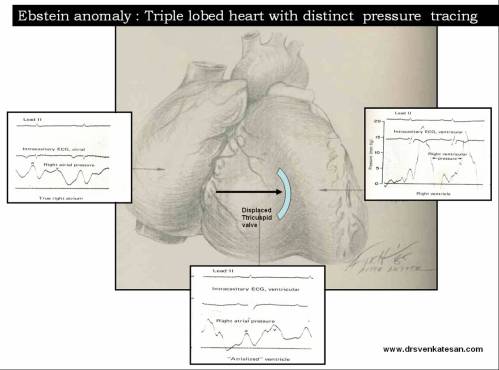
ebstein-anomaly

Down load high resolution PDF file

ebstein-anomaly

Ref:

An excellent article from H.Watson in british heart journal

HERNANDEZ FA  The intracavitary electrocardiogram in the diagnosis
of Ebstein’s anomaly. Amer J Cardiol 1: 181,  1958

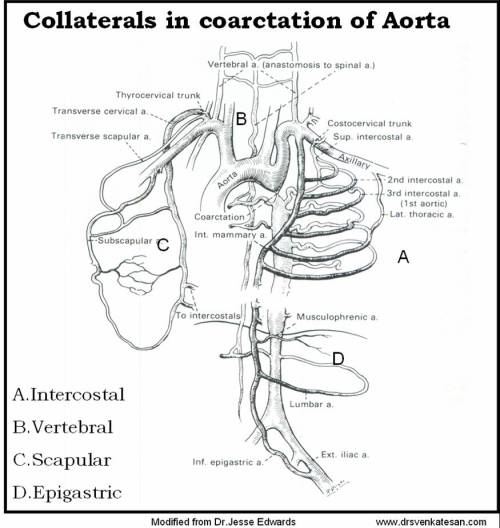
A perfect illustration  to understand

What will happen if the aorta is obstructed at the level of isthumus ?

One of the great illustrations I have come across

co-arctation-collaterals

collaterals-in-coarctation-21

Courtesy

Dr.Jesse Edwards (Fowler’s Text book of cardiology )

To  Download a PDF version and Zoom into the Aorta  as deep as you would like !

collaterals in coarctation of aorta

Also watch

Collateral in co arctation   : A video

PDA is a common congenital heart disease.It results in progressive left to right shunting.

Development of pulmonary hypertension is the major complication.PDA need to be closed once the diagnosis is made.Until recently surgery was the only option.Now we have device, coil closure   available. Not all ducts are amenable to device closure.

For a duct to be closed by device we have to know the exact anatomy of the ductus.echocardiography has  limitation to  accurately image the ductus. Angiogram is the specific method.

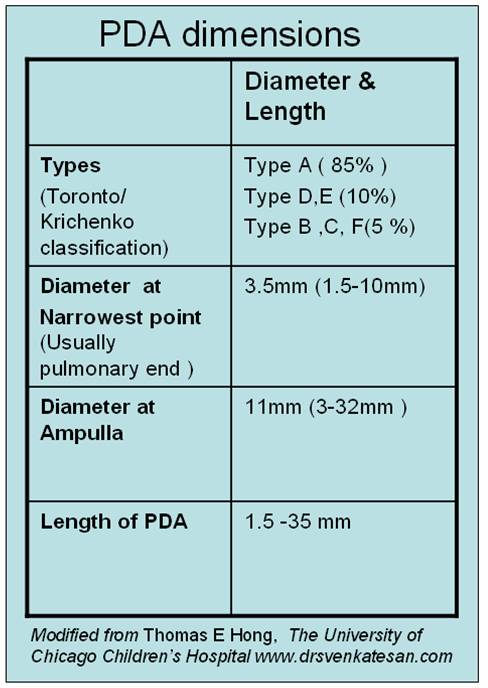
What is  the normal length of patent ductus  arteriosus ?

The length of duct is very variable it can vary between 1 mm to 35  mm.

A 2 mm PDA is nothing but direct adherence of aorta and pulmonary artery (Ultra short form , similar to AP window )

pda-size-ductus

What is the branching angle of ductus from aorta and the entry angle at the pulmonary artery ?

This is an important determinant of technical success of device closure .Very abtuse or acute angled ductus can

face difficulty in deploying devices. The normal angle in lateral view is between 30-60 d

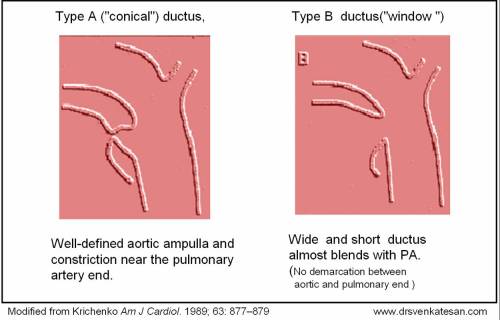
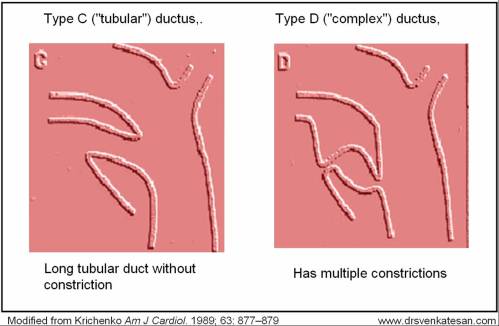
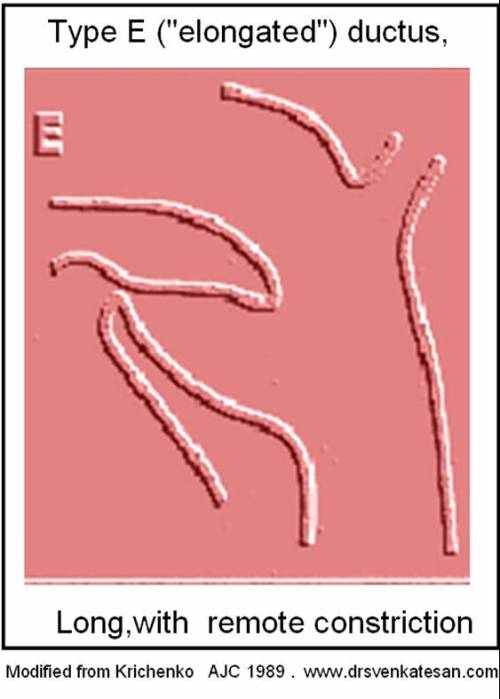
How do you classify PDA ? .

There is only one classification of PDA available  based on angiogram .Krichenko*

pda-4

pda-2

pda-31

Taken from  *Krichenko A,. Angiographic classification of the isolated, persistently patent ductus arteriosus and implications for percutaneous catheter occlusion. Am J Cardiol. 1989; 63: 877–879

Review article on PDA

http://www.circ.ahajournals.org/cgi/content/full/114/17/1873