March 8, 2009 by dr s venkatesan
Intraluminal filling defect is often observed during coronary angiogram .Thrombosis has become the default diagnosis in most situations.This has resulted in over diagnosis of thrombosis .In fact a strategically located plaque stained by the dye is an equally common cause for intraluminal filling defect.
In fact there are many recognised caused of filling defect
- Thrombus
- Dissection
- An eccentric plaque
- Dye trapped within plaque fissures
- Calcification projecting into lumen
- Plaque prolapse from stent struts
- Artifacts-End on view of side branches
- Static myocardial bridges
- Trapped air bubble(Transient filling defect)
- Streaming effect dye may mimic a filling defect
Message
It is not advicable to make a default dignosis of coronary thrombosis in all cases of intraluminal filling defects
Posted in Cardiology -Interventional -PCI | Tagged air in coronary artery, coronary calcification, coronary dissection, coronary thrombosis, dye streaming, end on view of coronary artery, intra luminal filling defect, intraluminal, myocardial bridging, plaque fissure, semi | Leave a Comment »
March 6, 2009 by dr s venkatesan
Why PCI in left main CAD is considered an inferior modality than CABG ?
CABG is superior to PCI for the simple reason it provides complete revascularisation virtually in all patients with LMCAD , while PCI is possible only in a fraction of patients with LMCAD.
If we take 100 patients with left main disease may be ten (At best !) would be suitable for PCI ! In other words PCI is contraindicated in vast majority of LMCAD by technical criteria alone , while there can never be a contraindication for CABG in patients with LMCAD.(Except when , comorbidity precludes surgery )
Why PCI in LMCAD difficult ?
It is dependent on technicalities
CABG does not tackle a lesion, it simply avoids it and by passes it ” No great brains required”
while PCI takes on the plaque frontally , in the dangerous terrain of left main artery itself !
so, much caution, planing , logistics are required . Further , if there is a complication there is a potential
for catastrophe as the only supply line is cut off . This is the reason , cardiologists were worried to try this on
unprotected left main. (Protected LMCAD refers to left main disease following CABG wherein atleast LAD or LCX is grafted )
Points to ponder in LMCAD
- PCI is suited for isolated discrete LM disease.In realty this is seen in less than 5-8 % CAD.
- LMCAD is very often associated with critical and multivessel distal CAD . So these patients will be candidates for CABG.
- Left main ostium or LAD ostial involvement makes PCI a tougher exercise
- Calcification is more common in LMCAD that again makes PCI difficult.
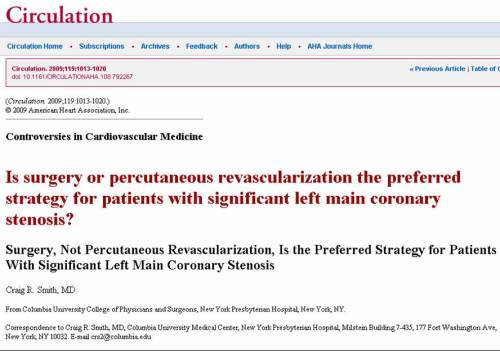
The following article in Feb 2009 is a major blow for proponents of PCI for left main
http://circ.ahajournals.org/cgi/content/extract/119/7/1013
http://content.onlinejacc.org/cgi/content/abstract/51/5/538?ijkey=84c977d189e84327c3abbd4c1228de17dd99048a&keytype2=tf_ipsecsha
Final message
- Conquering left main disease is an interventionist’s ultimate dream.
- But, before that they have to tackle the bifurcation lesions .This is of vital importance, because 2/3 rd of left main patients have some form of bifurcation lesions. Current techniques , hardware and outcomes are far below the idealistic solutions in bifurcation lesions.
- Till that time , CABG would remain the only choice for all , but for a small fraction of isolated left main disease where PCI may be possible.
Posted in cardiac surgery, Cardiology - Clinical, Cardiology -Interventional -PCI, cardiology -Therapeutics, Uncategorized | Tagged annlas of thoracic surgery, cabg, cardiac surgery, ctsnet, jacc, LAD, lancet, left main disese, left main stenting, left main vs cabg, lima, nejm, pci for left main, proximal lad, radial graft | Leave a Comment »
March 6, 2009 by dr s venkatesan
Left main coronary artery disease (LMCAD) often evokes a panic reaction among cardiologists .Not every LMD deserve that re. To label it as significant, we have a criteria , that is 50% diameter stenosis. So what you do , for a tapering or narrowed left main with 40% stenosis. Isolated insignificant left main is rare *, but real incidence is not known. LMCAD is most often due to , atherosclerosis of left main coronary artery without limiting the flow.
What are the options ?
- Leave it alone, with intensive medical management assisted by high dose statin(80mg)
- Elective PCI with stenting , even though the lesion is not significant.
*If associated LAD or LCX is there decision making is easier .
How significant is a coronary stenosis ?
The significance of a coronary lesion with reference to “lumen diameter obstruction” is basically flawed. The significance of a coronary stenosis, by tradition is based on it’s hemodynamic impact ,right from the CASS days in early seventies.Unfortunately our mind set has not changed even after realising non obstructive – sub critical lesion is more prone for acute coronary syndrome. Is it not ironical to call a 40% lesion a non significant one !
So, the significance of coronary stenosis is two fold.
- Hemodynamic significance
- Clinical and pathologic significance
The former predisposes to often chronic stable angina, later likely to result in ACS.
How will you approach a apparently insignificant left main disease ?
A 40 % lesion in left main is hemodynamically not significant , but pathologically very significant.It needs intensive treatment. Plaque passification with medical approach is first choice.If the lesion morphology is eccentric, has irregular margins or involves LAD or LCX ostium doing a PCI or even a CABG is to be considered in spite of the lesion is hemodynamically insignificant .
Why , PCI is considered “not appropriate” for less tighter lesions , even though these lesions have great clinical significance ?
The answer is simple, The risks and the potential cost are more than the benefit !
And further , stents are not innocuous devices either , they always carry a risk of sudden occlusion as like a sub critical lesion !
Answer to the title question
True incidence is not known . Our experince (Class 1 c evidence) would suggest Left main disease constitutes up to 10 % of CAD.Among this one third would be hemodynamically insignificant
Suggested reading
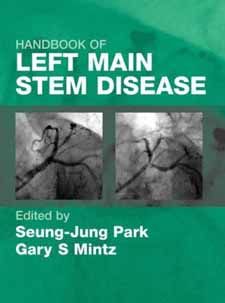
Handbook of Left Main Stem Disease
edited by Seung-Jung Park
//
Posted in Cardiology -Interventional -PCI, cardiology- coronary care, Cardiology-Coronary artery disese, Hemodynamics, Uncategorized | Tagged 70% or 90%, abrams, acc aha, acs, coronary artery diameter stenosis, coronary artery disease, coronary cross section, cypher, des, distal left main, ellis, flow limiting lesion, insiginifcant left main, LAD, left main disese, left msin 40% lesion, non flow limiting lesion, pci, ptca, scai, tapering left main, vulnerable plaque | Leave a Comment »
March 3, 2009 by dr s venkatesan
What is the simplest and accurate way to predict the origin of Right atrial tachycardia(RAT) from left atrial tachycardia(LAT) ?
Look at the P waves in V 1 ( Don’t look further ! )
- A negative or a biphasic (+/- ) P wave in V 1 is 100% specific for a right atrial tachycardia
- A positive P in V1 or a biphasic ( –/+ ) P-wave in lead V1 has 100% sensitivity for a left atrial tachycardia
What are the incidence of left and right atrial tachycardia ?
RA- 75%
LA -25%
What are the common focus of right atrial tachycardia ?
- Crista terminalis (60% of all RAT)
- Tricuspid annulus
- Coronary sinus ostium
- Perinodal tissue
- Right side of IAS
- Right atrial appedage
What are the left atrial focus in Left atrial tachycardia ?
- Right & left pulmonary vein (50% of all LAT)
- Superior mitral annulus
- LAA
- CS body
- Left septum
(Please note this rule is not applicable for re-entrant tachycardias, atrial flutter, AV nodal tachycardias)
Source :
P-Wave Morphology in Focal Atrial Tachycardia
Development of an Algorithm to Predict the Anatomic Site of Origin
peter M. Kistler et all.
This paper from Melburne, Australia is a rare gem of an article for understanding atrial tachycardia .This paper won the the Eric and Bonny Prystowsky Heart Rhythm society Fellows Clinical Research Award, New Orleans, Louisiana, 2005.
Click on the Link to reach the article
http://content.onlinejacc.org/cgi/content/full/48/5/1010
//
Posted in cardiology -ECG, Cardiology-Arrhythmias, Cardiology-Land mark studies, Tutorial in clinical cardiology | Tagged atrial tacycardia, greeat papers in cardiology, how to localise atrial tachycardia, p wave morphology in svt, svt | Leave a Comment »
February 15, 2009 by dr s venkatesan
Ventricular tachycardia as a group , constitute a major group of cardiac arrhythmias. Most of the VTs are managed by cardioversion followed by medical management. Few require , implantable defibrillator when there is severe LV dysfucntion .(ICD) Localising the origin of VT and subsequent , ablation is the treatment of choice in some of the patients with VT.
Traditionally VT was thought to arise fro the endocardial aspects of myocardium. Now we realise many times VT originate from the epicardial aspects of ventricle.
Epicardial VT : Defintion
Epicardial ventricular tachycardia (VT) is defined as VT in which the critical sites of the reentrant circuit (or the ‘sites of origin’) are located exclusively in the subepicardial tissue, as shown by entrainment manoeuvres or VT that is terminated within 10 s with standard radiofrequency (RF) pulses, or both. E. SOSA,M. SCANAVACCA et all http://www.springerlink.com/content/w608142674154tp5/
How to recognise epicardial origin of VT by surface ECG ?
- Terminal S wave in V2 and q in lead 1 strongly suggest VT of sub epicardial origin.
- Pseudodelta wave
- Intrinsicoid deflection time of 85 ms
- RS complex duration of >120msec
Suggest epicardial origin of the VTs.
Important Links
http://www.circ.ahajournals.org/cgi/content/full/113/13/1659
Berruezo criteria ,http://circ.ahajournals.org/cgi/content/full/109/15/1842 ( Must read)
http://cogprints.org/4222/2/tada.pdf
What is the clincal significance of epicardial VT ?
Endo cardial ablation not likely to be successful
Trans pericardial approach may be needed.
Posted in cardiology -ECG, Cardiology -Interventional -PCI, cardiology -Therapeutics, Cardiology -unresolved questions, Uncategorized | Tagged carto, electrophysiology, epicardail ventricualr tachycardia, heart rhythm, naspe, ventricualr tachycardia | 1 Comment »
February 8, 2009 by dr s venkatesan
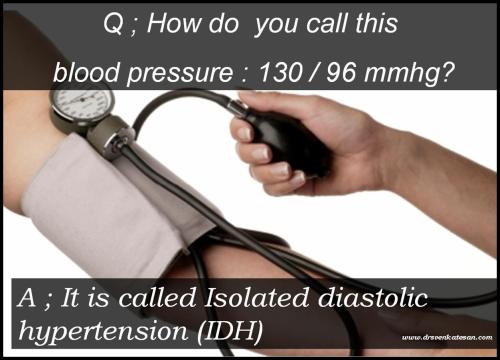
- Hypertension is major determinant of cardiovascular health of our global population
- Millions suffer, hundreds of societies , and as many guidelines , and drugs are still struggling to control the menace.
- An important sub group of HT , (ie IDH ) population has been neglected and never received the scientific interest , which it deserves !
- In our study it occured in 7.2% of all HT patients.
- JNC, the world authority on HT never considered IDH as a separate entity, and as of now there is no specific guidelines.
- And the irony is complete . There is not a major study available to analyse the differential effects of anti hypertensive drugs on systolic and diastolic blood pressure.
If a patient with the BP of 120/96 asks you , “Doctor , will the drug, you have prescribed , selectively lower my diastolic blood pressure ” what will be your answer ?
A clear , I don”t know !
The following paper was presented in the World congress of cardiology Sydney 2002
Isolated Diastolic Hypertension
S.Venkatesan,S.D.Jayaraj.Gnanavelu, Madras Medical College. Madras, India.
Abstract : Systemic hypertension continues to be a major determinant of cardiovascular morbidity. While isolated systolic hypertension(ISH) has been identified as a specific clinical entity, isolated diastolic hypertension(IDH) has not been reported as a separate group. When we analysed our data from our hypertension clinic we found a distinct subgroup of patients who had elevated diastolic blood pressure with normal systolic pressure. We report the clinical profile of these patients. 440 newly registered hypertensive patients between the year 1998-99 formed the study population. All patients with secondary hypertension were excluded.. IDH was defined as diastolic BP more than 90mmhg and systolic BP less than 140mmhg.
IDH was present in 32(7.2%) patients. The male female ratio was 3:1, mean age was 42(Range32-56) The mean diastolic pressure was 96 mm (Range 90-110).The mean systolic pressure was 136mm(Range 128-140). LVH was observed in 4 patients(12.5%). Diastolic dysfunction was detected by echocardiography in 20patients.(62%)
We conclude that isolated diastolic hypertension constitute a significant subset among hypertensive patients and they need further study regarding the pathogenesis, clinical presentation and therapeutic implication.
Link to PPT will be available soon .
Posted in cardiology -Therapeutics, Cardiology -unresolved questions, Cardiology hypertension, general medicine, Infrequently asked questions in cardiology (iFAQs), My presentations | Tagged allhat, amlogard, anti hypertensive drugs, hypertension, hypertension clinic, ish, isolated diastolic hypertension, isolated systolic hypertension, jnc, kaplan, mean areterial pressure, sweeny | Leave a Comment »
February 8, 2009 by dr s venkatesan
Ventricular tachycardia is considered as a dangerous electrical rhythm abnormality .It can immediately degenrate into ventricular fibrillation and result in SCD in many.Ironically, it is also a fact , a patient with VT can present silently without any symptom .Some VTs are slow and recurrent without much affecting The hemodyanmics.
In chronic recurrent, beningn VT (Some may consider it , ” height of absurdity ” to call a VT beningn ! but it is a reality , the term beningn denotes – very remote chance of converting into VF) ” Is there any other therapeutic option other than convertng into sinus rhythm. “( Read related topics)
The following paper was presented in the Annual scientific sessions of Cardiological society of India, Kochi , seven years ago in 2002
VENTRICULAR RATE CONTROL IN VENTRICULAR TACHYCARDIA
S.Venkatesan,,. Madras Medical College. Chennai
Mangement of hemodynamically stable recurrent ventricular tachycardia remains a delicate clinical problem. Reverting to sinus rhythm is considered as the only aim of treating VT.While rate control is accepted as a therapeutic option in atrial fibrillation, it is not so, for ventricular tachycardia.In this context we attempted to analyse the effect of Amiodarone on ventricular rate in stable ventricular tachycardia which fail to convert to sinus rhythm.
The study cohort consisted of 49 patients with stable VT who were admitted in the coronary care unit of Govt. General Hospital between 1998 to 2002.The criteria for inclusion were systolic BP>100mmHg and absence of hypoperfusion of vital organs The mean age was 52 years (range 26-68) with a male female ratio of 4:1. Of the study group 36 patients were either reverted with IV lignocaine , Amiodarone ( 150-300mg bolus ) or DC cardioversion . 13 patients who did not respond to either of these were followed up with Amiodaroneinfusion(1000mg) for 24 hours. The baseline diagnosis were old MI (6)) DCM (3) Arrhythmogenic RV displasia(2). Idiopathic VT was diagnosed in 2 patients.All these patients had VT during most part of the 24 hour follow up.
The pre Amiodarone mean ventricular rate was 152 (124 –196). Post amiadaorne (at 24hrs) mean ventricular rate was 128(88-142). The time taken for 50% heart rate reduction was 6.6h (4-24h). The average systolic blood pressure improved from 100 to 112mmhg . These patients were discharged in stable clinical status with oral Amiodarone and were referred for EP study.
It is concluded that Amiodarone, apart from it’s cardioverting ability , has a distinct ventricular rate controlling effect which can be of therapeutic value in at least certain subset of chronic recurrent VT.
Final message
Some of the patients with VT carry a very low risk of VF and SCD .In these patients , the only other major aim is to prevent tachycardiac cardiomyopathy that can be done with drugs which controls the ventricular rate whenever VT occurs !
Corrrecting the primary cause like cardiac failire , revascularisation ,detailed EP study ,tachycardia mapping , followed by RF ablation and ICD implantation is the state of the art approch in the management of VTs.But this small clinical observation was made to impress rate control could also be an option in patients in whom these procedures are contraindicated or not available .
Posted in cardiology -ECG, Cardiology -Interventional -PCI, cardiology -Therapeutics, Cardiology -unresolved questions, cardiology- coronary care, Cardiology-Arrhythmias, Infrequently asked questions in cardiology (iFAQs), My presentations | Tagged amiodarone, arvd, cardaic arrhythmias, electro physiology, ep study, heart rhythm, naspe, podrid, rate control, rvot, ventricular tachycardia, wellens, wide qrs tachycardia, zipes | Leave a Comment »
February 1, 2009 by dr s venkatesan
Ventricular tachycardia (VT) is one of the dangerous form of cardiac arrhythmias.
When it occurs , it may present in many ways
- Cardiac arrest with immediate degeneration into ventricular fibrillation.
- Pulseless VT in a conscious patient but in in shock.
- With pulse, relatively stable , not much fall in blood pressure.
- Incidentally detected.*(Rare)
This , gives us an idea that VT as an electrical abnormality has wide clinical presentations , life threatening at one end and, patient walking into the hospital with minimal palpitation on the other hand !
The management issues
- In patients with hemodynamic instability , decision making is easy as there is only option of DC shock.
- In patients with stable VT, it is natural for the physicians to get tentative or even confused.This is because , dangers of shocking a stable patient has to be weighed against the currently available excellent antiarrhytmic drugs( Amiodarone, Ibutilide etc) .
The major issue here is in ruling out underlying structural heart disease.
Never shock a stable VT, without knowing the myocardial and valvular function.There has been many occasions underlying severe LV dysfunction is missed and they may go for asystole.
VT in the setting of cardiomyopathy, Post MI(Scar mediated) are often refractory even to DC shocks.It is the drugs that will ultimately control the arrhythmia.DC shock is just used to terminate the VT.
VT structurally normal heart , especially arising the outflow tracts of LV or RV behave very differently (Fortunately they are more benign)
- Have less hemodynamic impact as it involves the outflow tract and not over the the pumping zone of LV as in conventional ischemic myocardial VT .
- They respond to calcium blockers verapamil to be precise (As they share properties of SVTs)
- Sensitivity to verapamil by no way convey a meaning of Amiodarone resistance.Out flow tract VTs will also respond to Amiodarone many times.
- Degeneration into VF is rare.
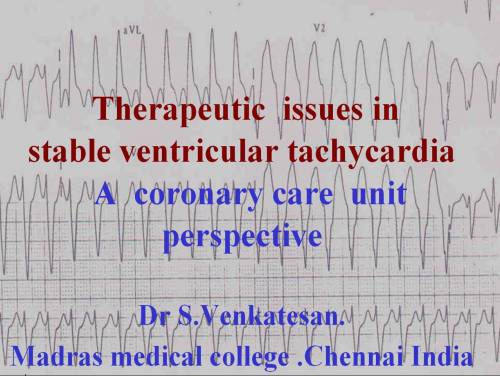
Also read Therapeutic issues in stable ventricular tachycardia
Presented and published in Indian heart journal
Related topics
Why some ventricular tachycardias are resistant , even to multiple DC shocks ?
Posted in Uncategorized | Tagged cardaic arrhythmias, cartp, ECG, electrophysiology, endosense, heart rhythm, naspe, ventricualr tachycardia | Leave a Comment »
January 28, 2009 by dr s venkatesan
Lignocaine , probably has saved more lifes world over than any other cardiac drug .
It was the only choice for ventricular tachycardia till 1990s, both in pre and post thrombolytic era.Every coornary care unit has reverted tens of thousands of unstable VTs with this simple and cheap intravenous drug.the utility value of lignocaine is not limited to ischemic VT alone it is effective in in almost all forms of VT.It was classically administered in two or more boluses followed by an infusion.
What happened to this wonder drug with great performance record ?
The power of statistics , and inappropriate interpretation by the scientific community has left a serious blow to this wonder drug .Now the drug has been made redundant, and mainstream cardiac literature has made everyone feel guilty , if anybody uses this drug for VT .
Why did lignocaine lose the battle ? The reason is three fold
- The advent of much fancied Amiodarone
- One negative study for antiarrhythmic drugs in post MI period (CAST)
- And two so called positive studies for Amiodarone (ALIVE & ARREST) has sounded the death bell for this drug which has resuscitated millions of life !
CAST study http://content.nejm.org/cgi/content/abstract/321/6/406
All , CAST said was routine suppression of asymptomatic ventricular arrhythmias in the post MI period is unwarranted. But you know , how this world interpreted it “Lignocaine has no role in ventricular arrhythmias in post MI setting ” The most funny thing was lignocine was never used in CAST study .
The studies involving one to one comparison of Lignocaine and Amiodarone (ALIVE and ARREST study) was also not interpreted properly.These studied only shock resistant VTs. What about the role of lignocaine where defibrillator was not available ?
Link to ALIVE and ARREST read and make your own conclusion.
http://content.nejm.org/cgi/content/abstract/346/12/884
http://content.nejm.org/cgi/content/full/341/12/871?ijkey=8fa241f3cebb86a177632ec6ccadfb5a3ded7bc2
Final message
- Lignocaine is not only a topical anesthetic , it is powerful and gentle myocardial anesthetic when administered in post MI period.
- With this property it successfully cardioverts and prevents dangerous ventricular arrhythmias.
- Time tested and worthiness proven.
- While , we are made to believe the success rate of Amiodarone in VT is far superior than ligncaine .It is a falsehood.
- Any experienced cardiologists will recognise , many times even Amiodarone resistant VTs often respond to Lignocaine .
- The fact of the matter is , without a good quality one to one study , lignocaine was ditched. One reason for this could be Lignocaine , is a generic drug and has no market value.
Let us take home , the message (scientific or unscientific ! ) Lignocaine still has a great role to play in the management of dangerous ventricular arrhythmias .The only caution is , it should not be used routinely and indiscriminately in all asymptomatic patients with VPDs or nonsustained VT . (Acknowledging CAST conclusion.)
Posted in Cardiology - Clinical, cardiology -ECG, Cardiology -unresolved questions, cardiology- coronary care, Cardiology-Arrhythmias, Cardiology-Coronary artery disese | Tagged alive study, amiodarone, arrest study, cast study, ccu, ICD, lignocaine, lignociane vs amiodarone, ventricualr tachycardia, xylocard | Leave a Comment »
January 27, 2009 by dr s venkatesan
Cannon waves occur classically, during ventricular ectopic beats .(Commonly irregular) regular cannon waves occur during Junctional tachycardias with 1:1 VA conduction
Cannon like wave may appear in the jugular vein if the VPDs is timed in a such a fashion ,the atrial systole occurs with a closed AV ( Tricuspid and mitral valve ) so the atrial contractile wave is reflected back into the veins.This not only happen in right atrium but also in the left atrium , but the cannon waves are sent into the pulmonary veins , which is not visible. As by tradition cannon waves are meant to be seen only in neck veins , we rarely realise the importance of such waves in the pulmonary veins.
There must be some significance for this abnormal pulmonary venous waves which travel in a retrograde fashion.In fact , with the advent of echocardiography, we realise pulmonary flow reversal is an important contribution for raised PCWP.
The dyspnea during multiple VPDs can be due to
1.Transient Mitral regurgitation and resultant elevation of PCWP.
2.Pulmonary venous cannon waves and it’s effect on J receptors.
3.Many of the intermittent episodes of dyspnea (Especially paroxysmal nocturnal dyspnea ) , other wise unexplained could be due to this pulmonary venous cannon waves.
4.It also need to be studied how this pulmonary venous cannon waves distribute themself into the 4 pulmonary veins.
//
Posted in Cardiology - Clinical, Cardiology -unresolved questions | Tagged cannon waves, cannon waves in pulmonary viens, left atrial cannon waves, mechanism of cannon waves, pulmonary cannons | Leave a Comment »
« Newer Posts - Older Posts »




