Feeds:
Posts
Comments

Posts Tagged ‘drsvenkatesan’

Pessimism, from the Latin pessimus (worst), is a state of mind which negatively colors the perception of life, especially with regard to future events.

Understanding pessimism is not that simple  . Some people argue  optimism   represents a strong mind while  a pessimism  is the domain of the weak . But it is not necessarily true.  Both pessimist and optimist are unreal , and playing the dangerous game of predicting the future. So realism is the answer .

In this era of information highways , commercial exploitation of science ,  our thought process is grossly determined by our perception of events.We hardly have an intention or time to analyse our thought process.

  • An optimist  ( Rather , unregulated optimist ! ) is a person who welcomes  any growth good or bad.*
  • A pessimist  is  a  person who welcomes only good growth.*

So how to identify good growth ? That is the million dollar question!

  • Many of the  optimists may not  bother about the final outcome of a treatment *
  • A pessimist bothers only about that .
  • An optimist  rarely asks questions, blindly accepts every thing !
  • A pessimist never believes any thing !

Actually the fundamental principle of scientific medicine lies in proving the null hypothesis null and void.Any treatment is useless until proved other wise .  So pessimist can be argued to follow true science , while  many of  the hardcore  optimists are blind believers ..

*It may be  a harsh   way of  interpreting an optimist  but  uncontrolled optimism  has played havoc in our  patients like many of the failed treatments (Some of them released prematurely into patient domain   has  killed many lives  . Power of positive thinking should be within the  realms of scientific feasibility !

So in  our  journey   to  conquer human health ,   we   may  proceed with  an optimistic mind and  a pessimistic eyes !

This understanding is all the more important in this era of contaminated science .It is a well known fact ,  now last 50 years of  planet earth has inflicted the maximum damage  to ourselves  than our ancestors did in 5000 years. That’s why we are compelled to meet at Copenhagen .(We never learn from our mistakes, that’s a different story !) .

There is definite and urgent  need for world summit  on  cleansing the medical science from  the clutches  of commerce  and ignorance . A medical green house effect, with dangerous holes in health care  is imposing on us (Another pessimistic thought . . . of course in the interest of human kind !)

World health organization ,  a sleeping giant has to be awakened on this issue


Final message:

Mankind has evolved over many millenniums ,  probably with a sole  purpose of living ,  that is reproduction and propagation of our genre without harming the environment and other species.

Unrestricted  and unregulated growth of any kind is dangerous we call it as malignancy in pathology .In science , we tend to call it a” great future ”

Our  sixth sense*  has  outgrown  miserably  out of  reality  , as have we decided to take on the nature and GOD .Now , many developing country men do not believe in death .They are fighting a losing battle against the God. And they suffer with escalating health costs of keeping the elderly ,  alive who are  knocking at the doors of heaven or hell . The same countries,  which deny funds for curable illnesses of the poor is a different story altogether !

The principle of modern medicine  would ideally  be

  • Reduce human suffering irrespective of economic status
  • Curing a illness if there is a cure
  • Prolonging life if there is useful purpose
  • Allow a good quality death if there is no cure.
  • Most importantly  , prey to god give us strength and capacity to identify which is good and which is bad for our patients  .

Read and learn for a  complete guide on optimism and pessimism

* It  is  important to recognise , the same sixth sense  has   made it possible to share our views through a great tool of  Internet  . So we should not be against the growth of science but against the misuses and wrong interpretations of it .

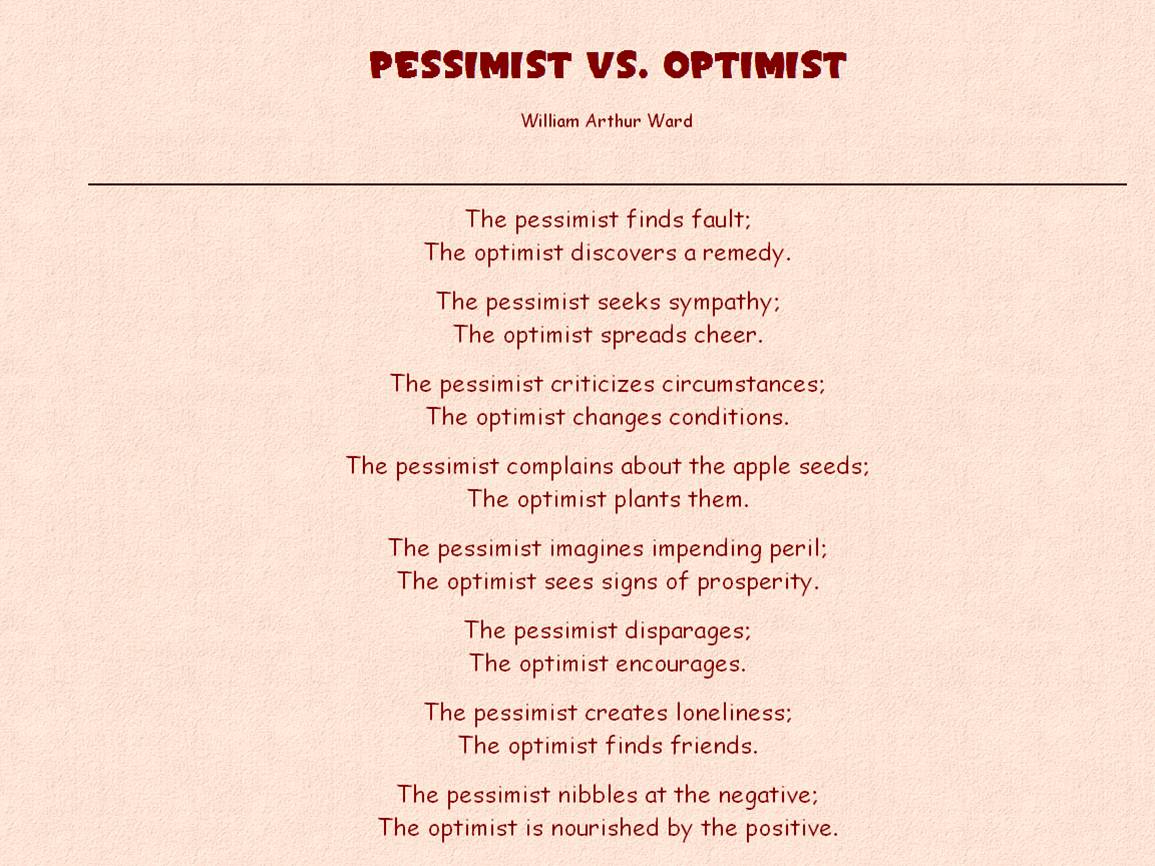
Pessimism

Optimism

The traditional characters  of  a pessimist
//

Read Full Post »

Modern era of cardiology aims to treat ACS  as and when it develops .That is , as soon as the vulnerable plaque ruptures or a thrombus  blocks the victim’s coronary artery.

But this can be achieved only if the patient reacts to this event.We know 20% of ACS can be totally silent. Some produce very vague symptoms especially in elderly and diabetics. ECG and enzyme changes may help us in patients who do not have clear symptoms.There are variety of markers available for STEMI & UNSTEMI.(CPK-MB, Troponin T , myoglobin etc) Now we are working at finding a marker for ischemia without necrosis. Ischemia modified albumin is one such molecule that is showing promise.

The ER department world over have vigorous screening protocols to diagnose ACS  for  the patients with chest pain. There are thousands of triaging protocol in the  emergency management of chest pain.In spite of  the highest awareness and availability of  scientific expertise , knowledge base the error rate of diagnosing  ACS  stands at an astonishing 58%.  This may seem odd , but this is what  this land mark article in NEJM tell us  (Data from Boston , Milwaukee etc).

Out of 10500 patients with suspected ACS. Only 17 % had real ACS.  55% were admitted initially as ACS  later turned out to be non cardiac .This may seem  acceptable for many  even if it is  an act of unnecessary admission and investigation. It gives us , a sense of satisfaction for not missing a diagnosis of ACS. But it has it’s own risk of complication arising out of unnecessary investigations.It is a chain reaction of  suspicion that  may end up in a coronary angiogram in many ! .It is also a well recognised fact these patients    spend  atleast an average of  2 days  to get rid of the ACS tag over their  necks .

Experience has taught us  simple presence of a human being as a patient within an  ICU ( however short the stay  may be ) can be a health hazard and risk .  This  55 % error ,  which does exactly  this to  our  patients with chest pain  who reach the ER  never bothers us  This is because  we feel credited both academically as well as financially .

In the same study 2.3 %  (About 25 patients) with true ACS  were sent home  after a missed  diagnosis . Paradoxically  this 2.3%  has worried the medical professionals too much . . . This happens  ,  even as we  do not have proper data on  how many of them had a real adverse event after a missed  ACS.

So the message here is even in best centres both missed and wrong diagnosis are  rampant. while wrong diagnosis (25 fold more here  )  is easily accepted by the medical community .We can justify  this as a screening camp for ACS  ,  akin to arresting  a group of suspected  criminals in a  preventive raid ,  later releasing for want of evidence.

In the morals of  criminal judiciary  , it is often said one can afford to  lose  a real offender from the clutches of law  , but a  innocent should  never be punished in any circumstance .

In medical parlance this  goes something like this  . . . Thousand patients shall die because of his or her illness but not even a single healthy person should die due to unnecessary treatment.

The above thoughts  were in response to  the excellent original article on missed diagnosis  of ACS from NEJM.  http://content.nejm.org/cgi/content/full/342/16/1163?ijkey=652d8337709a8bf84c813f4c9d685863ee053162

Final message : (Sorry for the  lengthy message !)

Can we afford to miss an  ACS in emergency room ?

“Definitely not” . . .but do we succeed in that ?  The answer is same “definitely not “

When we are able to accept with pride every time  we make  a  wrong diagnosis of  ACS  in perfectly normal people , It may to provocative to say  we can  also  afford  to do  the same  when we occasionally   miss a  diagnosis of ACS  as well .  Law of statistics dictates for every correct diagnosis made there is many fold number of wrong or missed diagnosis takes place. May be , reducing that is the only aim of medicine.

We need to realise  with even with a 55% of false positive initial  diagnosis  2%  real ACS  escape net !The only  fool proof method  for  not missing  ,  even a single case of ACS   is to label every patient with chest pain as ACS .

In this vexing  issue , we should realise  , in field of  medical decision  making ,  errors  due to acts of commission  ( Making an  inappropriate drug/procedure /surgery  is easily accepted by medical professionals as well as   the court of law !) . But acts of omission ,   like missing a diagnosis or failure to prescribe  a  drug or perform a procedure  is rarely accepted   and  is  considered   a great negligence and  bring intense guilty feeling among the physicians .

This  perception is definitely  not warranted in this  greatest profession  of glorious uncertainties ! Both acts of commission and omission  cause significant damage to  patients . In this modern era  ,  we have clear  statistics  that   reveal ,  acts of commission  leads far ahead over it’ s counterpart in injuring our people .

Hippocrates got it right over 2000 years  ago .  First let us do no harm  . . .

Read Full Post »

A  good collection of resources dedicated to cardiology

http://www.touchcardiology.com/articles/primordial-prevention-cardiovascular-disease-the-role-blood-pressure

Read Full Post »

Medical profession has  evolved over centuries with humble discoveries by genuine researchers in the past . As we  pursued  science vigorously  , we  looked  for innovations , when innovation  work ( or many times shown to work !) we jump to sky , even as  some of these  innovations fail and crash down  to earth , many times  we continue to be in the clouds . This is the fundamental problem of modern medical science . When  our expectations reached  unrealistic proportions ,   we tend to lose the common sense . Prolonging life and reducing human suffering may be the ultimate aim of the medical  profession , but  If we try to fight the death with science and money without application of mind , our current  life may become  miserable ! Thats what is happening for the majority of the population of this planet . After all ,  death is an essential and final  component of life !

Coming to the issue of CAD ,  in our country , a  rich gets a 4th generation drug eluting stent for a insignificant  asymptomatic PDA lesion , and poor fellow with left main dies without any intervention .This is  fairly acceptable   to this uneven world  , where a rich westerner  dies due to obesity related disease and a  poor African dies to malnutrition .

This article is in   response to  my  recent  experience  when  . . . I advised

Simple life style modification &   few drugs   for a patient with chronic multivessel   CAD  , I was  made to look   ordinary , inferior  and funny   by  many of the current generation cardiologists .

Further , the term optimal medical therapy(OMT)  for chronic stable angina has evoked laughter in one of the interventional cardiology  conferences  I  attended !

It is a sorry state of affairs  for the whole cardiology community , a  genuine scientific  fact , proven by  real life experience  as well,   is  being  ridiculed.

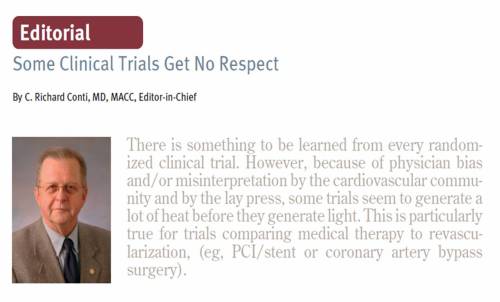
Richard  Conti tells in this excellent editorial in his journal   Clinical cardiology about the issue of medical management of CAD

“Respect in clinical trials”

Chronic stable angina pci vs cabg vs medical courage trial oat trial ethics in cardiology

Click here to reach the article  http://www3.interscience.wiley.com/cgi-bin/fulltext/122512853/PDFSTART

A similar study which  suggested  exercise  could be  better than PCI in the recent 2009 ESC is suffering the same fate !

What if regular exercise were as good as a stent for stable angina?

http://www.theheart.org/article/1000047.do

Read Full Post »

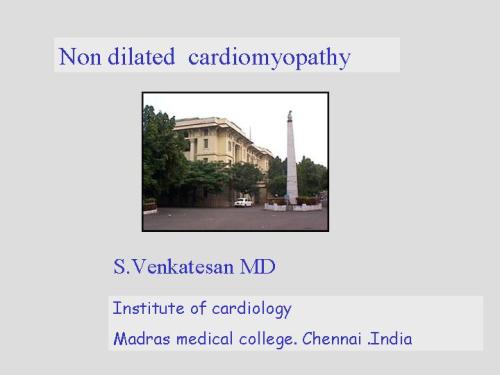
How will you refer to a ventricle which is not dilated but still has severe global contractile dysfunction ?

Traditionally cardiomyopathy is classified as

  • Dilated (DCM)
  • Hypertrophic(HCM)
  • Restrictive (RCM)

But there is large group of pateints who do not show any of the above features and still have global hypokinesia  contractile dysfunction. this group has been largely ignored .It could constitute up to 25%of all cardiomyopathy.there can be some overlap between non dialted cardiomyopathy and RCM.

We report our experience here with

non dilated cardiomyopathy click to download PPT

non dilated  cardiomyopathy

Read Full Post »

The irony of medicine is unlimited !  100 years of active clinical  research   failed  to find a specific cure for the rhino virus mediated common cold.In fact  US Govt stopped funding for this .

While ,   complete cure is possible  for many of the cancers, especially hematological ones !

Message 

In medicine there are thousands  of disorder  which have no cure ! 

Cancers ,  constitute  only a  fraction of  them !

Read Full Post »

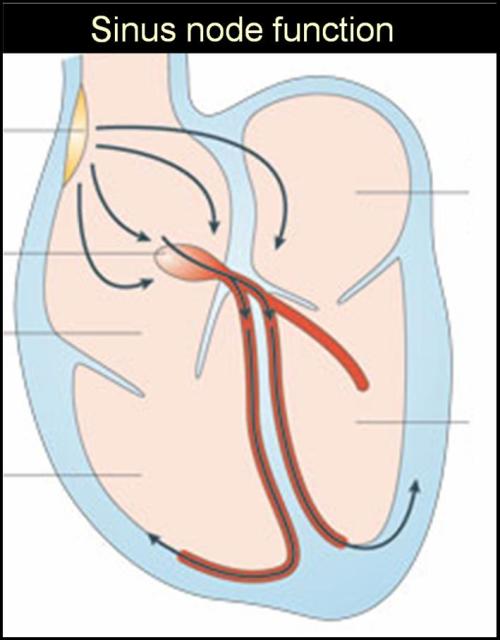
sinus-node


Sinus node  as the pacemaker , orchestrates the rhythm of life . It has  to fire for the entire life time of  a person.It  can not afford to take any rest ! But it can pause a little bit , of course that pause  could  be less  than 15% of it’s basic sinus length. This variation of sinus  cycle length is called sinus arrhythmia.This is physiological. When it exceeds 15 % of the previous sinus cycle it is referred to as sinus pause.

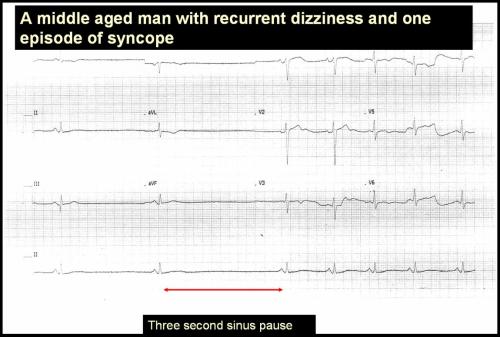
 Have a look at this ECG

sinus-pause-2


What follows a long pause ?

By strict terms  of definition a sinus   pause should be followed by  a delayed , next sinus  beat only. A  sinus pause  , many times  is followed  by   JPD – Junctional escape beat.This situation should be ideally  referred to sinus arrest as the sinus node is taking too much of rest and it is not able to wake up from the slumber and it needs assistance form the junctional pace maker.

So even though sinus pause and sinus arrest is used many times interchangeably, it should be avoided. 

What are the electrophysiological mechanisms of sinus pause ?

  • Simple sinus bradycardia . The commonest  mechanism is  the  increased vagal tone. This occurs more often in young athletes. Eventhough increased vagal tone  conveys   a innocuous meaning , at times  this can also be symptomatic  and require intervention.
  • Sinus node exit block.
  • First degree, second degree, complete SA block can occur as in AV node.

First degree SA block can not be diagnosed by surface ECG. Third degree SA block is same as sinus arrest and subsidiary pacemaker will function in these patients.  Second degree SA block is usually diagnosed when the sinus pause is in the multiples of resting sinus cycles. If the pauses are not in exact multiples  sinus arrest is diagnosed. All these arrhythmia’s are collectively called sinus node dysfunction(SND)

How do you manage these patients?

Sinus node disorders can occur in number of systemic diseases*. It  needs to be  ruled out.

  • Infiltrating diseases like amyloidosis, hypothyroid states can result in SND.
  • Drug induced SND like beta blocker and calcium blockers are fairly common and should be excluded
  • Some congenital heart disease (SVC ASD) can involve sinus node.
  • Ischemic SA node disease is rare but can occur  following  infero posterior  myocardial infarction
  • Sinus node disorders are  very often related to degenerative atrial diseases associated with HT, cardiomyopathy etc

*The list is not exhaustive

A very important association is noted  with atrial fibrillation as  a part of tachy brady syndrome .The link between SND and AF  is obvious as   atrial pathology is the common denominator in both ! This will be discussed later.

When is a  pause  significant ?

Any pause that is producing significant symptoms is significant.This depends upon the overall  hemodynamic compensation of the patient.Young, and fit can even tolerate three second pause without symptoms.Underlying heart disease makes even a smaller pause symptomatic.But generally a 3  second or more  pause is almost always pathological .Pauses can be up to  5  seconds (  a 5 second pause actually means a  heart rate of 12/mt , obviously it can not go on for a minute, a patient will develop a syncope). A 3 second pause  corresponds to 20/minute.

How will you evaluate a patient with sinus pause ?

There are sophisticated electrophysiological studies (EP) available like sinus node ECG ,sinus node function studies like sinus node recovery time, activation time etc. But these are generally of  academic interest.

If a patient is symptomatic  (syncope) because of bradycardia  he requires a pacemaker and  EP study is redundant . Similarly , if  he is totally asymptomatic in spite of pauses , again  EP study is  not  indicated.

Only for patients  in the  grey zone,   further studies are indicated .This would include a extended holter, loop recorders, event monitors etc.

Another important issue to consider  is , before putting a pacemaker   patient”s   symptom  must be correlated  with their arrhythmia.

What is  the overlap  between sinus node dysfunction and neuro cardiogenic syncope ?

SND  can occur as an overlapping syndrome with neurocardiogenic syncope.(NCS ).NCS is also a very common cause of syncope .In NCS  there are two limbs .Cardio inhibitory and vasodepressive. The cardio inhibitory form can exactly mimic an SND. In a given patient  it is very difficult to pinpoint which of this limb is dominant.Head up tilt test(HUT)  might help in few.  If a patent’s symptoms are due to inappropriate vasodilatation pace maker may not reduce the symptom of dizziness or syncope.

Management

  • There is no ideal  medical therapy* available as on date
  • Withholding all drugs which might aggravate bradycardia is of paramount importance.
  • Pace maker is the specific treatment in all symptomatic patients.

*Aminophyline tablet may be useful in some patients .It acts by antagonising adnosine receptors in SA node.Other drugs which can incrase the heart rate in the short term include  Orcipranaline(Beta 2 stimulant /Alupent ) Probantheline(M 1 blocker)

The key issue is to avoid unnecessary pacemaker implants in patients who have insignificant pause.

 Which pacemaker is ideal in SND ?

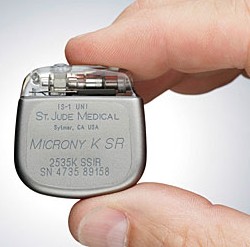
pacemaker

                                                              The need for dual or single chamber pacemker will be taken by the electrophysiologist .Atrial based pacemaker (AAI)  is preferred as it gives physiological pacing .But a simple ventricle based VVI pace maker is good enough in vast majority of patients. This takes care of   future risk of AV block also. DDD pace maker is the most physiological pacemaker and it is supposed to provide better quality of life. But it has an issue of insertion and  maintenance of  two leads, multi parameters to be programmed.It should switch to appropriate modes  at different times.(Like VVI mode during atrial fibrillation etc).Trouble shooting needs expertise , while  VVI is simple,  safe , and just effective as well .(In this turbulent world, quality of life is a  too trivial an issue  to be determined by a DDD  maker)

Read Full Post »

                                                 It is now mandatory for all  journals  to declare the  conflict  of interest by the authors  who are involved in medical research .The purpose apparently is to make all transactions or links  between the researchers and their funding agencies transparent .Even major journals  do not go beyond this . Some ensure it , to appear in the first page of  the article.

 What does the the journals tend to  convey to the reader by publishing the conflicts of interest ?

  •  Does it  mean the article in question  may have a bias or indeed have a bias  ?  and readers are warned  hereby !
  •  Do they send across a message  that the  article may not be really a genuine one and the judgement is left to the the consumers of the articles ?

How often a journal article is rejected purely on the basis of  conflicts of interest ?

Most of  journal articles are rejected  for poor methodology, statistical analysis and so forth .We don’t know how often a paper is rejected  due to a conflict issue per se.If this could happen ,bulk  of drug trials would face a torrid time from the editors.

Why , even the leading scientific  journals never indulge in grading the significance of the conflict ?

Here is an example .

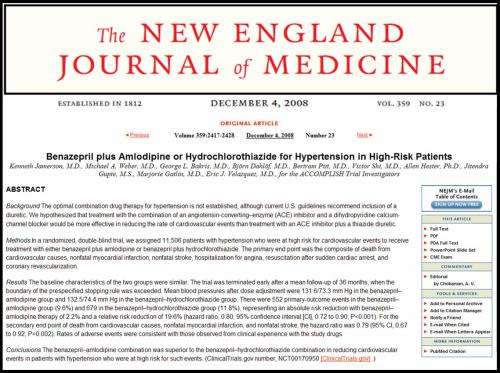
accomplish

nejm1

The much hyped drug trial on Hypertension “ACCOMPLISH”  was published in the  world’s most prestigious medical journal recently .It  left  it to the readers to  have their  own assessment  on the conflict issue.

  The consequence of not , grading and investigating  about the conflicts could have  serious  global health  implications both financially and academically .

This study was designed, formulated, completed and published  with a single hidden aim of neutralising the land mark trial  of ALLHAT which recommended diuretics as a first line drug in HT.Apparently diuretics are very  cheap  , effective  generic drugs.

 Is it a scientific rule  that  the  latest evidence  ,  should always prevail over the older evidence ?

No. Science can never have such a rule ! The question is how good and genuine is the evidence.
Just because an evidence is current , it does not  attain a scientific sanctity !

Read Full Post »

                                Hypertension is the most common clinical  cardiovascular entity.Left ventricular hypertrophy (LVH) is  an important consequence of  HT.In fact, it is considered as a end organ effect or damage. Others being brain, kidney, and peripheral vascular disease.Knowing about LVH is important because it has been linked to increased cardiovascular events.

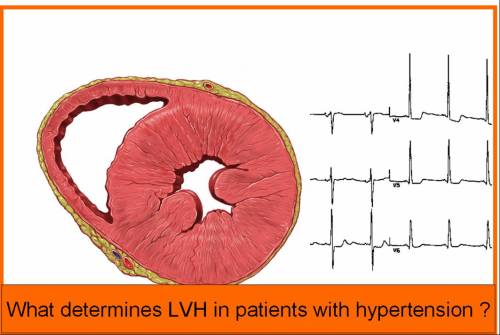
lvh-4

                              Though LVH is considered  as a close companion of  HT  it is  surprising  only a minority (15-30%)  show evidence of LVH .Some  experienced clinicians (Level C evidence)  quote even lower < 10 %  .Traditionally LVH was detected by ECG and now it is replaced by echocardiography.

What determines the LVH ?

It will be suprising to note , answer to this question  is  still not  clear .

  • Is it the duration of elevated blood pressure ?
  •  Is it the absolute level of blood pressure ?
  • If so , is it  the systolic BP  , diastolic BP or the mean BP ?
  • Or is it related to the etiology of HT ?
  • There has been no significant correlation between the above parameters

When we don’t know  the answer to a question in medicine , the answer will  generally will be inside the genes !

So in HT also the major determinant of LVH is in the genes that determine the myosin heavy chain  response .

and also ACE gene polymorphism.ACE genes are involved in the expression of growth factors within the myocardium.

An excellent study  on the issue http://www.nature.com/jhh/journal/v17/n3/full/1001523a.html#tbl1

It implicates , gender, age, race etc in the genesis of LVH

Final message

So , the  myocardium does not respond with LVH   in all patients with HT.It happens only in a minority* .Duration of HT can be an important determinant , but  the major factor is  the alteration of genetic switches  within the myocytes How this switches are going to  behave ,  is largely inherited .Regression of LVH is also not uniform again implying lesser role for hemodynamics. (Some studies revealed ACEI have maximum regression  of LVH , later disputed )

*LVH is more consistently seen  in hypertension due to reno vascular  or parenchymal disorders .It is also an observed fact , a  combination of diabetes and HT is more likely to result in  LVH.

The other major issue  that needs explanation in HT/LVH  is   , how much of LVH is due to  myocyte hypertrophy perse  and how much is contributed by interstitial cell hypertrophy(Non myocytic hypertrophy)

This issue will be discussed soon

Read Full Post »

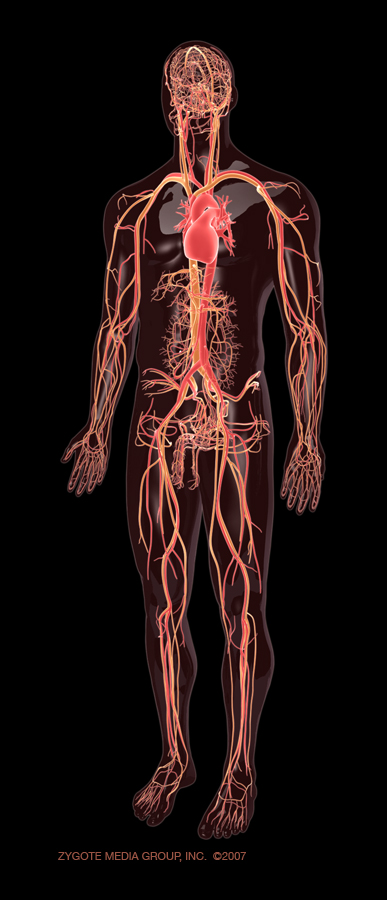
                    circulatory                                                                            A normally  functioning  circulatory system is vital for our survival . We have about 6000 ml of  blood, circulating  all over the  body in an  approximate time of 15-20 seconds.The pressure at which this blood moves across the body is called the blood pressure . Hypertension  or simply , high blood pressure is an undesirable  hemodynamic disturbance  in human circulatory system.Systemic hypertension is the most common type of hypertension. The blood pressure is primarily  dependent  on the status of the blood vessel(vascular resistance)  and cardiac contractility. This regulation is under  many neural and hormonal factors.Further  the blood pressure varies depending  upon the blood vessel calibre, and the local milieu.There is a progressive drop in blood pressure from major arteries to the small arteries .The pressure drop is maximum  across the arterioles to reach the venules .The venous circulation has the lowest pressure, it ends up at right atrium with a mean pressure of 0- 5mmhg.

Importance of regional variation of blood pressure.

It should be realised  ,  each organ has it’s own regulated blood pressure.The brain  perfuses by the  intracerebral pressure .The lungs decide how much should be the pulmonary arterial pressure.The kidney not only controls it’s own pressure but also  has a major regulatory role in  systemic pressure by rennin angiotensin system.The examples are numerous, portal system has it’s unique pressure controlling hepatic hemodynamics. The  retinal blood vessels regulate  intra ocular pressure. While the human  circulatory system has a wide variation of blood pressure  across the breadth and length of vascular system,  it is ironical a single snap shot BP with a brachial cuff is used  to define the normality and if it is normal every thing is thought to be  hunky dory !


It is widely acknowledged now , aging of humanity  is nothing but aging of our vascular system

                                    So we should have new parameters to assess individual organ’s vascular health as well as the currently popular systemic vascular health.The single important factor that determine coronary endothelial damage is the intra coronary pressure.It is never taken into account in any of the cardivascular mortality studies. This is the prime reason for  the widely prevalent conflict in the cardiology literature , namely : Controlling systemic  blood pressure has poor correlation with  cardiovascular outcome. Many of the so called normotensive individuals  have serious hemodynamic injury in their  coronary arteries.This was made apparent in the  ASCOT LLA  study , in which patients with  near normal blood pressure also benefited from statin therapy , implying  endothelial damage could occur at any level of systemic blood pressure.

What is the normal intracoronary pressure  ? When do you diagnose intracoonary hypertension?

The normal intracoronary pressure is around 40mmhg . Intra coronary hypertension as a clinical entity  is yet to be  recognised . There is no defintion available for intracoronary HT  , intracerebral hypertension as well. 

It’s still a  long way to  go , for the cardiology and neurology  community to assess non invasively  intracoronary pressures and  intra cerebral arterial pressure to prevent  coronary events ant strokes.

Final message

Simple risk prediction using brachial cuff blood pressure is a grossly unscientific method (Sorry, i really mean it ) to assess one’s vascular health.There has been  few attempts like vascular endothelial health assessment by fore arm blood  flow , central aortic pressure (Instead of brachial cuff pressure) as an  index for risk predictment and  assessment for hypertension is suggested.

Read Full Post »

« Newer Posts - Older Posts »