Feeds:
Posts
Comments

Posts Tagged ‘echocardiography’

  • Here is a site which has dedicated  resources for learning echocardiography .
  • The site has collection of various work shop and conference highlights
  • The basic echocardiography with classical line diagrams  would be very much useful for the beginners,

Cheers to duke university for sharing ! www.echoincontext.com

Read Full Post »

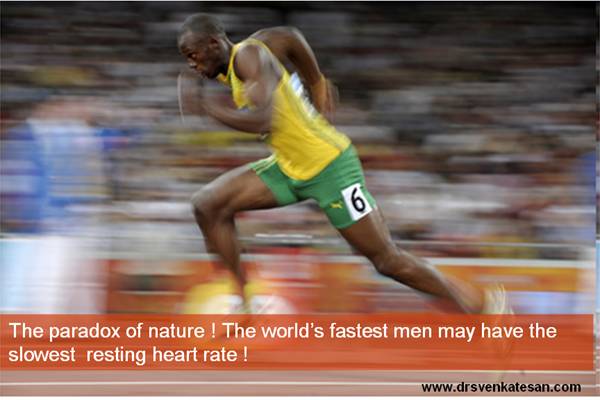
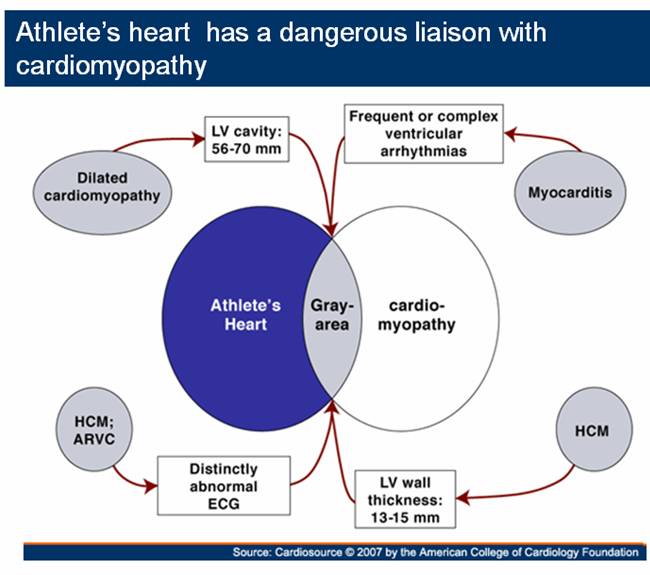
ECG of an athlete is many times difficult to interpret. The influence of autonomic tone in  athlete’s heart is an complex one.Contrary to our expectations the parasympathetic tone is higher in well trained athletes. The resting heart rate can be as low as 30/mt which is 99.9 times pathological in non athletes.This happens due to a concept called accentuated antagonism.The athletes who have episodic surge of high catecholamines keep stimulating the para sympathetic neurones in a constant fashion.

LVH is the most common feature.Here there is simple myocyte hypertrophy, without pathological fibrosis.This differentiates athlete’s, heart from HOCM .

Many ECG abnormalities are reported in athletes.

Excerpts from the ACC recommendation

1. Electrocardiographic findings that are common and training-related and that do not require additional evaluation are sinus bradycardia, 1° atrioventricular block (AVB), incomplete right bundle branch block (BBB), early repolarization, and isolated voltage criteria for left ventricular hypertrophy (LVH).

2. Uncommon and training unrelated electrocardiographic findings that mandate further evaluation include T-wave inversion, ST-segment depression, pathological Q waves, atrial enlargement, a hemiblock, right ventricular hypertrophy, a BBB, or a Brugada-pattern of ST-segment elevation.

3. Training-related electrocardiographic findings are more common in men than women, athletes of African descent, and high-endurance athletes such as cyclists.

4. Sinus rates <30 bpm and sinus pauses >2 seconds are common in highly trained athletes, particularly during sleep.

5. A normal chronotropic response to exertion and the absence of bradycardia-related symptoms distinguishes training-related sinus bradycardia from sinus node dysfunction.

6. 1° AVB and Mobitz I 2° AVB are common, but Mobitz II 2° AVB or 3° AVB should not be assumed to be training-related and require evaluation.

7. Early repolarization in Caucasian athletes most commonly consists of upwardly concave ST-segments and tall and peaked T waves; in black athletes, there often is convex ST-segment elevation and negative T waves, mimicking a Brugada pattern.

8. In the presence of voltage criteria for LVH, pathological hypertrophy should be suspected if there is left atrial enlargement, left-axis deviation, repolarization abnormalities, or pathological Q waves.

9. T-wave inversion ≥2 mm in ≥2 adjacent leads should prompt evaluation for structural heart disease.

10. Electrophysiological testing for risk stratification with possible catheter ablation is appropriate in athletes with ventricular pre-excitation.

Source :  Fred Morady, M.D., F.A.C.C.

http://www.ncbi.nlm.nih.gov/pubmed/19933514?dopt=Abstract

For an excellent article on the topic click here

Read Full Post »

Prosthetic valve obstruction is an important complication of artificial valves.The incidence of prosthetic valve obstruction  is  estimated  to  be  4% per year.

  • Pure thrombus 75%*
  • Pure pannus 10%
  • Combination of pannus and thrombus 12%

Data from Deviri (J Am Coll Cardiol, 1998; 32:1410-1417 )

pannus-2

*Note statistically you are going to be right 3 times out of 4 if you diagnose thrombus over pannus

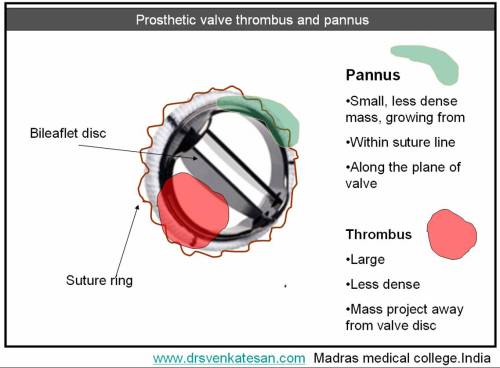
Pannus  literally means a hanging flap of tissue. It is is a membrane of granulation tissue as an response to healing.It can  occur anywhere in the body. When it occurs in the prosthetic valve tissue interface it has important consequences.It  is  same  as excessive scarring , ( something similar to keloid formation ) .

pannus

How do they clinically present ?

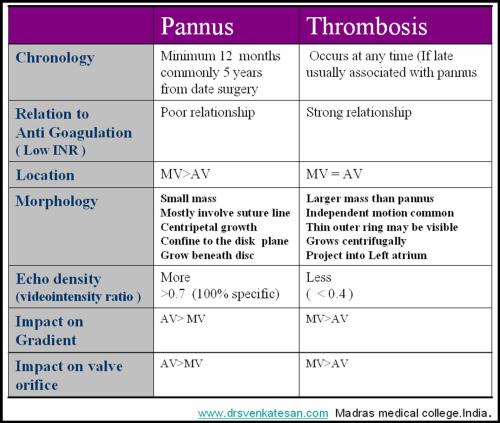
Prosthetic valve thrombosis is usually a acute or sub acute event as thrombus formation rapidly deteriorates the clinical situation.Pannus brings a patient with the complaints of chronic progressive dyspnea.(This rule is very subjective  but . . .)

What are the determinants of pannus growth ?

Time is the major determinant. minimum period required is 12  months. It is a avascular mass.It should be noted  a  injured pannus can predispose  a thrombotic process and a chronic thrombus  can trigger intravascular   growth factors  that promotes pannus growth.

What is the direction of growth of pannus in prosthetic valve ?

The pannus grows , usually in the tissue valve interface.It tracks and creeps along the suture lines .Generally this does not encroach the valve orifice or chamber sapce  , but occasionally the hanging edges can hit upon a leaflet.This is more common with tilting disc on the side of minor orifice. When excessive it can make a valve leaflet almost standstill.

How common is pannus formation in starr edwards valve?

Is relatively uncommon as the dynamic ball periodically interrupts the process of pannus in growth within the orifice.

Final message

Why is recognition of pannus important ?

Prosthetic valve thrombois is amenable to thrombolysis and it should be proptly differentiated for pannus.This is many times a difficult excercise, but the above observation will be helpful.

Further reading

http://content.onlinejacc.org/cgi/content/full/32/5/1410

Read Full Post »

Post myocardial infarction revascularistation either by PCI or CABG forms the bulk of the coronary interventions world wide.There has been considerable controversy in selecting the patients for the procedure.

Certain basic rules are to be applied.

  • Never do any thing on a totally asymptomatic and fully functional patient.(Functional , means good exercise capacity of atleast( 10Mets).Just medical treatment with good doses of statins, beta blockers will do.
  • If a patient has persistent angina  following MI  ,the issue is relatively simple as  they are  candidates  for CAG  and intervention .
  • The issue becomes little complex when the primary complaint is breathlessness and echo showing  LV dysfunction.

This dilemma is due to a  simple fact

coronary revascularisation has a  great impact in relieving angina but has  less impact in reversing

left ventricular  dysfunction

So,  how do you approach a patient with LV dysfunction and exertional  breathlessness and absolutely no chest pain ?

  1. Do a  CAG
  2. Assess the lesions if any (Some times,  to our surprise there may not be any critical lesions at all ! )
  3. If there is / there are critical lesions try to corroborate with infarct segments.(Use Echo for this correlation)
  4. Don’t bother much,  if a  vessel has a lesion  that is supplying a scarred myocardium.
  5. If there is gross LV dilatation, mitral regurgitation and LV clot refer these pateints  may benefit  from surgical management

One of the rules written by the cardiology community over the past few decades has been

We must document viable myocardium before doing a revascularisation procedures on them.

This rule was self imposed ,  to prevent inappropriate revascularisation in  post MI population.

So , a  gamut of investigations (Both invasive and non invasive came into vogue) to identify viable myocardium in post MI population. Stress echo, Thallium-sesta MIBI, PET  to name a few .

Even after liberal usage of these invesitgations , we realised ,  the confusion in the  optimal selection of candidates for revascularisation has not settled.

In fact,  the correlation between viabilty and subsequent interventional benefit is  inconsistent .Not withstanding this  issue  ,cardiologists inspite of the negative results of OAT and TOAT trials ,  started  opening or by passing any occluded vessel irrespective of viability status.

Unanswered  &  Unasked questions in myocardial revascularisation ?

1.Why viable myocardium is viable even in the adverse compromised vascular  environment ?

It  is viable for the simple reason it has some capacity to be alive . By it’s inherent survival capacity (Survival of the fittest ) or it somehow gets the nutrients by cell to cell perfusion.

2. It is viable allright  ,  why it is not contracting ?

Because ,  it is biochemically and metabolically alive (Can be documented by FDG PET scan mismatch ) but it can not synthesise adequate ATPs to make the muscle contractile.

3.”Viable myocardium is viable ” what more you want from it   ?

Simple viability is not suffice . How to make it mechanically active and contractile ?

4.Is viable  myocardium    synonymous with ischemic myocardium ?.

No,  it is not (Contrary to the popular perception ) .

5. Is it not  common to find dysfunctional segments with good TIMI 3 flow ?. So what is the purpose to document viability ?

It is not suffice to simply document viable myocardium but it is an absolute necessity to prove this viable segment is also  critically ischemic .

7.If angina is  a sign of viabilty why most of viable myocardium is painless ?

This again confirms the fact , much of the viable myocardium in the post MI phase is not ischemic but” still dysfunctional” waiting for healing time. This concept  was  introduced with great fanfare* as  stunned myocardium ,  20 years ago , which was subsequently rejected my mainstream cardiologists , as this concept tend to  restrict the  freedom of interventionists. * Even though ,the concept was genuine and proven scientifically !

6.Are we  certain , the  viable ,  non contractile myocardium  (Which we painstakingly document )  will get back the contractility once the  segment is    revascularised?

Absolutely not. (With lot of PET study doumentation )  This,  we can not guarantee even in ischemic, viable segments  ,  while in the  non ischemic, viable segment it is all the more unlikely.

7. What are the chances of these viable but  non contractile myocardium  regain the contractility  by natural course ?
Very significant chances .In fact every patient recover some LV  function spontaneously over time .

Final message.

  • Revascularisation is non controversial in patients with angina
  • In patients with  primary symptoms of dyspnea  ,  it is less effective and documentation of myocardial viabilty per se will not guarantee successful outcome following revascularisation.Out come depends on  multiple factors .

Read Full Post »
 Selected on the basis of ,  impact  on survival , relief of  human suffering index and also innovation

10.Percuateneous interventions

9.  Electrocardiography

8 . Hemodynamics of cardiovascular system

7.Fruesemide

6.Thrombolysis

5.Pacemakers

4.Defibrillation

3.Heparin

2.Prosthetic valves

1.Coronary care units


Waiting list

Concept of vascular biology

Statins

RF ablation

Nitric oxide

Total Artifitial heart

Echocardiography


Ten least important concepts and  inventions in cardiology

Selected based on duplication of research, futile scientific concepts and   of course impact on survival

10.Low molecular weight heparins

9.Cardiac resynchronisation

8.Rotablator

7.Multi  chamber pacing

6.Newer ARBs

5.C reactive protein

4.Three dimensional echocardiography

3.

Comments welcome  and please contibute

Read Full Post »


                                          CRT , cardiac resynchronisation therapy  is being  projected  as a revolutionary treatment for cardiac failure , where a failing heart is rewired electrically through multiple leads and make it contract  more effectively.The success rate of CRT was highly variable.The basic question here  is,  there should be a  significant  documentation of desynchronisation  prior to CRT , for resynchronisation to be effective. Further , the sites of  myocardial  stimulation ( Coronary sinus/LV epicardial) , dose of electricity and the sequence of stimulation and the  electrical delay  are very  critical. Achieving this into perfection  is not a simple job and is  real rocket science ! ( If we can achieve 5 % of what  the normal purkinje network do within the LV we can term it a huge success.) Let us hope we catch up with nature . Finally , it is ironical  the sites of LV pacing ,  electrophysiologists  select currently  is infact not selected by them but pre selected by the patients coronary venous anatomy ! .So as on date ,  one can imagine how scientific this treatment could be !

                                         Initially it was adviced for patients with only wide qrs later for even normal qrs patients.When people started using it indiscriminately  insurance companies started to rethink and thus came the   RETHINQ study in NEJM  and brought a full stop to CRT in normal qrs CHF.

How to identify who will benefit from  the costly CRT  ?

It is a million dollar question. So millions of dollars were spent to identify the correct tool to identify the true responders to CRT.Echo cardiography with sophisticated methods tissue doppler, tissue tracking and , 3 D echo ,velocity vector imaging were done .These methods are not only costly but also time consuming and  hugely expertise driven.

Does all this  efforts with  advanced echo techniques worthwhile ?

This simple question was addressed in PROSPECT study in circulation

Click to read the article

Read Full Post »

Orthopnea is a classical sign of established CHF.

While paroxysmal nocturnal dyspnea is an early sign of cardiac failure,orthopnea is a late manifestation of cardiac failure .This symptom was mainly attributed to volume displacement from systemic venous to pulmonary circulation when the patient goes to recumbent posture.The exact mechanism of this has been speculative. Now with liberal usage of bedside echocardiography, we have found out there is postural variation in the diastolic function of the failing left venticle.

Many patients develop a restrictive ventricular filling pattern in recumbent posture (Grade 3 diastolic dysfunction). While sitting up some of them revert to normal or downgrade to grade 1 diastolic dysfunctionThis observation proves another fact that every patient with severe systolic dysfunction also has significant diastolic dysfunction at some point in their course of illness.

Read Full Post »

« Newer Posts