Feeds:
Posts
Comments

Archive for the ‘Cardiology-Arrhythmias’ Category

STEMI is the commonest cardiac emergency . Many believe , we  are close to  conquering  it .  It is hardly the truth .

  • The  mortality is  up to  30 % out of hospital and another 6-8  % within CCU  and another 2 %   at  30 days due to recurrent ACS   .This  is followed by an   annual attrition rate OF 25  due to progressive LV failure  .
  • The commonest mode of death is electrical,  ie primary VF.
  • Mechanical deaths are also equally important. Free wall rupture carries 100% mortality . Ischemic MR, Ventricular  septal rupture (VSR ) may also result in deaths.

Here is a case history and ECG of a  patient with STEMI .

After thrombolysis , the paradox happened . ST elevation  increased by 4mm and soon the patient became restless with worsening pain and became silent instantaneously ,  with monitor showing EMD and asystole .A diagnosis of free wall rupture was made.
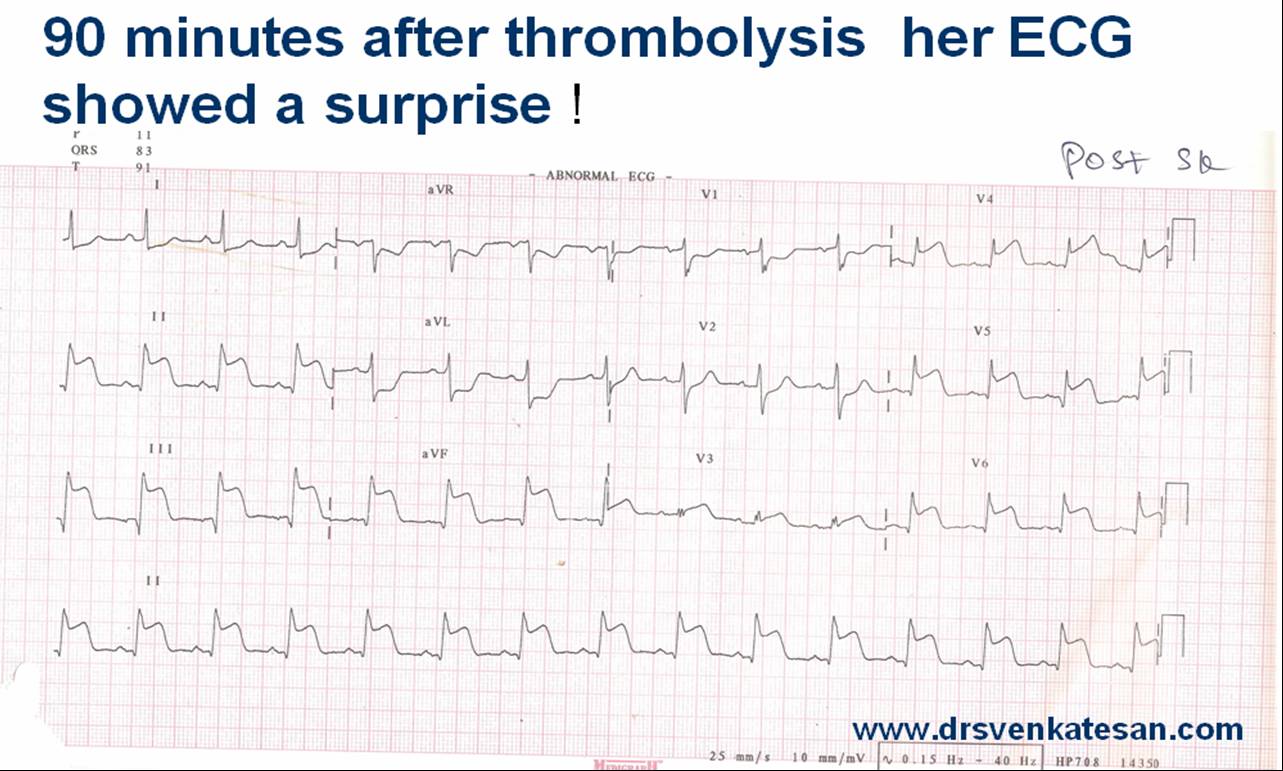
What we used refer  in our CCU (Madras medical college Chennai .One of the oldest CCU in  South Asia )

as   “Action pontentialisation”  of surface ECG . This ECG finding has  great  clinical significance .

Here is a zoomed up view of a qrs complex of  the patient , which is very

closely resembles an action potential

Picture courtesey  http://ocw.tufts.edu/Content/50/lecturenotes/634488/634591

Pathological basis of  “Action potenial”  Like ECG

  • When the ST elevation is huge and wide it mimics  an action potential .
  • Myocyte action potentials are normally recorded epicardially in physiology lab where a  micro electrode with glass pipettes directly enter the myocyte.
  • A giant ST elevation and a sustained dome indicate , the quantum of  electrical injury is  very large and the  ECG electrodes is picking up the myocyte electrical events like that of a intra cellular electrode.
  • It is to be recognised  ,  ST elevation in chest leads is substantially taller than limb leads   because the exploring electrode  is located just above the myocardium . But,    when a  huge  ST elevation  is recorded  over a limb lead (as in this patient )  one can imagine ,   how intense the electrical  charge  of  the myocardium  should  have been  !

This heavy downpour of electrical energy that  emanate from the myocardium   means two things

  • The area of infarct is very substantial
  • The tissue in question is  very unstable .

Clinical correlates of  action potential ECG

  1. Damage is transmural , the   infarcted area is soft, friable and often hemorrhagic .
  2. The pericardium is also  likely to get involved in the injury process .
  3. The myocardium is  rupture prone or already torn .
  4. Even minor hemodynamic stress can be fatal in these patients
  5. An episode of vomiting, a fall in blood pressure,   an episode of  LVF or a short run of VT is suffice  to result in a fatality.

The death happens by a sudden rupture ,  EMD and asystole .

Can a life be saved  by the much fancied Emergency PCI  ?

Not really. The PCI  can not reverse the myocardial damage ,  so it’s role is little . But , any way it should be done and  .  .  . it  will  be done  in most institutions to give the benefit of doubt (Of course , with  a definite the risk of doubting  !)

What is the risk  of  PCI in these situation ?

The infarct related artery * if opened up can convert a bland infarct into a  “angry red”  hemorrhagic  infarct .This   is as good as  giving  the patient ,  a  farewell  party for his journey to heaven !

Note : Primary PCI  definitely  saves life in STMI . The  * is applicable only in persistent ST elevation , late after an acute MI.

How could  have the above death prevented ?

As one of the comments to this article  suggested, we need to have methods to identify impending rupture early and accurately .This should  followed by a prophylactic  surgical intervention (Reinforcing the friable myocardium – with a patch or mesh  )  .This is again not  a easy decision to make .

Final message

When the ECG  assumes  a shape of an  action potential ,  it is often a sign of  imminent  death  . Even though it may sound a pessimistic  view  it is often the truth  . Of course , an  emrgency PCI or  CABG  are  the only options available , we have  to be remember the above truth  ,   as we   play  those sophisticated  games  within their coronary arteries.
Read Full Post »

Vasovagal syncope is the commonest cause for syncope in our population.It is also referred to as simple syncope .The mechanism is thought to be  an abnormal overshoot  response  by the vagus  in response to a  sudden surge of  adrenegic activity  usually occurring  in erect posture following   , often an emotional or physically stress full situation .The  receptors for  this  reflex pathway is thought to be located  left ventricular myocardium .

There are  two components  for  the VV syncope

  • Cardio inhibitory
  • Vaso depressive.

The quantum of contribution  by each component in a given episode of syncope varies. Pure vasodepressive or cardioinhibitory forms can occur .

Diagnostic issue

Before labeling  a patient as simple vasovagal syncope all potentially serious , cardiac causes must be ruled out. this may require a fairly extensive investigation in some

Read the related blog  : Why syncope is rarely  fatal ?

https://drsvenkatesan.wordpress.com/2008/09/30/why-syncope-is-rarely-fatal/

Management of vasovagal syncope.

  • Reassurance is the mainstay . By this we mean , V V syncope may never kill . . .
  • Prevention  – Involves  identifying syncope prone situations  & taking precaution
  • Emotional support
  • Pharmacological approach

Some will benefit from beta blockers, fludro cortisone(Increase the intra and extra cellular  fluid space )

Since  these are   simple ,   cheap  treatments ,  we worked over time to innovate  &   find some interventional solutions for this life threatening condition !!!.  Thus ,  the indication for cardiac pacing for vasovagal syncope came into vogue .

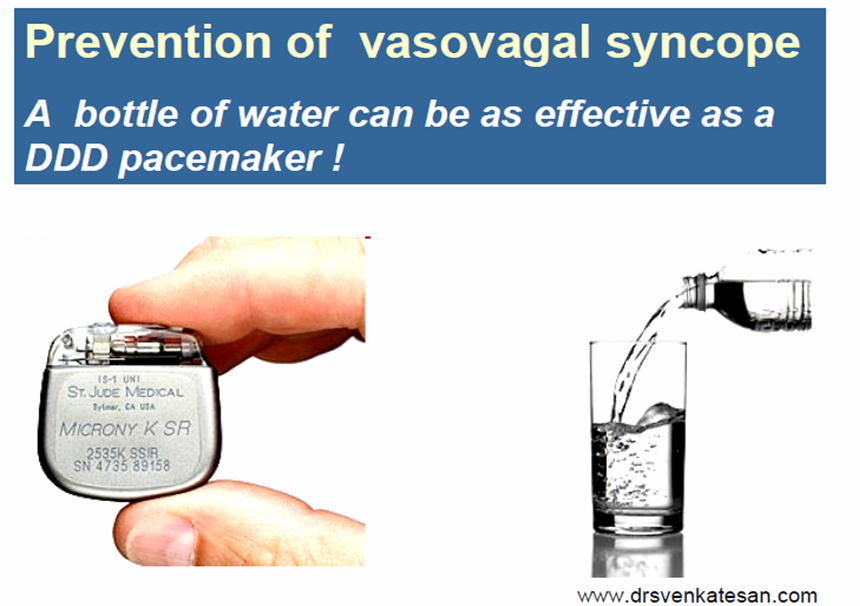
DDDR pacemaker was implanted worldwide for thousands of patients with vasovagal syncope .

It took  many years  for our  intellectual brains  to realise ,  there are  two limbs to vasovagal syncope Pacemakers ,  at  no stretch of imagination  is expected to counter vasodepresssive component of the syncope.

And then this article came !

http://circ.ahajournals.org/cgi/content/full/108/21/2660?ijkey=ba86da897c167581c498c81743c32afe14fc9393

Water ,  (Simple  H2O ! ) administered at right time in right quantity can prevent most  episodes of vaso vagal syncope . When a tumbler of water can be substituted for a  10000 $ misadventure  (DDD pacing)  , and  further  we have  hundreds  of similar examples in modern  day health care  ,   no surprise  why our health care system is  sinking  along  with our economy !

Epilogue :

In this  21st century   medical “AVATAR ”  , we need to realise   in a strong manner,   low cost  medicines  often   provide   high  quality  cure  ” while ,”   many of the  high cost  therapies  may  end up in  low quality  treatment !

It took 50 years of intense research of  medical comunity to realise ,  a good diet , physical activity and quitting smoking has the greatest way to control  and reverse  the cardiovascular epidemic . Please , note all of them come at free of cost .

Read Full Post »

Acute MI is a major medical emergency encountered in ER . Prompt adminstration of thrombolytic agents or rapid   triaging for a  primary PCI   may be required . The whole concept of management of STEMI  revolves around time as a therapeutic   target .Every minute counts . The beneficial effects of  reperfusion   and the resultant  myocardial salvage  rapidly declines over time . Hence ,  the symptom to door time  remains the ultimate determinant of  outcome in most situations.

So , estimating the  time window of  “Symptom to door time ” becomes an all important parameter. This is often done by paramedics .

The apparently  simple  job  measurement of time window  can be  misleading at times especially in elderly, diabetic and alcohol abusers .

When  a patient  says he has chest pain since yesterday straightaway he is excluded from reperfusion strategies as 12 hours  would have elapsed

When a patient  describes  chest  pain since two days , but  more intense  only since today morning what does it imply ?

  • The first episode of pain could  either  preinfarction angina or infarct
  • The second episode of pain could again be the continuation of same  angina or conversion of that angina into infarct

So ,  calculating the time window  when a  patient has recurrent episodes of angina prior to an MI is a real difficult issue.For the benefit of doubt, we have to take the last episode of chest pain  which was continuous and more severe as the infarct pain.

How does ECG help to time STEMI ?

When it is difficult  , to differentiate pre infarction angina from infarct pain, the ECG may give  useful clues to time the STEMI.

  • Degree  ST elevation
  • T wave inversion
  • Q waves

Among the  above three ,T wave inversion is most useful to time an infarct. If T wave begins to invert, it can generally assumed the acute  infarct process is  almost complete . Q waves are less reliable  to time a acute MI as ischemic stunning can in the  very early phase of STEMI   inscribe a q wave over the infarct territory.

How will you time a STEMI in silent MI ?

There is no symptom to door time in patients with silent MI . Many do not even reach the door , for the simple reason there is no symptom that drives them to hospital. Those who are refered  have vague non cardiac symptoms and incidental ECG  which shows STEMI like changes. Here , the decision to thrombolyse is taken entirely on the basis of ECG *finding .

Note : Cardiac enzymes are can also be  used  to  diagnose  to estimate the time window .

Read Full Post »

Cardiac rhythm disorder remains  as a  fascinating  clinical cardiac  problem  to  the physicians for many decades. The joy of decoding cardiac arrhythmias and categorizing into supra ventricular , junctional, ventricular tachycardias is unique ,  even as  many of these patients are struggling for life !

Initially the tachycardias were labeled with reference to their origin .Later as we recognised the locating the  origin is not an easy exercise , we introduced a practical classification  : Narrow and wide qrs tachycardia  emphasizing the fact that , both SVT & VT  can be either narrow or wide !

Traditionally there is much more  confusion in labeling the  narrow qrs tachycardias than the wide  qrs tachycardia.

Is the term junctional tachycardia still relevant ?

To answer this question we need to know what exactly we mean by the term Junction.

  • Is it a particular anatomical spot  called AV node ?
  • Is it a diffuse area in the vicinity of AV node ?
  • Is the early part of the his bundle included in the junction ?
  • Or  Is it formed by  the entire rim  of both  AV groove formed by the fibroskeleton  that form a electrical  barrier between atrium and ventricle ?

Answer:

The answer to the above question is very simple “we don’t know yet !”

The nearest fact is , for the electrophysiologist,  AV junction refers to the electrical  junction box of  that connects the specialised wires coming down from the atria and from there it connects  to the specialised his purkinje fibres of the ventricle .

Is AV node  anatomically distinct structure?

No .It is not. It is a collection of different conducting cells with varying properties.The term AV node need to be abandoned by the cardiology community for the simple reason there is no such entity.

In fact the AV junctional cells are are now called as pure atrial,atrial approach CELS ,  junctional approach cells, junctional cells,transitional cells,  ventricular approach cells.These cells interdigitate with each other , and has unique cell to cell communication.The cells that are above the AV junction share atrial electrical properties while the cells that touch the his purkinje  acquire some of the properties of specialized ventricular conducting properties.

What is the function of AV junction ?

One should realize  it is the AV junction does a  a very unique job of great importance  for human   survival ! Even though SA node is the pacemaker of the heart , the AV junction does the extraordinary it receives the impulse and delays it for about 200 millisecond and then hand over it to the ventricle.

The rules that govern the  nature is so fascinating  , this delay is vital for the venous return to enter the ventricle from atrium other wise , the ventricle is under filled and cardiac output falls.The bulk of the PR interval is contributed by the AVconduction delay (also called as AH interval )

What is the clinical relevance of this new found physiology of AV junction ?

It is to be understood the electrical properties of the AV junction is determined by neural innervation the ionic currents.Much of AV junction is under the dominant control of vagal fibres, while the ventricles get more innervation from sympathetic neurones. There is considerable overlap in the AV junction area.

The classical dual nodal physiology of AVNRT is nothing but longitudinal physiological splitting of AV junction  .Strands of slow conducting cells and fast conducting cells are arranged in such a way to create a reentrant circuit.The atrial approaches in the posterior aspect contain mainly slow pathway. and anterior aspect near his contain the fast pathway.

Some times  clusters of AV junctional cells are scattered around the upper septal area giving a slow conducting properties to ventricle.These cells can be site for reentrant septal or fascicular VT.

The overlap of  these AV junctional cells explains the verapamil sensitivity of some of the VTs  arising in the vicinity.

What are the tachycardias that can be termed  as junctional tachycardias ?(JT)

By logic and realism  any tachycardia that originates in the AV junction either by reentry or ectopic activity shall be called as JT

By tradition , we have been illogical.

AVNRT is never referred to as JT  in spite of the fact that,   it is initiated by a pathological reentry right  in the middle of AV junctional tissue.

So currently we are authorised to call only few arrhythmias as true junctional tachycardia  .

  • Non paroxysmal junctional tachycardia( NPJT)
  • Incessant junctional tachycardia
  • Permanent  junctional reciprocating  tachycardia(PJRT)
  • Accelerated junctional  rhythm

NPJT

This occurs in following situations

  • Digoxin toxicity(Classical description)
  • Post operative hearts
  • Occasionally during acute MIR
  • It may be observed during AV nodal ablation in EP LAB

NPJT is an automatic tachycardia .arising focally from AV junctional tissue . Ideal terminology should be focal junctional tachycardia(FJT) .The rate is between 70 -140. Accelerated junctional rhythm can be termed as a benign form of JT.DC shock has no role.

Incessant junctional  tachycardia

This was first described in infants .Thought to be congenital in origin.Now adult forms also recognised.Very malignant arrhythmiaRate is between 150-300. AV dissociation is the norm.May mimic atypical atrial flutter or ectopic atrial tachycardia .High risk for tachycardic cardiomyopathy. Amiodarone may be effective.Surprisingly ,verapamil may worsen it .There is a overlap between adult postoperative NPJT and Incessant JT.DC shock is not effective may worsen . RF ablation rarely effective.

Permanent form of junctional tachycardia

It is not clear what the  term permanent denotes ! May be because   these tachycardias occur with fixed anatomical substrates.In fact this can be called as a type of AVRT. But the difference is the retrograde ventricular circuit does not travel in any free wall but within the septal his bundle   . PJRT,  infact  may be labeled as AHRT -Atrio hisian  recipocrating tacycardia

It is a reciprocating tachycardia with antegrade condction through AV node and retrograde through a slow conducting accessory pathway in posteroseptal location.

The rate is between 90-150. Mimics long RP tachycardia like AT or fast slow AVNRT.Some believe , In fact a fast slow AVNRT can be  nothing but a variant of PJRT.

DC shock may be effective only to recur again.RF ablation is very effective .

Final  message

Junctional tachycardias are a unique group of narrow qrs  tachycardias  with differet mechanisms.It is diagnosed in specific clinical settings. They are generally difficult to treat,as the mechanism is often ectopic in nature (Except PJRT).Accelerated junctional rhythm can be termed as a benign form of JT. AVNRT need not be confused with JT , even though it may considered as a junctional reentrant tachycardia.


Reference

Rosen Circulation 1973

Read Full Post »

It is one of the greatest innovation in medicine  . . . that is . . . electric current being  used as  a  drug to  treat disorders of heart . Of course ,  it is not a surprising finding  when we know heart is an  electro mechanical organ ,  and electricity can be used  to treat various disorders of heart by delivering it  in an optimal dosage and site.

Devices  that help administer  electric  current in cardiac disease.

  1. External  cardiovertor and defibrillator
  2. Implanted defibrillator
  3. Anti bradycardia  pacemaker
  4. Anti tachycardia pacing
  5. Cardiac  resynchronisation device

What  is  the  difference  between cardioversion and  pacing ?

Cardioversion  is reverting  a tachycardia with  a electric shock that is delivered diffusely throughout the heart This  electrical wavelets traverse the  focus of tachycardia  and the adjoining myocardium  which is called critical electrical mass (Usually reentrant) .This depolarises the cells responsible for tachycardia and extinguishes the abnormal electrical activity.

Defibrillation is same as cardiversion except that it is a high energy shock  and delivered without synchrony with qrs complex . In VF, we defibrillate in all others  we cardiovert .

What are the disadvantages of cardioversion ?

Eventhough it is a very successful modality for treating cardiac arrhythmias it also has some issues.

  • Cardioversion is not infallible. It rarely works in tachycardia due to enhanced automaticity (Multifocal atrial tacycardia , Automatic junctional tacycardia , Digoxin induced tacycardia it may even be dangerous !)
  • Many times multiple shocks are required and may result in myocardial damage, stunning , and elevated cardiac enzymes.
  • In susceptible patients, especially in elderly it may depress the natural pacemaker ie the sinus node and dangerous  bradycardia

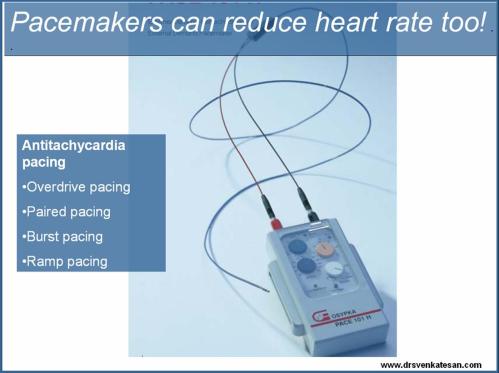
over drive pacing paired pacing anti tachycardia

What is difference between cardioversion   applied externally on the chest wall and intracardiac cardiversion as in Implantable cardiovertor defibrillator(ICDS) ?

The underlying principle is same except that the energy required is a fraction of that applied in the chest wall . The average energy required is up to 20 joules . while it requires up to 300 joules

What is anti tachycardia pacing ?   Why this concept came into vogue ?

When it became clear , cardioversion may not work in all forms of tachycardia and risks of multiple shocks  on the myocardium  not be taken lightly , experts in those times (1970s)   thought  a pace maker lead in a optimal site can do the job of cardiovertor. .

Pacing rapidly  in the tachycardia zone  provide us an opportunity  to  enter  the  tachycardia circuit , interfering , interrupting  and blocking the reentrant circuit  (We call it entrainment)  . If it is an automatic tachycardia pacing in close vicinity of the tachycardia   focus result in a  electrical  line of  barrier  which acts as an  exit  block ( Like the lakshman  reka !  in Ramayana )

The term ATP is used as a  general term as anti tachycardia pacing .Over drive pacing  can be used synonymously.

What is the  main advantage of ATP ?

  • Less injury as it avoids recurrent shocks  .
  • Can be administered as many time as  required .
  • Some tachycardias specifically respond to ATP only (Read below)

How to perform overdrive pacing ?

Can we use the external transcutaneous pacemaker paddles for overdrive  pacing ?

Yes we can, it may be termed a  non invasive external overdrive pacing .This  mode is not popular among cardiologists  not because it is ineffective  , rather we have not fully realised it’s  potential .

Different types of  overdrive pacing

What is coupled pacing ?

It is a type of overdrive pacing where   patient’s own spontaneous  rhythm   is used trigger a  pacemaker stimulus    and  hence only alternate beats or pacing beats which is coupled with the pateint,s own rhythm it is called coupled pacing . This  is different from from paired pacing  in that only single pacemaker stimulus per cycle .

What is paired pacing ?

Two pacing stimulus are given.The first impulse is maintained constant and the second impulse is done with varying coupling interval to scan the entire cardiac cycle .It is expected at some point of paired pacing the second impulse would  block the reentrant circuit.

What is random paired pacing ?

The atrium is   delivered a   pair of random stimulus ( . . Like a bite of snake !) is  delivered into the atria .This can revert many of the reentrant atrial and ventricular  re entrant tachycardia.

What is the  unique value of  sinus paired  pacing ?

In patients  with persistent sinus tachycardia,  especially  in patients with  high MVo2 situations or dysfunctional ventricle we have no option to control the heart rate without depressing myocardial contraictility . Most of the negative chronotropic drugs have negative inotropic action also.  In these situations pairing a pacemaker stimulus with a sinus impulse can produce a compenstatry pause  and result  in reduction in net heart rate as well  as increased  contractility due to post extrasystolic potentiation.

How does a  catheter whip inside the atria   terminate many of the procedure related  tachycardias in cath lab ?

It is a common maneuver  in cath lab ,  to  forcibly whip the   catheter for   terminating  many of the transient procedure related  SVTs and outflow tract VTs . The arrhythmias get terminated  either due to catheter hit induced mechano  electrical  cardioversion   (5 joules ?) or  the atrial subendocardial stretch due to the  whip lash .

What are the tachycardias that may  respond to overdrive pacing ?

It is logical to expect any of the reentrant tachycardia  might respond to ATP. The  exact success rate can  not be established  since this modality  is not applied  in vast majority of  patients . Only if a patient  is not responding to drugs or multiple DC shocks ATP is thought off . Of course ATP can not  considered  a first option   unless othe  patient is  on a temporary pacer.

What is the caution for using ATP ? Why  atrial overdrive pacing   is preferred over  ventricular  overdrive pacing ?

Pacing a ventricle rapidly carries a risk of inducing ventricular fibrillation . So whenever  possible ATP  should be administered  through  an  atrial lead. This may not be possible always as in the presence of AV block a VT  can not be captured  by atrial pacing  .

It is also  a fact  many times   when the    ventricular overdrive pacing  fails to revert a VT , an  atrial overdrive pacing has been successful . This is due to the  more uniform    depolarization  wave fronts , that reach the ventricle and reset the VT .

Currently ATP is useful in

  • Recurrent atrial tachycardia
  • Refractory ventricular tachycardia especially with enhanced automaticity (Early ischemic VT )
  • Digoxin induced tachycardias
  • Some cases of Tachy brady syndrome


In some of the modern pacemakers and  in all ICDs ATP is a an important programmable parameter .In fact, using this mode liberally would conserve battery life .Many times a simple hemodynamically stable VTs are shocked by ICDs  instead an ATP will  do the job . It is a well recognised fact that   ATP is underutilsed in ICDs .This issue needs to be addressed.

Final message

Pacemakers are not only meant to treat bradycardias but also tachycardia. Even though it is a well-known fact for over 3 decades, for some reason this simple and effective concept is not getting the  attention of the current generation cardiologists which it definitely deserves!

Reference

  1. Overdrive Pacing for Ventricular Tachyarrhythmias: A Reassessment    P. R. KOWEY andT. R. ENGEL
    ANN INTERN MED November 1, 1983 99:651-656
  2. Pacing Techniques in the Treatment of Tachycardias  I. WIENER  ANN INTERN MED August 1, 1980 93:326-329
  3. Treatment of Recurrent Symptomatic Ventricular Tachycardia R. A. WINKLE, E. L. ALDERMAN, J. W. FITZGERALD, and D. C. HARRISON ANN INTERN MED July 1, 1976 85:1-7
  4. Treatment of Tachyarrhythmias by Pacing J. E. Batchelder andD. P. Zipes


Over-drive pacing : A practical approach

wp-1641211960634

Read Full Post »

P waves represent atrial depolarisation. The p wave height  and width depends not only the size of the RA and LA but also the site of  origin of atrial  impulse .A normal SA nodal origin of P wave produce the normal shaped p waves.

We know  ectopic  p waves can have a wide variation of morphology.(Fully inverted, partially inverted, slurred, bi phasic, notched, rounded , deformed, etc. The morphology is dictated by the direction of p wave vector and thus it is quite variable in different leads. Further  it is also determined by the inter atrial and intra atrial conduction.So in summary , an ectopic p wave can have any morphology we can think off !

What is isoelctric P waves

It is rather a surprise we have not thought about so long,   like a low voltage QRS ,  a  p wave can also be very low amplitude and it may be entirely isoelectric , which could actually mean the p waves are as good as absent.This can happen in all leads or in few leads. .Atria gets electrically activated but fails to inscribe a p wave .This is termed as isoelectric p waves

The importance of isoelectric p waves

It  can  happen , both  in sinus rhythm  and in ectopic atrial rhythm . Absent p waves should be differentiated form isoelectric p waves. It is typically described in focal atrial rhythm arising from the right side  of  the  inter atrial septal near the   perinodal  tissue.The atrial tachycardias arising from this site are classically have isoelectric p waves in most of the leads especially  V1 .

Other causes of absent p waves

  • Atrial fibrillation

The classical example .in fact here p waves are replaced by fine or coarse fibillatory waves

  • Sinus arrest  plus Junctional rhythm with retrograde VA block

Not all junctional rhythm result in absent p waves .Many record inverted retrograde p if there is VA                            conduction.

  • Sino ventricular conduction .P waves appears  absent in surface ECG. It occurs in hyperkalemia /renal failure is due to high levels of pottassium   which suppress the atrial activity sort of atrial electrical paralysis but still impulse originates in SA node traverses  the inter atrial pathway and reach ventricles.typically P waves are absent or can be termed isolectric.
  • Atrial  stunning following cardioversion

Long standing atrial tacycardias may fail to resume it’s mechanical (or even electrical ) activity after  cardiversion  .If it is electrical stunning the p waves do not immediately appear  but occurs later .In fact this could be termed as failed cardioversion.

* Note  p waves are failed to identified in many of the VTs AVNRTs

Final message

Absent p waves ,  isoelectric p waves , hidden p waves, merged p waves , low voltage p waves , unrecorded p waves,  selective absence of p waves in some leads all can happen in clinical cardiology practice.

One should realise the importance  differentiating   absence of   p waves in the given strip of ECG from failure of p waves to  get recorded by the  ECG machine .This has diagnostic significance.

Read Full Post »

CHB and AV dissociation are often confused with one another . While CHB is an important cause for AVD , there are distinct differences  which have clinical implications. This table is an attempt to simpify the understanding of the two. Corections and suggestions welcome.

This is a high resolution image , to read better  right click on the table  copy image and open in any image viewer

complete-heart-block-chb-av-dissociation-avd-va-associationn-va-block-sinus-node-dysfunction-ecg-ep-study-interfernce-avd-aivr

Read Full Post »

  1. Do 64slice MDCT  in all patients who has  a coronary event and follow it up with catheter based CAG.
  2. Use liberally the new biochemical marker ,  serum  B-naturetic peptide (BNP) to diagnose cardiac failure in lieu of basal auscultation.
  3. Advice  cardiac resynchronisation therapy in all patients  who are in class 4 cardiac failure with a wide qrs complex .
  4. As it is may be considered a  crime to administer empirical  heparin, do ventilation perfusion scan in all cases with suspected pulmonary embolism.
  5. Do serial CPK MB and troponin levels in all patients with well  established  STEMI .
  6. Open up all occluded coronary arteries irrespective  of symptoms and muscle viability.
  7. Consider  ablation of pulmonary veins as an  initial strategy in  patients with recurrent idiopathic AF. If it is not feasible  atleast occlude their left atrial appendage with watch man  device.
  8. Never tell  your patients   the  truths  about the  diet , exercise &  lifestyle modification (That can  cure most of the early hypertension) . Instead encourage the  use of  newest ARBs  or even  try direct renin antoagonists   to treat all those patients in  stage 1 hypertension.
  9. Avoid regular heparin in acute coronary syndromes   as  it  is a disgrace to use it  in today’s world. Replace all prescription of heparin with  enoxaparine  or  still better ,  fondaparinux  whenever  possible.
  10. Finally never discharge  a  heftily  insured patient   until  he completes all the  cardiology investigations  that are available in your hospital  .

Coming soon :  10 more ways to  increase cost of cardiology care . . .beyond common man’s reach

Read Full Post »

Myocardial infarction (STEMI)  occurs in two distinct arterial  territories .The anterior LAD circulation and postero- inferior RCA/LCX circulation.The incidence is equally shared.

There has been some  learned and unlearned perceptions about Inferior MI.

Inferior MI is less dangerous than anterior MI.  True or false ?

Answer: Essentially true in most situations.

Reasons.

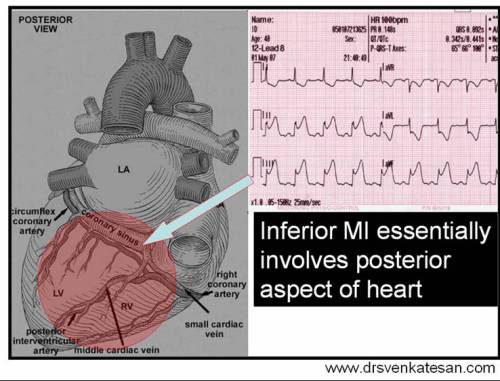
Inferior wall of the heart (strictly speaking there is no walls for heart , only surfaces , which blends with adjacent areas)  inferior wall  is formed by diaphragmatic surface and posterior surface.Inferior MI can occur by either RCA or LCX obstruction.The outcome of inferior MI is determined by mainly by  the extent  of   LV myocardial   damage it inflicts.To  quantitate this  we need to know , how much of LV is supplied by RCA , or LCX or combination of both ? This depend on the coronary dominance .It is estimated , the bulk of the LV is supplied ( up to 75%  ) by LCA. This becomes further high in left dominant circulations . In fact , it is believed LV can never get involved in non dominant RCA occlusions. This has brought in a new terminology  called “Small inferior MI”.Inferior STEMI due to PDA  occlusion or in a co -dominant circulation is not yet studied

Apart from the above  anatomical considerations the following clinical observations  have  been made regarding inferior MI.

  • When thrombolysis was introduced , many studies  suggested the the ST elevation in inferior  leads toched the isolectric levels  in most situations even without thrombolysis.Technically, this implies spontaneous , successful thrombolysis are more common in RCA. Among the thrombolysed ,persistent ST elvation is a rare phenomenon.
  • The well known difference in the conduction defect between anterior and inferior MI  is an important contibutor for better outcome in the later.(AV blocks in inferior MI , are often transient, non progressive, supra hisian location rarely require permanent pacemakers)
  • During acute phase cardiogenic shock occurs in a minority (That too , only if RV shock is included )
  • Even in the follow up the ejection fraction in inferior MI is  almost always above  40%. In many EF is not affected at all.
  • Progressive adverse remodelling of LV is rare

When can Inferior MI be dangerous ?

Anatomical factors

Inspite of the  above  factors  inferior MI can not be taken lightly . Especially when it  extend into posterior, lateral , (Rarely anterior) segments.

While  posterior extension  is often  tolerated , lateral extension is very poorly tolerated .This is probably explained as  the extension involves the vital free wall of LV and the laplace forces could precipitate LVF. Free wall rupture is also common in this situation.

Posterior extension , predominantly involves the surface of RV which is less important hemodynamically. Of course incidence of MR  due to it’s effect on posterior mitral leaflet can be trouble some.

inferior MI ECG

High risk clinical catagories.

Out of hospital STEMI  are at  equal  risk irrespective of the territories involved  .This is because,  primary VF does not differentiate , whether  ischemia comes from RCA or LAD .

  1. In elderly , dibetics and co existing medical condtions  the the established  benign   character  of  inferior MI disappear, as  any  muscle loss  in LV has equally adverse outcome.
  2. Even though  inferior MIs are immune  to cardiogenic shock  , a equally worrisome  prolonged hypotension due to high vagal tone, bradycardia, plus or minus RVMI can create trouble. Fortunately , they respond better to  treatment. Except a few with extensive transmural RVMI outcome is good.
  3. Presence of  mechanical complications of  ventricular septal rupture , ischemic MR can bring  the mortality on par with large anterior MI.

How different is the clinical outcome of infero-posterior  MI with reference  to the  site of  coronary arterial  obstruction   ?

The sequence of  outcome  From  best to worse  : Non dominant RCA* → Dominant RCA but distal to RV branch → LCX dominant with large OMs

* It is believed   an  acute proximal  obstruction of a  non dominant RCA may not be mechanically significant, but can be electrically significant as it retains the risk of primary VF and SA nodal ischemia. The ECG changes  can be very minimal or  some times simple bradycardia is the only clue. One should be able to recognise this entity (Non dominant  RCA STEMI)  as the outcome is  excellent and these patients  would never require procedure like primary  PCI

** A inferior MI due to a dominant LCX and a large OMs have comparable outcome as that of extensive anterior MI. The ECG will reveal ST elevation in both inferior and lateral leads.

***In patients with prior CAD  and collateral dependent  multivessel disease  the  inferior anterior sub classification does not make much sense as  entire coronary circulation can be mutually interdependent.

Final message

Inferior STEMI  generally lacks the vigor  to cause extensive damage to myocardium in most situations .Further they respond better to treatment. Risk stratification of STEMI based on the location of MI has not been popular among mainstream cardiologists. This issue needs some introspection as  the costly and complex treatment modalities like primary PCI  is unwarranted in most of the low risk inferior MIs.

Related posts in my blog:

1.Why thrombolysis is more effective in RCA?

Read Full Post »

Sick sinus syndrome  or sinus node dysfunction (SSS, SND ) is one of the common cause of  symptomatic bradycardia .The other cause for  pathological bradycardia is complete heart block.Together , these two entities share 99% of indications for permanentpacemaker implantation.

The sinus node can get affected in various diseases . The commonest cause for SND is age related.This is manifested  as inappropriate bradycardia .The  other common presentation of  SND is exaggerated bradycardia to betablockers and calcium blockers.In fact , some consider drug  induced bradycardia  is  nothing but  , unmasking of underlying SND.Pathological states that result in SND include  hypothyrodism , infiltrative   and inflammatory diseases . (Surprisingly ,  ischemic  SND  is a lesser  clinical problem when considering  the  rampant CAD in our population )

What is  is a fundamental difference between SND and complete  heart block* ?

Sinus node is the proximal most pacemaker of the heart. When it fails the chances of  a  subsidiary pacemaker coming to the rescue is far greater than  a complete AV block. Further the quality and stability of the escape pacemaker is better in SND. In fact , in pure SND  ( With out AV nodal disease)  a sinus arrest is rarely fatal as escape rhythm  occur without fail.

* It should be emphasised  ,  there can be associated AV nodal disease in  significant (10%)  number of patients with SND .This may be present either at the  time of diagnosis or it can develop later in the course .This has important implication in the selection of   pacemaker .The discussion here is confined to isolated SND .

How common is ventricular escape rhythm in SND ?

It is very rare. the ventricle never gets a chance to come to the rescue as invariably junctional pacemaker takes over at times of extreme sinus pause/arrest.For the same reason , pause dependent VT (Brady dependent ) is also less common in SND .

What is  stokes Adam’s attack ? How  common it is  seen in SND  ?

It is the cardiogenic  syncope due  to extreme bradycardia. This classically occurs in complete heart block , when

the the escape rhythm becomes either very slow or temporarily goes for sleep .This results in a huge  pause (unlike sinus pause  of   , the pause  here is  ventricular pause  , this is  actually an  asystole  )  it  can  immediately trigger an VT or VF .

If  SND is not life threatening why pace maker is indicated in them ?

The pacemaker is primarily indicated for prevention of dizziness , near syncope or syncope.So primary impact is on improving quality of life  , not reduction in mortality. While in CHB  pacemakers improve  symptoms and survival.

Which form of SND can be dangerous ?

When SND is associated with rapid atrial fibrillation  some times it can trigger a VT/VT if ,  these patients also have

a fast accessory pathway with short refractory period. (<250msec)

Final message

If you have only one pacemaker at your disposal , but there are  two patients ,  one with SND and other with CHB please put the pacemaker to  the patient with CHB , even if the later has insurance coverage and the former is not .You are justified in  diverting  the pacemaker !

Read Full Post »

« Newer Posts - Older Posts »