Feeds:
Posts
Comments

Archive for the ‘Cardiology – Clinical’ Category

Imaging  coroanry artery is  generally  in the   domain of interventional cardiologists. MDCT has helped us to change that.

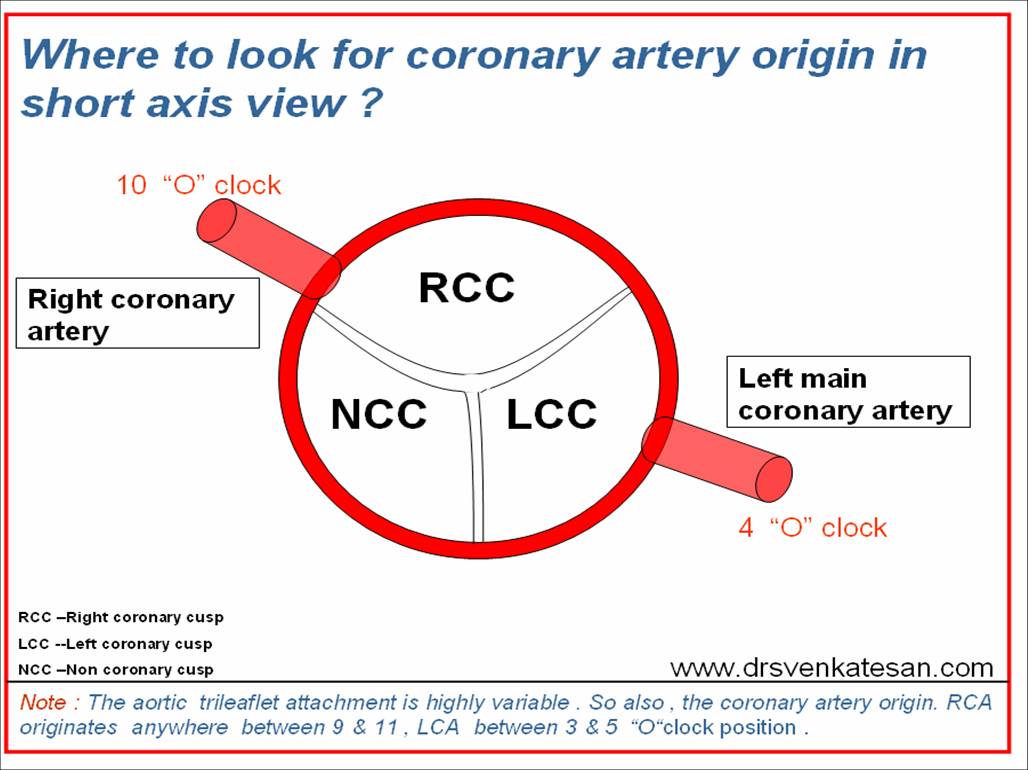
The  humble echocardiography can   identify the origin* of   coronary arteries   in  most   persons. The resolution power of modern day echocardiography is  2mm and the left main  ostium is >3.5mm in 99%  of population . If some body says one can’t  visualise the coronary artery by echo ,   it can only reflect their ignorance or lack of patience to get an optimal image. Of course technological limitations are there.

*  To be emphasised again , only the origin can be identified.

Can we identify ostial leftmain or proximal  left main disease  by echocardiography ?

It should be possible in  few .

Can we place  a doppler sample volume  within  the left main and measure coronary flow velocity ?

When obsterticians are able to  assess the  uterine artery flow  in a bulky uterus ,  it should be possible to do the same in  a coronary artery . Motion artifacts is the issue in the heart.  Micro sample voulme (<1mm) are expected in the future  that will make a non invasive coronary flow assesment a distinct possibility.

Read Full Post »

Hypotension is one of the dreaded complication of acute STEMI.

  • It can be due to either a  mechanical complication or hypovolemia.
  • The hypotension in inferoposterior MI is  often related to enhanced vagal tone and easily correctable with atropine  and fluid  administration.
  • RVMI is the classical example of hypotension that may improve with fluid resuscitation
  • Hypotension,  if  not reversible within 12  hours  ,  is more likely to  represent a more sinister mechanism like pump failure, MR or ventricular  septal tear etc .

A new mechanism for persistent  hypotension is increasingly recognised.

This is due to the

1.Loss of LVOT dynamic activity.

2.Excessive  dynamism of LVOT.

LVOT contractile and ejectile falure

Even though LV  outflow tract  contain  less  contractile myocytes  , it has an important mechanical  job to do. We know , it’s  primary job is that of a  conduit  but  it also  has to  eject the blood into aorta with sufficient force.  In fact, it is thought much of the acceleration of blood velocity occur in LVOT . So, LVOT  plays a key role in maintaining the cardiac index.  An excessively dynamic LVOT will impede the forward blood flow as in HCOM.  Similarly  less dynamic contraction  of LVOT  results in  low velocity propulsion , that interferes with   proper delivery of blood from LV cavity into the aorta .

These factors get amplified in  acute MI , as it is a compromised situation with fluctuating HR and contractility. So a properly functioning  LVOT conduit is  absolutely mandatory.

STEMI due to a proximal LAD obstruction   located can involve the septal .If the first septal branch  happens to be a major one,  there will be  definite impact on the LVOT function.

Excessive dynamism  , LVOT   desynchrony  LVOT collapse .

LVOT has a medial border formed  by IVS , an  anterior surface and  a posterior surface .The lateral border is relatively boundary less , except it is guarded by  the anterior mitral leaflet.

But one should recall , the AML comes towards the LVOT only in diastole . When it comes in systole it becomes a pathological event  called  SAM  (Systolic anterior motion )

The LVOT wall desynchrony can occur in both anterior and posterior MI.In a mulivessel CAD  this can happen when there is disproportionate inferior to anterior wall motion defect.

Management.

  • There is no specific management strategies aimed at restoring LVOT function.
  • Emergency revascularisation will attenuate the mechanical dysfunction
  • Dosage of powerful inotropic agents should be moderated in dynamic LVOT obstruction.
  • Spontaneous recovery  may occur in few

http://circ.ahajournals.org/cgi/reprint/116/5/e110.pdf

Haley et all Mayoclinciproceedings 1999

Read Full Post »

  • It is going to be the era of non invasive imaging  in  cardiovascular  diseases .Future looks very exciting
  • We have now ability to slice the heart 356 times a second !
  • Image resolutions are getting sharper .
  • The only worry ( Of course a major one !)  would be the radiation , that has to be addressed .

Now we have a dedicated journal for cardiovascular CT scan .

Does it surprise you  ?   For me  . . . It  is  !

Link to the current journal page . Get updated  !

http://www.journalofcardiovascularct.com/current

Read Full Post »

There are millions of  articles in cardiology . Some  simply  occupy   valuable spaces without any purpose  . Some give us knowledge . Some enlighten  us. While few are  so vital , it is almost a crime  if we do not read such articles and apply  it in day to day  practice .

This an article  written by Henri Justino that has a immense importance for the patients as well as the physicians .

Do not think  the article which came in pediatric radiology  is not applicable in adults !

Read Full Post »

Vasovagal syncope is the commonest cause for syncope in our population.It is also referred to as simple syncope .The mechanism is thought to be  an abnormal overshoot  response  by the vagus  in response to a  sudden surge of  adrenegic activity  usually occurring  in erect posture following   , often an emotional or physically stress full situation .The  receptors for  this  reflex pathway is thought to be located  left ventricular myocardium .

There are  two components  for  the VV syncope

  • Cardio inhibitory
  • Vaso depressive.

The quantum of contribution  by each component in a given episode of syncope varies. Pure vasodepressive or cardioinhibitory forms can occur .

Diagnostic issue

Before labeling  a patient as simple vasovagal syncope all potentially serious , cardiac causes must be ruled out. this may require a fairly extensive investigation in some

Read the related blog  : Why syncope is rarely  fatal ?

https://drsvenkatesan.wordpress.com/2008/09/30/why-syncope-is-rarely-fatal/

Management of vasovagal syncope.

  • Reassurance is the mainstay . By this we mean , V V syncope may never kill . . .
  • Prevention  – Involves  identifying syncope prone situations  & taking precaution
  • Emotional support
  • Pharmacological approach

Some will benefit from beta blockers, fludro cortisone(Increase the intra and extra cellular  fluid space )

Since  these are   simple ,   cheap  treatments ,  we worked over time to innovate  &   find some interventional solutions for this life threatening condition !!!.  Thus ,  the indication for cardiac pacing for vasovagal syncope came into vogue .

DDDR pacemaker was implanted worldwide for thousands of patients with vasovagal syncope .

It took  many years  for our  intellectual brains  to realise ,  there are  two limbs to vasovagal syncope Pacemakers ,  at  no stretch of imagination  is expected to counter vasodepresssive component of the syncope.

And then this article came !

http://circ.ahajournals.org/cgi/content/full/108/21/2660?ijkey=ba86da897c167581c498c81743c32afe14fc9393

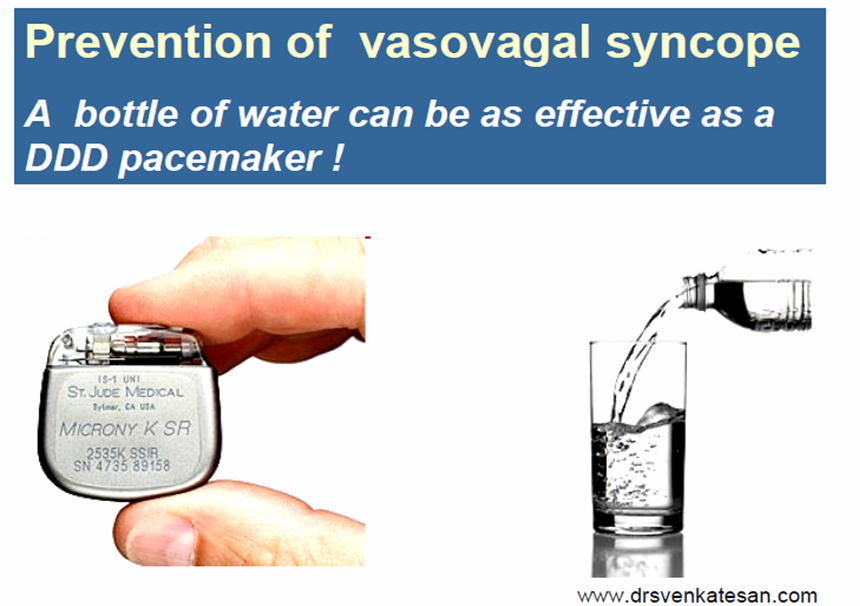
Water ,  (Simple  H2O ! ) administered at right time in right quantity can prevent most  episodes of vaso vagal syncope . When a tumbler of water can be substituted for a  10000 $ misadventure  (DDD pacing)  , and  further  we have  hundreds  of similar examples in modern  day health care  ,   no surprise  why our health care system is  sinking  along  with our economy !

Epilogue :

In this  21st century   medical “AVATAR ”  , we need to realise   in a strong manner,   low cost  medicines  often   provide   high  quality  cure  ” while ,”   many of the  high cost  therapies  may  end up in  low quality  treatment !

It took 50 years of intense research of  medical comunity to realise ,  a good diet , physical activity and quitting smoking has the greatest way to control  and reverse  the cardiovascular epidemic . Please , note all of them come at free of cost .

Read Full Post »

Exercise stress testing(EST)  is one of the common investigation modality in the evaluation of CAD.he indication for EST  generally fall into two broad categories.

  • Diagnostic in patients suspected to have CAD
  • Prognostic evaluation in patients with established CAD .9Many times after a coronary angiogram)

Currently there is a major shift in our thinking,  patients with  classical angina  may undergo coronary angiogram  directly .This is understandable as the stress test  has little to   improve  diagnostic  sensitivity and specificity in patents with clinically obvious CAD.

So , it is now becoming clear , the diagnostic  value  is  increasingly  restricted in the evaluation of  o atypical chest pain .

What is a strongly positive response ?

  • Gross ST segment depression > 2-3mm
  • Occurring in stage one
  • Fall in blood pressure
  • Prolonged angina into recovery

What is the angiographic  correlates of strongly positive EST?

  • Critical left main disease
  • Near total proximal LAD /LCX
  • A severely compromised bifurcation lesion

Morphological correlation

  • These patients  often have eccentric lesions with irregular margins.
  • unstable  lesions
  • Lack collaterals

What is the effect of vigorous  excercise on a critical flow limiting lesion ?

The shear stress over the plaque  increases  with  exercise  and  the  transcoronary gradient can reach a theoretical 60-90mmhg .One can imagine the what this stress can do to the  unstable lipid core .This is the reason unstable angina is an absolute contraindication  to EST.

What does a strongly positive EST imply for the patient ?

  • It indicates he needs urgent CAG and  most likely an immediate revascularisation.
  • Often , these patients have prolonged angina , and mandates admission in a coronary care unit.
  • there has been many incidence of ACS in these  patients  within 24hours of EST.
  • Lives have been lost  on their  way back    ,   as  these patients are sent home , as EST is a  OP procedure .

Final message

  1. It need to be realised a strongly positive response to EST  could  be a  clinical equivalent of  unstable angina .
  2. The common response  from a   physician or cardiologist    after witnessing  a  gross ST depression to EST  would be   “Had  I known this  I would have sent him straight into cathlab instead of EST ”
  3. If only , we give little ear to our patient’s  history we can pick the high risk clue in 9 out of 10 cases !
  4. It can be argued ,  a strongly   positive  EST  by itself  is  “A  clinical diagnostic  failure”  ,   ie  failure  of the physician  to recognise  the likely hood of strongly  positive EST ie a left main disease.
  5. These patients  should never be sent home immediately  after the EST .This is fraught with a risk SCD
  6. Most of them will require observation in step down unit for 24 hours  and if feasible they should be posted for coronary angiogram in the earliest available slot.

Read Full Post »

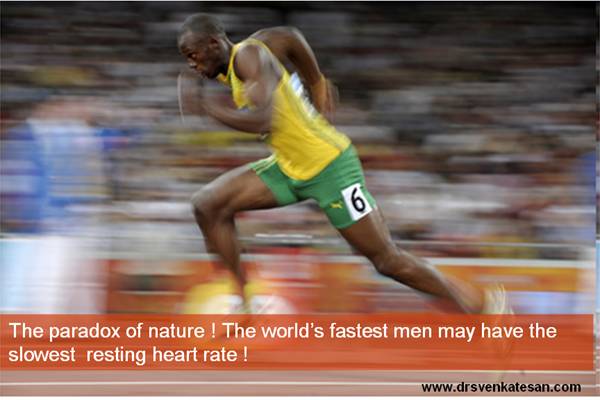
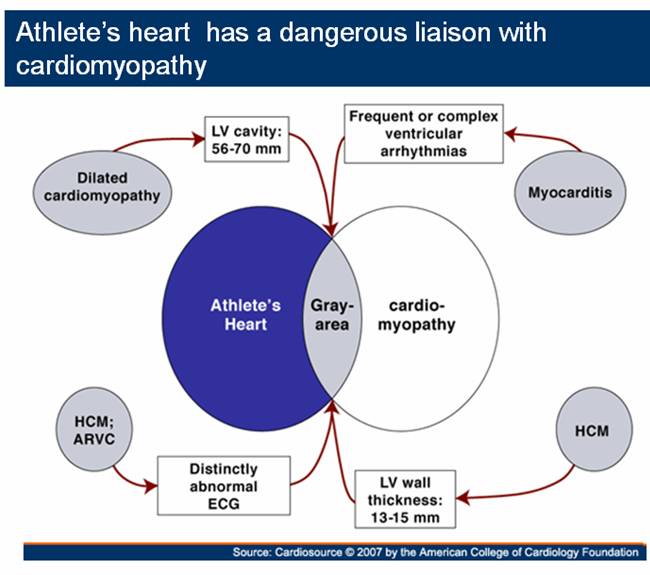
ECG of an athlete is many times difficult to interpret. The influence of autonomic tone in  athlete’s heart is an complex one.Contrary to our expectations the parasympathetic tone is higher in well trained athletes. The resting heart rate can be as low as 30/mt which is 99.9 times pathological in non athletes.This happens due to a concept called accentuated antagonism.The athletes who have episodic surge of high catecholamines keep stimulating the para sympathetic neurones in a constant fashion.

LVH is the most common feature.Here there is simple myocyte hypertrophy, without pathological fibrosis.This differentiates athlete’s, heart from HOCM .

Many ECG abnormalities are reported in athletes.

Excerpts from the ACC recommendation

1. Electrocardiographic findings that are common and training-related and that do not require additional evaluation are sinus bradycardia, 1° atrioventricular block (AVB), incomplete right bundle branch block (BBB), early repolarization, and isolated voltage criteria for left ventricular hypertrophy (LVH).

2. Uncommon and training unrelated electrocardiographic findings that mandate further evaluation include T-wave inversion, ST-segment depression, pathological Q waves, atrial enlargement, a hemiblock, right ventricular hypertrophy, a BBB, or a Brugada-pattern of ST-segment elevation.

3. Training-related electrocardiographic findings are more common in men than women, athletes of African descent, and high-endurance athletes such as cyclists.

4. Sinus rates <30 bpm and sinus pauses >2 seconds are common in highly trained athletes, particularly during sleep.

5. A normal chronotropic response to exertion and the absence of bradycardia-related symptoms distinguishes training-related sinus bradycardia from sinus node dysfunction.

6. 1° AVB and Mobitz I 2° AVB are common, but Mobitz II 2° AVB or 3° AVB should not be assumed to be training-related and require evaluation.

7. Early repolarization in Caucasian athletes most commonly consists of upwardly concave ST-segments and tall and peaked T waves; in black athletes, there often is convex ST-segment elevation and negative T waves, mimicking a Brugada pattern.

8. In the presence of voltage criteria for LVH, pathological hypertrophy should be suspected if there is left atrial enlargement, left-axis deviation, repolarization abnormalities, or pathological Q waves.

9. T-wave inversion ≥2 mm in ≥2 adjacent leads should prompt evaluation for structural heart disease.

10. Electrophysiological testing for risk stratification with possible catheter ablation is appropriate in athletes with ventricular pre-excitation.

Source :  Fred Morady, M.D., F.A.C.C.

http://www.ncbi.nlm.nih.gov/pubmed/19933514?dopt=Abstract

For an excellent article on the topic click here

Read Full Post »

Magnesium is a powerful cell membrane stabilizing agent. It is well recognized to act on the cerebral motor cortical cells and  suppress seizure , especially in eclampsia of pregnancy .

Mg SO4 is still the drug of choice for seizures of pregnancy. It  was soon realised  ,  the  molecular basis of  cellular excitability    is    similar  for  every cell  . And  thus , we got this  great antiarrhythmic drug !

  • Magnesium is a  cofactor in the enzyme Na /K ATPase in the myocyte cell membrane
  • Integrity of this enzyme is essential for proper maintenance of the intracellular potassium levels.
  • Many times hypokalemia can not be  fully corrected by administration of K + alone .
  • Co- administration of magnesium  increase the intracellular K +    and hyperpolarize the cells and make  it less excitable.
  • Further , magnesium competes with ca++  ions  to enter the cells and thus   it is a natural calcium blocker. This property also helps in controlling refractory calcium dependent  cardiac arrhythmia.

Indications for magnesium

  • Torsades de pointes . Note:  Magnesium does not shorten the QT interval significantly but still effective in torsades.
  • Any refractory VT especially , post MI.
  • Digoxin induced , hypokalemia dependent atrial tachycardias, MAT

It is administered 1-2mg boluses of 2-3 boluses.

Where we should not use magnesium ?

Routine Use of magnesium in recurrent non sustained VT following MI is not recommended .(Courtesy ISIS -4 trial )

Reference

http://www.ncbi.nlm.nih.gov/pmc/articles/PMC1368485/

Magnesium : Nature’s own calcium blocker

http://www.ncbi.nlm.nih.gov/pmc/articles/PMC1368485/

ISIS 4

Some think ISIS 4 was a delibrate attempt to defame magnesium !

Read Full Post »

The term  left main disease (LMD)  invariably  creates  a  near  panic  reaction in   many of the   contemporary cardiologists . It may be acceptable   in  a broader sense, but it need to be realised , there  is a significant group of patients  with  isolated  non critical  LMD . Many times , these patients can be managed effectively with  intensive medical management.

However , the  following rules may be applied in the management of non critical isolated LMD

  • In patients  who present with unstable angina  ,there is nothing called non critical LMD .Any degree of lesion (Even a 20%)  is significant .
  • Lesions with irregular margins, hanging eccentric  plaques are always critical irrespective of obstruction.
  • LMD involving LAD /LCX ostium need to be tackled as an  emergency .

What are the safe left main disease ?

  • Isolated tapering  left  main artery .
  • LMD  with <  50% lesion.
  • A left main patient who is pain-free on a tread mill > 10 METS
  • Left main with stable angina responding well to medical therapy
  • New onset left main disease in a patient with functional LIMA to LAD /LCX *

*This is sometimes called protected  LMD.  Protects what ? Protects the LAD ,   in case of  complication occurring during LM stenting . If the  function of  LIMA graft is good enough to  protect LAD , why should we attempt to open  the diseased LM in the first place ?  It is an unanswered question !

Why is it riskier  to  stent an  insignificant  LMD or stable  LMD ?

A  left main artery ,  engulfed with a  50%   stable plaque is less riskier to develop an  ACS than an  artificially  normalised  left main lumen with a stent. This is especially true for the  drug eluting stents which need life long  dual antiplatelet therapy as the drug which is supposed  to  prevent  the  restenosis ,  interferes  with  the normal endothelialisation over the stent .

In effect,   PCI   especially  with a DES for a hemodynamically insignificant lesion is fraught with a risk of converting a stable  lesion into  potentially vulnerable lesion !

Final message

A discerning  reader may ask , is it possible at all ? . . .to  have a   patient  with LMD  & enjoying  good exercise capacity ?

Yes , it  may be  rare , but not “non existent” .  Remember ,  one of   the common cause  for  rarity in medicine is ” non recognition of a  fact” or   otherwise  called ” Ignorance”

It is an irony , LMD is considered  by many as a  homogenous  entity ,  even as we  acknowledge  there is a  huge spectrum of lesions among left main disease . There is a distinct (although small !  )  subset of LMD * where medical treatment could be ideal and PCI  may even carry greater hazard.

*The most important caveat in assessing a LMD  lies  in the   50% criteria. Calipers  we use ( often visual )are never going to estimate the lesion correctly considering the importance of  Glagovian  phenomenon . As of now ,  we have no simple means to  measure the vulnerability of a left main plaque .Thermography, OCR/Raman spectroscopy/ RF intravascular ultrasound would probable redefine the indications for intervention in LMD.

Legal issue in LMD

Can we  defend in the  court of law, if a patient loses  his life,  who was adviced  medical management for LMD ?

Any thing can be defended in this funny world of  judiciary . A person who kills in broad day light,  hundreds of  innocent lives can argue  he has never seen a gun ! and he may even,  be  acquitted  for want of evidence  !

How can we   prove  with evidence , the  death in question  occurred  “only because ” he was  adviced medical management ?

No court on the earth can prove it !

So , an occasional life lost due to an unintentional  judgment  error can  easily be argued in favor of the noble profession . Scientific  guidelines are only recommendations .If a person with a  significant LMD  due to  a smooth stable plaque , who has  little  symptoms , carry on with his daily activities comfortably  , his  cardiologist has every right to advice him  medical management.  The doctor , can not be penalised , provided  , he has explained  to the patient ,  that  he is deviating from the official guideline only  for the benefit of   the patient’s  health and  he   has  fully understood the issue.

Read further , for  more controversy !

Land mark  randomised control trials (RCTs) are generally  done in specialised centres with high degree of expertise . They rarely represent the real world patients  seen in  the remote towns (or even  cities ) of the  developing countries  .We can not equate a PCI  done in an  angiographic core laboratory , say in Cleveland or Mayo clinic  ,  with that of  cath labs  ,  that  works  with par time staff and non dedicated cardiologists . So , in these situations  intensive medical therapy (which do not have a geographical variation in efficacy! ) would score over complex procedures .

Read Full Post »

It is a well known fact  ,   CABG and PCI  provides immediate relief  for patients with angina ,  which is refractory to medical therapy. Of course , this happens only if a critical occlusion of  at least one epicardial coronary artery is  opened . It need to be realised ,  angina  due to  microvascular  disease can not be cured by maintaining  epicardial  patency .

While angina  relief is prompt ,  dyspnea is not ! . If we  believe,  opening  up a  coronary artery  in a patient with LV dysfunction will  restore the LV function  ,  it  is grossly mistaken !

Why is it so ?

Angina  relief requires  simple  restoration  of  oxygen supply and correction of local ischemia .  This happens without any issue as the blood  seeps in to the ischemic cells and soothes the ischemic nerve fibres that trigger the pain signals   . While  ,  for LV function to improve , the blood flow has to be converted to mechanical activity in the form of myocyte actin/myosin interaction. For this,   there need to be an intact  cellular contractile mechanism . The myocyte architecture should be appropriate .In post MI ventricles we know there is  zig zag  orientation of myofibrils due to myocyte slippage that interfere with mechanical recruitment . Further , integrity of  extracellular matrix  namely the collagen frame work is also vital . Note ,  angina relief  is not concerned with any of the above .

And now ,  we also realise  dyspnea  in failing ventricles  is vitally  dependent on diastolic function ,  which is also very much  impaired in ischemic DCM .There is little proof for  PCI/CABG  to correct the  molecular   mysteries in  diastolic dysfunction !

Dysfunctional LV means what ? (read the link )

It is a collection of  variety of myocardial tissues . Viz : Fully  necrosed , partially necrosed ,  ischemic viable, non ischemic viable, ischemic non viable, non ischemic non viable , Apart from this patchy necrosis, patchy ischemic, areas are common. Finally , necrosed segments   may  also be perfused normally by  spontaneous reopening of an IRA.

One can imagine the complexity  of events in these segments  once we do the  PCI /CABG . The response  is highly variable and unpredictable. The major concept we  , the physicians  believe or ( to be precise made to believe !) is  the  sanctity  devoted to  the viable myocardium .For  many us ,  it is considered a  holy  exercise  to identify viable myocardium in patients following MI and then revascularise them if  found to have significant viable myocardium (Atleast 20% of infarcted area )

A full 2 decades were lost or (shall  we   say wasted on this futile exercise !) as   we have since  realised most of the cardiologists do not follow this rule .

Now , even a scarred myocardium is revascularised in the hope of recovery .As such , we have reached a stage where  there is no contradiction for not doing a PCI /CABG   with reference to LV dysfunction.

Now every  patient  with post MI  LV dysfunction  is considered to  have  some amount of viable myocardium that is  fit   enough  for revascularization

Are we justified in doing  this ?

Many clinical  trials  have revealed  , the  recovery of LV function  in these segments  has not been consistent at all .

The most surprising discovery is  a viable myocardium need not  be ischemic   .It might get adequate blood supply either  from invisible collaterals or trickle of antegrade flow .  Hence an adequately  perfused myocardial segment can  still be   non contractile . This shatters the myth  that  revascularisation must have a dramatic effect on the recovery of contractility in all viable segments.

The other major finding is  ,  even ischemic   viable   myocardium ( documented by metabolic activities PET etc)  need not regain it’s original contractility  after the ischemia is fully corrected .

*reference for  both the above statements are available from variety of sources including real life experiences .(Type C evidence )

Final message

  • Do a PCI/CABG promptly for patients with refractory angina.
  • Never  advocate PCI/CABG  for  a primary relief of dyspnea .  (Never is a harsh word,  let it be  “use it  with caution ” ! and  the  patient  should be  revealed  the whole facts  about  what we know and what we do not know regarding the complex  hemodyanmic events  in  revascularisation   )

Counter point

If  the above statements are really true ,   How does PCI/CABG   help  relieving  dyspnea  and functional class  what is your answer for thousands of patients  with CAD and ischemic DCM who have greatly benefited from CABG ?

The answer could  be  simple , The revascularization  piggybacks  over the   medical management (which , these patients pursue vigorously)     like  ACEI,  statins, salt restriction, betablockers  , optimal diuretics and tend to hijack the credits from the poor  drugs !

Read a related blog

Revascularisation for ischemic DCM

Read Full Post »
« Newer Posts - Older Posts »