Feeds:
Posts
Comments

Archive for the ‘Infrequently asked questions in cardiology (iFAQs)’ Category

Acute coronary syndrome  is primarily a disease of blood vessel , which perfuses  the heart.  It can even be a disorder of blood, often called vulnerable blood which predispose  for intra- coronary thrombus .

Mind you  , heart is an innocent bystander ! to the onslaught of  coronary atherosclerosis !

Hence , we  often use two terminologies .

CAD : Pure vascular (Coronary )  disease without  any structural and functional impairment of heart  ( No Angina, No myocardial damage ) Most of the asymptomatic plaques  , non flow limiting  lesions, incidentally detected by the modern coronary imaging gadgets  fall in this category.

When does  CAD becomes CAHD ?

CAHD : Coronary artery heart disease .Here not only the coronary artery is diseased , but it has it’s mission fulfilled   ie target organ either damaged structurally (STEMI, NSTEMI ) or functionally (EST positive , Chronic stable angina CSA )

Does the heart does any wrong to suffer from Acute coronary  syndrome  ?

No, it is simply not .The fault lies in one or more  of the following   .Generally at-least two these factors are enough to impede blood flow )  . They  combine to produce an ACS.

  • Blood defect
  • Vessel wall defect
  • Slowing of flow (Stasis)

This is called as Virchow’s triad   suggested over 100 years ago . Still valid in the era of per cutaneous  aortic valve implantation.

* The concept of de-linking  disorders of  coronary  vascular disease  from myocardial disease  is vital  in understanding the implications of current modalities of treatment. 

Even though we PCIs target the culprit ie blood vessel , it need to  realised , we  always fall short of real target . . .namely the heart . In coronary interventions  the catheters and wires roam around superficially over the heart  and they never even touch the heart .This is the reason PCIs are struggling to prove it’s  worthiness over medical therapy in many CAHD patients , which can reach deep  into the vessel, heart  and even every individual cells of heart.

Many (or . . . is it most ?)  Interventional  cardiologists have a bad  reputation for ” failing to look  look beyond the lesion” .  It is estimated  a vast  number  of cathlabs  and CABG theaters worldwide  are engaged in futile  attempt to restore coronary artery patency after a target organ damage is done .This is akin to building flyovers  to dead and closed highways .

Salvaging a coronary  artery and reliving a coronary obstruction is an entirely unrelated and futile  exercise to  a patient who has a problem  primarily in  musculature .

The much debated concept of  documenting  myocardial viability  , before revascularisation  died a premature death as the concept  by itself , was not viable commercially . (Viability studies   , tend to tie down the hands of device industry further , some  interventional   cardiologists began to see this concept  as an  interference to their freedom to adventure  )

Of-course , now  we have  other parameters  phenomenon  like  FFR estimation by Doppler , epicardial  -myocardial dissociation, slow  flow , no re-flow are  gaining importance.

Final message

ACS is primarily a disease of blood vessel but it’s impact is huge on heart. We need to look beyond the lesion .Restoring  a blood vessel  patency  to an ailing organ (Heart ) is not synonymous with total  cardiac intervention  and protection . There is lot more to cardiac physiology other than it’s blood flow. Heart muscle is a too complex organ to be controlled by few balloons and wires  which beat around the bush.

Read Full Post »

Dilated cardiomyopathy (DCM )  is the commonest  cardiac muscle disease .Diagnosis is simple and straight forward. All that we  require is,   documentation of LV dilatation and contractile dysfunction.The nomenclature of cardiomyopathy has remained a difficult exercise .This   is primarily  due to   iatrogenic  & intellectual confusion  among  cardiologists . They mixed up etiological and morphological entities together ,   later on  they  wanted to de-link  etiology from morphology  ,  ultimately they realised  when illness strikes the heart ,   it   can not differentiate the  morphology, etiology and pathology as we would want to   . So , whenever possible we have to label  cardiomyopathy with all components (Dilated cardiomyopathy due to alcohol with some restrictive features.)

This article  tries to evoke  some thoughts    about  why  LV dilatation  is central to the understanding of cardiomyopathy.

DCM is the prototype where LV dilates with global hypokinesia.The upper limit of   LV diameter is generally considered to be 56mm in diastole.  (Range 35 -56mm) .This cut off  point is too empirical  for the simple reason, the  left ventricle can dilate   up to  50 %  from it’s basal diameter and still technically  be within normal limits.( A 3.5 cm LV ( end diastolic diameter ) can dilate to 5.6 cm ,i e  a 50 % dilatation , still LV  has not reached the upper limit of normal  )

Even as we do not have a clear  answer to the above issue , we  recognise  left ventricle muscle can hypertrophy, progressively  dilate , transiently dilate, fail to  dilate ,  regressively  dilate  or  hypotrophy .These changes can be dynamic and heavily influenced by hemodynamic and local pathologic factors like fibrois, interstitial proliferation etc. Meanwhile , the pharmacological ,   surgical /catheter injuries we  inflict    , modifies  the muscle behavior in a positive or negative manner.

In this back ground ,  we have found a new entity called NDCM .

Apart from  DCM, a newer form of  cardiomyopathy  is being recognized  .This is often referred to as NDCM (Non dilated cardiomyopathy)  .Global  systolic LV dysfunction  with normal  LV dimension.This a similar to the terminology MDCM (Minimally/Mildly  dilated  cardiomyopathy  where LV dimension  do not  increase  beyond   15 %  upper limit of normal  ) .

This is seen in CKD and diabetic individuals.Atria may be enlarged .Diastolic dysfunction may co exist.  It is no surprise,  this entity closely mimics RCM. But in RCM LV systolic function  is not greatly compromised till the  late stages , while NDCM it begins with systolic dysfunction. This is the only difference .There can be overlaps .

MDCM was reported in 1990  . Keren gave a excellent insight about the condition  ,  It is unfortunate it failed to take off as a popular  clinical entity .  Cardiologists are argued to use this term liberally in their clinical practice .

Final message

Cardiology is not  that  simple as one would like to ! The two components of cardiomyopathy ie   LV dilatation and LV dysfunction can be temporally dissociated  one may precede the other. To  complicate the matter further, one of them may not manifest at all !

Few ,  still consider many of the RCMs and NDCM are one and the same entities that present in different time frames in their natural history.

So the simplified  concept  to decode the cardiomyopathy conundrum  could be

  • When both  dilatation and dysfunction occur it is classical DCM
  • When dysfunction  alone occur without dilatation it is NDCM
  • When both dysfunction  and dilatation are less it is RCM*(Relaxyl dysfunction must)
  • When dilatation is mild and dysfunction is severe it  is MDCM

Read Full Post »

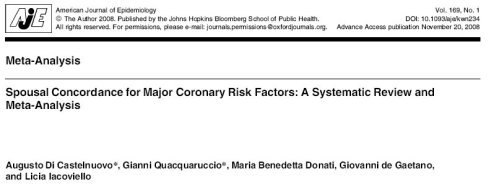
American journal of epidemiology in a land mark analysis has found , spouses share the same profile of coronary risk factors .This is a huge finding , considering the fact that , genetic factors are not involved here . So , it is something to do with family diet ? domestic issues, sibling effect ?

It is well-known lipid profile of family members are comparable . There are many Indian families who have high basal triglycerides .Mind you, husband and wife is the least (Zero link) linked genetically for familial dyslipidemia ,still they often share a similar lipid profile

Related issues without answers !

When a spouse gets a coronary event what are the chances of other to develop an event ?

Any body’s guess

In this era of bi- polar family life, can spouse behavior /unrest be a coronary risk factor ?

Yes . No surprises here .Apart form passive domestic smoking which is a well established coronary risk factor , in our coronary care unit , an initial survey of acute coronary syndrome patients revealed , a recent quarrel with their spouses, was a potential trigger for ACS. Further analysis of these data is being done

Spouse Ego : A powerful health risk

Spouse Ego : A powerful health risk

Divorce and coronary events ?

These are hypothetical observations in few families we have come across .

  • Forced divorce can be a definite coronary risk factor
  • Consensual divorce is not .
  • Women seeking divorce is more a risk for men than they inflict on women

Reference
Augusto Di Castelnuovo and others, Spousal Concordance for Major Coronary Risk Factors: A Systematic Review and Meta-Analysis, American Journal of Epidemiology, Volume 169, Issue 1, 1 January 2009, Pages 1–8, https://doi.org/10.1093/aje/kwn234

Read Full Post »

Coronary circulation is an enigma . This is true even after 50 years of coronary angiography.  What we visualise  in CAG is  only a  fraction ,  when  compared with what we do not see !  The intricacies of  coronary collateral circulation and micro circulation is comparable only to the  ultimate force of   invisibility “The  God ”

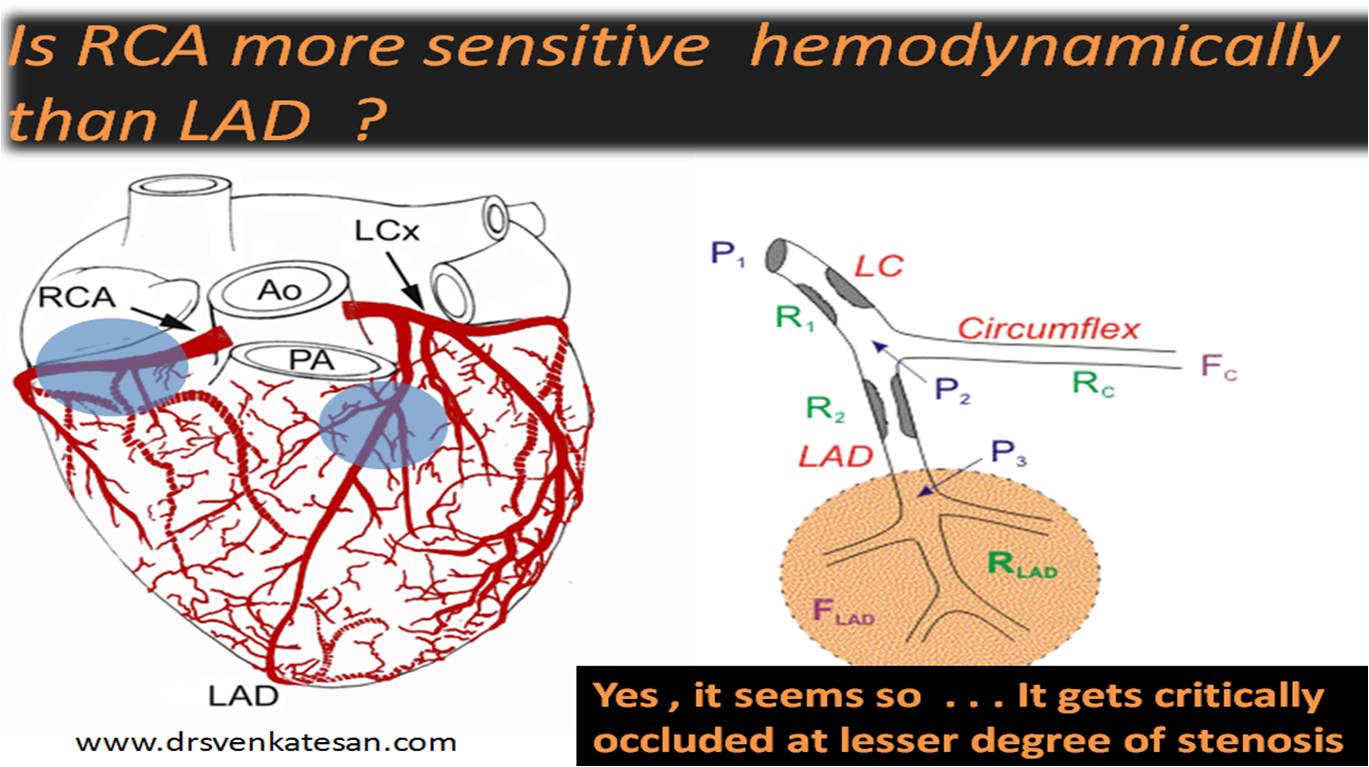
But , we will never ever believe what we do not see  . . .  but we have to accept the following  fact . How is it possible   for  some of the coronary  arteries  to maintain  a near normal blood flow from a donor (Contralateral ) coronary  artery  in spite of  100 % occlusion ?  Is it not common to see TIMI 3 flow even with 99 % occlusion .(Link to related article in  this blog  and  video ) . This is because the coronary  vascular bed has an extraordinary capacity to drop its distal pressure to negate the effects of obstruction.

Does the distal vascular bed anatomy and physiology same in RCA and LCA ?

We presume it so . The problem in medical science  is , these   presumptions  often  become  facts in due course  ! Now we have (It is in fact 30 years old !) RCA has lesser ability to withstand the stress  of stenosis than LCA.

The prime reason for this observed difference could be the LCA has a well developed microvascular bed which can reduce the distal coronary resistance .(Again , this is my  presumption  . . . !!! )

This interesting article was published in Circulation 1980 .


Read Full Post »

Planimetery is the age old method to measure the mitral valve  area( MVA) by echocardiography.

Advantage

  • Simple modality
  • 2D echo  is enough
  • Doppler errors avoided
  • In the presence of MR, planimetery orifice has an edge over other methods

Disadvantage

  • Optimal gain setting becomes  important .There is  significant inter and intra observer variability.
  • Shape of the orifice is not constant  ( MVO is funnel like) . Narrowest diameter is usually measured.
  • Planimetery is  a purely an anatomical orifice,while blood flows through both primary and secondary mitral orifices .Sub valvular fusion makes secondary MVO the  narrowest point  . Measuring it becomes difficult as it has no defintion of border.
  • Gross errors possible in calcified valve.
  • In post commissurtomy  the  lateral extent of split is often  not tractable

How to improve the accuracy of planimetery ?

Color Doppler aided  2D  planimetery . This can improve some of the limitations , as  it provides a hemodynamic MVO(Some what physiological ) Of course  , pressure halftime derived MVO is purely a physiological orifice .

Other options to measure MVO

  1. Pressure half time
  2. Continuity equation
  3. PISA method

Advantages and disadvantages  of Pressure half time derived MVO will be posted soon.

Read Full Post »

The world of  medical science is  moving in a alarming speed.In any field , speed is always dangerous ! That’s why we have speed breakers , traffic police , speed cameras , etc etc . The medical world  is flooded with new devices, drugs , procedures . Though the mankind is benefited with many of them , a equal number could do the opposite.

How to identify which is causing benefit and which doing harm ?

It is a horrible fact , this is the most difficult exercise  for the  medical academia   . . . Still worse , harm will masquerade as benefit ! Further ,  beneficial concepts are  often buried alive if  it lacks  glamor  or  commercial value (Eg: The Digoxins,)

Lay public (as well as )  the physicians   are fed with half-baked ( Often quarter baked !) medical information .Many  of the medical journals,  guidelines , sponsored  seminars  ,  some times  even text books do a clandestine  campaign  . Even after a completion of major trial,  real truths rarely  come out . Funnily ,  they call them aptly , as blinded study ! Who is blinding whom is a different issue .

So ,  in  this  new millennium , thousands of innovations are on the pipeline. These pipes are often  infested with trivial , duplicate or even  harmful  concepts waiting for a grand release into human domain.

Take the story of coronary stents

In 1977 , Gruntzig mastered the  opening  of  the obstructed coronary  arteries with a simple balloon without any add ons . That patient is still alive  without  angina  . In the next 30 years we have ridiculed (Rather , we were compelled  to ridicule it ! * Read the related article  Is  there a role for  plain balloon angioplasty ?

Technology made  it  possible to introduce a  gamut of intra coronary  devices .We used (?abused ) all sort of anticancer drugs within the tender human coronary arteries .In 2002 , we claimed to  have climbed the summit and conquered  the restenosis with DES. And in 2010 , every one knows  what is happening to DES .

The malaise is  deep rooted  in every specialty . Next  came the  Stem cell fiasco ? and more  recently huge  conflicts of interest exposed  in the  vaccines  against H1NI

Final message

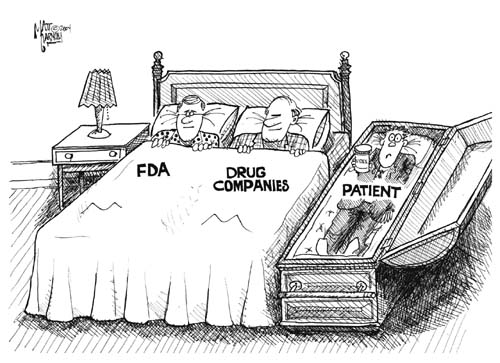
Who is going to regulate the menace ?  Hmm . . . . then  . . . Who will regulate the regulators ?

Is there a way out for our patients ?  or  they  have to suffer with it  along with the disease . The later is  more realistic option !

Read Full Post »

Thrombolysis is specifically indicated when there is  ST elevation in ECG. ST elevation is a surrogate marker for  total coronary occlusion. It occurs due to current of injury flowing   towards* the lead  facing the  infarct territory . There is only one situation where you can safely and effectively administer thrombolysis in the presence of ST depression ie

Note : There is no accepted terminology  to label a MI as  ST depression MI . Here it is used to emphasise ST elevation is not the only indication for thrombolysis .In posterior MI there is infact ST elevation but it is failed to pick up by standard 12 lead ECG.

NSTEMI is a different entity altogether and  thromolysis is never indicated.

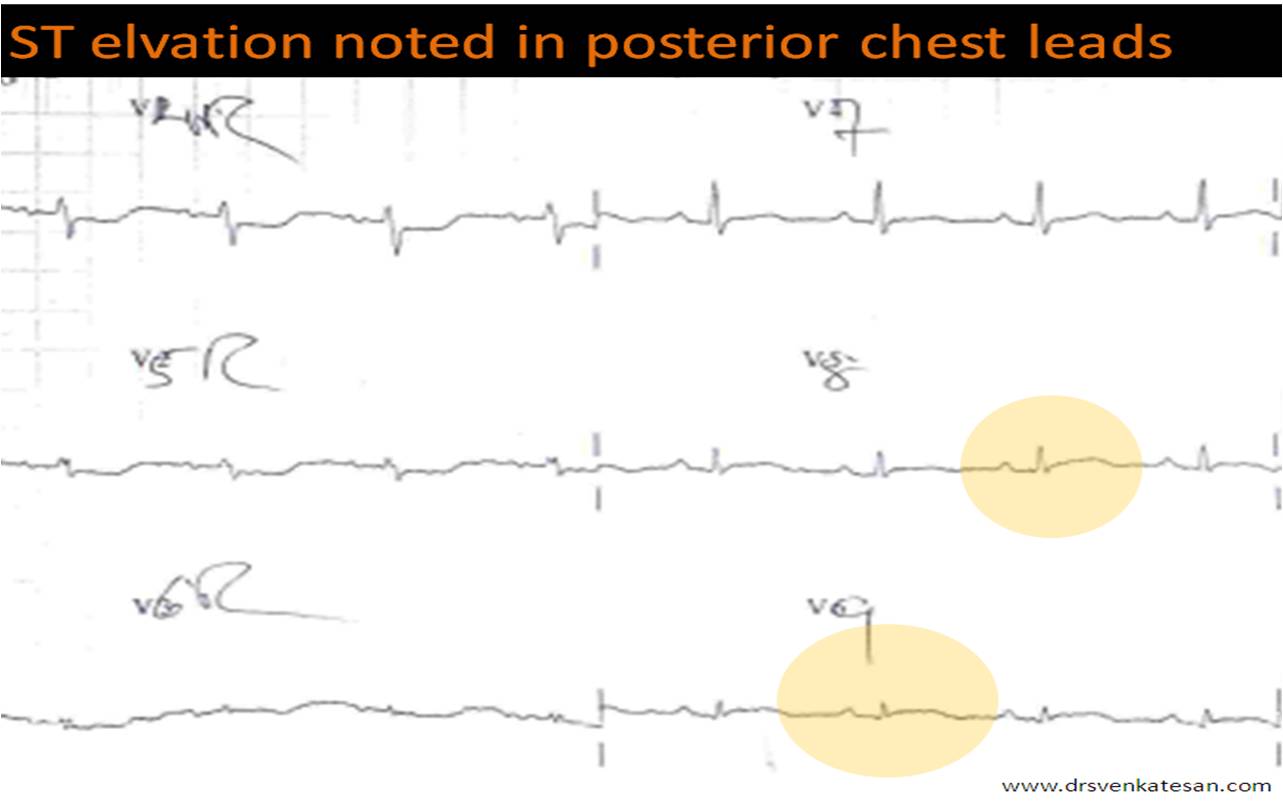
Isolated ST depression in V1 V2 V3 .It almost always indicate isolated posterior STEMI. This can be confirmed by posterior chest ECG leads V7-V10 .

*One will be surprised, to know  the mechanism of ST elevation in STEMI is still not fully elucidated .Technically speaking the net movement of current is away from electrode as  there is only a baseline  diastolic shift  which  gets neutralised in systole  mimicking an ST elevation .(Electro-optical illusion !)

How sensitive is these leads to detect isolated posterior STEMI  ?

Fairly sensitive. Both scapula and  para spinal muscles can be a  significant electrical  barrier that can prevent ST elevation from inscribed .In case of doubtful ST elevation in posterior leads , mit is always better to rely on the clinical presentation.Acute chest pain , consistent with ACS and a new onset ST depression >2mm V1 to v3 is a definite indication for thrombolysis .

Link between posterior MI and RV MI ?

They are closely linked entities .In fact posterior surface of heart is contributed significantly by RV.

What is the angiographic correlation of  isolated ST depression in V1 to V3 ?

It almost always localise the lesion to left circumflex artery . If it is dominant , it can involve lateral and RV territories.

Is isolated posterior MI  less dangerous ?

May be yes , but only after the patient reaches the hospital as electrical risk is same in every STEMI .

The area of infarct  is less , LV failure is less common. While conduction disorders and ischemic mitral regurgitation   can occur  significantly.

Also read ,  Why thrombolysis is contraindicated in UA/NSTEMI ? in this blog

Read Full Post »

It is traditionally believed  , renal blood flow is critically determined by the  luminal diameter  of  renal artery.But in reality  there are more important factors  other than renal  arterial diameter  that determine the glomerular  blood flow.  As in any vascular bed, it is the arterioles that determine the resistance and hence the flow . These arterioles  form the  critical  resistance  points and acts as   check  valves in this  “vascular  highway”  flowing across the renal terrain !

Unlike other micro-circulations ,  the kidney has a  special job to do ,  ie  filtering  the toxic  molecules.  Hence,   for the blood entering the kidneys  , even  nourishing the kidney seems ,  a less important  function !  The nephrons  of the kidneys are probably the most  “high – tech” cells in human body (Of course ,next only to brain cells ) .The vascular  tuft of glomerulus located within the bowman’s capsule  is perfused  by afferent arteriole and drained by efferent arteriole .

The entry of blood into glomerulus is regulated both by afferent and  efferent arteriolar  tone .These  two micro-circulaoty units  are under the  sensitive control of both neural  and humoral  signals. Glomerular circulation is meticulously  regulated by renal juxta glomerular apparatus.It modulates the glomerular  blood flow by secreting renin which  acts through Anigiotensin 2  on the   efferent arteriole .

The tone of the  efferent  arteriole  is thought to be the single important factor in this servo control mechanism.

What happens in bilateral renal arterial stenosis ?

When there is bilateral renal arterial stenosis the effective renal blood flow is not  significantly reduced , but maintained at  the cost of increasing the efferent arteriolar constrictor tone. It  is  like a  check valve at  the  exit point of a dam , which is partially closed to maintain the adequate pressure head (Here , intra-glomerular  pressure head )

What happens when ACEI are introduced ?

Once ACE inhibitor  is administered , the efferent arteriolar   tone is removed , this triggers  the intra glomerular pressure to drop  suddenly and filtration pressure reduces .

Note: ACEI does  not reduce the renal  blood flow  directly  but  the glomerular  perfusion pressure drops hence precipitating acute renal function deterioration.

What is your comment about the reno-protective effects of ACEI ?

The medical science’s  most  crucial  moments  occur  , when we confront  two diagonally opposite views  are  debated  and both  suggest , there is definite benefit for the patient ! Cardiologists and nephrologists were always  made to believe  ,  ACEI are  unfriendly to kidneys . But ,we now have  evidence , ACEI is not an untouchable molecule in renal  dysfunction.

This is based on  the observations made , over the years that  excess Angiotensin 2  is  ultimately a liability for the kidneys !

Looking at a  long  term perspective  , AT 2  increases the intra -glomerular hypertension and ACEI inhibitors reduce it.This  pr0tects the  nephrons from  hyper-filtration  mode ,  that accelerates the  glomerular  injury . So , the  current thinking  is  ACEI has a definite role in arresting the progress of  renal cell injury .

This is akin to beta blocker story in CHF which was initially contraindicated in CHF later became a definite indication

The only issue for ACEI is , it should not be continued if an ARF like picture sets in .(Acute deterioration ). Otherwise ,  in CRF at any  basal level of serum creatinine  , ACEI can be continued . Some think even an  increase by few mg of creatinine  can be allowed .

So the following can be a working guideline *

  • ACEI can be started  or continued at any level of creatinine in stable CKD with or without dialysis

But ,ACEIs need to be stopped in all of the following 

  • Acute renal failures
  • Acute on chronic renal  failure
  • Accelerated elevation of  creatinine  (As in bilateral renal artery stenosis)

How much elevation of creatinine is allowed in CKD  with ACEI  ?

This is   not answered yet .

*Caution : The above conclusions on ACEI and creatinine was  derived  by me , based on  with  personal discussions with my  Nephrology colleagues. It may  be subjected to correction.

//

Read Full Post »

The much fancied criteria   “suspect secondary  HT” if the  onset of  hypertension  is   before 30 years   later than  55  years ,may be useful  .But a caution about this criteria  : It does not mean you should not hesitate to  diagnose renal HT  between 30 -55 years.  The  real onset may be   < 30years , but  the patient may report to the physician  late  in his /her  40 or 50s !

  1. Diastolic blood pressure > 120
  2. Sudden acceleration blood pressure
  3. Blood pressure which is  resistant to control with three or 4 drugs ,that shall typically include a  diuretic.
  4. An episode of left ventricular failure (Often referred to as  called flash pulmonary edema)
  5. Presence of  Hypertensive retinopathy
  6. Para umbilical bruit
  7. HT associated with significant CAD
  8. Marked LVH in echocardiography
  9. Finally , most importantly , worsening of renal function with ACE inhibitor is a  strong clue the kidney is under perfused  and  the   renal circulation  is dependent on  elevated angiotenisn 2 (Which ,if blocked worsens the GFR ).This implies every physician should take a baseline serum creatinine  and urea before starting them on ACEI.(Which is rarely followed , as far as my country is concerned !)

Is there any simple way to  differentiate  reno vascular from renal parenchymal HT ?

It is very difficult to differentiate between these two clinically. It makes things more difficult , as  combination of both occurs. Prolonged renal ischemia can result in parenchymal damage as well.

The simplest way is to do a rapid ultrasound imaging to assess kidney size and texture (Loss of cortical-medullary differentiation indicating early renal contraction phase ).Of course , our nephrology colleagues are always there to help you out .

* It need to be remembered the functional renal HT -Renal tubular acidosis,  Adrenal HT (Conn’s /chromo-pheocytomas  has to be ruled out , as these entities also occur in the same age group ).The combination of hypokalemia and mild alkalosis is a  good clue to rule out many of these  defects.

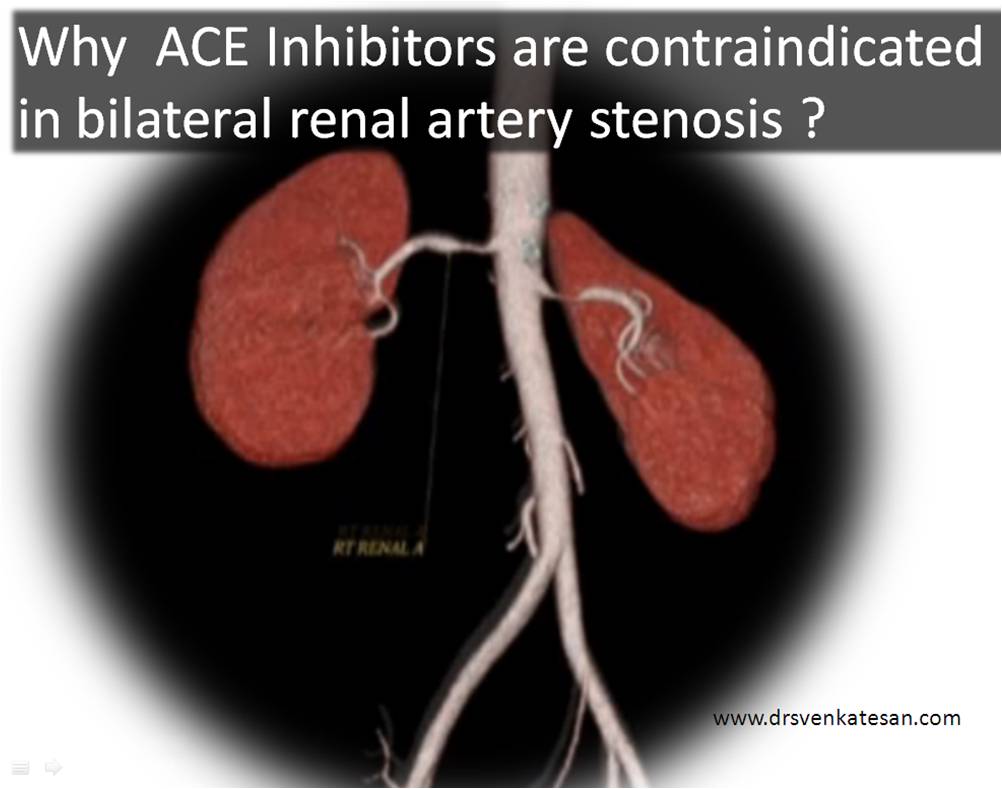
* The CT scan image used in the above illustration  courtesy

http://www.ajronline.org/cgi/content-nw/full/189/3/528/FIG21

Read Full Post »

We have read extensively  about LV pressure volume loops . What about Left atrial pressure volume relationship ?

This could be vitally important to  understand left atrial failure . While, it is often taught that , LA comes to the rescue of  left ventricle  at time of stress , we rarely talk about left  atrial failure !

Where  will the LA look  for help  when it is stressed ?

Pulmonary veins ?  , No , the LA  simply succumb and patient deteriorates.The only way it can react  is by a  panic response and starts fibrillating !. This is what happens in many  cases of dilated cardiomyopathy  and late stages of aortic valve disease . This AF is very poorly tolerated . ( Of course , we do not understand fully ,  why AF is relatively well  tolerated in severe  mitral stenosis  , inspite of very high  LA pressures Often >40mmHg?)

The  importance of left atrium as a mechanical chamber   is well  recognised .It is supposed to empty the blood  it receives  from pulmonary veins  within a narrow  pressure zone of  8-12mmhg within a  fraction of a second. Even a slight increase in LA pressure may result in pulmonary venous regurgitation and  the incoming venous tides are reversed(“a” reversal in pulmonary vein echo )  that results in the so called pulmonary congestion /Pulmonary venous hypertension.

If only god has created  additional pulmonary venous  valves** at it’s  entry , LA can perhaps a  relax a little bit  . But it is not the case  . So,  LA function becomes as  vital  as LV.

(**Can we create pulmonary venous check valves  ?  . . . will it be  an answer for preventing recurrent LVF in cardiomyopathies etc)

Here is an  article from European heart journal , which gives  great insight into Left atrial function.

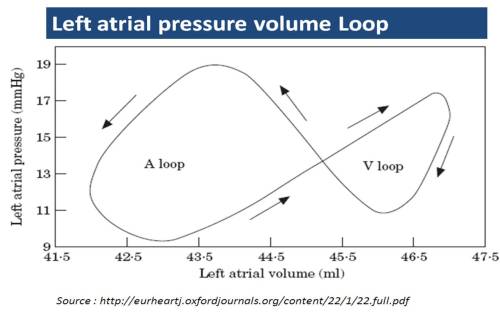
The one that has fascinated me is the  LA  pressure volume loop.

The two pressure waves in left atrium reflect distinct  properties . “v” wave  is a  volume dependent wave and  “a” wave a pressure generated wave . Surprisingly the volume dependent wave generates more pressure than the atrial contraction wave.(Note in LA  v > a while in RA a>v)

http://eurheartj.oxfordjournals.org/content/22/1/22.full.pdf

Read Full Post »

« Newer Posts - Older Posts »