Feeds:
Posts
Comments

Archive for the ‘Infrequently asked questions in cardiology (iFAQs)’ Category

Pulmonary embolism is  one of the  important  causes of acute chest pain . It can mimic  acute coronary syndrome . In fact along with aortic dissection  , it forms  a  differential diagnosis for STEMI especailly if the ECG is not typical.

pulmonary embolism chest pain dvt d dimer ventilation perfusion

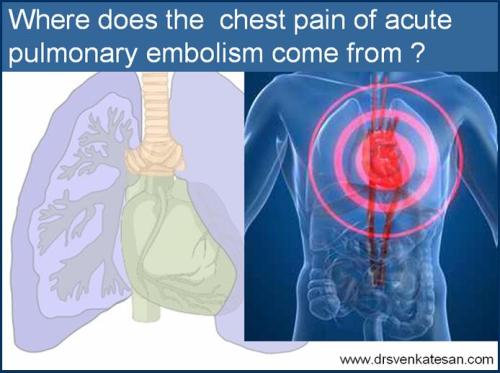
The Chest pain of acute pulmonary embolism can originate in one of the following structures  with different mechanism

  • Lung parenchyma ( Necrotic pain ?)
  • Pluritic pain in adjacent necrotic segment
  • Main Pulmonary artery and it’s branches
  • Right ventricular mechanical stretch
  • Right ventricular ischemia
  • Hypoxia induced LV ischemia with coexisting CAD.
  • Multiple contribution from any of  the above *

It should also be remembered , medicine never respects logic, as some times  an episode of pulmonary embolism can occur without any chest pain

Localisation of chest pain

One can imagine ,  how difficult for the  nervous system to zero in on the origin of this  pain as  the structures involved in acute pulmonary embolism are in different planes  and in different depths  within the chest cavity . Patients  often complain vaguely  the site of pain but  what is universal is severe resting pain deep within the chest . If the ischemic lung segment  transmit pain signals , the location and radiation depend on the  bronchpulmonary segment involved.This again adds on to the complexity in the  genesis of pain  .It can be virtually any where in the back or front of chest.

But , the central and retrosternal chest  pain are equally common as invariably the central pulmonary arteries go for a acute stretch which can be severely painful .In fact , current thinking is it could contribute maximum  for the intensity of chest pain. Similarly,  acute dilatation of RV result in mechanical pain. RV sub endocardial ischemia may   also contribute .An intact bronchial  circulation( From aorta)  can limit the  ischemic lung pain .

Final message

Analysing  the chest pain of acute pulmonary embolism can be an  interesting academic exercise . It could arise from multiple structures with different mechanisms. It may not be much significant with  reference to management . But it has a diagnostic role.  A pain which is severe , and  atypically located should raise the suspicion of acute PE especially  if the patient has associated dyspnea.

Read Full Post »

Normal P waves

normal p wave ecg rae lae

What are the components of Pwave ?

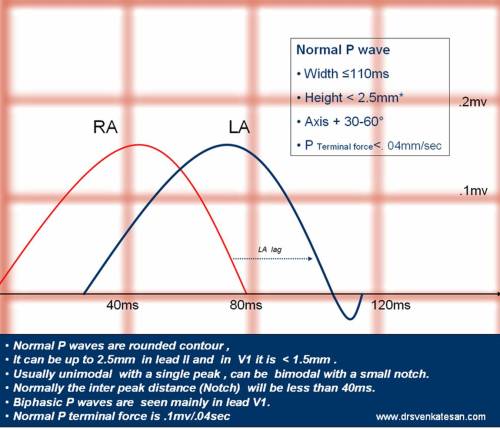
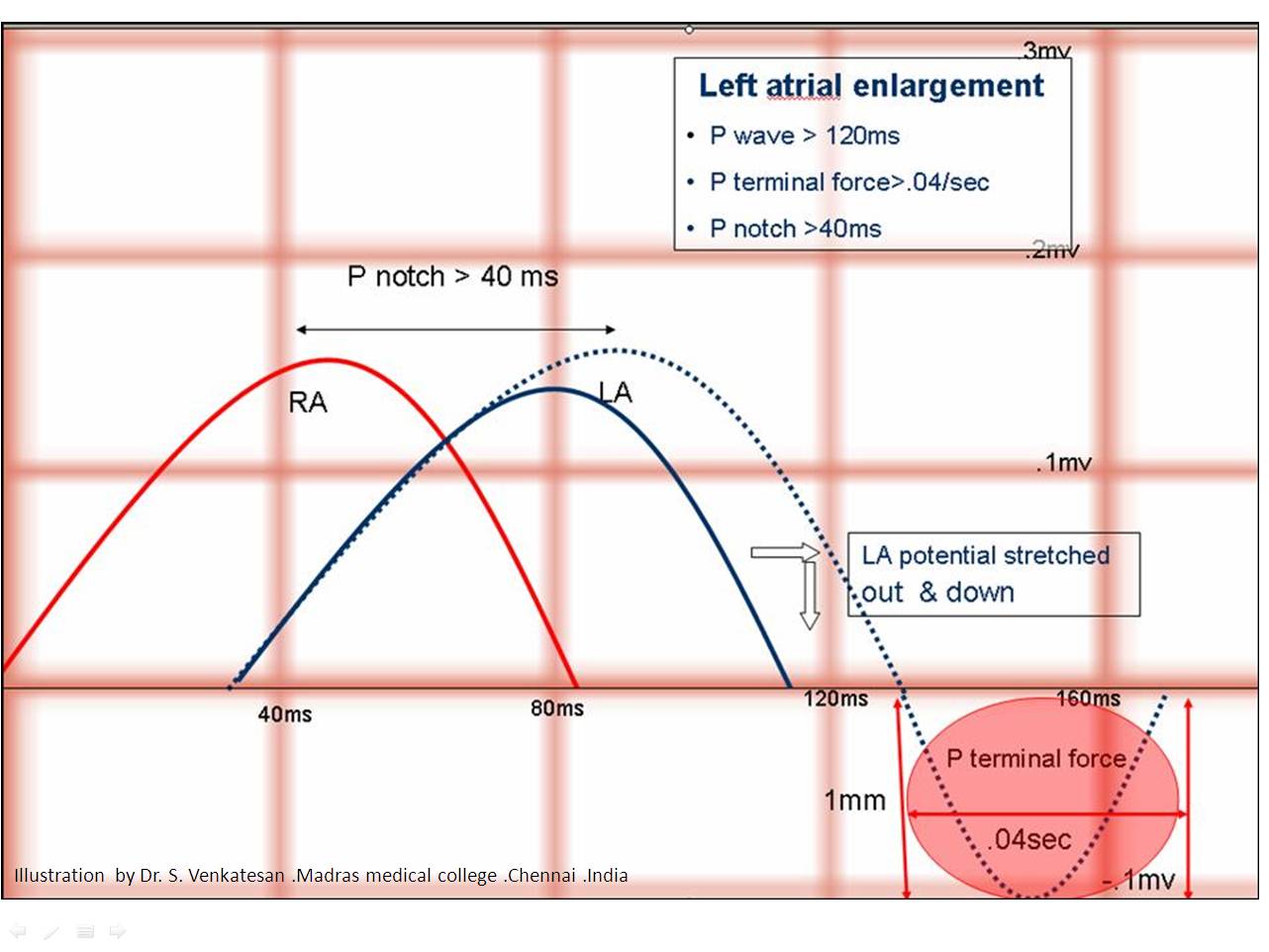
RA component : The SA node depolarises the RA first  , so the initial part of  P wave represents  RA  current .After about 40msec  the wave front reaches LA and it begins it’s depolarisation .LA component :By the time LA is maximally depolarised the RA  already starts its repolarisation.So there is  overlap and also a short time lag between these two wave forms . This is very important to recognise as , even if the RA conduction is prolonged in pathology the RA component of P Wave still falls within the LA wave .Hence it is not shown in the ECG and P wave is not widened in RA enlargement. This is in contrast to LA enlargement , when the terminal half of P vector delayed it stretches the P wave wide beyond the normal 110ms .Hence LAE widens the Pwave.

Why P wave becomes taller in RA enlargement ?

In classical P pulmonale , the P waves are  tall >2.5mm. It is easy to explain why it not getting wide than  why it is getting taller ! The atrial vector has two components .The initial RA vector  is directed  anteriorly .The main reason for tall p with RAE is  due to the anatomical proximity of RA to the chest wall Further ,the  Initial atrial  electrical dp/dt is steep . Any RA voltage increase is easily picked up by the chest leads and P wave voltage increase and becomes tall. We need to realise LA is not only left of RA its equally posterior of RA. Hence LA enlargement rarely brings (Never ?)  it closer to chest wall ,and hence high voltage tall P is almost unheard of with LA . Note , deep negative late P wave activity is typical of LAE , consistent with its posterior location as well its late depolarisation compared to RA)

rae right atrial enlargement ecg tall p p pulmonale p tricuspidaleright and left atrial enlargement how to differentiate lae rae

Why LAE can not produce tall P wave ?

The Left atrial vector which  follows RA vector  is mainly directed posteriorly and hence inscribe a  descending  limb of   P wave . This causes the P terminal force .  So  the direction of vector forces  and the anatomical locality  make a  tall & positive P  deflection highly improbable in   LAE .

*Of  course  when LAE is   huge , where a antero -supero vector from  roof of LA may inscribe a positive wave .

What happens in bi atrial enlargement ?

It can have features of both . Tall & wide P waves .

Can RA generate a Q wave ?

Yes . When RA assumes a huge  size  , especially if the RV is also at high pressure as  in severe PHT or valvular PS   a  q wave is generated in the lead V1 .This q wave is nothing but the intra cavitary potential of the enlarged RA.

What is the difference between atrial enlargement, atrial dilatation, atrial hypertrophy, intra atrial block and inter atrial  block  ?

The p wave morphology has no  specificity to identify the various entities. In any pathology of atrium the first thing that happens is a conduction delay ! It is now realised the bulk of the changes we see in atrial enlargement especially in LAE is due to intra and inter atrial  blocks or more subtly conduction delay.

It is  obvious , a wide P wave can occur either  due to LAE or simple conduction delay .In elderly  hypertensive patients atrial fibrosis is more common , one can not confirm LAE  without echocardiogram .

A notched P wave  can be a very specific sign of   inter atrial block .Which is more common in severely diseased left atrium. A notch , slurred p wave is a good marker for impending AF or atrial flutter.

//

Read Full Post »

Left ventricular  hypertrophy (LVH) is one of the most common  structural heart disease.Systemic hypertension, aortic valve disease are responsible for the bulk of the cases .Some  of the LVH occur due to cardiomyopathy (HCM/Non HCM variants).Athlete’s heart is a physiological response to exercise and  it  is largely a normal entity.

How many patients with SHT develop LVH ?

It is surprising to note , not every patient with SHT develop LVH .In fact estimates suggest only  about 30-40% of chronic  hypertensive individuals develop SHT .

What are the determinants of LVH in SHT ?

  • Magnitude of systolic pressure
  • Magnitude of diastolic pressure
  • Pulse pressure
  • Duration of SHT
  • Age
  • Gender
  • Body  weight/Obesity
  • Effect of treatment

While any of the above factors may operate in determining LVH

none of the above are important than this

“Genetic susceptibility ”

The myosin isoforms are determined by the genes .The re expression of   fetal isoforms in adults is responsible for LVH in many .This is determined by the genetic homogeneity

LVH  in  renal disease

Secondary hypertension due to renal dysfunction is a major determinant of LVH. This is espcially true if the pateints are dialysis dependent.The mechanism are not clear .

Diabetes and SHT :  LVH  friendly forces

When diabetes alone and SHT alone is less likely to result in LVH the combination of these two entities greatly increase the likely hood of LVH.DM induced microangitis amplifies the after load effect of HT and result in early LVH.Further this LVH is different from pure forms of hypertensive LVH  in that the interstitium goes for hypertrophy and in some cases neovascualrisation. In hypertensive LVH it is predominately myocyte hypertrophy  with little interstitial  proliferation. this has important therapeutic implication as any drug which reduce the blood pressure can regress pure myocytic hypertrophy, while in diabetic LVH  regression is difficult to achieve .

Lipid levels inversely related to LVH ?

There is no consistent relation between lipids and LVH .Occasional reports suggest a negative correlation.

Which LVH is associated with diastolic dysfunction ?

It is a well known fact , LVH has major effect on LV diastolic function.But it is also a fact only some forms of LVH develop this. Now it is clear only if the interstitial hypertrophy occur  diastolic dysfunction is manifested.  Even as the as the hypertrophied  myocyte  continue to  relax  the interstitium do not have molecular mechanisms to relax .Hence, as discussed earlier , diabetic hypertensive patient often  develop diastolic dysfunction .

Final message

LVH is not a simple expression of raised after load.It has major  non hemodynamic determinants which if identified , could have important therapeutic implication.

Coming soon . . .

Can  coronary artery  disease induce LVH in the absence of SHT or DM ?

//

Read Full Post »

Fundamental principle  of  human biological system is to live in harmony with nature and environment.Each cell  has a unique reaction  when it comes into contact with  external  material. This reaction can be acute or chronic  ,   local or systemic. The most severe form of allergy is called anaphylaxis  that can result in instantaneous loss of life. There  is a whole gamut of disorders  that  resulted  in a  separate  speciality called allergic medicine .

Further ,the transplantation  science have   taught us  an  organ or cell can be rejected at any point of time after implantation (Hyperacute -chronic) .With advancement of science we have started implanting a variety of devices  with complex metallurgy ,inside human body, metal clips, prosthesis, valves, wires, etc .How the body handles them .The consequences can be a mild reaction to major ones occasionally.

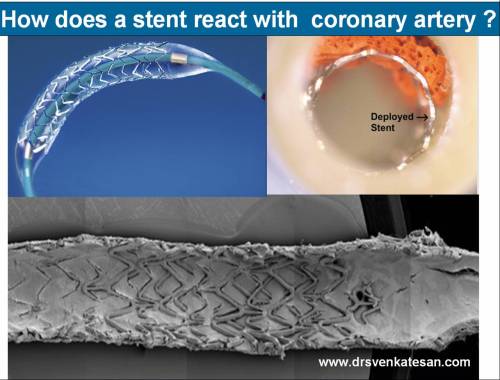
Consider ,a local allergy due to a orthopedic prosthesis  in one of the leg bones  is far less serious than a metal within a coronary artery  irritating the intima .

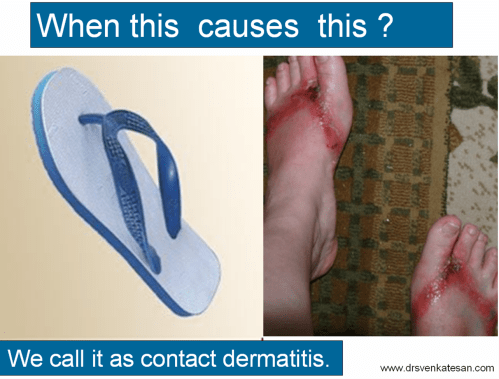
Remember hypersensitivity reactions can be severe . This lady reacted  like this to a sandal slipper -A  fiery red  infiltration

contact dermatits stent allergy pci coronary

Imagine  if a stented coronary artery react like this what would be the possible consequence ?

In susceptible  individuals  , can a metal cause

  • Intimal hyperemia
  • Intimal induration
  • Intimo-medial edema  following stent deployment

pci stent coronary angiogram thrombosis des

Why drug eluting stents are more prone for hypersensitivity ?

The answer is simple , while metal allergy is a comparatively rare phenomenon, the drugs we  coat and the polymers used are  many fold likely to result in hypersensitivity reaction.

While  the world is worried  more  about penicillin , sulpha allergy which occurs in 1 in 100000 ,  we tend to ignore the metal and drug  reactions within  the tender coronary arteries.

stent des rejection virmani  pci

What is  the clinical expression of  stent hypersensitivity ?

It is  often a coronary event in the acute phase and restenosis in chronic phase.

How much of acute stent thrombosis is related to stent allergy mediated reaction ?

The exact incidence  will  never be known. It could be high. Whenever a sudden unexpected early stent occlusion can be a suspect .

Is stent allergy a local reaction or systemic reaction ?

It is most often local .The drugs the stent elute can elicit a systemic reaction occasionally.

So what can be done to prevent this complication ?

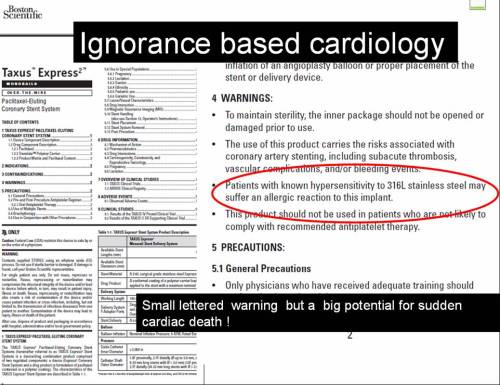
Drug companies in it’s  package regularly  include the warning  message ! What does it imply to have a caution  on the covers ? .This warning simply represent about our ignorance in this issue. We presume it is a minor problem.

pci stent thrombosis stent allergy metal

Questions unanswered

  1. How does a cardiac patient knows whether he is hypersensitive to stainless steel or nickel ?
  2. Is it practical to have a stent allergic test in every patient before PCI ?
  3. Is routine administration of corticosteroids for few days after PCI an answer ?

Reference

R.Virmani , circulation 2004

http://circ.ahajournals.org/cgi/content/full/109/6/701?maxtoshow=&HITS=10&hits=10&RESULTFORMAT=&fulltext=stent+%27allergy%22+&searchid=1&FIRSTINDEX=0&resourcetype=HWCIT

Read Full Post »

Heparin was invented accidentally by a 26 year old  , Jay McLean, a  pre clinical  medical student  in 1916 .It was one of the greatest discovery  in  medicine .It helped us prevent blood from clotting.Frozen blood inside human circulatory system constituted one of important mechanisms  of  human  death.This ranged from acute myocardial infarction to cerebral thrombosis  .
heparin3

As we decoded the mechanism of action of heparin , it was clear it bound to the  naturally occurring molecule antithrombin 3 and effectively blocks the intrinsic coagulation mechanism and thus behaves as an important anticoagulation agent.

How heparin acts as a thrombolytic agent ?

We know , our hematological system has a powerful  natural  fibrinolytic mechanisms  to protect against unwarranted( pathological ) intravascular coagulation. This is mediated by  anti thrombin, protein C , protein S  ,  plasminogen  system etc  . Natural concentrations of tissue plasminogen activator (Tpa)  also  help in lysing intravascular clots.

There is a constant  , delicate balance between procoagulant , anticoagulant and antifibrinolytic molecules .Intra vascular  clots occur when a vascular  injury triggers  a clot formation and the clinical event occurs.

But,   once insulted ,   the  circulating blood   does not remain a silent spectator . It is  constantly  on the look out for a foe to attack the thrombus that is interfering  with its natural flow  . Antithrombin 3 is one such molecule. Success  of lysis depends on the power of natural forces. There are hundreds of episodes of microlysis that take place every day  (Which happen without our knowledge ) .In  patients with vascular  disease these episodes are likely to be further more.

What does  Intravenous heparin in high doses  do ?

Heparin immediately  blocks of powerful procaogualtion activity .One of the important heamatological principle  is “Thrombus begets thrombus “. It is  a vicious cycle. This is immediately  tackled by heparin .The powerful trigger of thrombus induced thrombus propogation is shut off .

This makes a  2 cm sized clot to remain  in  2cm . After  making sure of this , the blood in the immediate vicinity   start percolating the clot.  The heparinised blood   switches to  a pro- fibrinolytic mode as the balance of forces  is fully tilted in favor of fibrinolysis or thrombolysis.

Is there clinical evidence to call heparin as thrombolytic agent ?

Yes . Contrary to the popular scientific  principle we have only clinical evidence  . laboratory evidence is not convincing as heaprin lyses clot only in vivo . Since ,  evidnece based medicine requires  laboratory evidence  we hesitate to call this as  thrombolytic agent !

It has been a strong clinical observation ,   many  major intracardiac or  intravascular  clots  regress in size

(or totally dissolve )  with intensive heparin  regimen .The effect is seen in 48-72 hours.Some times in first 24 hours.

What are the clinical situations where heparin has successfully lysed the clots*?

  • Pulmonary embolism
  • LV clot
  • LA clot
  • Cortical venous thrombus
  • Deep vein thrombosis
  • Coronary thrombosis**
  • Portal vien thrombois
  • Renal vein thrombois

* Plenty of case reports available for each condition

** Sustained micro  thrombolysis  is the major mechanism of benefit in NSTEMI

If it is true ,  heparin dissolves thrombus , why  it is not called as thrombolytic agent ?

Why not ?  You decide yourself !

How does heparin compares with  the great thrombolytic agents*  like  Strepotiknase, Urokinase,Altepase, Retepalse , Teneckteplase (TNK TPA) ?

Many (Rather most . . .)  would consider it ,  as  foolish , to compare heparin with these agents .But the fact of the matter is except for streptokinase there is no comparison studies available. Attempting such a study  in humans will  be considered unethical. Without   a proper scientific  data  heparin  can not be ignored either.

But ,  some of the control groups in major  studies of thrombolysis  through some light !

In pulmonary embolism thrombolytic agents and heparin have similar effects on intrapulmonary thrombus

An important point to remember here is   , the powerful thrombolyic agents are administered  in as short duration (Bolus / 1  hour infusion ) .This is invariably  followed by heparin infusion . Why do we  do that ? because we know it is important . One may never know , how much of lysis is done  by the trhombolytic agent and how much by heparin .

if you analyse the  data  success rate of thrombolytic agents are infact attributable  to the follow up heparin

Thrombolytic agents  piggy packs on heparin and claims the  credit for thrombolysis *

In thrombolytic  therapy  , heparin  is considered  as an adjunct to streptokinsae but in reality  streptokinase  may an  adjunct to heparin

Importance of  heparin In Acute MI (HEAP Trial)

It should be realized  there is a time window for heparin too . . .  early administration  can have  great benefit

Early heparin prevents formation of  core  of the clot .The   importance of acute administration of  aspirin  in suspected STEMI  is well recognized  by paramedics  .  A bolus of heparin (10000 u)  immediately  could have great impact on the outcome as well  .Paradoxically we talk more  about emergency PCI,  on  transit TPA  etc . . . We have seen  number of patients  referred  with  STEMI   from   suburban areas traveling for hours with out any anticoagulants but promptly getting sorbitarate tablets ! Unfortunately prehospital heparin is rarely stressed in literature .

Watch the video : Heparin : The forgotten hero

Final message

  • Heparin is   an  under rated drug  as a thrombolytic agent.
  • Just because it has no direct action  on thrombus it is considered an inferior agent.( One other reason  for it to be  considered  inferior ,   it  is  very cheap  !)
  • Heparin too ,  has a time window effect in acute MI (Class 3 evidence ie   wide clinical experience)
  • It’s  usage should be early  and  liberal , especially  in out of hospital setting in vascular  emergency.
    Note of caution : This article is not meant  to  defame  the thrombolytic agents.It only stresses a point that , heparin has also a role , as a thrombolytic agent. *Whenever rapid thrombolysis is required in life threatening situations specific thrombolysis is indicated as per guidelines.

Read Full Post »

Coronary stents have revolutionised the management of CAD. Stents are metallic scaffolding devices that help keep the atherosclerotic plaque  plastered within the coronary arterial wall.Thus it gained the name angioplasty. Stents have aradial strength that  exerts a constant force on  the plaque . Since metals are unfriendly partners for coronary artery , we need to have minimum metal within the coronary artery.The stent struts weave around the lumen generally the stento/ artery area ratio should be as less as possible (15%).

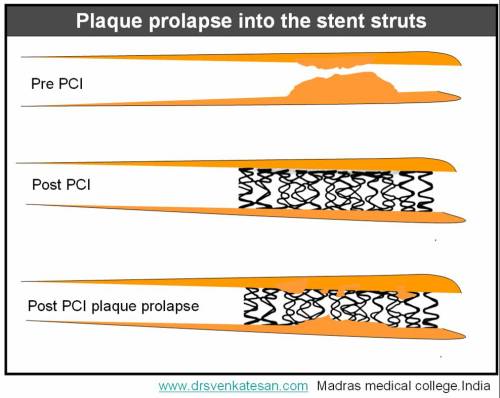
But this has a trade off .The uncovered area of plaque tend to project into the lumen .This is many times not significant.But can be a problem if the plaque is very soft and bulk of the lipid core may reenter the lumen.this event is called plaque prolapse.

plaque-prolapse

What is the time taken for plaque to prolapse ?

Generally it is late event.But it can happen immediately after the procedure also.

Which type of lesions are more likely to have plaque prolapse ?

Eccentric and complex lesions especially with overhanging edges are prone for prolapse

What is the sequale ?

It can be benign.If there is a erosion due to stent struts can precipitate an ACS.It progresses into instent restnosis in many.

What is the angiographic appearnce ?

Angiographically it often appears as luminal  irregularity withi stented segment .

Many times , it may appear as a filling defect also.

Is there any specific issues in plaque prolapse in drug eluting stents ?

Coornary artery is not drugged uniformly by the drug eluting stents.In fact contact  lines of metalic struts  , through it’s micropore oozes the drug with polymer.Pathological studies have revelaed non homogenous drug penetration and resultant irregularity on the plaque surface.This could amplify the plaque penetration preferentially in few areas.

How to manage plaque prolapse ?

It should be managed as any other instent restenosis.Plaque resection with atherectomy devices has not solved the problem to the desired levels.A second stent is the most common approach advocated by the cardiologists.(Whic is not ideal though !)

Read Full Post »

Prosthetic valve obstruction is an important complication of artificial valves.The incidence of prosthetic valve obstruction  is  estimated  to  be  4% per year.

  • Pure thrombus 75%*
  • Pure pannus 10%
  • Combination of pannus and thrombus 12%

Data from Deviri (J Am Coll Cardiol, 1998; 32:1410-1417 )

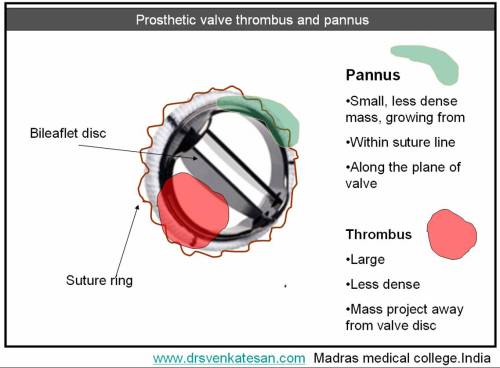
pannus-2

*Note statistically you are going to be right 3 times out of 4 if you diagnose thrombus over pannus

Pannus  literally means a hanging flap of tissue. It is is a membrane of granulation tissue as an response to healing.It can  occur anywhere in the body. When it occurs in the prosthetic valve tissue interface it has important consequences.It  is  same  as excessive scarring , ( something similar to keloid formation ) .

pannus

How do they clinically present ?

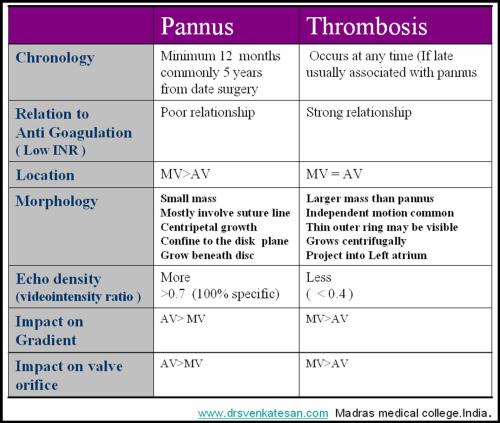
Prosthetic valve thrombosis is usually a acute or sub acute event as thrombus formation rapidly deteriorates the clinical situation.Pannus brings a patient with the complaints of chronic progressive dyspnea.(This rule is very subjective  but . . .)

What are the determinants of pannus growth ?

Time is the major determinant. minimum period required is 12  months. It is a avascular mass.It should be noted  a  injured pannus can predispose  a thrombotic process and a chronic thrombus  can trigger intravascular   growth factors  that promotes pannus growth.

What is the direction of growth of pannus in prosthetic valve ?

The pannus grows , usually in the tissue valve interface.It tracks and creeps along the suture lines .Generally this does not encroach the valve orifice or chamber sapce  , but occasionally the hanging edges can hit upon a leaflet.This is more common with tilting disc on the side of minor orifice. When excessive it can make a valve leaflet almost standstill.

How common is pannus formation in starr edwards valve?

Is relatively uncommon as the dynamic ball periodically interrupts the process of pannus in growth within the orifice.

Final message

Why is recognition of pannus important ?

Prosthetic valve thrombois is amenable to thrombolysis and it should be proptly differentiated for pannus.This is many times a difficult excercise, but the above observation will be helpful.

Further reading

http://content.onlinejacc.org/cgi/content/full/32/5/1410

Read Full Post »

To further understand women's heart click on the title

SCD  continues to be  the major mode of  death of  our  population . Millions of men die every year instantly .The commonest mechanism is due to primary ventricular fibrillation following an abrupt closure of coronary artery due to a thrombus.Most die , within few minutes of the event, some  before reaching the hospital , few within the ambulance  and an  unlucky few die on the CCU bed  or cath lab table even after getting the best treatment.

If we analyse the data, there is a  surprising fact !  Men form the bulk of these SCD victims.In our experience , out of 100 cases of consecutive  in hospital primary VF only  6 were females , indicating  an important  biological phenomenon to be studied.The data for out of hospital primary VF is more difficult to get , but the  log records of EMRI and emergency rescue team consistently confirm the male preponderance of primary VF .

How  does the female heart enjoys this relative immunity from primary VF even as the blood supply is acutely compromised ?

The answer  is  not known . If we are able to  decode this , one can replicate the same  model in male .

The QT paradox and incidence of primary VF

QT interval represents a combination of  electrical depolarisation and repolarisation .It is a well established   scientific  fact  that  women have   relatively  prolonged QT interval .This  is determined by evolutionary biology and  inherited characteristics of  potassium channels  during myocardial repolarisation

In simple terms, the female heart  knows how to relax slowly and prolong the electrical relaxation time.(Not mechanical)

It is also a well known  fact ischemia mediated a prolonged  QT interval is a trigger for dangerous ventricular arrhythmia.This ischemia induced QT prolongation is less pronounced in females than males as the baseline QT itself is slightly longer in women.The percentage increment of QT interval during acute ischemia is significantly higher in male .This could be one reason for the preponderance of VF in men

The billion dolor question and a real challenge for the cardiologists is

How to make a heart electrically inert during ongoing ischemia ?

  • Pain is also trigger for primary VF due to high adrenergic tone.Prompt control of chest pain make VF less likely.
  • Lignoacaine a myocardial anesthetic if administered quickly can prevent many of the primary VF.

And now , shall we  think little wildly !

What if , if  we administer lignocaine spray straight over the (or sublingually ) in every patient with  chest pain

as like a sport injury and try calm down the heart electrically !

Also read

1.Lignocaine  the forgotten hero .

2.View this video -Ignorance based cardiology !

Reference

Arrhythmias and sex hormones


Read Full Post »

Post myocardial infarction revascularistation either by PCI or CABG forms the bulk of the coronary interventions world wide.There has been considerable controversy in selecting the patients for the procedure.

Certain basic rules are to be applied.

  • Never do any thing on a totally asymptomatic and fully functional patient.(Functional , means good exercise capacity of atleast( 10Mets).Just medical treatment with good doses of statins, beta blockers will do.
  • If a patient has persistent angina  following MI  ,the issue is relatively simple as  they are  candidates  for CAG  and intervention .
  • The issue becomes little complex when the primary complaint is breathlessness and echo showing  LV dysfunction.

This dilemma is due to a  simple fact

coronary revascularisation has a  great impact in relieving angina but has  less impact in reversing

left ventricular  dysfunction

So,  how do you approach a patient with LV dysfunction and exertional  breathlessness and absolutely no chest pain ?

  1. Do a  CAG
  2. Assess the lesions if any (Some times,  to our surprise there may not be any critical lesions at all ! )
  3. If there is / there are critical lesions try to corroborate with infarct segments.(Use Echo for this correlation)
  4. Don’t bother much,  if a  vessel has a lesion  that is supplying a scarred myocardium.
  5. If there is gross LV dilatation, mitral regurgitation and LV clot refer these pateints  may benefit  from surgical management

One of the rules written by the cardiology community over the past few decades has been

We must document viable myocardium before doing a revascularisation procedures on them.

This rule was self imposed ,  to prevent inappropriate revascularisation in  post MI population.

So , a  gamut of investigations (Both invasive and non invasive came into vogue) to identify viable myocardium in post MI population. Stress echo, Thallium-sesta MIBI, PET  to name a few .

Even after liberal usage of these invesitgations , we realised ,  the confusion in the  optimal selection of candidates for revascularisation has not settled.

In fact,  the correlation between viabilty and subsequent interventional benefit is  inconsistent .Not withstanding this  issue  ,cardiologists inspite of the negative results of OAT and TOAT trials ,  started  opening or by passing any occluded vessel irrespective of viability status.

Unanswered  &  Unasked questions in myocardial revascularisation ?

1.Why viable myocardium is viable even in the adverse compromised vascular  environment ?

It  is viable for the simple reason it has some capacity to be alive . By it’s inherent survival capacity (Survival of the fittest ) or it somehow gets the nutrients by cell to cell perfusion.

2. It is viable allright  ,  why it is not contracting ?

Because ,  it is biochemically and metabolically alive (Can be documented by FDG PET scan mismatch ) but it can not synthesise adequate ATPs to make the muscle contractile.

3.”Viable myocardium is viable ” what more you want from it   ?

Simple viability is not suffice . How to make it mechanically active and contractile ?

4.Is viable  myocardium    synonymous with ischemic myocardium ?.

No,  it is not (Contrary to the popular perception ) .

5. Is it not  common to find dysfunctional segments with good TIMI 3 flow ?. So what is the purpose to document viability ?

It is not suffice to simply document viable myocardium but it is an absolute necessity to prove this viable segment is also  critically ischemic .

7.If angina is  a sign of viabilty why most of viable myocardium is painless ?

This again confirms the fact , much of the viable myocardium in the post MI phase is not ischemic but” still dysfunctional” waiting for healing time. This concept  was  introduced with great fanfare* as  stunned myocardium ,  20 years ago , which was subsequently rejected my mainstream cardiologists , as this concept tend to  restrict the  freedom of interventionists. * Even though ,the concept was genuine and proven scientifically !

6.Are we  certain , the  viable ,  non contractile myocardium  (Which we painstakingly document )  will get back the contractility once the  segment is    revascularised?

Absolutely not. (With lot of PET study doumentation )  This,  we can not guarantee even in ischemic, viable segments  ,  while in the  non ischemic, viable segment it is all the more unlikely.

7. What are the chances of these viable but  non contractile myocardium  regain the contractility  by natural course ?
Very significant chances .In fact every patient recover some LV  function spontaneously over time .

Final message.

  • Revascularisation is non controversial in patients with angina
  • In patients with  primary symptoms of dyspnea  ,  it is less effective and documentation of myocardial viabilty per se will not guarantee successful outcome following revascularisation.Out come depends on  multiple factors .

Read Full Post »

idh

  • Hypertension  is  major determinant of cardiovascular health  of our global population
  • Millions suffer,   hundreds of societies ,  and as many guidelines , and drugs are still struggling  to control the menace.
  • An important sub group of HT , (ie IDH ) population has been neglected and never received the scientific interest , which it deserves !
  • In our study it occured in 7.2% of all HT  patients.
  • JNC,  the world authority on HT never considered  IDH as a separate entity, and as of now there is no specific guidelines.
  • And the irony is complete . There is not  a  major study available to analyse the differential effects of anti hypertensive drugs on systolic and diastolic blood pressure.

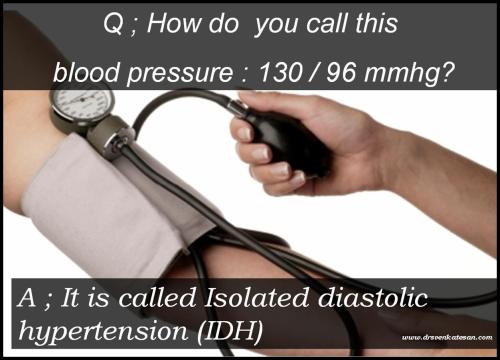
If  a patient with the BP of 120/96 asks you , “Doctor , will the drug,   you have prescribed , selectively lower my diastolic blood pressure ” what will be your answer ?

A clear ,  I don”t know !

The following paper was presented in the World congress of cardiology Sydney  2002

Isolated  Diastolic Hypertension

S.Venkatesan,S.D.Jayaraj.Gnanavelu, Madras Medical College. Madras, India.

Abstract : Systemic  hypertension  continues to  be a major determinant of cardiovascular  morbidity. While isolated systolic hypertension(ISH) has been identified as a specific clinical entity, isolated  diastolic  hypertension(IDH) has not been reported as a separate group. When we analysed our data from our hypertension   clinic  we found  a distinct subgroup of patients who had  elevated  diastolic blood pressure   with  normal systolic pressure. We report the clinical profile of these patients. 440 newly registered hypertensive  patients between the year 1998-99  formed the study population. All  patients with secondary hypertension  were excluded.. IDH  was defined as  diastolic BP more than 90mmhg and systolic BP less than 140mmhg.

IDH was present in 32(7.2%) patients.  The male female ratio was 3:1, mean age was 42(Range32-56) The mean diastolic pressure was 96 mm (Range 90-110).The mean systolic pressure was 136mm(Range 128-140). LVH was observed in 4 patients(12.5%). Diastolic dysfunction was detected by echocardiography   in 20patients.(62%)

We conclude that isolated diastolic hypertension  constitute a  significant subset among  hypertensive  patients and they need further study regarding the pathogenesis, clinical  presentation and  therapeutic implication.

Link to PPT  will be available soon .

Read Full Post »

« Newer Posts - Older Posts »