Feeds:
Posts
Comments

Left ventricular hypertrophy (LVH) is the most common structural abnormality of the heart. Hypertension and LVH are close associates . Still ,not every one with HT develop LVH .  So,  there  obviously  is a missing link . Similarly , diabetes  in the company of   hypertension  love to  target the  heart muscle with more vigour .  The  incidence of LVH  can be near  100%  when DM  join hands with HT.

So, what is the secret ?

Sustained elevation of afterload  due to high BP   inflate the myocyte ,  result  in myocyte hypertrophy , which is more of a physiological response.  The diabetes mellitus  adds some spice to the hypertensive LVH.

Diabetes causes glycation of  myocyte cell membrane  proteins . This  opens the  flood gates  and  the  cell permeability barrier vanishes. Hence there is exudate collect in the  cardiac interstitium. This is  equivalent to diabetic microangiopathy seen in retina and  kidneys.

There is  well established link between diabetic LVH and microalbuminuria  , suggesting  a  protein  leak  equivalent  in   heart  (Myocardial proteinuria)  . The only difference  here  , is the  protein leaks into the interstitium   instead of  renal  tubules  .  As we know interstitial leak is a  powerful  stimulant for   fibrotic reaction and  new cell growth. Fibroblasts in combination with extracellular matrix  and macropahges form  a rigid  and timid myocardium . If the patient is also a dyslipidemic(  which is usually the case !)  the leaked LDL , TGL adds to the chaos .

Pathological  effects of  diabetic LVH

  • Increased LV mass
  • Early LA enlargement
  • Early diastolic dysfunction
  • Prevent regression of LVH  even after good BP control

Can  diabetes per se cause LVH without Hypertension ?

Yes .this is also possible , but it  is less recognised.Diabetic LVH  can be a part of generalised organomegaly seen.(Right from the days of fetus diabetes has a  tendency to increase solid  viscera  size –  Large babies in  diabetic mothers , diabetic kidneys rarely shrink !)

Other factors that are related to LVH in diabetes include

  • Female Gender
  • Insulin resistance
  • The lipid connection – Hypertriglyceridmia is linked to LVH

Can tight blood sugar control reverse diabetic LVH ?

We hope so . It may not happen in real life .it depends upon the extent of interstitial invasion of abnormally glycated proteins.

Can echocardiography identify diabetic LVH from hemodynamic LVH of SHT ?

The diabetic LVH is fundamentally different in that ,  the classical septal hypertrophy is uncommon, instead the overall LV mass is increased .This is logical,  as septal LVH is more often reflect hemodynamic stress .

Diabetes  infested myocardium   bright echoes arise  from within . This is due to reflection from  interstitial  proteins.

The newer modalities of echocardiography  like integrated back scattering  analysis can characterise  tissues.

Tissue doppler  myocardial spectral analysis  can identify LVH contributed by DM..

Final  message.

What we know about LVH ,  is far less than we do not know !  , especially when  a patient has a combination of DM and HT. The interaction between them  is so intimate ,  we fail to recognise individual contribution to the process. If only we decode this  mystery , we can intervene better in the  pathological progress of  LVH.

http://care.diabetesjournals.org/content/28/9/2255.full

 Inter atrial septum(IAS)  is a delicate structure , formed by a  “curious IAS  embryological process”  , when  two septums ,  two ostiums  cross each  other .They  fold  and unfold  like  curtains  in different times ,  ultimately result in a  single membrane separating LA and RA  with a  central physiological   hollowness called foramen  ovale .

All along this process ,  blood has to shunt  from  RA to LA  untill the baby comes out ,  when the direction reverses that  result in the flap  of foramen ovale locking  against the septum secundum with raising LA pressure . So , basically the genesis of  IAS is all  about growing,   resorbing  and  sticking of two septums . This starts in utero and continues well after birth. One can imagine  complexity of  the factors that determine the thickness of IAS.

The IAS thickness varies between 2mm to 4  mm . With increasing use of trans esophageal echocardiography and also the need for cardiologists to puncture the IAS , it is becoming important to study the anatomy of IAS in detail.

A new  cause of  thickened IAS  is reported recently .

 This is refered to as Double Inter atrial septum,  fused like a sandwich  with a  potential space  in between  .

The embryological basis is not clear. (A septum primum and secundum fusion ?)

The PFO   is an  oblique orifice in many .It is some times refered to as tubular PFO . A large tubular PFO can mimic a double IAS.

An  aneurysm of IAS  may get  fused to appear like a double septum

or Is it  IAS dissection which  give an appearance like double IAS ?

Personal perspective

  • It is very difficult to embryologically  explain the concept of double IAS .  I would think  , it is  double layer  of single embryological  septum   with a  potential  space  in between .
  • It is possible an intra mural hematoma (Spontaneous or acquired ) may cleave the septal plane and mimic a double IAS   when the   thrombus gets dissolved later.

Other causes of thick IAS

Septal thickness an issue during transeptal puncture . During PTMC and left heart catheterization a thick septum may be a hurdle.

Infiltrative  myopathies especially amyloidosis is known for a very thick non -puncturable IAS  

Reference

1.http://ejechocard.oxfordjournals.org/content/9/5/707.full

2. http://www.ncbi.nlm.nih.gov/pubmed/16950474?dopt=Abstract

STEMIis numero uno of any medical emergency . The risk of death is maximum in the first  hour.

Here is a patient who presented within 30 minutes  of  chest pain.Enzyme sample was  just sent and a bed side echo  revealed a severe wall motion defect in LAD region.

What would have been  the response from a  current generation cardiologist ?

  • Alert the cath lab . Send the patient direct to cath lab .
  • This did n’t happen as we are in a underdeveloped country and the patient  is poor .
  • Should we worry about that  l ?  Not at all  . . .  He received a shot of   much ridiculed streptokinase injection which  costs 2000 Rs ( 50 dollars) in India  .

And see the result yourself !

Can you imagine this man had a major STEMI just an hour back ?

 Any intervention that is done immediately has a major impact on outcome. When the patient comes to you  early within 3o minutes and  STEMI,  or  actually a TEMI  , T wave elevation MI or Hyper acute MI .

When the patient comes to you early cardiologist should raise  to the occasion and set a new  challenge  .

What is that  challenge ?

The aim should  not to be in  salvaging  the myocardium  , rather   prevent  the  event of   ACS   and   abort the MI process itself !

How is this possible ?  Can you abort a STEMI or TEMI by primary PCI ?

Since one has  to act fast , primary PCI is a likely  loser  9/10 times in aborting a STEMI  .

The best option  is  to do an intervention which can have almost zero door to needle time* .  The good old thrombolysis  administered  at the door itself pips the pPCI  convincingly with a huge cost saving as well .

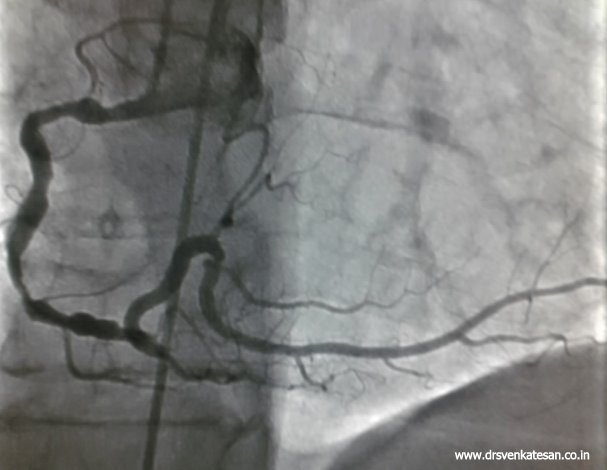
This is what  this patient received. and  see the result . His angiogram  later  showed a fully recannalised LAD .No stent  was advised .He was put on high dose  statins ,beta blocker  and antiplatelet agents.

*You  can not balloon the patient on the arrival in  door steps  !  .

Final message

Do not ridicule any modality of  therapy for being simple and cheap .  They may be most effective as well .


Interventional cardiologist are excessively  talented  guys .They always  lead ahead in innovations  .The only issue is , their  enthusiasm  (   many times  overtake  the pace of science .  In the name of off label indications  they indulge   in drug and device extravaganza   in uncharted territory .

Even as we boast of practicing evidence  based cardiology   scientific  adventures  happen  without  proper  evidence  . . .   rather  we  have wait for evidence to come later .” A clear case of  cart pulling the horse “

The wide-spread of use of  second generation DES in STEMI has not been found to superior to BMS in the  EXAMINATION trial just released in ESC 2011 Paris. It failed miserably ,  when every one took  the superiority  for  granted.( Some may claim  non inferiority is  not a failure , but for a DES which was perceived a revolution,  it is definitely a failure in the  STEMI subset )

Further,  what  EXAMINATION  trial did not  address  is  acute and sub acute  stent thrombosis .Even as the DES is credited  with a dubious  record for  sub acute stent thrombosis ,   there is every reason to  suspect , in  the milieu of STEMI the thrombotic risk of DES  would increase many fold.

The  seemingly  low   incidence  of stent thrombosis with DES  in STEMI ,   in  EXAMINATION  trail  is a statistical mirage .This  trial was  neither  planned  nor powered to address the issue of stent thrombosis.

In the  ultimate  analysis of EXAMINATION ,   One could conclude   Cobalt chromium BMS,  has  cemented  its place ,  more firmly for use in primary PCI.

DES  at best ( *With all those conditions apply , Dual antiplatelet etc) can be equal to BMS,  while  BMS at any  day ,  would  casually will  win over DES without any conditions at a  huge cost advantage.

The above analysis is diagonally opposite to that of general  perception  that  emanated  from Paris  ESC meet 2011   trial   .

Please remember EXAMINATION trial did not reach its desired primary end point  !

That is  a strong point  against it  .What do you think ?

Reference

http://www.theheart.org/article/1272077.do

A  TV  debate on Examination  trial from EURO PCR

http://www.oxfordjournals.org/our_journals/eurheartj/ehjvideo.html

Moderator band is a ubiquitous structure  found inside right ventricular   cavity , often overl0oked by cardiologists. God has created no structure  without any purpose ! Moderator band has important role to play  both in physiology and pathology .

Image credit and courtesey : Whoever has created

The table attempts to summarise  the features  of moderator band. The  structural and functional behavior of moderator band  in , RV cardiomyopathy , RV non compaction and arrhythmogenic  RV dysplasia is not fully studied yet  . Reference :Content is taken from various sources and with a personal input in few places.  The anatomical data is largely taken from the pioneering  work of cardiac  pathologist and morphologist  RH Anderson of  United kingdom.

Here is an article  from my institute Madras medical college  published in Indian journal of Thoracic and Cardiovascualr surgery in 1982.

An autopsy study  on moderator band   by Paul Ravindran and   Solomon victor

http://www.springerlink.com/content/g35616v662976g1r/

http://circ.ahajournals.org/content/67/6/1268.full.pdf+html http://www.ncbi.nlm.nih.gov/pubmed/20235167

//

Pectinate muscles are specialized Intracardiac  muscle

  • Pectinate muscles are located mainly in the right atrium  , more  in right atrial  appendage , sparse in left atrium
  • Has muscle fibers arranged in a  comb like fashion.
  • Has less mechanical activity, no significant contribution to atrial contractility.
  • Can stretch and improve the voluminous nature of right atrium
  • The pectinate muscle  folds act as RA volume reserve  during adverse loading conditions . It helps RA dilate with out much wall stress.
  • Rarely it can be a cell of origin for focal atrial tachycardia

Image Source : Greys anatomy

The concertina like effect of pectinate muscle .

The atrial infolding increases the surface area of atrial chamber at times of dilatation , like  the music instrument .So,  these macro  folds ( like intestinal villi )  help overcome the  constantly changing volume status of right atrium.Since the  variation  left atrial blood flow is  not that much ,  the pectinate muscles  are not well developed  in the left atrium.

The same rules would apply for  why  there is excess  trabeculations  in right  ventricle  than  left  ventricle .

This  happened  in one  of the cardiology  work shops  I  recently attended ,  which  beamed  live cath lab procedures from across the  country.

An   interventional   cardiology  team  in a  bright sky  blue  suit was preparing a  patient for   graft angioplasty  in  a degenerated  SVG graft to left circumflex  . The patient had apparently had  CABG  few years ago  (LIMA to LAD still functional   )   . His LV  EF  was reported   to be  40 %.  The procedure was about to begin. The femoral artery was  being  cannulated . . .

As the audience  were encouraged  to ask questions.  A young cardiologist wanted to know what was the indication to open up the graft  / And what was  his symptom ?

“Do not ask such silly question”  . Prompt came the reply from  one  of a   senior interventional cardiologist from within the cath  lab. He further said  such questions can  not be entertained  as the   forum is meant for tips and tricks to cross a degenerated vessel graft .  When he insisted for an  answer , the entire panel  joined the  ridicule and  the questioner  quietly went out of the hall !

What  do you infer from such reaction?

What makes this question silly ? Why the cardiologist got annoyed and amused ?

This odd  reaction  implies  ,  the  cardiologist  has  something to hide or has guilt of   doing inappropriate procedure.

Such is the transparency in  cardiology workshops  transmitted  live all  over the  country  imagine   what  one can  expect in regular cath labs .

No doubt  JAMA has come out with most  important article  for us. http://jama.ama-assn.org/content/306/1/53.abstract

Live  workshops are not simply to train our hands . It is supposed to teach  us   the “what is right” and “what  is wrong” ,  “what is good” and “what is bad”  for our ailing patients. The senior  cardiologists who administer these workshops  should realise this fact. Very often a bad example is set .   When asking for  patient’s  true symptoms   looks  silly  for us  . .  .  guess where our profession is  heading for !

Left atrial clot is a  traditional contraindication for performing PTMC.  This rule was formed in the early days of PTMC.

PTMC  recently celebrated  its 25th birth day .  In India  it was  first  done by   GB Pant hospital by  Kallilulah in early 1980s.

Now most  centers  do it  routinely   like a diagnostic angiogram.  Even fellows can do it  with ease. (If allowed !)

We have learnt  the nuances  of septal puncture , maneuvering the transpetal needle and  the balloon  catheter  within the LA in the last two decades.it is also becoming clear  how the IAS anatomy  behaves in various LA and RA sizes  and pressures . So , the experts (Read again         . .  .experts !)  have relaxed the rule of the PTMC game !

PTMC  can safely be  done  if the LA   clot is confined to  the appendage  .Even clots  abutting just  out of LAA appendage  may  be tried if you have the expertise  akin to  Dr Manjunath and  his team  from the garden city of India .(Jayadev  institute ,  Bangalore probably has the largest  talent  pool for PTMC , In fact  they have  classified the LA clot according to size and location .)  Read the reference below.

If a cardiologist  is allowed to meddle the LA  filled with clot ,  why not a surgeon  do  a CMC   in the presence of LA clot ?

I believe old generation surgeons did it. I am told few surgeons  have specail talents to deliver LA clot off pump and complete a successful CMC   with lateral thoracotomy .  Fresh un organised clot can be flushed out of LA .
But currently doing a CMC  with LA clot is considered unscientific . Further  surgeons  often consider CMC as an inferior Job .They love to go on pump  and replace mitral valve with a  slightest provocation .  It need  be realised a half functional native  valve  is at any time   better than an artificial valve . In  developing countries    CMC  would make lot of sense when we confront with small LAA clots . One can do 5 CMCs at the cost of one mitral valve . Surgeons comments are welcome.


What  will happen  if LA cot gets accidentally dislodged ?

A stroke  or a systemic vascular event may occur  , but it depends upon the embolus size .Up to 2mm clot  debri can easily cross the cerebral  microcirculation and escape a major stroke.Showers of micro emboli can cause a lacunar infarct or vascular dementia.

By the way ,  I am curious to know what will happen to  these  clots after successfully  opening the mitral valve by         PTMC*  ?

PTMC can not be claimed as a cure  as long as the patient harbors the clot in a precarious location . So it  needs intensive oral anticoagualtion (or even heparin ) and many times we have observed these small clots disappear .

*Logic would  suggest an LA clot  with a  closed  mitral  valve  could be  much safer ! many times we have seen large LA clots struggle to get past the mitral valve because of critical stenosis.

A video of mobile LV clot from our institute . http://www.youtube.com/user/venkatesanreddi#p/u/40/zHdPtm32YZQ

Here there is no chance of PTMC ,  however good you are !

Future innovations

  • Distally  protected PTMC
  • Either you should trap it and remove it or desiccate it into minor particles.
  • Basket in root of aorta to capture  the clot in transit   may be a good  concept to try.

What  happens to LA clot following long term oral anticoagulations ?

Most disappear according to a study from JIPMER , Pondicherry , India .

http://www.ncbi.nlm.nih.gov/pubmed/14686666

Excellent PTMC  data   from Pakistan and Sudan

If you want to learn about PTMC  please note  the experts are not  in Cleveland clinic  or  from Great ormond  street

they are from the remote third world locations .

http://www.sudjms.net

http://www.ayubmed.edu.pk

A stent missing a  lesion after a PCI  is referred to as geographical miss.

It can be metal missing a lesion ( in BMS )or a drug missing a lesion  with DES.

Geographical miss is  obviously  more important with DES ,   as both metal and drug can miss a lesion ! (A double miss !)

Read a related article in this site. Geographical Miss : Difficult coronary Runways . . .

What are the types of  geographical miss ?

A.Longitudinal

B.Axial

Longitudinal miss is more of a technical failure (Interventionist error ) While  axial miss  is  often a  design or concept failure .

Longitudinal  miss results in edge lesions ( either  stent inflow or outflow lesions) .Axial miss result in discreet  in-stent lesions .

Please remember ,  axial GM  is  much more common .

What is definition of  axial geographical miss ?

Inadequate inhibition of intimal hyperplasia within the region of stent .

Mechanisms of  geographic miss in DES era

  1. Stent  vessel diameter mismatch  (Less drug vessel contact)
  2. Low drug dose -Pharmacological error
  3. Stent radial strength more than the desired force per unit area . This excess  stress  effect  might interfere with drug release.
  4. Some degree of vessel injury is needed for drugs to percolate. (A very smooth deployment may not release the drug  properly )*

*A modern day cardiologist  is expected not only to deploy the stent properly , he has to make sure drugs reach the target cells . What an  irony  cardiology can be  .  . . a  too gentle  PCI  can show up a  negative face ! when we want to poison selectively  the atherosclerotic plaques .

What is the incidence of GM ?

In  STLLR trial which looked specifically the issue of GM  the incidence was very high ,  an astonishing 65 %

How to recognise it ?

Longitudinal miss can be identified by conventional angiography.

Axial miss is very difficult to diagnose . IVUS,ICT will  help.

Many times it is an after thought  when patient presents with  an event.

What can we do once we recognise it ?

Unfortunately nothing much can be done to reverse the miss especially the axial ones.

longitudinal miss can be corrected by a over lapping stent .(Still ,  we do not know the implication of double metal doses  dragging an edge of lesion !)

Can  “Geographic miss”   be termed as  a failed PCI ?

Clinically , technically , logically and morally  Yes .

But  practically  “No” ,  as GM  takes much longer time to manifest as a clinical event  ,  by then , no one   would  really attribute  the event as  procedure  related  . And of course ,  we have numerous other  excuses to convince our patients.

The link to STLLR  trial which gave us the startling data about GM .


http://www.ajconline.org/article/S0002-9149%2808%2900350-0/abstract

Medical science is  nothing ,  but trying hard all possibilities. Most innovations die .Only a fraction will survive .

That does not mean we should not try ! The greatness is in accepting the failure.  The wonder drug which was an analogue of human atrial  naturetic peptide    (BNP)  Nesiritide   , died a peacful death on July 7th 2011 .

Long before , in year 2005 ,  Eric Topal in a hard hitting  Editorial  of  NEJM  wanted to hang this drug .

But it was a case of prolonged  death sentance .

http://www.nejm.org/doi/full/10.1056/NEJMp058139

Should we  pity with the drug companies  and forgive them for delaying it’s  exit ,  enable them  recover the  cost involved  .

Meanwhile , Nesiritide might have died ,  the  concept of  BNP analogues may need to be explored further.