Feeds:
Posts
Comments

Heart is the first organ to differentiate in the fetus.The first heart beat begins on the 22nd day of fetal life ! . From that day , it’s function is linearly determine the   fetal growth  .It continues in the new-born,  infancy and  up to late child hood.

It is no surprise  then, to detect growth retardation in congenital heart disease. A proper evaluation begins right from fetal mass / birth weight estimation  .Motor and cognitive milestones should be assessed meticulously .

The pattern of growth affliction is  complex  and poorly understood.Few  working rules are  often taught in cardiology classrooms.

Caution : This is a too simplified version. Discerned readers should consult all sources cited here.

Acyanotic heart disease

ASD, VSD, PDA  tend to affect weight gain  more but generally do not affect height  much  . But, the onset of pulmonary  hypertension early in the course will severely  affect height as well.

Co arctation of  Aorta and other Aortic interruptive   diseases  can have a differential  affection of growth . (Upper part of body > Lower part)

Cyanotic heart disease

CHD  affects both height and weight proportionately. Cyanotic  heart disease with increased pulmonary blood flow  the overall survival is less ,  recurrent failure is common  and hence growth and development is more affected.

The mechanism of stunted  growth.

The often used terminology  ‘failure to thrive” , may not be attributed to heart disease per-se. It has to be multi factorial and  is related to  social well-being  ,  feeding habits , and mother’s effort  , interruptions due to co existing illness , effects of surgery  etc. Obviously these factors operate  more  in infants with increased pulmonary blood flow.

Effect  on cognitive function

Contrary  to the expectations  even chronic hypoxia and cyanosis has no compelling effects  on the child’s intelligence . Unless there is co existing  neurological defects severe compromise of cognition  is  uncommon.

However now we realise , brain development do  suffer   in hypoxic environment.In fact, the damage  to cognition could start right from the fetus .

New evidence is coming  up.

*Recurrent hypoxia spells and convulsions in TOF  can lead to reduced cognition

Is the normal  growth  and development   restored after complete correction of the disease by  cardiac surgery ?

The expected benefit is usually achieved  . The catch up occurs . But it is not guaranteed,   especially in  cyanotic heart disease. As , many times the  destined growth of a child   is  reprogrammed and  predetermined  in the fetus itself.


Link to a rare review article on the topic

References  on Growth impairment in congenital heart disease


R. L. Naeye, “Anatomic features of growth failure in congenital heart disease,” Pediatrics, vol. 39, no. 3, pp. 433–440, 1967.

A. Mehrizi and A. Drash, “Birth weight of infants with cyanotic and acyanotic congenital malformations of the heart,” Journal of Pediatrics, vol. 59, no. 5, pp. 715–718, 1961.

R. J. Levy, A. Rosenthal, D. C. Fyler, and A. S. Nadas, “Birthweight of infants with congenital heart disease,” American Journal of Diseases of Children, vol. 132, no. 3, pp. 249–254, 1978.

H. H. Kramer, H. J. Trampisch, S. Rammos, and A. Giese, “Birth weight of children with congenital heart disease,” European Journal of Pediatrics, vol. 149, no. 11, pp. 752–757, 1990.

y

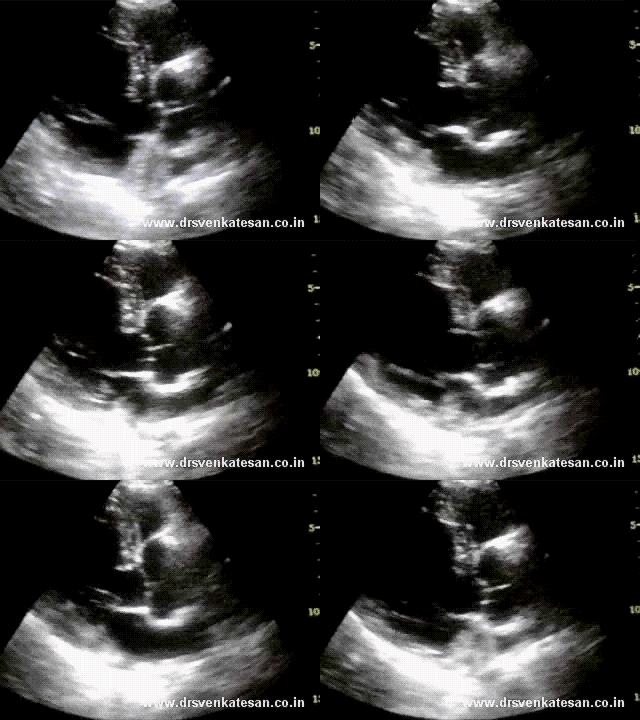
A classical restrictive cardiomyopathy . Both atria balloon out as they face stiff resistance from the ventricles

Restrictive cardiomyopathy(RCM) is a common form of myocardial disease which was difficult to recognise  in the past.It was also commonly confused with constrictive pericarditis. Today , one can easily recognise this entity.A simple clue is bi- atrial enlargement  with relatively normal ventricle size.The above case is a classical form of RCM.

In late stages of RCM ,both LV, RV begins to dilate and can mimic a dilated cardiomyopathy. Doppler filling pattern  , and tissue Doppler motion of mitral annulus are recently validated methods to identify RCM. Still ,  2D features  are  very useful .This implies , the anatomical changes in the chamber size  are as important as physiological AV filling profiles. It is generally believed , physiological impairment precedes anatomical defects.( But not proven concept yet ! )

Note: The ventricles are not dilated and retain good systolic function

In the above patient  , etiology could not be confirmed and was labeled as idiopathic RCM  as tests for amyloid and eosinophilic infiltrations were negative.

M -Mode of the same patient confirms good systolic function

One would  call  for doppler mitral filling profile here ,  to confirm restrictive physiology ( A short DT , Short IVRT  . A reversal in  pulmonary veins , E/E’ ratio etc etc ) But all these are redundant here.

How is RCM different from non dilated cardiomyopathy ?

A new entity is being recognised in the cardiac  muscle disease.This is often referred to as NDCM (Non dilated cardiomyopathy)  .Global  systolic LV dysfunction  with normal  LV dimension.This a similar to the terminology MDCM (Minimally dilated  cardiomyopathy  where LV dimension increases  not more than  15 % of basal size ) .

This is seen in CKD and diabetic individuals.Atria may be enlarged .Diastolic dysfunction may co exist.  It is no surprise,  this entity closely mimics RCM. But in RCM LV systolic function  is not greatly compromised till late stages , while NDCM it begins with systolic dysfunction. This is the only difference .There can be overlaps .

Many strongly believe ,  both  RCM  and NDCM are one and the same entities ,  that present in different time frames in their natural history.

Final message

Diagnosing RCM is no longer difficult in established cases* . The message from  this article is , 2 D echo can  strongly suggest  the possibility of RCM (or even clinch it)  .  Never ever  diagnose RCM with normal 2 D echo. Doppler filling profiles are useful  additional tools . We  can not diagnose RCM with doppler features alone , but we can  be fairly certain about RCM when we encounter  typical bi-atrial enlargement and a normal LV by  2 D echo.

Caution : Patients  with longstanding atrial fibrillation of any cause , can dilate their atria and could mimic RCM .They can be some compromise in LV function due to chronic tachycardia .

* Recognizing RCM ,  very early in the course is still a problem . Here the  newer modalities like Phase  MRI, tissue doppler, speckle tracking, and velocity vector imaging may be useful.

Dilated cardiomyopathy (DCM )  is the commonest  cardiac muscle disease .Diagnosis is simple and straight forward. All that we  require is,   documentation of LV dilatation and contractile dysfunction.The nomenclature of cardiomyopathy has remained a difficult exercise .This   is primarily  due to   iatrogenic  & intellectual confusion  among  cardiologists . They mixed up etiological and morphological entities together ,   later on  they  wanted to de-link  etiology from morphology  ,  ultimately they realised  when illness strikes the heart ,   it   can not differentiate the  morphology, etiology and pathology as we would want to   . So , whenever possible we have to label  cardiomyopathy with all components (Dilated cardiomyopathy due to alcohol with some restrictive features.)

This article  tries to evoke  some thoughts    about  why  LV dilatation  is central to the understanding of cardiomyopathy.

DCM is the prototype where LV dilates with global hypokinesia.The upper limit of   LV diameter is generally considered to be 56mm in diastole.  (Range 35 -56mm) .This cut off  point is too empirical  for the simple reason, the  left ventricle can dilate   up to  50 %  from it’s basal diameter and still technically  be within normal limits.( A 3.5 cm LV ( end diastolic diameter ) can dilate to 5.6 cm ,i e  a 50 % dilatation , still LV  has not reached the upper limit of normal  )

Even as we do not have a clear  answer to the above issue , we  recognise  left ventricle muscle can hypertrophy, progressively  dilate , transiently dilate, fail to  dilate ,  regressively  dilate  or  hypotrophy .These changes can be dynamic and heavily influenced by hemodynamic and local pathologic factors like fibrois, interstitial proliferation etc. Meanwhile , the pharmacological ,   surgical /catheter injuries we  inflict    , modifies  the muscle behavior in a positive or negative manner.

In this back ground ,  we have found a new entity called NDCM .

Apart from  DCM, a newer form of  cardiomyopathy  is being recognized  .This is often referred to as NDCM (Non dilated cardiomyopathy)  .Global  systolic LV dysfunction  with normal  LV dimension.This a similar to the terminology MDCM (Minimally/Mildly  dilated  cardiomyopathy  where LV dimension  do not  increase  beyond   15 %  upper limit of normal  ) .

This is seen in CKD and diabetic individuals.Atria may be enlarged .Diastolic dysfunction may co exist.  It is no surprise,  this entity closely mimics RCM. But in RCM LV systolic function  is not greatly compromised till the  late stages , while NDCM it begins with systolic dysfunction. This is the only difference .There can be overlaps .

MDCM was reported in 1990  . Keren gave a excellent insight about the condition  ,  It is unfortunate it failed to take off as a popular  clinical entity .  Cardiologists are argued to use this term liberally in their clinical practice .

Final message

Cardiology is not  that  simple as one would like to ! The two components of cardiomyopathy ie   LV dilatation and LV dysfunction can be temporally dissociated  one may precede the other. To  complicate the matter further, one of them may not manifest at all !

Few ,  still consider many of the RCMs and NDCM are one and the same entities that present in different time frames in their natural history.

So the simplified  concept  to decode the cardiomyopathy conundrum  could be

  • When both  dilatation and dysfunction occur it is classical DCM
  • When dysfunction  alone occur without dilatation it is NDCM
  • When both dysfunction  and dilatation are less it is RCM*(Relaxyl dysfunction must)
  • When dilatation is mild and dysfunction is severe it  is MDCM

Medical profession is the noblest of all !  . Doctors are akin to God in  many ways  ! They  have the potential  to remove the  sufferings of  mankind  . These are the often made  quotes about doctors   for  many centuries. Today’s medical professionals are ,  a  strained   lot  to fulfil their role expected of them .They have to maintain the social identity and earn enough to sustain their image in society. The onslaught of commercial and pseudo-scientific concepts have ruined the profession considerably.

Those were the days when the family physician  concept was flourishing , where in  a doctor was taking care of entire family. This  concept has  taken a different avatar now .

Now a doctor feels , once the patient is seen by him becomes his/her  patient rather a property! This perception has grown in a malignant manner , many doctors do not refer to a specialist even in deserving cases  fearing patient poaching .

This  possessiveness  of doctors about their patients leads to many  of the  unethical behavior .

My case . . .my patient . . .   my fees , . . .this sort of approach though appeared  good in the past ,  is rapidly becoming a liability for the patients  .Lack of organised health  care   by private and Government sector also amplifies the issue .It is pathetic to note         ,  at least Govt hospitals have some accountability ,  majority of private health systems  do not have  mortality or morbidity auditing . 

The my patient, my property  doctrine is playing havoc in medical health delivery system  .The following are the situations where a patient genuinely suffer due to this abnormal thinking pattern of many of the medical professionals today.

  • When general practitioners want to have control of their patients even after referring them to big tertiary care centres.
  • This is being encouraged  by the corporate desk of big hospitals as they probably send financial benefits to the referring doctors. Hence doctors are worried their property may get lost during  transit or inside the  big hospital. There are instances , I  have witnessed , where severe mitral stenosis are manged medically by some established physicians fearing that their property will be lost .
  • Patients with severe angina are not offered angiogram and remain on medical treatment fearing loss of monthly consultation fees.
  • When the care takers energy and thought process are consumed in many non academic activates one can expect how the illness can be taken care off.
  • When investigations are ordered the primary referring doctor feels he is being denied of  kick backs from costly investigations which is enjoyed bu the specialists .so these general practices what to finish of all required investigations in their desired lab and sent to the specialist.
  • This has led to  curious  situations  where a  ENT surgeon calls for  a  64  slice CT scan and obstetrician asking  for MRI brain (  because the patient is theirs  ! )  

The sequale is two fold . 

The specialist often gets annoyed  and  feel insulted  to read an investigation  ordered by a  different physician(  rather irrelevant  physician !) done  in a non friendly lab  without incentives.

  1. Either he looks at it reluctantly
  2.  Or orders  fresh investigations

 (Some physicians show   extreme  arrogance ,   as  they call for fresh investigation even if the patient is having    good quality ,    investigations  with  images done recently  !)

Finally , the most dangerous thing

A  patient once admitted  under a  doctor, the  prescriptions and procedures are  often  controlled by the admitting doctor .We  have seen a pathetic situation of plastic surgeon admitting a rheumatic heart disease and trying to manage  with the help of  telephoning consultations with a cardiologist .

There is a  chaotic  discipline  in ordering Investigations and treatment modalities  in our country .Any one can order any thing they want .In this scenerio,  abberrant patient  behavir leads to further  complications as patients  themself  decide what investigations they want.

What is the solution* ?

The concept of family physician is still a best option . It has to be continued. There need to be a proper referral services into well equipped, staffed ,  audited institution in every district and counties either controlled by Government or well-regulated. private bodies . The financial remuneration for the doctors should be constant and fixed irrespective of the form   treatment they provide.

In other words the entire health care delivery  should  be centralised and institutionalised .The need for specialist to be assessed properly and care should be rationed .

                                                           Consider this  anarchic situation –  An   asymptomatic, incidentally  detected  30 %  PDA  lesion in a rich bed ridden ,  old man   is  stented by a  3rd generation drug electing stent in a corporate hospital,  while   many  young  Indians with a productive life  with  critical  left main .proximal LAD   is allowed die in peace .

                                            Where are our medical economists and  health care planners hiding ?  ! And we are talking about billion dollar medical  tourism industry .

A general practitioner  should receive same amount as consultation as a neurosurgeon or cardiologist .If we  divide  the doctor into different grades according to the knowledge  and place of work ,  the lesser doctors  will find someway to equalize their earning with their superior colleagues.

After all , all doctors take the same oath . . .   A  doctor who treats a febrile convulsion in a remote village by administering  a timely diazepam  injection can not be considered unequal    to  a Cleveland neurosurgeon   who clips a AV malformation in the circle  of  Willis to terminate  recurrent convulsion in a similar child .

* One would  tend to  think , these solutions are highly theoretical  not implementable in today’s world.  But trying to bring order to a dysfunctional  medical  care delivery system is not a crime any way !

Final message

Most doctors continue to be noble and dedicated.  But the faith in them is rapidly eroding .This is becoming  a dangerous trend . They can not to be  blamed  in isolation.   It is the dynamics of  social and economic scenario  that  are  driving  the medical profession in a journey towards a  commercial extravaganza , where humane care is  as obsolete as a Mediterranean dinosaur !

Now young doctors are  readily manufactured  in the countryside   (Not my merit  , but  bought as commodities akin to real  estate) . A three bed room flat and a MBBS  seat roughly  costs equal in India !

There is  no wonder then  , doctors will treat their degrees  and patients  as  precious   property . Nothing wrong to consider  them as their property ,  but let them handle the property with at most concern , faith and trust !

Disclaimer *This  article does not intend to  defame any doctor or medical profession . It aims to  encourage a wider debate on the issue  . This is  about  many physicians which we come across everyday   in  our  towns and cities  .This article may be irrelevant in  many  other  countries and  to those physicians working in a completely institutionalised  health care delivery system  including  Govt .hospitals where the collective care (or is it collective no care ?)  is the norm .

LIMA-Left internal mamary  artery is the most common arterial  graft used in CABG.It is anastomosed with LAD /and or diagonal artery. Routine visualisation of LIMA is advocated by many , but it is required only  in patients with critical CAD.

LIMA angiogram is done

  1. To confirm the presence of LIMA .
  2. To exclude subclavian  stenosis.(If present hand can steal blood from heart !)
  3. To rule out disease of LIMA (Which is unlikely )
  4. Diameter of LIMA should be matched with LAD .LIMA with large lumens can accelerate restenosis in LAD due excess flow induced endothelial reaction
  5. To identify  any early branching of LIMA .This can divert the  blood flow and underperfuse LAD.
  6. Terminal bifurcation  of LIMA can some times be used as a sequential graft to LAD/LCX/OM
  7. Tortuosity and looping of  LIMA is common but generally has no hemodynamic significance.
  8. LIMA may  provide vital  nutritional support to sternum through direct or   intercostal branches .If  LIMA dependent sternal  blood supply is found to be significant ,   sufficient precautions to be taken and anticipate sternal ischemia related complications.This is especially important in diabetic subjects.

Bosentan an non selective endothelin  antagonist is an approved drug  for pulmonary arterial hypertension.

Even this drug has not fully proven it’s worth . Meanwhile ,  a relatively  unknown company manufactured sitaxentan a similar molecule with a  self claimed  selective endothelin blocking property .

Pfizer bought this company and marketed it as Thelien . The liver injury is less  than bosentan , they claimed and it was  prescribed once a day .The same old story unfolds.physiological endothelin  in liver was in appropriately blocked and caused dangerous forms of liver injury.

Only one difference this time , Pfizer self banned this drug and stopped all research activities  about this molecule.

.

American journal of epidemiology in a land mark analysis has found , spouses share the same profile of coronary risk factors .This is a huge finding , considering the fact that , genetic factors are not involved here . So , it is something to do with family diet ? domestic issues, sibling effect ?

It is well-known lipid profile of family members are comparable . There are many Indian families who have high basal triglycerides .Mind you, husband and wife is the least (Zero link) linked genetically for familial dyslipidemia ,still they often share a similar lipid profile

Related issues without answers !

When a spouse gets a coronary event what are the chances of other to develop an event ?

Any body’s guess

In this era of bi- polar family life, can spouse behavior /unrest be a coronary risk factor ?

Yes . No surprises here .Apart form passive domestic smoking which is a well established coronary risk factor , in our coronary care unit , an initial survey of acute coronary syndrome patients revealed , a recent quarrel with their spouses, was a potential trigger for ACS. Further analysis of these data is being done

Spouse Ego : A powerful health risk

Spouse Ego : A powerful health risk

Divorce and coronary events ?

These are hypothetical observations in few families we have come across .

  • Forced divorce can be a definite coronary risk factor
  • Consensual divorce is not .
  • Women seeking divorce is more a risk for men than they inflict on women

Reference
Augusto Di Castelnuovo and others, Spousal Concordance for Major Coronary Risk Factors: A Systematic Review and Meta-Analysis, American Journal of Epidemiology, Volume 169, Issue 1, 1 January 2009, Pages 1–8, https://doi.org/10.1093/aje/kwn234

Mitral regurgitation jets can take many shapes

  • Symmetrical
  • Central
  • Eccentric

The direction of the jet depends upon

  • The angle of co-optation
  • The  plane of  orientation of regurgitant  orifice . It  can be entirely off track with  physiological  mitral orifice .
  • Degree of prolapse or shortening /subvalvular  fusion.
  • Flail valve tips can guide the jet selectively into anterior/superior  or posterior aspect of LV

Rheumatic mitral valve showing poor leaflet co-optation.Patient is having significant tachycardia


Perpendicular 90 degree MR jets


In rheumatic heart disease  eccentric jets are more common. In dilated cardiomyopathy MR jets are often symmetrical and central as the pathology is annular dilatation.

What are  the significance of eccentric MR jets ?

  • Anterior jets clinically mimic aortic stenosis as the murmur is  often well conducted to neck
  • Murmurs of  posterior jets well conduct to axilla .
  • Eccentric jets are often acute and compromise hemodynamics
  • Suspect early infective endocarditis.Carefully look for vegetation.
  • Eccentric jets make it difficult /risky  for PTMC (Note : In Mitral stenosis  +  grade 1  MR   with central jets  one can safely do PTMC)
  • Severe eccentric jets can flood one of the pulmonary veins and result in unilateral or regional pulmonary hypertension or even lobar /segmental pulmonary edema

It is well  recognised for STEMI  to get aborted   spontaneously or through intervention.

Can a glamorous procedure like  Primary PCI be redundant ?

Yes of course . This paper,  is about how a planned  Primary PCI  can go awry  . . . Presented in the Annual scientific sessions of cardiological society of India Kolkatta December 2010.

Down load full presentation  in PDF format (primary_pci_)

Summary of the presentation

ABORTED  AND     ABANDONED    PRIMARY PCI

S.Venkatesan  G.Gnanavelu.R.Subramanian .Geetha Subramaninan

Madras Medical College. Chennai

Primary PCI has become the  standard of care  for acute STEMI in all  those eligible patients. Apart from the individual & institutional expertise ,the  key  to success  lies in  expediting   the symptom to balloon time to less than an hour.

Even though  STEMI   is characterized  by  acute total obstruction , it  is also a fact during this critical time window , a less recognised   positive  phenomenon takes place within the  ill fated coronary artery. Intrinsic fibrinolytic activity gets activiated and begins to take on the thrombus head on .It should be recalled this is the  earliest intervention in STEMI by natural forces , with zero time window . The power of this natural lytic process has  never  been easy to predict and quantiate . But  we  have  often realised  such a phenomenon do occur often and  is referred  by  various  terminologies like spontaneuous  thrombolyis, aboted MI etc .The exact incidence  is not estimated .In this era of  primary PCI we have found a new opportunity to confirm  this concept.

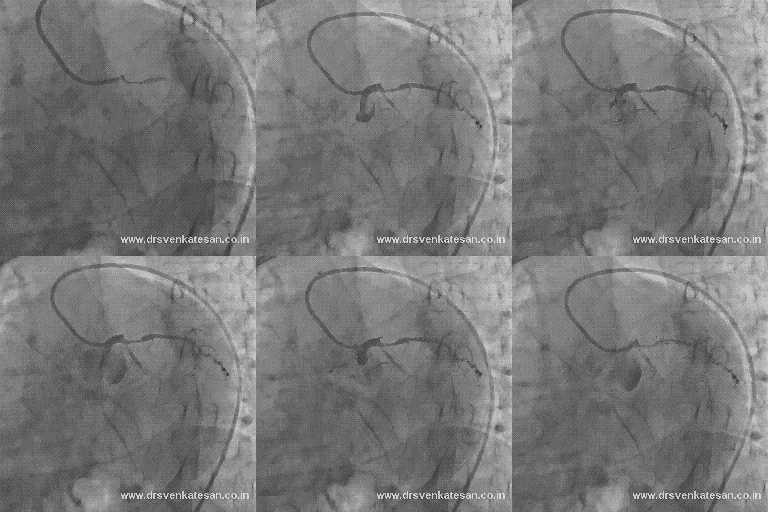
It has been  observed during  primary PCI ,  an occasional patient  may  have  either  a totally  patent IRA  or a minimal &  insignificant lesion  like luminal irregularity .This has  subsequently led on to cancellation of the procedure .We report our experience with  two patients with  this particular situation .One patient with IWMI with a time window   of  6hours had a totally patent  RCA.  Even , the luminal irregularities were difficult to locate .The other patient had anterior MI with ongoing ischemic pain.He was taken up for primary PCI.The initial angiogram  showed a total mid LAD  obstruction . As soon as the  guidewire reached the thrombotic lesion the  artery opened up   wth a TIMI  3 flow .There was no residual lesion or thrombus  noted. Both of the above  patients  were  young , smokers . 2b 3a antagonists were not administered. We infered, both had thrombotic STEMI and   presumed  to  had either spontaneous reperfusion , or  reperfusion assisted by dye injection & guidewire manipulation. They were  shifted out of cath lab with a new code of aborted primary PCI and  were discharged with normal LV function .It need  to be  realised here, a   distinction must me made between  aborted PCI  and   abandoned or failed  primary PCI  as  the later  connote a negative outcome. The  causes for abandoning  primary PCI are due to complex  lesions like bifurcation /Trifurcation lesions , triple vessel disease  with difficulty in identifying culprit lesions.A  Primary PCI is  considered failed  when the  IRA patency  is not accomplished or  failure to  sustain myocardial flow inspite of  IRA patency (No-Reflow) . These patients may end up in CABG or occasionally fall back on  thrombolysis  which was considered a inferior modality just few hours earlier !

.                                         We conclude , in the management of STEMI ,  primary PCI once contemplated need not always reach it’s  logical conclusion. There are situations  it can  get  aborted or abandoned  at various levels . Aborted  primary PCI  due to spontaneous  lysis though uncommon ,  can be a therapeutically and financially rewarding concept for the patient  and  physician .

Squatting is an excellent hemodynamic adaptation in patients with TOF. Children with TOF assume this posture   in  a natural and effortless manner . For years cardiologists are fascinated by this maneuver  and the mechanism by which it gives relief  to those patients with TOF.

Now , we have realised  this posture  has a new diagnostic role in echocardiography ! This paper was presented in the recently concluded  Annual scientific sessions of cardiological society of India held in Kolkatta December 2010

Download  the full   presentation in PDF  format  (  Squat Echo)