Manuals are not only for doctors . There are few heart maintenance manuals for patients as well.
This one from Philadelphia , is worth reading and of-course following thereafter !
Manuals are not only for doctors . There are few heart maintenance manuals for patients as well.
This one from Philadelphia , is worth reading and of-course following thereafter !
Posted in Best books in cardiology, Cardiology - Clinical | Tagged BARI 2D, courage study, heart repair manual, MASS 2 study, medcial vs pci, pci stent, zerbini foundation mass 2 study | 1 Comment »
God has created and arranged every organ in an order with a purpose . The unique relationship of the food tube and the heart which run silently , posterior to the heart has evoked much interest for the cardiologists.
Whenever LA is enlarged it pushes the Esophagus back .We also know the vintage clinical entities of cardiac dysphagia that occurred with rheumatic mitral stenosis.
Since the lower end of esophagus just hugs the left atrium , this anatomical concept was successfully exploited for imaging heart in TEE.Now cardiac anesthetists routinely use the esophagus as an imaging port during complex mitral valve surgeries.
How esophagus can be utilized to resuscitate the heart at times of emergency ?

Note , the esophagus does a friendly hug as it crosses the heart posteriorly .It is a perfect anatomical sense , to Image and pace the heart from within the esophagus !
In a cardiac arrest situation , when we need to rapidly access to heart , we have multiple options .Each has some advantage and few draw backs.
It was in 1980 , a dramatic concept was conceived . Why not use the esophagus as an access for pacing the heart
after all , it reaches as close as possible to the heart !
How to convert a Ryles tube into a a trans – esophageal pacing lead ?
There was a certain article on this topic , which I read , when I was cardiology resident. It answers the following. Distance form mouth , Discomfort of the lead , Pacing threshold , Esophageal burns .
I am unable locate that article. Will post it once I get it.
Limitations of trans-esophageal pacing*
* Primarily useful in acute SA nodal defects, sinus arrest or any other atrial electrical failure. Infra- nodal complete heart block trans esophageal pacing may not be effective .
Other potential uses of trans-esophageal leads
Over drive pacing
Overdrive entrainment of tachycardias , including resistant ventricular tachycardia is possible.
Trans esophageal ECG recording .
This can magnify p waves during supra ventricular tachycardias and aid in decoding narrow qrs tachycardias
Safety Issues and Caution
Good earthing is necessary .Burns can occur.
Final message
Every cardiac physician is expected to possess the expertise to rapidly pace a heart by trans jugular /subclavian access at times of emergency .
Further , any modern CCU will have a defibrillator equipped with trans-cutaneous pacer as well. (The disposable pads are too costly and is a deterrent in many hospitals !).
This article explores other possible way to pace the heart in dire emergency situations.
It has one more purpose ! It rekindles the acumen , motivation and hard work of our cardiac ancestors (Which many of us are pathetically lacking !)
http://circ.ahajournals.org/cgi/reprint/65/2/336
Role of trans-esophageal lead during EP study atrial fibrillation
http://cardiovascres.oxfordjournals.org/content/38/1/69.full
Posted in Cardiology - Electrophysiology -Pacemaker, cardiology -ECG, great illustrations in cardiology, history of cardiology, Uncategorized | Tagged atrial pacing through esophagus, emergency temporary pacing, medtronic transesophageal lead, oesophageal pacing, over drive pacing through esophagus, pacing electrode within ryles tube, pacing the esophagus, pacing threshold in esophageal pacing, pacing via nasopharnynx, sinus braducardia, temporary pacing through esophagus | Leave a Comment »
In pacemaker science , any pacemaker that maintains AV synchrony is often referred to as physiological pacemaker. This is of course , a wrong reasoning .None of the pacemakers available today can be claimed to be completely physiological .All pacemakers which paces the right ventricle induces IVS dysynchrony (Including the modern DDD)
Single chamber physiological pacing
AAI
Paradoxically , the most primitive of pacemakers AAI can be the near perfect physiological pacemaker . The simple explanation is , In AAI mode , expect for the origin of pacemaker impulse the entire depolarisation and repolarisation is through the normally existing physiological conducting system .(AV node, HIS, Purkinje etc)
(It not only has atrio ventricular synchrony but also has ventriculo ventricular and intra ventricular synchrony )
So, technically AAIR is most physiological pacemaker possible .But the practical utility of such a pacemaker is limited.It can be used only in isolated sinus node dysfunction with intact AV conduction . (The problem is the AV nodal conduction can develop later ) To over come this DDDR pacemaker can be programmed to AAIR as a default mode.
VVIR
This rate adaptive pacemaker , to a certain extent can be termed physiological as the heart rate can improve with exercise . (Still it is unphysiological as it paces the RV )
VVD
This is based on the concept , for pacing to be physiological , it requires atria to be at least sensed not necessarily paced.This mode which has a floating sensor attached to the lead as it crosses the atria.This facilitates atrial sensed ventricular pacing .But many believe the atrial sensing is not consistent in VDD mode.Currently this mode is not popular.There is scope for improving the atrial sensor technology .
Dual chamber physiological pacing
DDD, DDRR
Both these are the prototype dual chamber physiological pacing modes.
Bi-Ventricular or triple chamber pacing ( one atria two ventricle) are our elusive answers for attaining perfect physiological pacing . it need to be realized, we simply , can not mimic the natural cardiac conduction system.It is estimated to be more than 10 miles long specialized fibers .
Final message
In our quest for physiological pacemaker we often forget the fact , AAI is the most physiological pacemaker mode available .(It even has VV synchrony ! )
We should use it liberally whenever possible .Of course ,we cannot use it in complete heart block .Still 50 % the permanent pacemaker we implant is for sinus node dysfunction. Many of them could be candidates for AAI mode .If current generation cardiac physicians feel out dated to insert a AAI pacemaker, at the least they should program the DDDR into AAI mode with a mode switching to ventricular pacing modes whenever required.
In spite of all advantages , why atrial based pacemakers are not gaining popularity ?
Posted in Cardiology - Clinical, Cardiology - Electrophysiology -Pacemaker | Tagged aai mode, can single cahmber pacemaker be physiological, david study, dual chamber pacing, floating atrial sensing lead, medtronic, mode switching, non physiologcal pacing, pacing modes in sick sinus syndrome, pathologicalpacing, physiological pacing, rate adaptive pacemakers, single vs dual chamber pacing, sinus node dysfunction, st judes, triple cahmber pacing, vdd mode, vvi mode, wahat is a physiological pacemaker | Leave a Comment »
Prosthetic valve implantation has revolutionized the management of valvular heart disease . The original concept valve was a ball in a cage valve , still considered as a fascinating discovery. It was conceived by the young Dr Starr and made by Engineer Edwards .This was followed by long hours of arguments, debates and experiments that ran into many months . The silent corridors of Oregon hospital Portland USA remain the only witness to their hard work and motivation. At last, it happened , the first human valve was implanted in the year 1960. Since then . . . for nearly 50 years these valves have done a seminal job for the mankind.
With the advent of disc valve and bi-leaflet valve in the later decades of 20th century , we had to say a reluctant good-bye to this valve.
There is a lingering question among many of the current generation cardiologists and surgeons why this valve became extinct ?

Starr and Edwards with their child !
We in India , are witnessing these old warrior inside the heart functioning for more than 30 years.From my institute of Madras medical college which probably has inserted more Starr Edwards valve than any other during the 1970s and 80s by Prof . Sadasivan , Solomon victor , and Vasudevan and others .
It is still a mystery why this valve lost its popularity and ultimately died a premature death.The modern hemodynamic men working from a theoretical labs thought this valve was hemodynamically inferior. These Inferior valves worked like a power horse inside the hearts the poor Indian laborers for over 30 years.

A Starr Edwards valve rocking inside the heart in mitral position
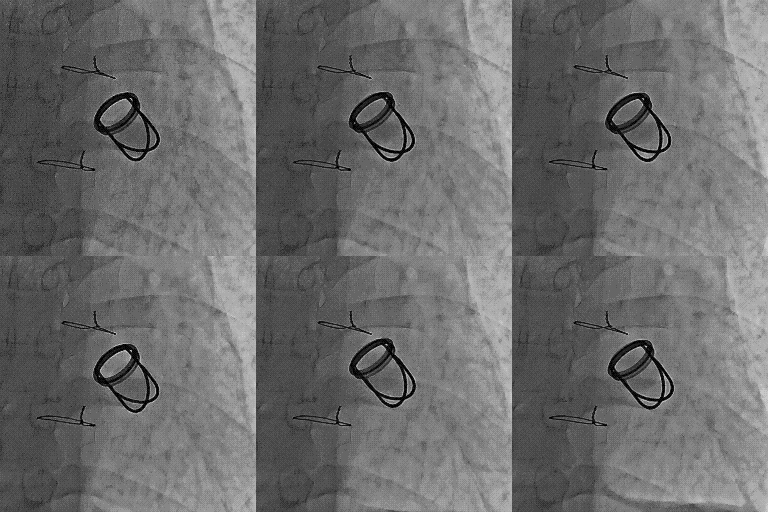
The cage which gives a radial support* mimic sub valvular apparatus, which none of the other valves can provide.
* Mitral apparatus has 5 major components. Annulus, leaflets, chordae, pap muscle, LV free wall.None of the artificial valves has all these components. Though , we would love to have all of them technically it is simply not possible. The metal cage of Starr Edwards valve partially satisfies this , as it acts as a virtual sub valvular apparatus.Even though the cage has no contact with LV free wall, the mechano hydrolic transduction of LV forces to the annulus is possible .
Further , the good hemodyanmics of this valve indicate , the cage ensures co axial blood flow across the mitral inflow throughout diastole. .Unlike the bi-leaflet valve , where the direction of blood flow is determined by the quantum of leaflet excursion in every beat . In bileaflet valves each leaflet has independent determinants of valve motion . In Starr Edwards valve the ball is the leaflet . In contrast to bi-leaflet valve , the contact area of the ball and the blood in Starr Edwards is a smooth affair and ball makes sure the LV forces are equally transmitted to it’s surface .
The superiority of bi-leaflet valves and disc valves (Over ball and cage ) were never proven convincingly in a randomized fashion . The other factor which pulled down this valve’s popularity was the supposedly high profile nature of this valve. LVOT tend to get narrowed in few undersized hearts. This can not be an excuse , as no consistent efforts were made to miniaturize this valve which is distinctly possible.
Sudden deaths from Starr Edwards valve .
Final message
Science is considered as sacred as our religion . Patients believe in us. We believe in science. A good durable valve was dumped from this world for no good reason. If commerce is the the main issue ( as many still believe it to be ! ) history will never forgive those people who were behind the murder of this innocent device.
Cardiologists and Cardio thoracic surgeons are equally culpable for the pre- mature exit of this valve from human domain. Why didn’t they protest ? We can get some solace , if only we can impress upon the current valve manufacturers to give a fresh lease of life to this valve .
http://www.heartlungcirc.org/article/S1443-9506%2810%2900076-4/abstract

Posted in cardiac surgery, Cardiology - Clinical, cardiology -Therapeutics | Tagged ball valve, cardiommc, departemnt of cardiology, dr sadasivam madras medcial college, dr sadasivan, dr vasudevan, mitral starr edwards, portland hospital, prosthetic heart valve, solomon victor india chennai madras medical college, starr edwards valve, www.cardiommc.com, www.cardiommc.org | 5 Comments »
It is surprising to find many similarities between our heart and the car .Both essentially carry out mechanical function. One carries the life , while the other beats , breaths life !
When the silent screams of the heart are not respected and heard , there is no other option left for it , to register its protest , except with a heart attack .This can either be a SOS call or a call from Heaven !
Final message
Remember , the heart breathes your life , your car doesn’t .Heart is million times glorious than your car.
It is foolish to compare the heart with a car . But let us at least learn to respect it . . . like our car.

Heart service station
Some hearts may servicing alright , but realise , you are the master of the service station .
If only you respect it , it rarely requires to be sent to a garage (cath lab )

Simple life style, adequate activity, nutritious diet, peaceful sleep, good work ethics ,respect to fellow citizens ,good-bye to anger , helping the poor, a joyous family life , and finally . . . less visits to your physician ! These make a perfect , sure shot recipe for living 100 glorious years !
Posted in Cardiology - Clinical, Cardiology -Interventional -PCI, cardiology innovation | Tagged annual maintenace contract of the heart, cath lab is the heart service station, heart garrage, heart repair station, heart service, heart service station, over oil your heart | Leave a Comment »

Why is it . . . so difficult , to acquire healthy habits and good behavior in life ?
How to over come it ?
Answer :
No body can answer this question . . .Except yourself !
Posted in bio ethics, Cardiology - Clinical, medical quotes | Tagged aging gracefully, geriatric medicine, healthy aging, healthy living, how to live for 100 years /, life, preventive cardiology, recipe for living 100 years, secrets of living 100 years, stress free life | Leave a Comment »
We know, electrical deaths constitute the bulk of sudden cardiac deaths in MI. Mechanical deaths due to pump failure, muscle rupture , valve leak , also cause significant deaths .(Surprisingly many of the mechanical deaths may also fulfill the sudden death criteria !)
Free wall rupture is invariably a fatal event. Papillary muscle trunk rupture leads to severe LVF and unless intervened sure to result in fatality.
The ones who tear their interventricular septum are some what blessed ! Here , the rupture does not result in instant death as there is no loss of blood , instead , there is an volume over load of right ventricle followed by the left ventricle after a few beats. Hypotension is the rule. Even though this is a major complication there is something about VSR which makes it unique.
Sudden giving way of IVS has a decompressing effect on the ailing left ventricle.This many times bring a temporary relief to LV and if the patient survives the first few hour he is likely to stabilise further . In fact , sudden deaths within 24hours after the onset of VSR is an exception.This defect always gives the cardiologists and surgeon some time to plan the management. We need to use this time judiciously.
The natural history is delicate . Five themes are possible
* Pleasant themes occasionally witnessed !)
Here is 55 year old women came with extensive anterior MI with lower septal rupture.(She belonged to type 3 of the above scheme)
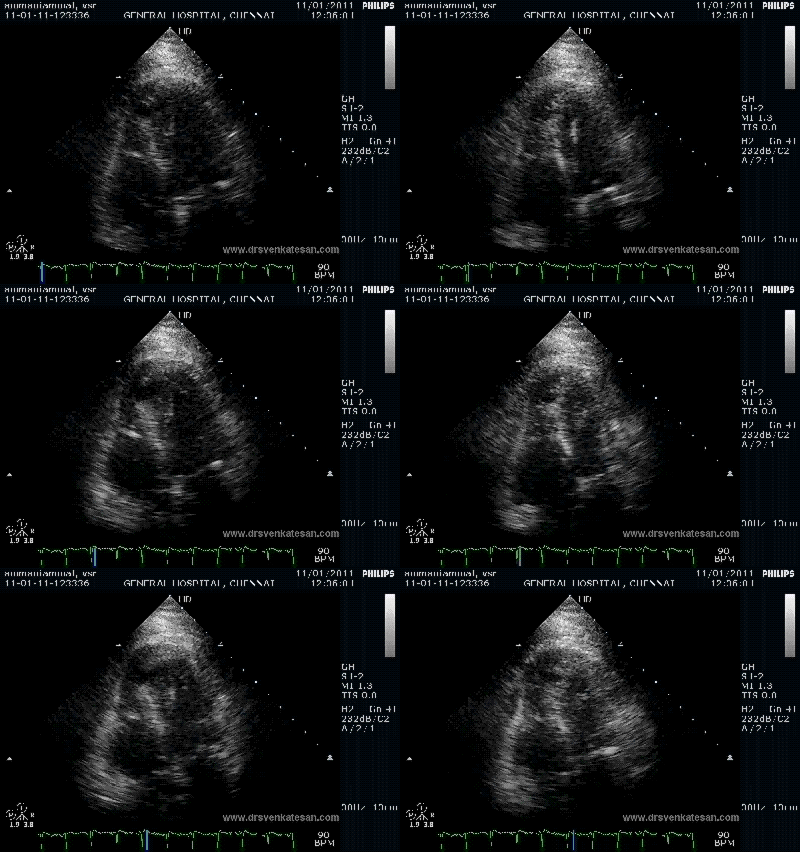
Note the septal rupture is visible even in 2D Echo
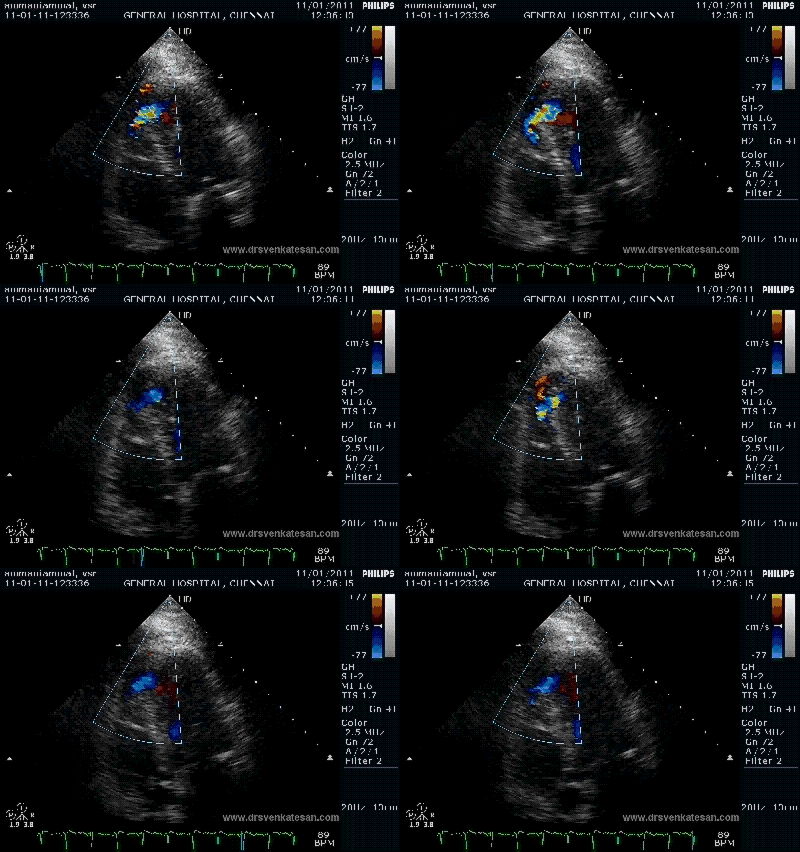
Color flow showing significant shunting from LV to RV.This shunt depends upon the LV contractile function, LVEDP and ofcourse the RV pressure
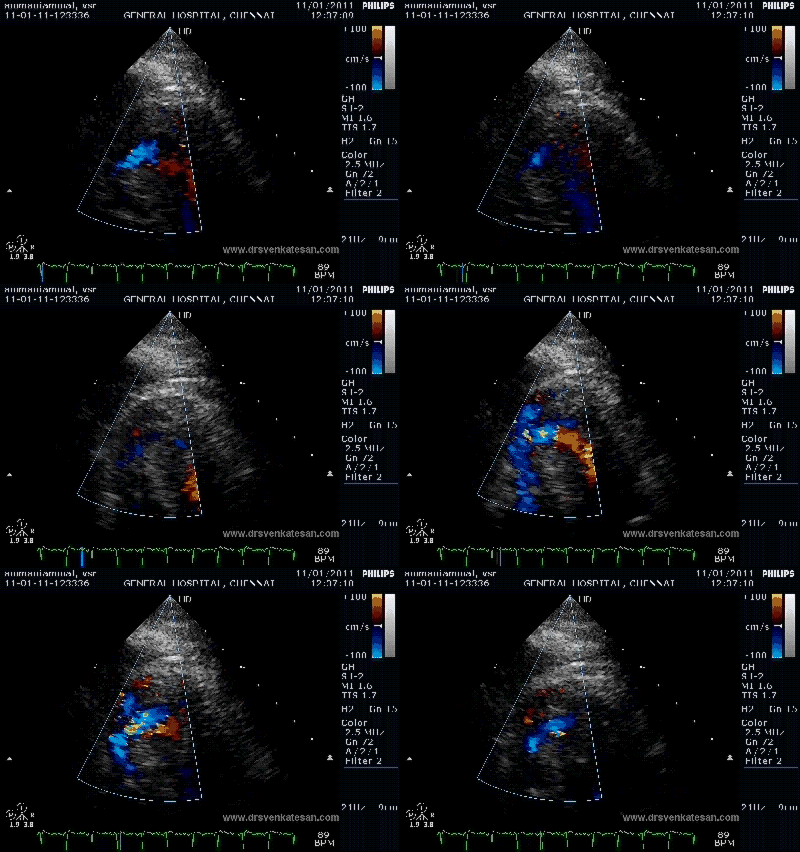
If there is severe RV dysfunction or bi ventricular dysfunction flow across the defect is inconspicuous.Brisk left to right shunting may be an indirect marker for good LV systolic function and absence of significant pulmonary hypertension.Both imply a better outcome.
The main determinant of survival is the underlying LV dysfunction and associated co morbidity(Renal function ) and complications .
Infero -posterior ruptures tend to be complex and may have multiple irregular tracks that makes it difficult to repair.
Investigations
Echo cardiogram is the mainstay .Serial echos should be done to assess the mechanical function and the progress of VSR.Hemodynamic monitoring may be done without injuring the patient .
Medical management
Surgeons role
Timing of surgery
Continues to be a controversy . Surgeons love to operate in a stable patient. But they need to realise , surgery is often needed to stabilise many patients. . The issue of tissue friability is blown out of proportion in the literature .When a life is is at danger we can not worry about friable tissues !
The rule of thumb could be
Surgical options
In our experience each of the above , has a role in a given patient depending upon the logistic , financial , social and even the available expertise. (A good surgeon in bad Institution !)
Is coronary angiogram mandatory before attempting to close VSR ?
Logically yes. If it is not available just do not bother . But, many times , when issue is saving lives , we can not afford to be too scientific , many lives have been saved by not following such strict protocols .A simple emergency thoracotomy and closure of rupture site (Without even touching the LAD ) can be a distinct and viable option in a selected few .
Role of cardiologists
Contrary to the popular belief the role of cardiologists is minimal , except to prepare the patient and hand over to the surgeon.
Interventional approach to close a VSR is currently be termed as an adventurous option ! The VSRs can assume unpredictable shapes and the tears can be multiple in different planes. The devices , catheters and other hard ware are not specifically made to tackle these issues .An acquired VSR should never be compared with congenital VSD.
Posted in cardiac surgery, Cardiology - Clinical, Cardiology -Interventional -PCI, cardiology -Therapeutics, Cardiology -unresolved questions, Echo library and gallery, echocardiography, myocardial disease | Tagged acquired vsd, cabg, cardiogenic shock, catheter closure of vsr, dobutamine for vsr, free wall rupture, lad bypass in vsr, lvedp in vsr, mechanical complications of stemi, post infarct vsd, stable vsr, surgery for vsr, sutures give way in vsr, tissue friability in vsr, unstable vsr, ventricular septal rupture, vsr closure without cabg, vsr closure without coronary angiogram, vsr vs mr | 2 Comments »
NSTEMI is a common clinical problems in CCU.
When we say NSTEMI it can mean any of the following
By default most of us think , if it is NSTEMI . . . there must be ST depression. This thinking is not logical but traditional. Still, ST depression may be the common presentation. NSTEMI with ST depression has much worse outcome than other forms.
The following ECG is from a 45 year old man with a vague mid sternal chest pain for 48 hours.
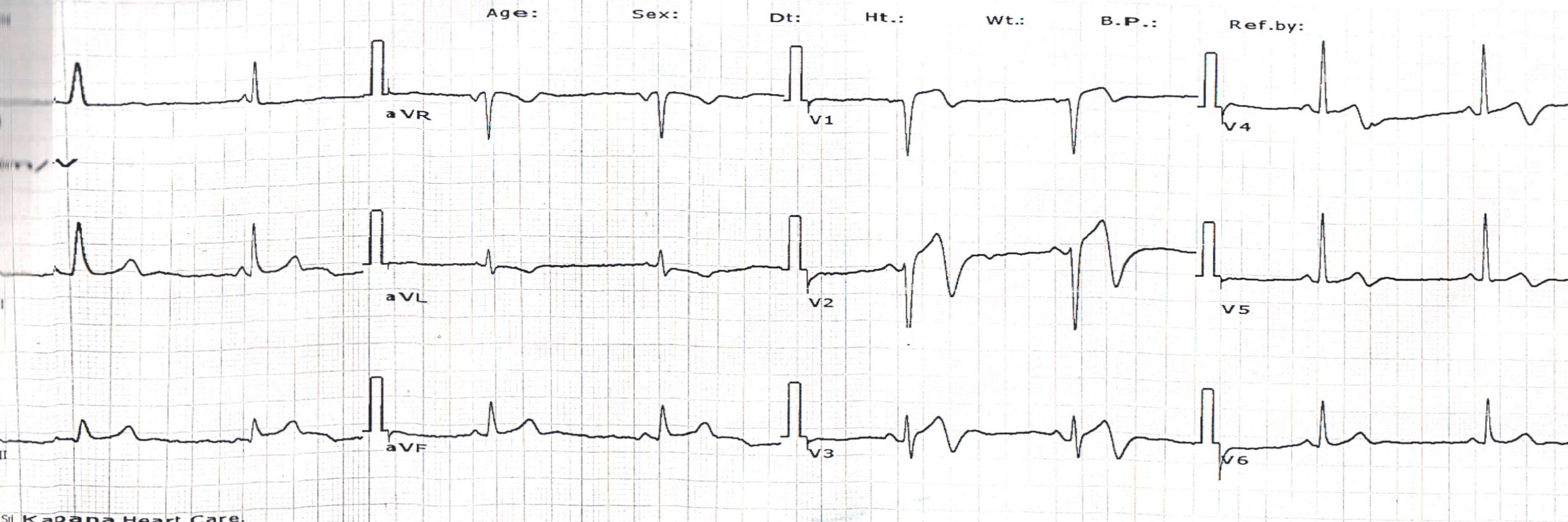
The unusual type of NSTEMI with Bi-phasic T waves
His echo showed wall motion defect in LCX territory .A diagnosis of NSTEMI was made.The predominant finding was biphasic T waves .
**One may wonder why can’t we call this ECG as a Classical STEMI ?
There is a 2mm ST elevation , with a infarct as well ? But , the point here is there is no business for T waves to get bi-phasic or inverted in the early hours of a classical STEMI .
This exactly has happened here. Hence we can not call the above event as STEMI . Instead it is , STEMI evolving into NSTEMI . So a combination of features of STEMI/NSTEMI occur together. The best description for above entity is STEMI in transition to Non Q MI
Read the related article in my site Is the terminology of Non Q MI still relevant or obsolete ?
Posted in Uncategorized | Tagged bi phasic t waves, nstemi, stemi | Leave a Comment »
What happens to vegetation following successful therapy ?
Answer.
Each of the above statement can be true in different patients at / different times. However No 1, is generally the dominant theme.
Persistent culture negativity may be a good index for successful management . But a negative blood culture does not in any – way imply absence of vegetation.
http://www.ncbi.nlm.nih.gov/sites/entrez?Db=pubmed&Cmd=Retrieve&list_uids=7985602&dopt=abstractplus

Posted in Uncategorized | Tagged bacterial vegetation, infective endocarditis, natural history of vegetations, pleural effusion, recurrence of vegetation, regression of vegetation, sterile vegetation | Leave a Comment »



 Dr.S.Venkatesan MD
TRANSFER-AMI study : Transfer with caution . . . bumpy roads ahead !
January 14, 2011 by dr s venkatesan
Preamble
The much published TRANSFER -AMI study has few important queries to ponder about.It was supposed to test the role of routine PCI following thrombolysis. In other words it compared rescue only strategy with routine strategy.The caveat is , even among failed thrombolysis, the rescue strategy has not convincingly proven superior to medical management (if the time is lapsed ) as much of the damage is done .
Will the investigators share their experience ?
Finally
Why the title of the paper says it is about “Routine angioplasty” and the conclusion emphasizes it is indeed “high risk subsets ofangioplasty” (While the study itself involves a 92 % least risk Killip class 1 ) . Why this double dose of confusion ? (Is it deliberate ! Which i think is unlikely )
NEJM please take note of this . . .
All that glitters are not natural glitter . . .some are made to glitter !
Rate this:
Posted in Cardiology -Interventional -PCI, cardiology -Therapeutics, Cardiology -unresolved questions, cardiology journal club, cardiology journals, Uncategorized | Tagged comments about transfer ami, facilitated pci, FAILED THROMOLYSIS, journal watch transer ami, letters to the editor transfer ami, nejm transfer ami, REACT STUDY, rescue pci, routine early pci, stemi, tenecteplase failure, time window for pulmoanry thromolysis, TRANSFER -AMI STUDY | Leave a Comment »