Feeds:
Posts
Comments

Posts Tagged ‘bmj’

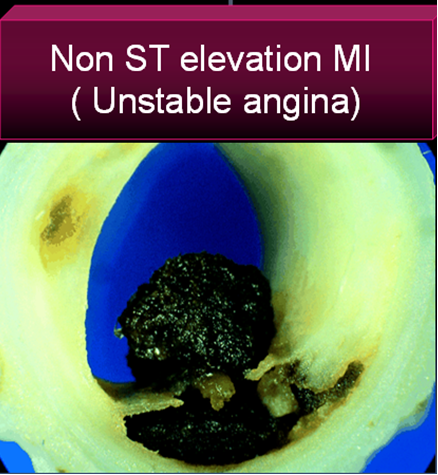
              Intra coronary thrombosis is the sine qua non of acute coronary syndrome ( Both STEMI and NSTEMI.) But thrombolysis is the specific therapy in STEMI and is contraindicated in NSTEMI/UA.

Why is this apparent paradox ? What is basic differnce between UA and AMI ?

In STEMI there is a sudden & total occlusion of a coronary artery usually by a thrombus with or without a plaque .The immediate aim is to open up the blood vessel . Every minute is important as myocardium undergoes  a continuous process ischemic necrosis. So thrombolysis (or more specifically fibrinolysis should be attempted immediately) .The other option is primary angioplasty,  which will not be discussed here.

The thrombus in STEMI  is RBC &  fibrin rich and often called a red clot. Number of fibrinolytic agents like streptokinase, Tissue palsminogen activator,(TPA) Reteplace, Tenekteplace etc have been tested and  form the cornerstone of STEMI management.The untoward effect of stroke  during  thrombolysis  is well recognised , but usully the risk benefit ratio favors thrombolyis in most situations except in very elderly and previous history of stroke or bleeding disorder.

Unstable angina is a  close companion of STEMI . Many times it precedes STEMI often called preinfarction angina. During this phase blood flow in the coronary artery  becomes sluggish gradually,and patients develop  angina at rest .But unlike STEMI there is never a total occlusion and myocardium  is viable but ischemic,  and emergency salvaging of myocardium is not a therapeutic aim but prevention of MI becomes an aim. It is a paradox of sorts ,  even though thrombus is present in  UA ,  It has been learnt by experience thrombolytic agents are not useful in preventing an MI .


Why  thrombolysis is not useful in UA ?

1.In unstable angina  mechanical obstruction in the form of plaque fissure/rupture is more common than completely occluding thrombus. So lysis becomes less important.

2. Even if the thrombus is present , it is often intra plaque  or intra lesional and the  luminal  projection of thrombus is reduced  and hence thromolytic agents have limited area to act.

3.Further in UA/NSTEMI since it is a slow and gradual occlusion (Unlike sudden & total occlusion in STEMI) the platelets  get marginalised and trapped within the plaque .Hence in UA  thrombus is predominantly  white  . Often, a central platelet core  is  seen over which fibrin clot may also be  formed.

4.All available  thrombolytic agents act basically as a fibrinolytic agents,  and   so it finds   difficult to lyse the platelet rich clot.There is also a small risk of these agents lysing the fibrin cap and exposing underlying platelet  core and trigger a fresh thrombus.This has been documented in many trials( TIMI 3b to be specific) So if we thrombolyse in UA , there could be a risk of recurrent ACS episodes in the post thrombolytic phase.

5. UA is a semi emergency where  there is no race against time to salvage myocardium .Administering a  stroke prone thrombolytic agent tilts the risk benefit ratio against it.

6. Among UA, there is a significant group of secondary /perioperative UA   due to increased demand situations. Here there is absolutely no role for any thromolytic agents,  the  simple reason is , there is  no thrombus to get lysed. 

7.Many of the UA patient have multivessel CAD and might require surgical revascualarisation directly .


So fibrinolytic  agents are contraindicated in UA so what is the next step ?

The emergence of  intensive and aggressive platelet-lytic agents.

A combination of aspirin, clopidogrel, heparin, glycoprotien 2b 3a antagonist formed the major therapeutic protocol in these patients.Even though these are called antiplalet agents some of them  like 2b/3a antagonist eptifibatide, tirofiban, and many times even heparin has a potential to dissolve a thrombus. So technically one can call these agents  as thrombolytic agents.

What are the unresolved issues

                                       Even though clinical trials have convincingly shown thrombolytic agents  have no use in UA .There is a nagging belief  THAT  there could  be group of patients  with UA , still might benefit from thrombolysis as total occlusions have been documented  in some cases with UA.This is  especially true in peri-infarction unstable angina (Pre & post) as there is a fluctuation  between total and subtotal occlusions ) .But bed side recognition of this population is very difficult.

Many would consider this issue as redundant now,  since  most of  these patients  are taken up for emergency revascularisations

Read Full Post »

CURRENT   CARDIOLOGY  PRACTICE: EVIDENCE  OR  EXPERIENCE  BASED ?    AN  ANALYSIS OF  ACC/AHA  GUIDELINES.

S. Venkatesan,  Madras Medical College. Chennai


If  a  major therapeutic procedure is adviced based on simply by experience or expert opinion  how can we say evidence based medicine is practiced !


                                    Evidence based cardiology  is  the  buzz word  in global cardiovascular  health care  organizations. All diagnostic  and therapeutic  interventions are  undergoing  rigorous randomized  trials  for  proof of  efficacy  and  safety. ACC/AHA   have published  management guidelines and it  has been accepted  as de-facto standard of clinical cardiology practice world wide.  In these guidelines  class  1  indication  is defined as Conditions for which there is evidence for and/or general agreement that the procedure is useful and effective. These indications are supported by three levels of evidence.(A,B,C) .It has been observed,   many of the recommendations  in  class 1  were supported by only level  C  evidence. (Expert consensus or  agreement  ). We  analysed how much of todays guidelines is  agreement based  and  how much is evidence based. The  latest  practice  guidelines  of  ACC/AHA   for  Acute myocardial infarction , Unstable Angina and Non–ST-Segment Elevation Myocardial Infarction , chronic  stable angina  ,coronary angiography  were analysed. The  no  of  class 1  indications  were counted  in each set of guidelines  and  each  of the indication were  sub grouped with reference to the  levels of  evidence  to which it was supported. There  were a total  of 210  class 1  indications.


Class  1

Level A

Class   1

Level  B

Class  1

Level  C

P value

1A vs 1C

AMI(54)

7

25

22

<.0001

UA  (66)

11

26

29

<.0001

CSA(59)

8

29

22

<.0001

CAG(31)

3

12

16

<.0001

Total(210)

29(13.9%)

92(43.8%)

89(42.4%)

<.001

 13.9%   of class 1  indications were based on  level  A evidence.  42.4%  of class 1 indication were based  on Level C  ( agreement  of experts).Though evidence based cardiology   is   considered  to  define  the  standards in  Cardiology  practice  in reality  we lack evidence in most of the situations. 

                                       We  conclude  that  consensus or  agreement  based cardiology  practice is the dominant theme in current   ACC/AHA 

Read Full Post »

Pulse deficit is a clinical sign wherein , one is able to find a difference in count between heart beat (Apical beat or Heart sounds ) and  peripheral pulse .This occurs even as the heart is  contracting , the pulse is not reaching the periphery.This can occur in few clinical situations .

1 . Atrial fibrillation.

2. Very early diastolic  ventricular  ectopic beats

3. Some patients with Pacemaker.

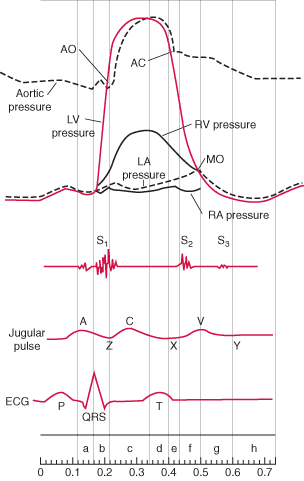
The mechanism is  , the ventricular contractions are  too weak and unable to open the aortic valve  (Or opens feebly*)  , but at the same time they are good enough to close the mitral valve. To open the aortic valve it has to generate atleast 60-80 mmhg pressure , while mitral valve closes even  as LV generates  8-14mmhg  .(LV/LA pressure cross over). So intermitently the  second heart sound  is missed while S1 is retained,  producing more heart sounds and less pulse count in the periphery. The S1 is either felt or heard at the apex but the corresponding pulse is missing . Further , this intermittent absence of  S2  results in totally irregular S1 /S 2 relation.


Why some of the contractions of LV is too weak to open the aortic valve ?

Because the RR interval varies , the ventricular filling also varies , diastole duration is constantly changing some of the diastole are too short  and LV hardly gets filled , as the LV force of contraction is directly decided by the LVEDV and LV  fibre length these contractions are too weak.

Other published studies

There has been some doppler observations ,where there is a midventricular LV blood flow reversal in atrial fibrillation that could  explain the pulse deficit . Mechanism of production of pulse deficit in atrial fibrillation: assessment by blood flow dynamics

Second Department of Internal Medicine, Kagoshima University School of Medicine.

 http://www.ncbi.nlm.nih.gov/pubmed/3221309

What is the clinical significance of pulse deficit ?

Currently there is no great clinical significance of this phenomenon. But an astute clinician will pick up this sign and it may indicate underlying LV dysfunction. In patients with PPM,  pulse deficit  suggests  pacemaker malfunction .Some patients with cardiac tamponade &  pulsus paradoxus  systolic  blood pressure falls too low to make the pulse feeble or not palpable in the periphery .This situation may mimic a pulse deficit if not recognised.

Dr.S.Venkatesan ,Madras Medical College , Chennai, India

* What is the evidence for intermittent absence or feeble Aortic valve opening in Atrial fibrillation ? I could find this from the book written by Harvey Feigenbaum. whom we consider Father of Echocardiography


Read Full Post »

« Newer Posts