Feeds:
Posts
Comments

Posts Tagged ‘drsvenkatesan’

                                                   Infective endocarditis is a serious clinical cardiac problem. The disease has evolved over many decades and now we are witnessing the  most virulent forms of the disease . Infection of heart , can occur in a native healthy valve, native diseased valve, or a prosthetic valve. Further, IE can occur either as  an acute (usually non diseased valve) , or sub acute form (usually in diseased valve).The changing microbial pattern has made this entity very complex. The vigorous   treatment protocols are available for IE. Still  the  prognosis and outcome with medical management is  dismal even in best centers.So the role of surgery in IE has increased over the years.We propose here,  a radically different approach to the problem.

 Traditionally there is a set of criteria for surgery in IE  :  These include

  •  Abscess formation
  •  Worsening valve lesion
  •  Refractory cardiac failure
  •  Persistent fever even after  2 weeks of  appropriate and adequate anti microbial therapy .
  •  Vegetation of more than 10mm size.
  •  Failed medical treatment

(The list is not exclusive)

In any large tertiary  hospital  series, if you  apply the above rule  more than 50 % of all patients with IE will be the candidates for  immediate surgery.

In the remaining 50% the mortality in medical management is very high. The reason being,  the  medical treatment is often prolonged over weeks. Many  of the complications occur  during the course of medical treatment.The common ones are abscess formation, embolic episodes, renal failure etc.Once a complication set in we call it as failed medical treatment and ask our surgical colleagues  to operate.By this time patient’s  general condition  deteriorates and either the surgeon refuses to take  up the case or  patient dies on the table.

So the key point  is , failure of medical treatment  is so common , it is simply not acceptable  to delay  the surgery in these patients as  majority of  them are  doomed to  fail  the trial of medical therapy.

What is the incidence of failed medical management, how to recognise it ? what is the impact of recognising it late ?

  • Failed medical therapy is around 60-70%  even in best centers.
  • Failed medical patients  constitute the greatest  surgical risk .
  • So it is proposed all IE patients should be triaged  early and the  dominant theme should be surgery (Commonly valve replacement, or valve repair)   .
  • If there is large vegetation surgery may be done for the sole purpose of physical removal of the vegetation*.

Final message

In Infective endocarditis experience has taught us, surgery  should be the default management protocol and medical therapy should be offered  to selected few who don’t require surgery.This is especially true in preexisting  rheumatic valve disease.

*The fundamental principle of management of infectious diseases, state that when there is a  resistant focus of infection .Always  remove the focus whenever possible.


Read Full Post »

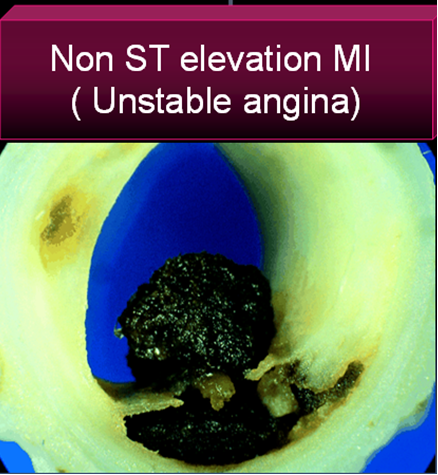
              Intra coronary thrombosis is the sine qua non of acute coronary syndrome ( Both STEMI and NSTEMI.) But thrombolysis is the specific therapy in STEMI and is contraindicated in NSTEMI/UA.

Why is this apparent paradox ? What is basic differnce between UA and AMI ?

In STEMI there is a sudden & total occlusion of a coronary artery usually by a thrombus with or without a plaque .The immediate aim is to open up the blood vessel . Every minute is important as myocardium undergoes  a continuous process ischemic necrosis. So thrombolysis (or more specifically fibrinolysis should be attempted immediately) .The other option is primary angioplasty,  which will not be discussed here.

The thrombus in STEMI  is RBC &  fibrin rich and often called a red clot. Number of fibrinolytic agents like streptokinase, Tissue palsminogen activator,(TPA) Reteplace, Tenekteplace etc have been tested and  form the cornerstone of STEMI management.The untoward effect of stroke  during  thrombolysis  is well recognised , but usully the risk benefit ratio favors thrombolyis in most situations except in very elderly and previous history of stroke or bleeding disorder.

Unstable angina is a  close companion of STEMI . Many times it precedes STEMI often called preinfarction angina. During this phase blood flow in the coronary artery  becomes sluggish gradually,and patients develop  angina at rest .But unlike STEMI there is never a total occlusion and myocardium  is viable but ischemic,  and emergency salvaging of myocardium is not a therapeutic aim but prevention of MI becomes an aim. It is a paradox of sorts ,  even though thrombus is present in  UA ,  It has been learnt by experience thrombolytic agents are not useful in preventing an MI .


Why  thrombolysis is not useful in UA ?

1.In unstable angina  mechanical obstruction in the form of plaque fissure/rupture is more common than completely occluding thrombus. So lysis becomes less important.

2. Even if the thrombus is present , it is often intra plaque  or intra lesional and the  luminal  projection of thrombus is reduced  and hence thromolytic agents have limited area to act.

3.Further in UA/NSTEMI since it is a slow and gradual occlusion (Unlike sudden & total occlusion in STEMI) the platelets  get marginalised and trapped within the plaque .Hence in UA  thrombus is predominantly  white  . Often, a central platelet core  is  seen over which fibrin clot may also be  formed.

4.All available  thrombolytic agents act basically as a fibrinolytic agents,  and   so it finds   difficult to lyse the platelet rich clot.There is also a small risk of these agents lysing the fibrin cap and exposing underlying platelet  core and trigger a fresh thrombus.This has been documented in many trials( TIMI 3b to be specific) So if we thrombolyse in UA , there could be a risk of recurrent ACS episodes in the post thrombolytic phase.

5. UA is a semi emergency where  there is no race against time to salvage myocardium .Administering a  stroke prone thrombolytic agent tilts the risk benefit ratio against it.

6. Among UA, there is a significant group of secondary /perioperative UA   due to increased demand situations. Here there is absolutely no role for any thromolytic agents,  the  simple reason is , there is  no thrombus to get lysed. 

7.Many of the UA patient have multivessel CAD and might require surgical revascualarisation directly .


So fibrinolytic  agents are contraindicated in UA so what is the next step ?

The emergence of  intensive and aggressive platelet-lytic agents.

A combination of aspirin, clopidogrel, heparin, glycoprotien 2b 3a antagonist formed the major therapeutic protocol in these patients.Even though these are called antiplalet agents some of them  like 2b/3a antagonist eptifibatide, tirofiban, and many times even heparin has a potential to dissolve a thrombus. So technically one can call these agents  as thrombolytic agents.

What are the unresolved issues

                                       Even though clinical trials have convincingly shown thrombolytic agents  have no use in UA .There is a nagging belief  THAT  there could  be group of patients  with UA , still might benefit from thrombolysis as total occlusions have been documented  in some cases with UA.This is  especially true in peri-infarction unstable angina (Pre & post) as there is a fluctuation  between total and subtotal occlusions ) .But bed side recognition of this population is very difficult.

Many would consider this issue as redundant now,  since  most of  these patients  are taken up for emergency revascularisations

Read Full Post »

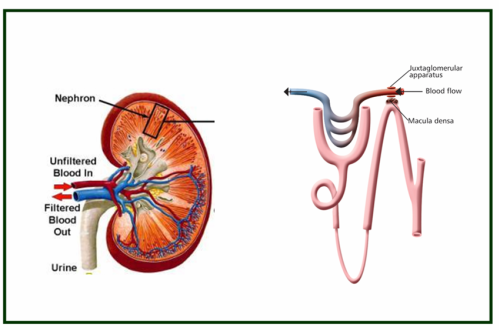
Diuretics are the most commonly prescribed anti hypertensive agents.Thiazide diuretics which  was introduced many decades ago ,  lost popularity  in recent years ,  again got a second life after  the publication of ALLHAT trial recently. Now diuretics has become the  the drug of first choice in almost any hypertension unless any specific contraindication.

The most commonly used thaizide is hydrochlorthiazide ,and chlorthalidone.The blood pressure reducing effect is so consistent and smooth , all the currently popular molecules like ACE inhibitors and ARBs come with a combination with thiazide. While every one is clear diuretics are  effective anti hypertensive agent How it does is not clear.

How does a diuretic reduce blood pressure?

A. The exact mechanism is not clear. May not be uniformly effective in all patients  with HT.

B . Salt sensitive HT respond well to diuretics.

C. Volume correction /free water clearance might be a factor

D. Direct effect on vascular smoth muscle documented.The sodium transporter is blocked and  hence   calcium : sodium exchange is prevented .This depletes  intracellular calcium  in vascular smooth muscle cells .Less calcium for actin myosin interaction and hence vasodilatation

E. Thiazides combine well with all other antihypertensive drugs (ACEI, ARB, Beata blockers, calcium blockers)

F. Loop diuretics  like frusemide  can never be  a good antihypertensive agent.

Read Full Post »


Chronic renal failure and CAD are common companions.Severe CAD  in patients with renal failure  pose an imposing task on the treating physicians.CABG  and kidney transplantation  both are major interventions.When a patient  requires both the decision making becomes much more difficult.

The possible  choices are

A. Do CABG first follow it with renal transplant .

B. Do  renal transplant first follow it with CABG.

C. Do CABG first  and  defer transplant &  advice life long dilaysis

D.Do  renal transplant and offer medical management / PCI for CAD if feasible.

E.Simultaneous CABG & renal transplant is a remote possibility .

F.In terminally ill , combined cardiac and renal transplantation is the ultimate option. (Possible in very few centres in the world)   

G.In severe co-morbid condtions avoid both and support life. Success is not in completing   the procdeures but in providing useful life !

Among the options the most prefered worldwide is option no 1. This has a caveat. If angina is dominant  CABG should precede transplant. If cardiac failure is dominant the issue need further scrutiny.

Given a situation ( DCM & End stage renal disese) , your patient could  undergo only one procedure,  which will you prefer ?

              This again is highly emprical but logic could still be applied. Never do  CABG with a sole  aim of improving severe LV dysfunction in ischemic DCM .It happens only in  journal articles & major clincal trials!.Of course mitral valve correction and LV reduction surgery might help.But in a patient with  renal failure prolonging the CABG on table time , with add on surgery is highly risky. So it would be logical to think intensively  for  postponement of  the CABG in a patient with class 4 cardiac failure and renal failure. Do only the transplant .

 What is the impact of end stage renal failure  on LV dysfunction ?

 End stage renal failure has a great adverse impact on LV function. Many times it is reversible.We will never ever know, if you do a CABG first on them. So always think twice or even thrice before voting  on this vital issue . Correction of renal impairment can improve the cardiac status dramatically in some.

Read Full Post »

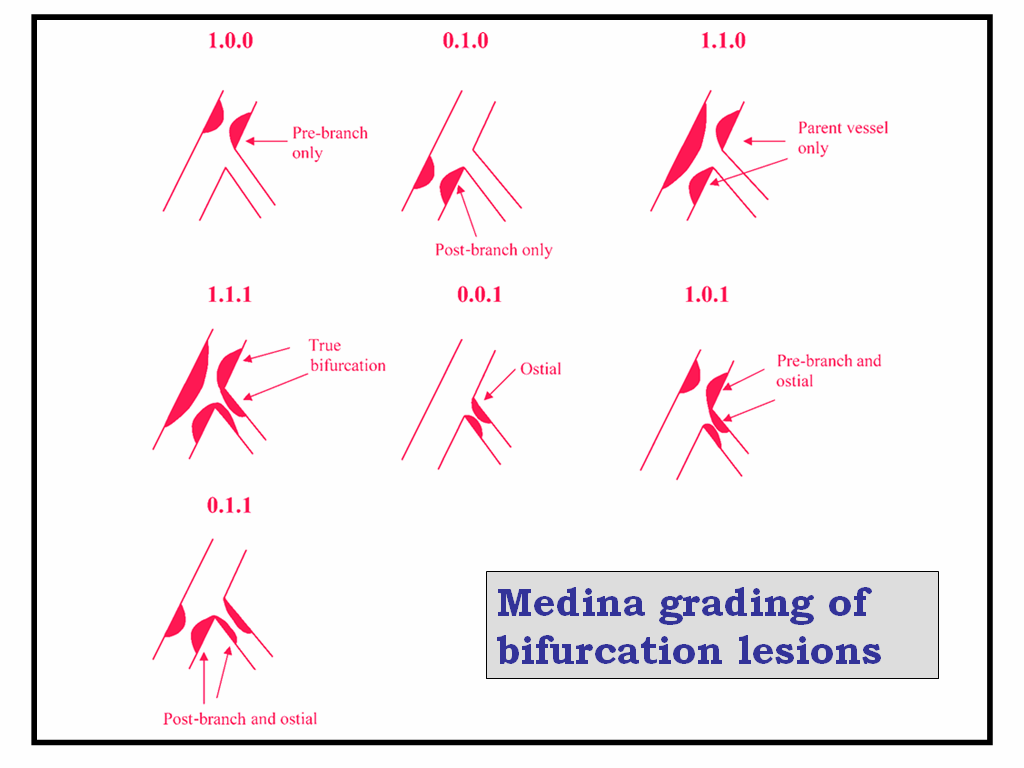
There are numerous complex grading for bifurcation lesions available.

The one proposed by Medina is simple and most useful.

In this grading three segments

  • Proximal main vessel
  • Distal main vessel
  • Branch vessel

Are given a code 0, and 1 if  lesion is present or absent .

This grading gives simple and fast method to label a bifurcatiuon lesion and to asssess the response to PCI. The only issue here is the individual  lesions are not graded , for example branch vessel ostium just involved about 20 % is not addressed . Further TIMI flow in these vessels may also be incorporated

How medina grading can be used to assess effectiveness of

angioplasty  ?

A patient with 1.1.1  after the treatment should revert back to 0.0.0.  if converted into 0.0.(.5) may indicate a residual side branch lesion  .5 shall indicate 50% residual lesion, .3 , 30% etc


What is the best management strategy for bifurcation lesions?

The topic has been discussed extensively for over a decade in various forums.

Though the lesions and intervention techniques  appear complex the basic concept is simple.

Following is the 8 point algorithm

1. Assess the bifurcation lesion accurately.

2. Apply the general rule and ask the first question whether PCI is neccessary at all ? if decided for PCI

3. Stent the main vessel.Protect the side branch.  

4. Dilate the side branch with a balloon.(KIss or through the struts) 

5. Very rarely,  if the side vessel is more significant and large  stent it and balloon the main vessel.

6. Use drug eluting stents with caution .

7. Resist the temptation of using two stents unless the situation demands and is absolutely required.

8. Never attempt to do bifurcation angioplasty during ACS as apart of primary angioplasty.( Unless you’re extremely competent, even then aim of primary PCI is to salvage myocarium quickly , not to provide TIMI 3 flow in non IRA vessel.)

Dr.S.Venkatesan.Madras medical college.Chennai.

Read Full Post »

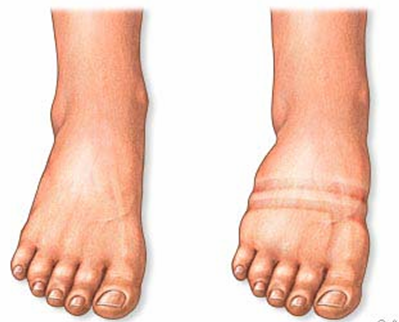
Edema is considered the cardinal feature of cardiac failure for decades. It is one of the minor criteria of  the Framingham protocol  to diagnose cardiac failure.

The mechanism of edema in cardiac failure is multifactorial . The major mechanism attributed is raised venous pressure. This is transmitted backwards into the circulation and resultant increase in hydrostatic pressure in the venous end of capillaries results  in edema .

Even though this is considered as the  dominant mechanism for decades , it may not be true. Apparent reduction in cardiac output (Effective circulatory volume) and resultant reduction in renal blood flow triggers renal ischemic response and RASS activation (Rennin angiotensin aldosterone system). This is a powerful stimulus for sodium and water retention . This could be the major mechanism of cardiac edema. While there is clearcut explanation for the mechanism of edema in cardiac failure the explanation for lack of edema in many is not available in literature.

Does the activation of neuroendocrine happen in every one with cardiac failure ?

We think so ! but it may not be. Further,  activation of RASS trigger a counter hormone  response mediated by atrial natriuretic peptide  that promotes active water loss  from  the distal tublues which could prevent edema formation in many. So there is a distinct group of patients with cardiac failure who rarely develop edema .

In which type of cardiac failure edema is common and gross?

  • Predominatly right sided failure.
  • Corpulmonale
  • Tricuspid valve disese
  • Constrictive pericarditis

Read Full Post »


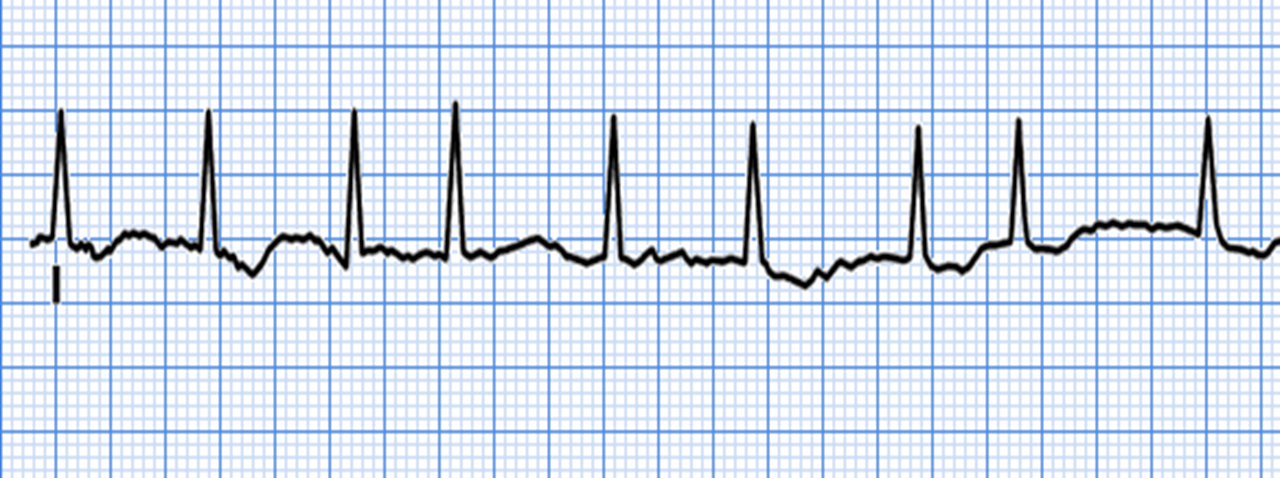
The debate of rate control verses rhythm control in atrial fibrillation  goes on and on. The AFFIRM, RACE,PIAF, STAF the HOT CAFE all went against sinus rhythm in the last 10 years . This was one of the settled contoversies in cardiology . The conclusion was ventricular  rate control was no way inferior to rhythm control in patients with SHT, CAD population .This made the electrophyiologists wonder how can a natural rhythm fare bad ! . But the findings  were consistent .Rhythm control neither improved the quality of life nor  it reduced the incidence of stroke. The later finding was very surprising but the explanation was convincing as stroke in elderly was more related to SHT, CAD, DM etc than  AF itself. The source of emboli in ischemic stroke could come any where distal to LA .The big assumtion that all strokes in elderly  should come from LA appendage or the body  of LA was  premature and  wrong. What prevented stroke in AF was not restoration of SR but administration of oral anticoagulants with adequate INR.(2-3)

Having failed to document superiority in elderly  population   , the  logic machine  strongly suggested restoring SR  in patients with CHF,  will atleast provide hemodynamic and also survival  benefit .

And thus came the AF-CHF trial  published in NEJM 2008

Alas !  AF-CHF  also found there is no useful purpose of restoring sinus rhythm in patients  with atrial fibrillation and cardiac failure. In fact patients in SR fared little worse !

 Why . . .  why . . . why ?

Should we ask the seemingly absurd question !

Is sinus rhythm poorly tolerated by cardiac failure  patients ?

It is some times possible atrial fibrillation by itself could be a mechanism to amplify the  cardiac reserve by which it provides a  relatively high ventricular rate to improve the cardiac index  . Even though the optimal ventricular rate in AF is around 80-90 at times of need it has to increase to 120-130. Patients in class 3 CHF and AF often achieve this in times of demand .This is not possible in patients who are getting rhythm control drugs and further patients in SR can  not increase the HR suddenly from 80 -130  .

So is this a  wild imagination !   AF could be a safety valve mechanism in CHF to increase the HR . Where the atria come to the rescue of ventricle like a rate adaptive pacemaker .

The other logical* ! argument is that  there  is nothing wrong with restoring  SR , but the  methods to achieve and  maintain SR  is too cumbersome and results in adverse outcome .The currently available  drugs are too toxic for the purpose  .

If we have a simple and safe way to restore SR in these patients it should always be superior to AF .

But it is a well  known fact  that , whatever be the rhythm or rate the ultimate outcome will be dictated by the LV function, mitral valve function etc.

 Read abstract of AF-CHF

Rhythm Control versus Rate Control for Atrial Fibrillation and Heart Failure

Denis Roy, M.D., Mario Talajic, M.D., Stanley Nattel, M.D., ., for the Atrial Fibrillation and Congestive Heart Failure Investigators

<!–

Rhythm Control versus Rate Control for Atrial Fibrillation and Heart Failure

Denis Roy, M.D., Mario Talajic, M.D., Stanley Nattel, M.D.,  the Atrial Fibrillation and Congestive Heart Failure Investigators* –>ABSTRACT

Background It is common practice to restore and maintain sinus rhythm in patients with atrial fibrillation and heart failure. This approach is based in part on data indicating that atrial fibrillation is a predictor of death in patients with heart failure and suggesting that the suppression of atrial fibrillation may favorably affect the outcome. However, the benefits and risks of this approach have not been adequately studied. Methods We conducted a multicenter, randomized trial comparing the maintenance of sinus rhythm (rhythm control) with control of the ventricular rate (rate control) in patients with a left ventricular ejection fraction of 35% or less, symptoms of congestive heart failure, and a history of atrial fibrillation. The primary outcome was the time to death from cardiovascular causes.
Results A total of 1376 patients were enrolled (682 in the rhythm-control group and 694 in the rate-control group) and were followed for a mean of 37 months. Of these patients, 182 (27%) in the rhythm-control group died from cardiovascular causes, as compared with 175 (25%) in the rate-control group (hazard ratio in the rhythm-control group, 1.06; 95% confidence interval, 0.86 to 1.30; P=0.59 by the log-rank test). Secondary outcomes were similar in the two groups, including death from any cause (32% in the rhythm-control group and 33% in the rate-control group), stroke (3% and 4%, respectively), worsening heart failure (28% and 31%), and the composite of death from cardiovascular causes, stroke, or worsening heart failure (43% and 46%). There were also no significant differences favoring either strategy in any predefined subgroup.
Conclusions In patients with atrial fibrillation and congestive heart failure, a routine strategy of rhythm control does not reduce the rate of death from cardiovascular causes, as compared with a rate-control strategy.


Read Full Post »

                                                          Left main coronary  lesions are  fairly common  during routine coronary angiogram.These may be a critical or a innocuous lesion.The  word “left main” triggers a sort of alarm reaction to many cath lab staff as well as the cardiologists and surgeon.Many times, these left main lesions are detected in patients   with chronic stable angina who have stable symptoms. Left main disese has not been graded  clearly in literature . Often it is perceived , any lesion in LM is serious.

There is an unwritten rule,  rather a medical compulsion  to take a patient  with left main disease  for emergency CABG ( Now some centres ,emergency PCI) .Some institutions make it  a rule these patients  are posted  in the  next available slot in the theatre.

 The basic question we raise here is   “Should we consider all  left main  disease  as  an  emergency”?

Not really , especially when it occurs in a stable angina .One can wait , buy some time to fully evaluate and prepare  the patient  and may be the patient can be posted  as an elective case. It is a well recognised fact that, CABG carries adverse outcome when done as an emergency procedure. This is primarily due to inadequate pre op work up and resultant complications. It is also well known ,  surgical  back up team may not be available in full strength in odd hours .

This post is  to convey the message , that left main is  a serious disease but that doesn’t  mean it should elicit  a panic reaction and be taken as an ultra emergency . There has been many morbid and fatal outcomes in many hospitals due to this apparent  pseudo emergency !


Note* 1.Left main  disease during acute coronary syndrome is to be seen in different perspective.2.Some of the proximal LAD lesions are so tight and  could be more significant than left main lesions.

Read Full Post »

All is not well,  that ends well !

                                       Treatment guidelines in cardiology  practice  are periodically published by ACC/AHA/ESC.These guidelines  represent the current scientific practice. They are called some times as recommendations. Medical professionals tend to adhere to this guidelines whenever possible.They are not legally binding in most of the countries.In USA some states believe it, to be legally binding.


The problem with these guidelines  are , they are classified as class 1 ,class 2 , class 3 recommendations.


Class 1, A  drug , device  or a procedure  Is definitely useful and must be prescribed.

Class 3,   A  drug , device  or a procedure  Is not useful and should not be used .

Class 2*, A  drug , device  or a procedure  may be useful  or may be harmful , and hence may be used or may not be used . (Vaguest possible guideline!)

 *Altered to convey the meaning

What are the  guideline violations that can be sued in court of law  ?

A person with established  CAD who is not been prescribed a  statin (Cholesterol lowering drug)  can be sued straight away,  even if the patient has no adverse outcome due to the nonprescription of that drug. The issue here is , the doctor  has not prescribed  a drug which has  proven benefit .The law is clear on that .Most will  agree that,  the  doctor is at fault ,  and he  is never protected  even by their  colleagues .He  can’t defend his action.

What are the medical errors that can never* be sued in court of law !

But the same doctor who opens up a totally occluding coronary artery in an asymptomatic patient(CTO -chronic total occlusion) and lands up  in a complication and the  patient dies. This could be  major guideline violation as opening a CTO in an incidentally detected , asymptomatic patient is a class 3 recommendation. Neither the physician, patient , institution  nor  the regulatory authorities bother about this even though there is strong case for censure , in reality it never happens. Number  of  experts from leading hospitals do this procedure in live work shop all over the world with full media glare, It is an irony the same  experts are only  writing  in their  guidelines  that  these procedures should not be done inappropriately.

And this medical  error ( Should we call it a  crime if it is knowingly done ! )   keeps growing as the physician never feels guilty about it .

The message here is

 A physician of a state of the art hospital,  in a scientifically advanced  country  goes scott free and guilt free  even if he openly violate the scientific guidelines and do a inappropriate procedure that result in a patient death. Mean while a small time physician in a remote place in the same country can be taken to task  for not prescribing a officially  recommended drug (By standard guidelines) .He will be labelled unscientific and unethical even if his non prescription , had not caused any untoward health outcome .

In short , in today’s modern medical practice 

 Even a  ” Minor error of  ommision”   attracts guilt and perceived fear among the physicians. Meanwhile  many  of the ” Major errors of commission”  done by professionals are rarely frowned upon and thus these  mistakes continue to perpetuate !

*There should be a strong provision in medical law to address the issue of inappropriate procedures even if the procedure has not resulted any untoward effect to the patient.

Read Full Post »

Interventional cardiology as a speciality is in cross roads.

The number of coronary interventions (PCI) has increased exponentially world over. With increasing  Cath labs and growing  expertise ,  access to PCI has enormously increased  even in underdeveloped countries.  Meanwhile ,  public lack  specific technical information about the appropriateness  of these costly procedures. It is our duty to do self audit on this issue.  .

                           In this context,  the evaluation  following a PCI  should look beyond  lumen oriented  endpoints.  Many  land mark trials on DES report 3 months are 6 months angiographic outcome and better luminal appearance . Many   tend to worry  more about the status of the stent rather than the patient !  This is primarily because the device companies have repeatedly stressed the technical end points rather than clinical end points .

It is a  well recognised fact  that ,stented coronary artery never guarantees against future  coronary events (ACS) either within the stent or away from it .It is an explict fact that , a patient  after getting a coronary stent , especially a drug eluting stent carries a life long risk of acute stent obstruction and possibly SCD .This information is rarely passed on to the patient in  and hence they are not able to take “learned consent”

It is true ,  one gets  a gratifying feeling  when  opening up a obstructed artery , but we also need  to answer this simple question   What is it’s impact on  patient’s  life  ?

COURAGE & OAT trials have put a break on the  prevailing precondtioned behaviour in the labs, namely any obstruction must be relieved if  technically feasible .

One should recall  the Gruentzig’s legacy  . Whaterver,  we do inside  a  patient’s coronary artery must have some useful purpose . We should not use patient’s  coronary artery to show our expertise and skills !

Dr.S.Venkatesan, Madras Medical College, Chennai, India

Read Full Post »

« Newer Posts - Older Posts »