Feeds:
Posts
Comments

Posts Tagged ‘nstemi’

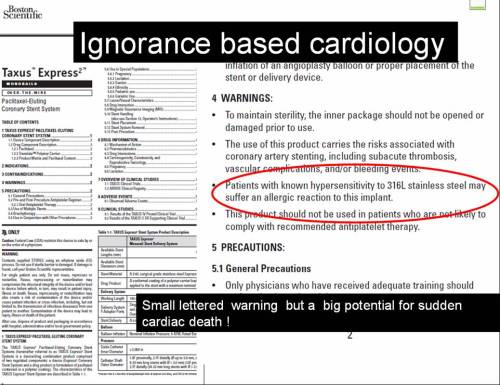
Fundamental principle  of  human biological system is to live in harmony with nature and environment.Each cell  has a unique reaction  when it comes into contact with  external  material. This reaction can be acute or chronic  ,   local or systemic. The most severe form of allergy is called anaphylaxis  that can result in instantaneous loss of life. There  is a whole gamut of disorders  that  resulted  in a  separate  speciality called allergic medicine .

Further ,the transplantation  science have   taught us  an  organ or cell can be rejected at any point of time after implantation (Hyperacute -chronic) .With advancement of science we have started implanting a variety of devices  with complex metallurgy ,inside human body, metal clips, prosthesis, valves, wires, etc .How the body handles them .The consequences can be a mild reaction to major ones occasionally.

Consider ,a local allergy due to a orthopedic prosthesis  in one of the leg bones  is far less serious than a metal within a coronary artery  irritating the intima .

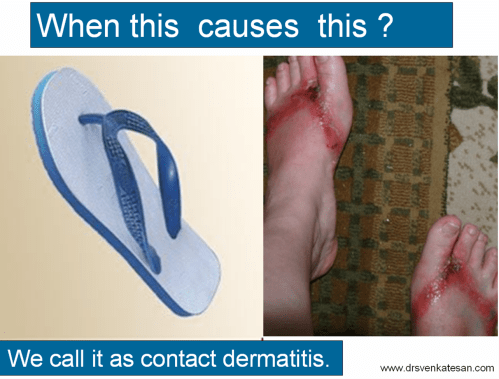
Remember hypersensitivity reactions can be severe . This lady reacted  like this to a sandal slipper -A  fiery red  infiltration
contact dermatits stent allergy pci coronary

Imagine  if a stented coronary artery react like this what would be the possible consequence ?

In susceptible  individuals  , can a metal cause

  • Intimal hyperemia
  • Intimal induration
  • Intimo-medial edema  following stent deployment

pci stent coronary angiogram thrombosis des

Why drug eluting stents are more prone for hypersensitivity ?

The answer is simple , while metal allergy is a comparatively rare phenomenon, the drugs we  coat and the polymers used are  many fold likely to result in hypersensitivity reaction.

While  the world is worried  more  about penicillin , sulpha allergy which occurs in 1 in 100000 ,  we tend to ignore the metal and drug  reactions within  the tender coronary arteries.

stent des rejection virmani  pci

What is  the clinical expression of  stent hypersensitivity ?

It is  often a coronary event in the acute phase and restenosis in chronic phase.

How much of acute stent thrombosis is related to stent allergy mediated reaction ?

The exact incidence  will  never be known. It could be high. Whenever a sudden unexpected early stent occlusion can be a suspect .

Is stent allergy a local reaction or systemic reaction ?

It is most often local .The drugs the stent elute can elicit a systemic reaction occasionally.

So what can be done to prevent this complication ?

Drug companies in it’s  package regularly  include the warning  message ! What does it imply to have a caution  on the covers ? .This warning simply represent about our ignorance in this issue. We presume it is a minor problem.

pci stent thrombosis stent allergy metal

Questions unanswered

  1. How does a cardiac patient knows whether he is hypersensitive to stainless steel or nickel ?
  2. Is it practical to have a stent allergic test in every patient before PCI ?
  3. Is routine administration of corticosteroids for few days after PCI an answer ?

Reference
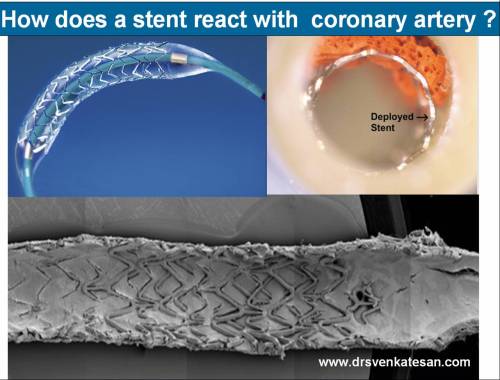
R.Virmani , circulation 2004

http://circ.ahajournals.org/cgi/content/full/109/6/701?maxtoshow=&HITS=10&hits=10&RESULTFORMAT=&fulltext=stent+%27allergy%22+&searchid=1&FIRSTINDEX=0&resourcetype=HWCIT

Read Full Post »

Myocardial infarction (STEMI)  occurs in two distinct arterial  territories .The anterior LAD circulation and postero- inferior RCA/LCX circulation.The incidence is equally shared.

There has been some  learned and unlearned perceptions about Inferior MI.

Inferior MI is less dangerous than anterior MI.  True or false ?

Answer: Essentially true in most situations.

Reasons.

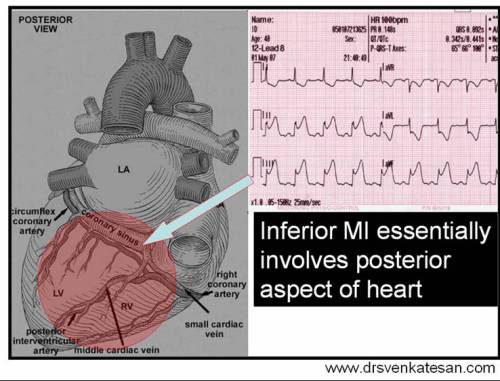
Inferior wall of the heart (strictly speaking there is no walls for heart , only surfaces , which blends with adjacent areas)  inferior wall  is formed by diaphragmatic surface and posterior surface.Inferior MI can occur by either RCA or LCX obstruction.The outcome of inferior MI is determined by mainly by  the extent  of   LV myocardial   damage it inflicts.To  quantitate this  we need to know , how much of LV is supplied by RCA , or LCX or combination of both ? This depend on the coronary dominance .It is estimated , the bulk of the LV is supplied ( up to 75%  ) by LCA. This becomes further high in left dominant circulations . In fact , it is believed LV can never get involved in non dominant RCA occlusions. This has brought in a new terminology  called “Small inferior MI”.Inferior STEMI due to PDA  occlusion or in a co -dominant circulation is not yet studied

Apart from the above  anatomical considerations the following clinical observations  have  been made regarding inferior MI.

  • When thrombolysis was introduced , many studies  suggested the the ST elevation in inferior  leads toched the isolectric levels  in most situations even without thrombolysis.Technically, this implies spontaneous , successful thrombolysis are more common in RCA. Among the thrombolysed ,persistent ST elvation is a rare phenomenon.
  • The well known difference in the conduction defect between anterior and inferior MI  is an important contibutor for better outcome in the later.(AV blocks in inferior MI , are often transient, non progressive, supra hisian location rarely require permanent pacemakers)
  • During acute phase cardiogenic shock occurs in a minority (That too , only if RV shock is included )
  • Even in the follow up the ejection fraction in inferior MI is  almost always above  40%. In many EF is not affected at all.
  • Progressive adverse remodelling of LV is rare

When can Inferior MI be dangerous ?

Anatomical factors

Inspite of the  above  factors  inferior MI can not be taken lightly . Especially when it  extend into posterior, lateral , (Rarely anterior) segments.

While  posterior extension  is often  tolerated , lateral extension is very poorly tolerated .This is probably explained as  the extension involves the vital free wall of LV and the laplace forces could precipitate LVF. Free wall rupture is also common in this situation.

Posterior extension , predominantly involves the surface of RV which is less important hemodynamically. Of course incidence of MR  due to it’s effect on posterior mitral leaflet can be trouble some.

inferior MI ECG

High risk clinical catagories.

Out of hospital STEMI  are at  equal  risk irrespective of the territories involved  .This is because,  primary VF does not differentiate , whether  ischemia comes from RCA or LAD .

  1. In elderly , dibetics and co existing medical condtions  the the established  benign   character  of  inferior MI disappear, as  any  muscle loss  in LV has equally adverse outcome.
  2. Even though  inferior MIs are immune  to cardiogenic shock  , a equally worrisome  prolonged hypotension due to high vagal tone, bradycardia, plus or minus RVMI can create trouble. Fortunately , they respond better to  treatment. Except a few with extensive transmural RVMI outcome is good.
  3. Presence of  mechanical complications of  ventricular septal rupture , ischemic MR can bring  the mortality on par with large anterior MI.

How different is the clinical outcome of infero-posterior  MI with reference  to the  site of  coronary arterial  obstruction   ?

The sequence of  outcome  From  best to worse  : Non dominant RCA* → Dominant RCA but distal to RV branch → LCX dominant with large OMs

* It is believed   an  acute proximal  obstruction of a  non dominant RCA may not be mechanically significant, but can be electrically significant as it retains the risk of primary VF and SA nodal ischemia. The ECG changes  can be very minimal or  some times simple bradycardia is the only clue. One should be able to recognise this entity (Non dominant  RCA STEMI)  as the outcome is  excellent and these patients  would never require procedure like primary  PCI

** A inferior MI due to a dominant LCX and a large OMs have comparable outcome as that of extensive anterior MI. The ECG will reveal ST elevation in both inferior and lateral leads.

***In patients with prior CAD  and collateral dependent  multivessel disease  the  inferior anterior sub classification does not make much sense as  entire coronary circulation can be mutually interdependent.

Final message

Inferior STEMI  generally lacks the vigor  to cause extensive damage to myocardium in most situations .Further they respond better to treatment. Risk stratification of STEMI based on the location of MI has not been popular among mainstream cardiologists. This issue needs some introspection as  the costly and complex treatment modalities like primary PCI  is unwarranted in most of the low risk inferior MIs.

Related posts in my blog:

1.Why thrombolysis is more effective in RCA?

Read Full Post »

Total coronary artery occlusion is a common finding in CAD  especially in chronic stable angina. Normal coronary blood flow is 5 % of cardiac output  that amounts to 250-300ml/mt.At an average  heart rate of  70/mt  , each  beat  injects  about 5cc blood into the coronary circulation.This is shared between two coronary arteries.  This means , only few CC (2-3cc) of blood enters  each coronary artery with each cardiac cycle .

When one of coronary artery is totally occluded what happens to the coronary

blood flow ?

A.Total coronary blood flow  can be be  maintained   normal  at rest  as it  forms  only about 5% of cardiac output  (or it is only  slightly reduced )

B. It is believed , the unobstructed coronary artery  could receive the blood meant for the contralateral coronary artery. This  possibly explains the increased coronary artery diameter in the non obstructed artery.

C. It’s nature’s wish ,  that the  contralateral  coronary artery  shall share  50% of  it’s  blood through  collaterals if available.

D.If collaterals are not formed it , the unobstructed coronary  artery  may be over perfused with double the amount  of blood flow.

E. Some times , the collaterals steal  much more than what  the  obstructed coronary artery  deserves and make the feeding coronary artery ischemic. This is many times observed in  total RCA occlusion with well formed  collaterals  from LAD/LCX.

F.The collateral flow  in CTO also depend on whether flow is directed from LAD system to RCA or from RCA -LAD system. The LAD is better placed to assist RCA than vice versa.This is for two reasons.1.LAD blood flow is higher than RCA so it can share it.2.The driving pressure is more  from LAD -RCA , as RCA can receive  blood flow even during diastole .

F.During exertion , the coronary hemodynamics become further complex.The collateral’s are traditionally thought to be less than adequate during times of exercise.But it is more of a perception than solid scientific data.This rule  may be applicable in only certain group of patients. We know CTO patients with very good exercise tolerance who have documented collateral’s.

G.Collaterals can be either  visible or invisible by CAG. The strength of collateral circulation is not in it’s visibility but it’s capacity to dilate and  respond to neuro humoral mediators at times of  demand.  Currently  , there is lot to be desired  regarding  our knowledge about  the physiology  of visible collaterals , no need to  mention about invisible collaterals !

Final message

The above statements  are based  on logics and observations .

Is it not a  irony  in cardiac literature ,  where  thousands of articles  are coming out every month  to tackle  totally occluded coronary artery(CTOs) ,  there is  very little data   regarding the coronary hemodynamics in chronic total occlusion .   How  does a patient with CTO can manage a active life with only one functioning  coronary artery ?

Read Full Post »

NSTEMI constitutes an important sub group of ACS. In fact it  forms the major  group. Real world data would indicate it   UA/NSTEMI could form up to 75% of all admissions for ACS in any cardiac emergency units. Risk stratification of NSTEMI is important and  is available. It is  one primarily with clinical features , ECG and troponin positivity. Classifying NSTEMI   with reference to underlying patho anatomy is not available.

Classifying  NSTEMI based on the following is  is suggested .

A.Based on the  extent  of infarct.( For example there is no entity called extensive NSTEMI  unlike STEMI)

B.Based on the Location of NSTEMI .

Currently , NSTEMI simply means there is an infarct some where in the heart ? Should we not localise it ? Is it not surprising , we have not attempted to localise  NSTEMI  so far ?

C.Based on the coronary anatomy : RCA NSTEMI vs LAD vs LCX NSTEMI.

The reason is two fold.

1.NSTEMI is often patchy , subendocardial . Some times  only islands of infarct can occur.But , .How common is segmental NSTEMI ? May not be common, still if wall motion defect occur it must be an segmental MI.Some estimate wall motion defect in NSTEMI is around 25%.

2.Is  there any clinical purpose for localising NSTEMI ?

Some would  think there is no real  purpose. That does not  mean ,  we should not attempt to do it. In fact there is an  important reason ,  we  need to  localise  NSTEMI. Triple vessel disease ,  is the common pathology underlying NSTEMI. They often have  multiple critical lesions as well. Identifying the  the  culprit lesion is not an easy task. If we know the site of infarct ,  however small it may be , it  helps us fix  the coronary artery.

A real dilemma could occur in patients  with NSTEMI , who has a  90 % lesion  in  RCA and  50 % proximal LAD lesion  . We ( tend to !)  take it as granted  ,  RCA  lesion is likely to be responsible for the NSTEMI. But  the real culprit  could be  the  recannalised LAD .  If it is so ,   the 50%  LAD lesion  could   be  more important and if you leave it free there is a strong  likely hood of recurrent UA. If we could some how located  the NSTEMI in the LAD region in this patient  , he could  get a PCI for LAD as well.

Of course , there is  an   universal approach available “Doing PCI for all suspected culprit lesion however mild it may be ”  . Unfortunately , it  increases the metal load for the  patient, which is an independent risk factor for a future ACS.

How to locate NSTEMI ?

So , it is often helpful to locate NSTEMI  . Of course ,  it needs little more efforts. A very meticulous echoc cardiography can aid in locating  the subtle  wall motion defects in NSTEMI . Perfusion studies/PET studies may be indicated in occasional patients.Myocardial contrast echo can be useful.

Coming soon

Difference between Anterior NSTEMI and inferior NSTEMEI

Read Full Post »

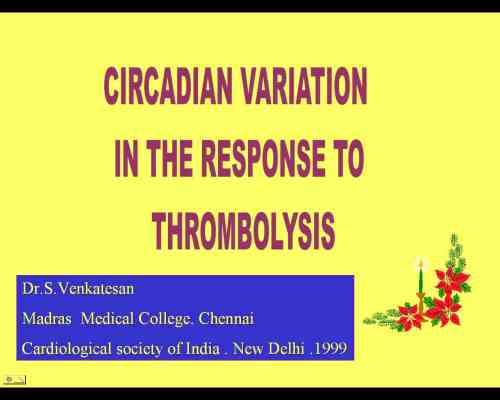
In  thrombolysis  of  STEMI ,  there is a   less  published ,  but   interesting observation . It is  often noted , variation  in the efficacy of streptokinase according to the time it was administered.It was most effective in the evenings and least effective in the early morning hours. The mechanism  is thought to be  due to  ,  pineal gland driven   endocrine   spikes    ,  that result in  a  less pronounced  progoagulant activity in the evening hours.    There could be a therapeutic significance for this phenomenon.

The following paper was presented as an abstract in the cardiological society of India annual scientific sessions in New Delhi in 1999.

CIRCADIAN

Download full PPT presentation stemi thrombolysis ppt

Read Full Post »

When  a doctor is confronted by serious  doubt  ,  what will be the outcome for the patient  ?

Can  doubting  be beneficial for a patient ?  . It seems so ,  according to  EBM which  stresses   about statistical outcome at every turn of events in a  patient who  is critically  ill .

Is  something ,  always  better than  nothing   ?   Our  limbic  system tends to think so .  It  may not be true. But  in  dire situations ,   many  things  (Proven , unproven)  need to  be tried  however doubtful it ‘s  efficacy  may be  .This is  akin to an  emergency in an  airplane. Even here there need to be a logic.

Then ,this question  arises . How do we make  sure ,  we have a  dire situation on hand  ?

This is the key issue ,  in  the  decision making  for the   critically ill patients .  It  needs  experience ,  only experience !  Though the principle of uncertainty  is the fundamental rule in medicine ,   EBM  aims to bring some degree of certainty in medical therapeutics.

ebm evidence pci coronary

Benefits of doubting in coronary care unit.

In  a  sinking patient  with cardiogenic  shock  , try  the maximum treatment . Even if , the patient is  in severe shock  , take him to the  cath lab ,  try  open the coronary artery . Give the benefit of doubt  to him even though the chances of reviving him is less than 10%.

Risk of doubting in Coronary care unit.

A.Elderly STEMI  with SHT,(Arriving late ,  with  an unknown time  window  after an MI ) To thrombolyse or not ?  . There is  no benefit of doubt here.  Do not thrombolyse. Here , apply  the benefit of doubt against thrombolysis .

B. Chest pain with  LBBB (Thought to be new onset LBBB ) don’t ever rush to thrombolyse.  Wait for the enzyme result . Don’t try to thrombolyse your doubt , instead  thrombolyse the  confirmed thrombus !

C. Patient with persistent ST elevation following thrombolysis ,in an  otherwise asymptomatic and stable patient. Don’t  pass on  ” your doubt ” of salvaging   at least  some myocardium  by rescue PCI .Rescue  should be done before death. You can not resuscitate  dead myocytes.

Final message

The concept of   giving  the  benefits of doubt  to the patient   is a widely prevalent practice  in medicine .This concept is alive  and popular , not because it has proved effective, but because of the primitive   human perception and cognition  , namely “Something is better than nothing ” !

Common sense and logic would suggest , whenever  there is  a benefit  for doubting there would be a  equal (  or  even  more ) unmeasured  hazards and risks . This  becomes  especially  true ,  when   a   physician makes  a therapeutic move  based on doubting than on conviction .

Read Full Post »

Sinus tachycardia in the early hours of STEMI is  a very common arrhythmia. This seemingly simple problem can be really worrisome to many cardiologists and give sleepless nights(While the patient may sleep comfortably !)

The importance of sinus tachycardia in STEMI  primarily lies in answering the following question

A.  Is it compensatory sinus tachycardia ? ,  Where in  , the left ventricle is struggling to maintain the cardiac output and works more  per minute to maintain the vital cardiac index

Or

B. Is it a non compensatory -Inappropriate Sinus tachycardia ?  It is a simple  response to heightened adrenergic tone  and   increased neural traffic from the injured ventricular myocardium . (or  high  baseline anxiety levels  )

It should be recalled , tachycardia in any form is  detrimental  following STEMI as it increases the MVo2 ie myocardial oxygen consumption. This is the reason ,  beta blockers are administered in this situation. Compensatory tachycardia  denotes , myocardium is working at it’s reserve capacity  , to prevent an  LVF that is impending . Hence ,  one should recognise , the compensatory tachycardia can not be  tampered  with ,  as we like ! .

How do you clinically differentiate a largely benign inappropriate tachycardia from potentially  harmful compensatory tachycardia ?

It is not an easy task. Heart rate  is typically around 120/mt   in  compensation to impending LVF.  While inappropriate tachycardia has no limits , it can exceed up to 140 or so . Further , tachycardia due to LV dysfunction has reduced variability.( Typically hovers around 120( +/- 5) .In stress or anxiety  heart rate  fluctuates  more .

Accompanying S3 suggest compensatory tachycardia . Even a few basal  crackles would make a diagnosis of  LVF .

The definite way to differentiate  could be   ( Also the dangerous way !  ) looking for  therapeutic worsening to beta blockers .

How to control the sinus tachycardia in STEMI ?

Beta blockers are  the  mainstay. Any of the beta blockers ,  metoprolol, atenolol, carvidilol can be used.Oral metoprolol up to 50 mg can be used. Beta blocker usage is primarily useful in non compensatory tacycardia. It should be  realised , the wide spread routine use of intravenous beta blockade has largely been discontinued as it has adverse outcome.The greatness of carvidilol,  in cardiac failure mainly applies to stable chronic cardiac failures. So ,  it is important to  recognise,  carvidilol can not be used liberally ,  in sinus tachycardia associated with impending or manifest LVF in STEMI.

*The potential source for tachycardia like dopamine,  dobutamine etc should be excluded.

Other options are

Digoxin ( Not withstanding the critics ,  it is still useful in acute MI with persistent sinus tachycardia ,The advantage is ,  it can be used without a need to differentiate whether it is compensatory or non compensatory!)

Ivabradine , a  wonder drug supposed to reduce selcetively  reduce the sinus rate without negative inotropic action could be tried.(Data lacking for this use )

Final message

Sinus tachycardia ,  may be seen as a simple arrhythmia .  but, the circumstances  in which it occurs , it’s mechanism and  the limited therapeutic options , narrow safety margin of beta blockers  , makes it a interesting clinical issue.

Read Full Post »

Poverty is the number one killer in this world . Malnutrition, infectious diseases  , poor maternal child and health are the leading killers. The life expectancy is short in many underdeveloped countries.

While the scenario  is dismal for most of the poor people in this world.

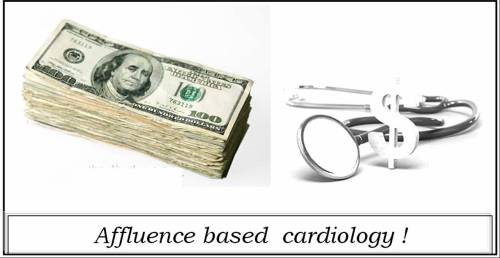
Can affulence be a risk factor for poor health ?

Yes. This seemingly awkward  answer is  many times true. The disease  acquired by affluence is labeled attractively as life style diseases . They are : Obesity, Diabetes mellitus, cardiovascular diseases, some forms of cancer etc .

coronary angiogram cardiology

How else can affluence affect the health of an individual ?

Apart from affluence being a risk factor ,  it  is a powerful  risk factor for getting  inappropriate  medicines,  procedures  &   surgeries  ,  hence  the resultant  adverse effects.

It is a  non-established fact , in  both  developed  and developing world , the single important  predictor of a given form of treatment  say  revascualrisation or  surgery  for CAD  is affordability to the treatment (Either  by insurance or  self payment) .Financial well being , interferes with applying  valid scientific principles on them . Applying  the  results of  the  land mark trials CAD trials ,   COURAGE  &  BARI 2D  are very difficult  for them , which argues for   simple , less costly , less glamorous medical therapy for CAD.

Example 1

A wealthy adult  male  who  lands  up for master health check up  in a big state of the art  hospital found to have a  borderline stress test , CAG reveals a single vessel distal RCA disease .He was given an  option of PCI , undergoes  it ,  and ends up in a complication and damages his entire  inferior myocardial  territory.

Had he been a poor uninsured  guy , he would have promptly be  labeled as stable CAD and would have been on  good medical therapy*  and his  myocardium could have been saved .

* PCI can never be an option  for him ,  courtesy : His wealth status !

Mind you , this is not an isolated  example, such  affordability  guided treatment modalities  are rampant in the society and has a potential to make  our rich and  affluent a major health risk target !

Final message

Being wealthy and affluent can also be a health risk factor. While the poor suffer from lack of health care the  rich many times suffer because of  too much health care ! (or  Is it care less ,  health care ?)

Coming Soon

How reccession  time  is a  boon  for human health  !

Read Full Post »

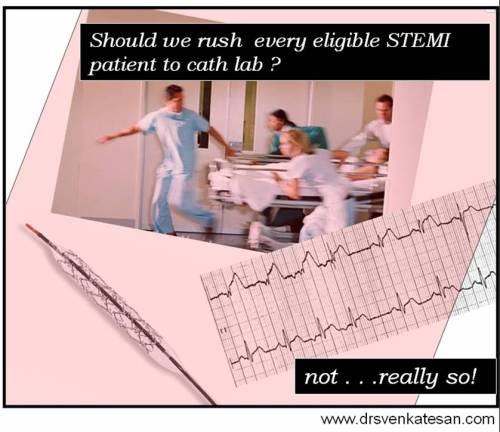
Primary PCI  has proven to be the   best  option for management of STEMI . But it need to be  done very early by a an experienced team in a good facility . (Note ,  it is not the individual expertise that matters !  Ronalodo alone can never guarantee a   match win  !  )

Any treatment ,  which has a great therapeutic potential also  carries a hazard .

So , these treatment must be used with caution.  Not every STEMI patient , has a high risk of death.  In fact the mortality  in some of the subsets of STEMI ,  can be less than 1%. If , a  STEMI patient with a likely 1% mortality   is going to get a procedure with  3-4% ,  risk it is bound to raise a  validity  question ?

primary PCI PTCA STEMI CORONARY ANGIOGRAMS

What are the situations in  STEMI , where primary  PCI could be dangerous*?

* The  term dangerous here  means ,  Risk > Benefit .

Side vessel STEMI : STEMI in  branch coronary arteries. Main vessel STEMI(LAD,RCA,LCX ) has higher risk than side vessel STEMI( Diagonals, OMs, Septal) .

Side vessel  STEMI is not easy to diagnose in ECG ,  but an MI with ST elvation restricted to  only  2 leads  could be a side vessel STEMI.

The following could be some examples.

  • 1 /AVL , High lateral
  • V2 V3 ,   Septal
  • 3 AVF ,  PDA/RV/ Acute  marginal
  • V5 V6     OMs/Ramus

A spontaneously evolving  STEMI , with  ST segment   returning   towards  baseline  and T wave  getting inverted .This indicates IRA is either partially patent and  the coronary blood flow is in the salvage mode. Here , thrombolysis is going to be very effective .

Final message

In the management of  STEMI  , primary PCI could be  consciously avoided in some of the patients   to improve the overall outcome .

Read Full Post »

Coronary arterial spasm is a commonly discussed entity  in clinical cardiology. Originally described by prinzmetal decades ago .It was reported to occur only in coronary care units as variant angina .There is nothing called stable spasm every episode of spasm is considered as unstable angina.

How common is coronary artery spasm ?

This condition thought to be very  common during ACS , but  notoriously difficult to confirm.In fact many of episodes are clinically suspected and never confirmed. There has been lot of provocative tests for confirming coronary spasm like ergonavine etc.None of these tests were  neither useful nor practical.

What are the clinical situations where coronary spasm occur ?

Old concepts die hard.Most of us believe , the most common cause for coronary spasm is prinzmetal’s  angina ie , angina   in normal coronary arteries or  with minimal lesions .Clinical experience ,  has taught us coronary spasm can occur in all spectrum of acute coronary syndrome or even chronic coronary syndromes.

Some believe every episode of STEMI will have a component of coronary spasm.

In NSTEMI/Unstable angina spontaneous coronary spasm is an important pathogenetic mechanism

Now,  we witness transient coronary artery spasm in the cath lab due to catheter and other hard ware.The spasm  here  , is secondary to mechanical stress and this in no way related to the coronary spasm described by prinzmetal in the pre cath era.

What is the link between coronary spasm and electrocardiogram ?

The most common  fallacy among  coronary care physician is , if it is spasm  there must be ST elevation

The classical cardiology teaching all over the world , has been so powerful  this myth continues to prevail over . The fact  of the matter is ,  the  coronary arterial spasm  , can never have any direct impact on the ECG. (Unless , coronary smooth muscle generate ST currents !)  . So , whatever  be  the effect of spasm it  is through it’s effect on the myocardial  blood flow.

Hence ,  it is not the coronary artery spasm that will dictate  the movement of ST segment . It is the impact of myocardial blood flow  to the layers of the myocadium  namely , endocardium, epicardium  , epicardium (  or a combination of  the above )  that will dictate ST segment dynamics.

What are the  the ECG features of coronary artery spasm ?

It can be

  1. ST depression
  2. ST elevation
  3. Only with T wave changes (Tall or Deep T invrsions)
  4. Flattish ST segment  or  rarely , entirely normal ECG indicating balanced ST forces

Among this , the most common manifestation of coronary spasm is thought to be ,  subendocardial ischemia and resultant ST depression .This classically occur in many cases of NSTEMI/UA .

This makes  ST depression  the dominant manifestation of spasm  ,

How coronary spasm can elevate the ST segment ?

If it  can   induce a transmural ischemia  it  can elevate a ST segment . Does  all episodes coronary spasm result in transmural ischemia ? No,not at all .in fact it happens very rare  as we have already seen .

To result in transmural ischemia , the spasm should be total &  sustained ,   at least for few minutes   to   completely   occlude  the blood flow .

Milder forms of spasm can elicit only  a  sub endocardial ischemia  that  depress the ST segment.

*There is a rare variety of spasm where subepicardium is more affected than endocardium and hence ST elevation may occur.

What is the effect of Nitroglycerine on coronary spasm ?

This is a very powerful coronary spasmolytic agent.We can witness it’s action more vividly in cath lab .

It brings back the ST segment to neutral position , from either a elevated or depressed state  .Many believe , ( may it’s a fact ) much of the early  benefit of angina relief in UA/NSTEMI is  amelioration of coronary spasm

Is coronary spasm a neural event or a biochemical event ?

The exact  answer is not known .It should be chemicals as  neural  signals are also mediated by chemicals.

What are the biochemical mediators of coronary spasm ?

  • Smooth muscle calcium : Calcium flux is the immediate cause for spasm
  • Mediators .Neural :Catecholamine ,
  • Thrombus  secretes  Thromoxane A2  which is a powerful vasoconstrictor

Smooth muscle calcium

Is  coronary vasoconstriction  and  coronary spasm  are synonymous ?

Both terms are synonymous . Vasoconstriction is often used to refer  constriction of  microvasculature

while  spasm  often describes  the event in large  epicardial vessel. Some times the term coronary vasomotion is used to describe  fluctuating coronary arterial tone.

What are the determinants of coronary artery spasm ?

  • Location (RCA>LCA)
  • Lesion characteristics -Eccentric overhanging lesion can trigger a spasm by  the plaque ‘s weight.
  • Thrombus content
  • Acuteness of the event
  • Adrenergic tone and nerve activity
  • Concomitant betablockade  .  Theoretical risk ?

What are the types  of coronary spasm ?

  • Discrete ring or band like  spasm
  • Segmental
  • Diffuse long segment  spasm
  • Multilevel spasm in same coronary artery
  • Pan coronary spasm entire vessel (rare)
  • Remote spasm away from catheter tip

Unanswered questions in coronary spasm

Can a totally normal  coronary artery go for spasm all of a sudden ?

It is thought to be rare. Even in prinxmetal series some amount of atherosclerosis was documented in most patients.

What is the relationship between spasm and adjacent lesion ?

Spasm following PCI :Can spasm crush a stent ?

Can a  coronary collaterals go for spasm ?

Logically  Spasm  can  occur  coronary collaterals .But it is difficult to document .coronary collaterals eventhough  has three layes as that of artery (Intima, media, adventia) th medial smooth muscles are less sparse. Advential lack vasa nervorum and hence neural input is less.So spasm is a rare event in coronary collaterals

Read Full Post »

« Newer Posts - Older Posts »