Feeds:
Posts
Comments

Posts Tagged ‘pci’


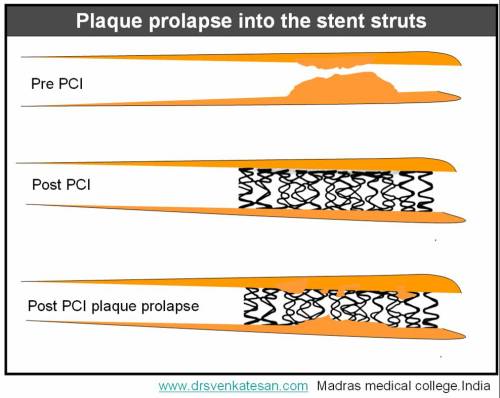
Coronary stents have revolutionised the management of CAD. Stents are metallic scaffolding devices that help keep the atherosclerotic plaque  plastered within the coronary arterial wall.Thus it gained the name angioplasty. Stents have aradial strength that  exerts a constant force on  the plaque . Since metals are unfriendly partners for coronary artery , we need to have minimum metal within the coronary artery.The stent struts weave around the lumen generally the stento/ artery area ratio should be as less as possible (15%).

But this has a trade off .The uncovered area of plaque tend to project into the lumen .This is many times not significant.But can be a problem if the plaque is very soft and bulk of the lipid core may reenter the lumen.this event is called plaque prolapse.

plaque-prolapse

What is the time taken for plaque to prolapse ?

Generally it is late event.But it can happen immediately after the procedure also.

Which type of lesions are more likely to have plaque prolapse ?

Eccentric and complex lesions especially with overhanging edges are prone for prolapse

What is the sequale ?

It can be benign.If there is a erosion due to stent struts can precipitate an ACS.It progresses into instent restnosis in many.

What is the angiographic appearnce ?

Angiographically it often appears as luminal  irregularity withi stented segment .

Many times , it may appear as a filling defect also.

Is there any specific issues in plaque prolapse in drug eluting stents ?

Coornary artery is not drugged uniformly by the drug eluting stents.In fact contact  lines of metalic struts  , through it’s micropore oozes the drug with polymer.Pathological studies have revelaed non homogenous drug penetration and resultant irregularity on the plaque surface.This could amplify the plaque penetration preferentially in few areas.

How to manage plaque prolapse ?

It should be managed as any other instent restenosis.Plaque resection with atherectomy devices has not solved the problem to the desired levels.A second stent is the most common approach advocated by the cardiologists.(Whic is not ideal though !)

Read Full Post »

Post myocardial infarction revascularistation either by PCI or CABG forms the bulk of the coronary interventions world wide.There has been considerable controversy in selecting the patients for the procedure.

Certain basic rules are to be applied.

  • Never do any thing on a totally asymptomatic and fully functional patient.(Functional , means good exercise capacity of atleast( 10Mets).Just medical treatment with good doses of statins, beta blockers will do.
  • If a patient has persistent angina  following MI  ,the issue is relatively simple as  they are  candidates  for CAG  and intervention .
  • The issue becomes little complex when the primary complaint is breathlessness and echo showing  LV dysfunction.

This dilemma is due to a  simple fact

coronary revascularisation has a  great impact in relieving angina but has  less impact in reversing

left ventricular  dysfunction

So,  how do you approach a patient with LV dysfunction and exertional  breathlessness and absolutely no chest pain ?

  1. Do a  CAG
  2. Assess the lesions if any (Some times,  to our surprise there may not be any critical lesions at all ! )
  3. If there is / there are critical lesions try to corroborate with infarct segments.(Use Echo for this correlation)
  4. Don’t bother much,  if a  vessel has a lesion  that is supplying a scarred myocardium.
  5. If there is gross LV dilatation, mitral regurgitation and LV clot refer these pateints  may benefit  from surgical management

One of the rules written by the cardiology community over the past few decades has been

We must document viable myocardium before doing a revascularisation procedures on them.

This rule was self imposed ,  to prevent inappropriate revascularisation in  post MI population.

So , a  gamut of investigations (Both invasive and non invasive came into vogue) to identify viable myocardium in post MI population. Stress echo, Thallium-sesta MIBI, PET  to name a few .

Even after liberal usage of these invesitgations , we realised ,  the confusion in the  optimal selection of candidates for revascularisation has not settled.

In fact,  the correlation between viabilty and subsequent interventional benefit is  inconsistent .Not withstanding this  issue  ,cardiologists inspite of the negative results of OAT and TOAT trials ,  started  opening or by passing any occluded vessel irrespective of viability status.

Unanswered  &  Unasked questions in myocardial revascularisation ?

1.Why viable myocardium is viable even in the adverse compromised vascular  environment ?

It  is viable for the simple reason it has some capacity to be alive . By it’s inherent survival capacity (Survival of the fittest ) or it somehow gets the nutrients by cell to cell perfusion.

2. It is viable allright  ,  why it is not contracting ?

Because ,  it is biochemically and metabolically alive (Can be documented by FDG PET scan mismatch ) but it can not synthesise adequate ATPs to make the muscle contractile.

3.”Viable myocardium is viable ” what more you want from it   ?

Simple viability is not suffice . How to make it mechanically active and contractile ?

4.Is viable  myocardium    synonymous with ischemic myocardium ?.

No,  it is not (Contrary to the popular perception ) .

5. Is it not  common to find dysfunctional segments with good TIMI 3 flow ?. So what is the purpose to document viability ?

It is not suffice to simply document viable myocardium but it is an absolute necessity to prove this viable segment is also  critically ischemic .

7.If angina is  a sign of viabilty why most of viable myocardium is painless ?

This again confirms the fact , much of the viable myocardium in the post MI phase is not ischemic but” still dysfunctional” waiting for healing time. This concept  was  introduced with great fanfare* as  stunned myocardium ,  20 years ago , which was subsequently rejected my mainstream cardiologists , as this concept tend to  restrict the  freedom of interventionists. * Even though ,the concept was genuine and proven scientifically !

6.Are we  certain , the  viable ,  non contractile myocardium  (Which we painstakingly document )  will get back the contractility once the  segment is    revascularised?

Absolutely not. (With lot of PET study doumentation )  This,  we can not guarantee even in ischemic, viable segments  ,  while in the  non ischemic, viable segment it is all the more unlikely.

7. What are the chances of these viable but  non contractile myocardium  regain the contractility  by natural course ?
Very significant chances .In fact every patient recover some LV  function spontaneously over time .

Final message.

  • Revascularisation is non controversial in patients with angina
  • In patients with  primary symptoms of dyspnea  ,  it is less effective and documentation of myocardial viabilty per se will not guarantee successful outcome following revascularisation.Out come depends on  multiple factors .

Read Full Post »
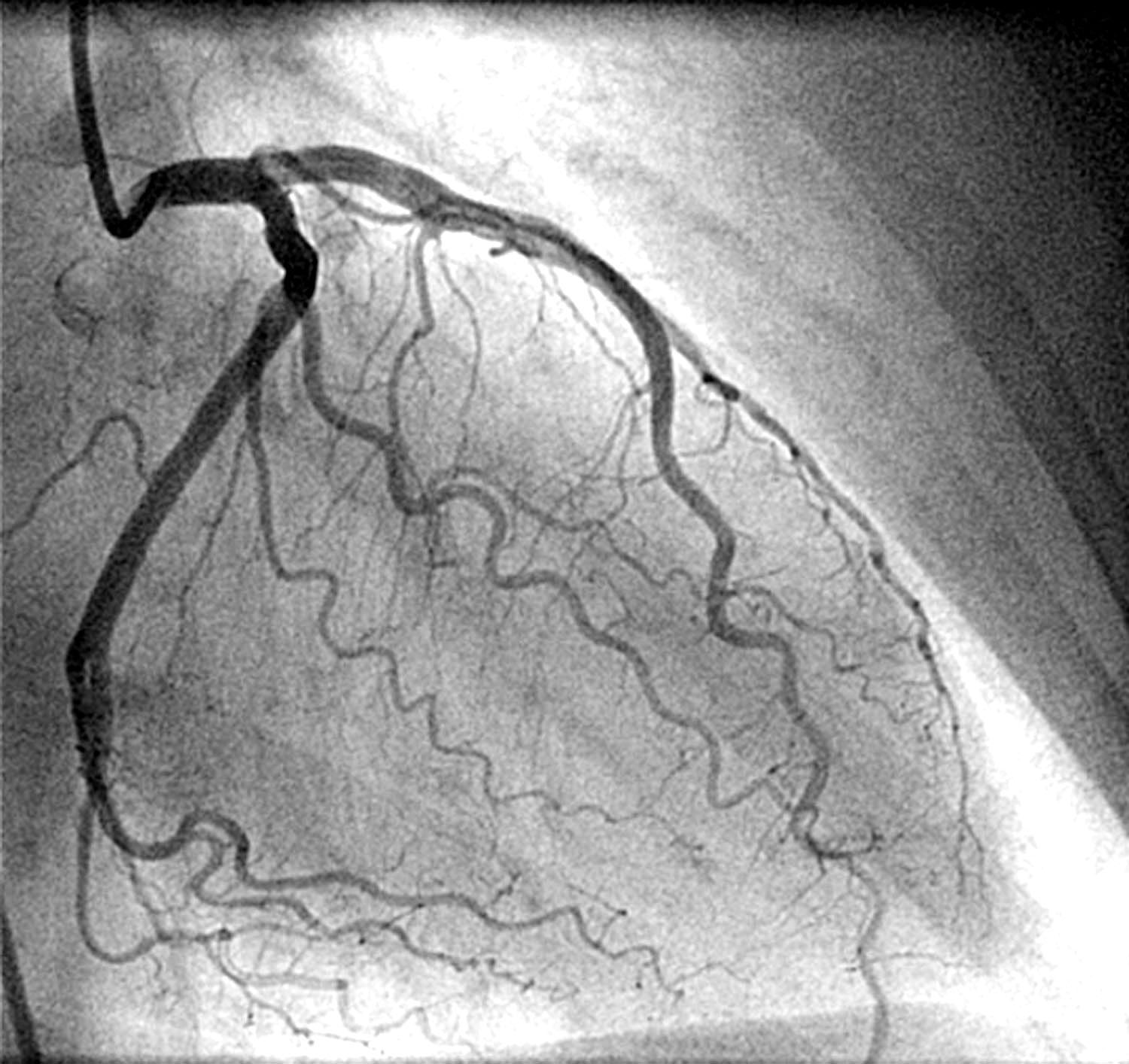
Left main coronary artery disease (LMCAD) often evokes  a panic reaction  among cardiologists .Not every LMD deserve that re. To  label  it as  significant, we have a criteria ,  that is 50% diameter stenosis.  So what you do , for a tapering  or narrowed left main with 40% stenosis. Isolated insignificant left main is rare *, but real incidence is not known.  LMCAD  is  most often due to  , atherosclerosis of left main coronary artery without limiting the flow.

What are the options ?

  • Leave it alone, with intensive medical management assisted by high dose statin(80mg)
  • Elective PCI with stenting , even though the lesion is not significant.

*If associated LAD  or LCX is there decision making is easier .

How  significant is a coronary stenosis ?

The significance of a coronary lesion with reference to “lumen diameter obstruction” is basically flawed. The significance of a coronary stenosis, by tradition is  based on it’s hemodynamic impact ,right from the  CASS days in early seventies.Unfortunately our mind set has not changed even after realising    non obstructive – sub critical lesion is more prone for acute coronary syndrome.  Is it not ironical to call a  40% lesion a non significant one !

So, the  significance of coronary stenosis is two fold.

  1. Hemodynamic  significance
  2. Clinical and  pathologic significance

The former predisposes to often chronic stable angina, later likely to result in ACS.

How will you approach a apparently insignificant left main disease ?

A 40 % lesion in left main is hemodynamically not significant , but pathologically very significant.It needs intensive treatment. Plaque passification with medical approach is first choice.If the lesion morphology is eccentric,  has irregular margins or involves  LAD  or LCX ostium doing a PCI or even a CABG is to be considered in spite of the lesion is  hemodynamically insignificant .

Why , PCI is   considered  “not appropriate”  for   less tighter lesions , even though these lesions  have great clinical significance ?

The answer is simple, The risks  and the  potential cost are more than the benefit !

And further ,  stents are  not innocuous devices  either  , they  always carry a risk of sudden occlusion as like  a sub critical lesion  !

Answer to the title question

True incidence is not known . Our experince (Class 1 c evidence) would suggest Left main disease constitutes up to 10 % of CAD.Among this one third would be hemodynamically insignificant

Suggested reading

Handbook of Left Main Stem Disease


edited by Seung-Jung Park

hbleftmn

//

Read Full Post »

                                                    Drugs are poisons , whenever it is administered without valid purpose. it can enter human body  in many ways (Oral, intravenous, percutaneous etc ) And now we have another route namely intracoronary !

                                                   In quest for prevention of restenosis, many of the anti cancer drugs are now delivered directly inside the coronary arteries .These drugs are secreted  like a sustained release  tablet from the drug coated stents.These drugs are expected to prevent restenosis within the stented segment.But, after years of  intense debate and research  , we realised that ,  drugs  eluted from the stent  could damage the distal coronary vascular bed and coronary microcirculation.( And thus came the epidemic of acute stent thrombosis ! )

                                                The tender and sensitive coronary microvasculature  is constantly exposed to  these  powerful anticancer and immmunosuppresive  drugs .It is a great surprise , no body thought of  this dangerous drug -coronary artery interaction ! It required the genius of Renu virmani and others to point out this.

But still , the cardiology community by and large , fails to consider  this an important issue.This is proven by the fact, usage of DES is  still increasing  and used mainly as an off label indication.

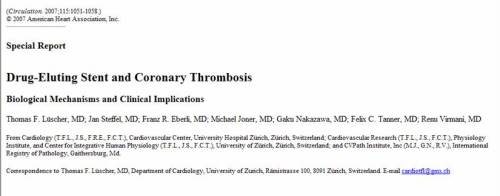
Read this land mark article from circulation

picture1

http://circ.ahajournals.org/cgi/content/full/115/8/1051?maxtoshow=&HITS=10&hits=10&RESULTFORMAT=1&author1=renu+virmani&andorexacttitle=and&andorexacttitleabs=and&andorexactfulltext=and&searchid=1&FIRSTINDEX=0&sortspec=relevance&fdate=1/1/2007&tdate=12/31/2007&resourcetype=HWCIT


Questions that need to be answered

  • What is the long term effects of drugging a coronary artery ?
  • Is no reflow or slow flow  more common after DES , because of the adverse drug reaction in the distal vascular bed ?
  • If a patient  with  DES  undergoes a CABG later what  would be  the impact of the  drug on the graft ? Will the functional vasodilatation   affected ?

Final message

                                  A drug , to get a legal clearance it has to undergo  hundreds of rigorous tests . Finally it is cleared for that  specific indication for which it is tested  .Just because a drug is cleared for one purpose ( Paclitaxel for malignancy ) it does not mean it is safe to use for any other  purpose for which it is deemed to be useful . Exactly the  opposite is happening   in the  the field of interventional cardiology . No body wondered to think what would be the effect of these drugs on the normal coronary endothelial cells and vasculature.Is it not a crime ,  without analysing this particular issue  , dozens of drug eluting stents have been released in the market . And now,  sounds of crying  foul is heard world wide !

Let us thank  , the so called negative forces in cardiology  for making this an  issue . In science ,  the watch dogs should bark  at  times of danger not wag the tail !

Read Full Post »

 Selected on the basis of ,  impact  on survival , relief of  human suffering index and also innovation

10.Percuateneous interventions

9.  Electrocardiography

8 . Hemodynamics of cardiovascular system

7.Fruesemide

6.Thrombolysis

5.Pacemakers

4.Defibrillation

3.Heparin

2.Prosthetic valves

1.Coronary care units


Waiting list

Concept of vascular biology

Statins

RF ablation

Nitric oxide

Total Artifitial heart

Echocardiography


Ten least important concepts and  inventions in cardiology

Selected based on duplication of research, futile scientific concepts and   of course impact on survival

10.Low molecular weight heparins

9.Cardiac resynchronisation

8.Rotablator

7.Multi  chamber pacing

6.Newer ARBs

5.C reactive protein

4.Three dimensional echocardiography

3.

Comments welcome  and please contibute

Read Full Post »

A poorly deployed drug eluting stent is far inferior to a properly deployed bare metal stents

  • Doing a plain old balloon  angioplasty ( POBA)  is not a scientific crime , millions of coronary lesion just  need that! ( Click here -Why POBA is important ? )
  • PCI is most effective during an ACS than a chronic coronary syndrome
  • Primary PCI is a race against time and muscle , not a race against money ! Don’t do it  for a  evolved   MI
  • Recognise , from the patient point of view  the term no reflow is  generally  synonymous with   failed primary PCI( It is semantics !)
  • Side branch  can be more important than main branches , so don’t sacrifice it often
  • Attempting a trifurcation  angioplasty is generally not in  the interest of the patient but  to show interventional expertise
  • Make sure surgical back up means, a table is reserved with a surgeon fully informed and ready

When in  doubt , it is always  better to err on a longer stent than a shorter one

Read Full Post »

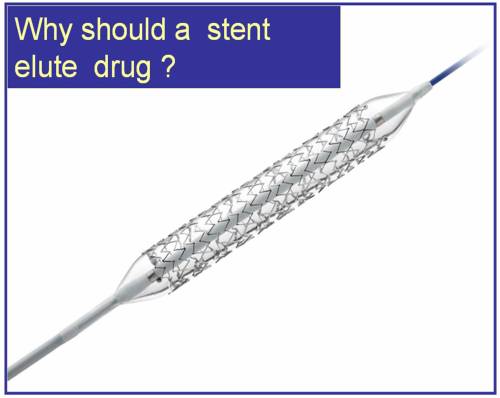
Stents are mechanical  devices like  a  spring ,  used to  keep an artery open after a PTCA or PCI.

des-why4

                                Bare metal stents(BMS) were found to have restenois rate of about 25%.  So it was perceived a stent should have it’s own protective coat , so that it won’t get restenosed.For this the researchers thought  anti cancer drugs are ideal as they block cell proliferation and thus neovascualrisation and restenosis.Alas, they were found dismally wrong ,  after all , neointiaml proliferation is only a part of the problem of restenosis  and simple blocking of cell growth is insufficient . The issue doesn’t stop with that, the anti cancer drugs incorporated within the stent simply can not differentiate normal from abnormal cells and

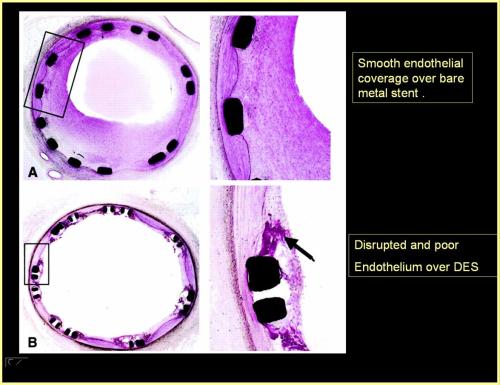
DES effectively blocks the normal endothelisation over the stents and make this highly vulnerable for acute stent thrombosis .

This complication is unique to DES and can result in SCD.Further ,during the last 6 years of DES , we recognised the restenosis rate has increased form the much hyped O % to almost 15% and it’s still growing . These  complications  has made a huge question mark over the future of drug eluting stents !

des-coverage

The concept of DES may not die , but which drug it should elute should be answered ! This  again is  going to be a long battle. So it is currently   adviced,  based  on common sense ( With due respects to  those RCTs  funded by industry )

Whenever you encounter a block within the coronary artery* Ask the following  questions in sequence  ,

  • Whether we can leave it alone  with medical therapy  ,  if the answer is no , proceed  to the next step !
  • Is there a possibility for plain balloon angioplasty in a given vessel (POBA, Yes !  the concept is not dead yet !)
  • If you decide a stent is required , Will  the  bare metal  do the job ?
  • In multivessel CAD  , Did the issue of increased metal load on the  long term outcome was considered ?
  • If lesions appear complex,  should we  not strongly consider CABG as an option ?

However  if we  have the habit of  ask ing the following  question  you are likely to deviate from scientific approach  

Is it possible to put a stent  across  the block ?

Yes , will be the answer most of the time ,and the patient will invariably get one or more stents  and carry a life long  stent related problems.

*The rule does not apply in Acute coronary syndromes

Also read this letter  posted by the author published in  British medical journal

Read Full Post »

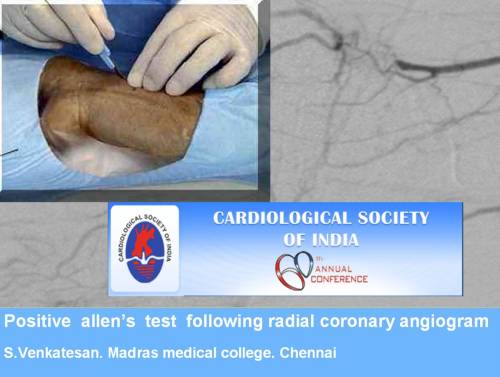
This paper was presented in the just concluded 60th Annual scientific sessions of cardiological society of India , Chennai.India

POSITIVE  ALLEN’S  TEST  FOLLOWING RADIAL CORONARY ANGIOGRAM

Venkatesan  sangareddi , G.Gnanavelu, R.Alagesan,V.Jaganathan.

Department of cardiology, Madras Medical College, Chennai.


                          Radial  artery  has become the  major access  site for the interventional cardiologist in recent years. Radial approach has provided increased patient comfort and  less access site complication. Many  of  the   complications  are  unique to radial approach mostly due to  anomalies of origin, and course while others are  hardware related .Unlike femoral arterial access ,  compromise of blood supply to hand is never considered a  threat because of dual blood supply to hand  .But the fact  is that,  it  could be sub-clinical  and the hand is rarely assessed for vascular insufficiency after a radial procedure.

             The aim of the study is to assess the  impact of   radial  procedures  on the  blood flow  to  hand . 20 patients who had undergone routine  radial coronary  angiogram  formed the study population. All patients had negative Allen’s test prior to the procedure. The mean procedure time was   25mts (18-45) .Standard  hardwares were used. Difficulty in crossing at forearm and   subclavian   was observed in  4  patients. Extravasation of dye  in forearm was observed in two. Allen test  was  done 24 hours  after sheath removal and  repeated 48 hours after the procedure .  4 patients   showed positive Allen test  at 24hrs. One  patient   regained  Allen negativity at  48hours. The incidence of positive Allen test at  24 hours is 20%. The compromised blood flow was correlated with the  procedure time, and a difficult catheter course .

                 We propose,  radial procedures especially , when prolonged has a potential to compromise palmar arch flow .This phenomenon  is  either  permanent  or transient  and  may be attributable to enhanced  endothelial tone and sheath related injury. Irreversible  compromise  of blood flow to  palmar arch  may  also occur  in radial dominant hands. Further enhanced  sympathetic tone can  spill over to ulnar artery as well . 

             It is concluded, interventions through radial route has hitherto unreported adverse effect  of  “Post procedural  positive  Allen test”  . It  implies , radial  procedures  could  convert  a dual blood supply  pattern of the  hand to ulnar dependent  uni-modal  blood flow  in a significant  subset of patients. This is important   to recognise, as it   precludes further radial procedures in the same patient.


Final message

Hand function could be as vital as our heart’s ,   please handle with care to avoid this complication


Click on the slide to download PPT presentation

radial2

Read Full Post »

                                Coronary artery  by pass graft surgery has become the most common cardiac surgery done world over ever since it was first introduced by Favalaro in 1969.The common indications  are, triple vessel disease and left main disease in any of the following situationsE.

Elective CABG(Non emergent)

1.Chronic stable angina

Either emergent or elective

1.Unstable angina

Emergency CABG*

1.Acute myocardial infarction.-Cardiogenic shock

2.Failed thrombolysis

3.Failed primary PCI

4.Complications during routine PCI(Cath lab crashes !  etc)

5.As an associate procedure after a  mechanical complication during MI (Septal rupture, Acute MR etc)

*In emergency situations even a single vessel disease would require a  CABG

Hybrid CABG

Combining CABG and PCI in the same patient is followed in very few centres .(Example LAD graft and RCA angioplasty)This is done in patients who have co morbid conditions who can not tolerate prolonged surgical times.Further there can be situations  one lesion is very ideal for PCI  while for other grafting is the only solution.

Controversial CABG

1.CABG as a primary revascularisation  in STEMI*

(Rarely done now , almost obsolete , primary PCI has almost replaced it  . . . but it is still  useful if performed within 6 hours of MI )

2.Incidentally detected CAD*  following routine coronary angiogram.

( *CABG for incidentally detected asymptomatic CAD is  increasing in many parts of world )

Inappropriate CABG

         If it’s triple vessel disese it must be CABG -CASS study (1980s)

                       Coronary artery surgery study (CASS) still has considerable influence among the  cardiology  community in the decision making process  for CABG , even though it is many decades old .There has been a phenomenal development in both medical as well as interventional techniques since  CASS . (Thrombolysis, Statins, ACEI, PCI  DES to name a few) .

                     When CASS study was done many decades ago,it was believed triple vessel disese constitute a  homogeneous population and  carry  the same clinical significance . For example a 90% proximal LAD , 50% RCA and 50% OM technically qualify for a CABG and unfortunately , some of them are  subjected to it even in  2008 !  Now we clearly know, it is not the number of diseased vessels  that is important, but it’s location, severity , LV function, presence or absence of diabetes . Finally , the presence of revascularisation eligible myocardium must be documented in all post MI patients . (Technically referred to viable & ischemic myocardium ).              

              Currently , with the  PCI  & medical management has grown so much, CABG should be reserved only for, critical triple vessel disese , with at least one proximally located lesion (Mostly  LAD  or Left main ), especially in diabetic individuals.

Read Full Post »

Answer: Do  coronary angiogram  for all patients  who had suffered from an acute myocardial infarction* ( Forget about all those mulitpage ACC/AHA  guidelines !).

For an  interventional cardiologist ,  it is often  considered a crime to  follow a conservative  approach !

*Caution This one line guideline is not based on scientific fact  but reality based . Ideally one should identify  high risk subsets among the patients who had an AMI .Patients who had complications during the MI get immediate CAG. Others need  a focused LV function asessment ,  pre discharge  sub maximal excercise stress test or perfusion studies .But this concept has been  virtually replaced by pre discharge coronary angiogram for all ,  in many  of the centres in the world.

Read Full Post »

« Newer Posts - Older Posts »