Feeds:
Posts
Comments

Posts Tagged ‘primary pci’

Coronary artery stenting  , many consider  as the 2nd revolution in cardiology after   the invention of  cardiac catheterisation .  Millions of angioplasties  take  place  world wide every year .  Suddenly it would appear that medical therapy  was forcibly  thrown  out into the  bin .This in spite of  the fact there is no  major difference in ultimate CAD outcome in the long term between PCI and medical  therapy in chronic CAD.

The COURAGE trial which gave a renewed lease of life to medical therapy , was  severely criticized by the interventionists. 5 years after the COURAGE  the inappropriate stent usage continues unabated.

The term inappropriate usage ,  some how undermines the seriousness of the issue.  Few realise  the fact , inappropriate usage  actually amounts to  mal-practice or  an act of  medical  negligence (Guideline  violation)   which deserve  a strong  condemnation .

The general media is just been exposed to the tip of the Iceberg  (Not even the tip !) At least in USA and other developed countries  they  have systematic data  about  the usage of stents. In a country like India  . . .less said is better. There are many  like  Dr Mark  Midei  camouflaged  in every country.

More pro active Media is required like the ones below.

Read Full Post »

Acute coronary syndrome  is primarily a disease of blood vessel , which perfuses  the heart.  It can even be a disorder of blood, often called vulnerable blood which predispose  for intra- coronary thrombus .

Mind you  , heart is an innocent bystander ! to the onslaught of  coronary atherosclerosis !

Hence , we  often use two terminologies .

CAD : Pure vascular (Coronary )  disease without  any structural and functional impairment of heart  ( No Angina, No myocardial damage ) Most of the asymptomatic plaques  , non flow limiting  lesions, incidentally detected by the modern coronary imaging gadgets  fall in this category.

When does  CAD becomes CAHD ?

CAHD : Coronary artery heart disease .Here not only the coronary artery is diseased , but it has it’s mission fulfilled   ie target organ either damaged structurally (STEMI, NSTEMI ) or functionally (EST positive , Chronic stable angina CSA )

Does the heart does any wrong to suffer from Acute coronary  syndrome  ?

No, it is simply not .The fault lies in one or more  of the following   .Generally at-least two these factors are enough to impede blood flow )  . They  combine to produce an ACS.

  • Blood defect
  • Vessel wall defect
  • Slowing of flow (Stasis)

This is called as Virchow’s triad   suggested over 100 years ago . Still valid in the era of per cutaneous  aortic valve implantation.

* The concept of de-linking  disorders of  coronary  vascular disease  from myocardial disease  is vital  in understanding the implications of current modalities of treatment. 

Even though we PCIs target the culprit ie blood vessel , it need to  realised , we  always fall short of real target . . .namely the heart . In coronary interventions  the catheters and wires roam around superficially over the heart  and they never even touch the heart .This is the reason PCIs are struggling to prove it’s  worthiness over medical therapy in many CAHD patients , which can reach deep  into the vessel, heart  and even every individual cells of heart.

Many (or . . . is it most ?)  Interventional  cardiologists have a bad  reputation for ” failing to look  look beyond the lesion” .  It is estimated  a vast  number  of cathlabs  and CABG theaters worldwide  are engaged in futile  attempt to restore coronary artery patency after a target organ damage is done .This is akin to building flyovers  to dead and closed highways .

Salvaging a coronary  artery and reliving a coronary obstruction is an entirely unrelated and futile  exercise to  a patient who has a problem  primarily in  musculature .

The much debated concept of  documenting  myocardial viability  , before revascularisation  died a premature death as the concept  by itself , was not viable commercially . (Viability studies   , tend to tie down the hands of device industry further , some  interventional   cardiologists began to see this concept  as an  interference to their freedom to adventure  )

Of-course , now  we have  other parameters  phenomenon  like  FFR estimation by Doppler , epicardial  -myocardial dissociation, slow  flow , no re-flow are  gaining importance.

Final message

ACS is primarily a disease of blood vessel but it’s impact is huge on heart. We need to look beyond the lesion .Restoring  a blood vessel  patency  to an ailing organ (Heart ) is not synonymous with total  cardiac intervention  and protection . There is lot more to cardiac physiology other than it’s blood flow. Heart muscle is a too complex organ to be controlled by few balloons and wires  which beat around the bush.

Read Full Post »

It is well  recognised for STEMI  to get aborted   spontaneously or through intervention.

Can a glamorous procedure like  Primary PCI be redundant ?

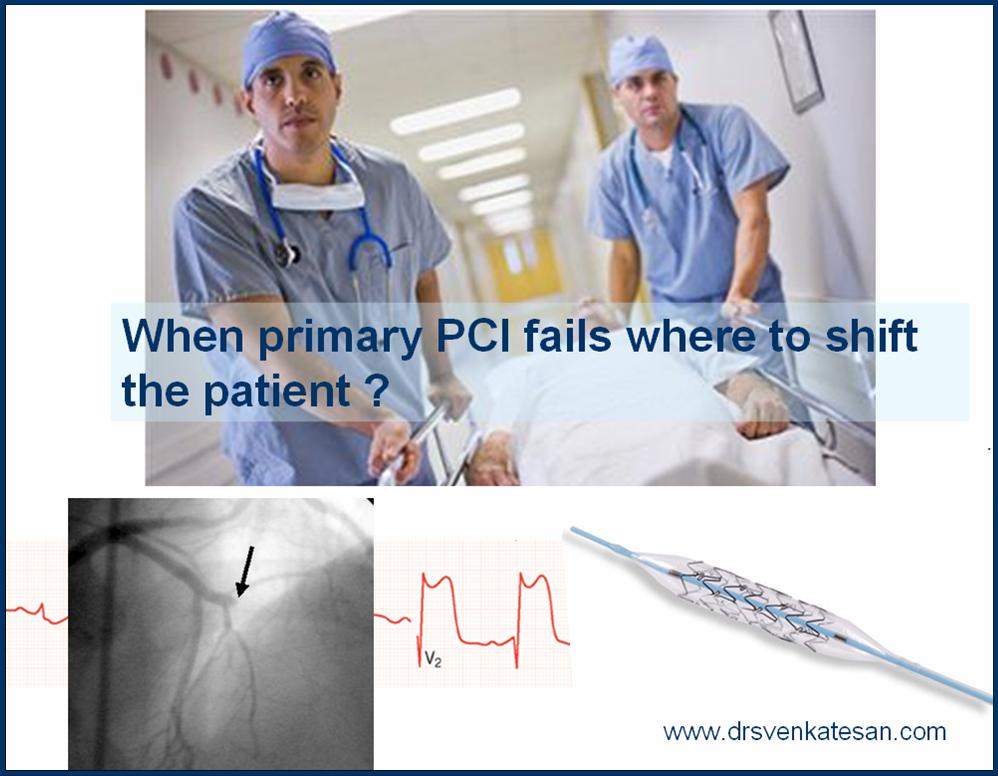
Yes of course . This paper,  is about how a planned  Primary PCI  can go awry  . . . Presented in the Annual scientific sessions of cardiological society of India Kolkatta December 2010.

Down load full presentation  in PDF format (primary_pci_)

Summary of the presentation

ABORTED  AND     ABANDONED    PRIMARY PCI

S.Venkatesan  G.Gnanavelu.R.Subramanian .Geetha Subramaninan

Madras Medical College. Chennai

Primary PCI has become the  standard of care  for acute STEMI in all  those eligible patients. Apart from the individual & institutional expertise ,the  key  to success  lies in  expediting   the symptom to balloon time to less than an hour.

Even though  STEMI   is characterized  by  acute total obstruction , it  is also a fact during this critical time window , a less recognised   positive  phenomenon takes place within the  ill fated coronary artery. Intrinsic fibrinolytic activity gets activiated and begins to take on the thrombus head on .It should be recalled this is the  earliest intervention in STEMI by natural forces , with zero time window . The power of this natural lytic process has  never  been easy to predict and quantiate . But  we  have  often realised  such a phenomenon do occur often and  is referred  by  various  terminologies like spontaneuous  thrombolyis, aboted MI etc .The exact incidence  is not estimated .In this era of  primary PCI we have found a new opportunity to confirm  this concept.

It has been  observed during  primary PCI ,  an occasional patient  may  have  either  a totally  patent IRA  or a minimal &  insignificant lesion  like luminal irregularity .This has  subsequently led on to cancellation of the procedure .We report our experience with  two patients with  this particular situation .One patient with IWMI with a time window   of  6hours had a totally patent  RCA.  Even , the luminal irregularities were difficult to locate .The other patient had anterior MI with ongoing ischemic pain.He was taken up for primary PCI.The initial angiogram  showed a total mid LAD  obstruction . As soon as the  guidewire reached the thrombotic lesion the  artery opened up   wth a TIMI  3 flow .There was no residual lesion or thrombus  noted. Both of the above  patients  were  young , smokers . 2b 3a antagonists were not administered. We infered, both had thrombotic STEMI and   presumed  to  had either spontaneous reperfusion , or  reperfusion assisted by dye injection & guidewire manipulation. They were  shifted out of cath lab with a new code of aborted primary PCI and  were discharged with normal LV function .It need  to be  realised here, a   distinction must me made between  aborted PCI  and   abandoned or failed  primary PCI  as  the later  connote a negative outcome. The  causes for abandoning  primary PCI are due to complex  lesions like bifurcation /Trifurcation lesions , triple vessel disease  with difficulty in identifying culprit lesions.A  Primary PCI is  considered failed  when the  IRA patency  is not accomplished or  failure to  sustain myocardial flow inspite of  IRA patency (No-Reflow) . These patients may end up in CABG or occasionally fall back on  thrombolysis  which was considered a inferior modality just few hours earlier !

.                                         We conclude , in the management of STEMI ,  primary PCI once contemplated need not always reach it’s  logical conclusion. There are situations  it can  get  aborted or abandoned  at various levels . Aborted  primary PCI  due to spontaneous  lysis though uncommon ,  can be a therapeutically and financially rewarding concept for the patient  and  physician .

Read Full Post »

“Time is muscle” is  the often quoted “sermon”  in emergency cardiology , implying ,  every patient with STEMI should be taken up for   thrombolysis or primary PCI at the earliest  after the onset of symptoms.

While thrombolysis is the proven method of reperfusion for over 25 years , Primary PCI , a costly , risky but better  alternative is struggling to prove it’s impact in the world of acute coronary syndrome ! (Some may  see non- sense in this statement !  But it still can make sense  !)  In India hardly 3 -5 % of STEMI is taken for primary PCI .This includes the much hyped corporate cardiology centres.

If primary PCI is a revolutionary reperfusion strategy  , why it has not invaded the cardiology field  by strom  ?(A pathetic 5% growth over 15 years will tell the true story !).

We know 6 hours is the acceptable time window before which some form of repefusion must be attempted. A time limit of 90minutes   for the   “door to  balloon”   is  fixed  as optimal for primary PCI .

In other words ,  if primary PCI can be arranged within 60-90 minutes   one  can afford to lose the golden hour !  How does this logic works ?

In fact it does not work ! in many .

The 90 minute criteria is not strictly followed . Common  sense would have it ,  this 90 minute time frame for primary PCI  would  logically be the   “symptom to  balloon time”,

But in reality  the time window of STEMI   is a collection of  following

  1. Symptom recognition  and 911/108 alert
  2. Ambulance arrival time
  3. Ambulance  to ER time (Traffic delays)
  4. ER to Fellow
  5. Fellow to consultant
  6. Consultant decision-making time
  7. Insurance clearance time
  8. ER to Cath lab door time
  9. Cath lab to needle time(Femoral /Radial )
  10. Needle to Balloon time

Where does the   90 minute  rule  for performing primary PCI stand ? It  can  mean many things

After all those hectic  activity  any one of the following is achieved !

Coronary flow – TIMI  3 ?  TIMI  2 ? TIMI 1 ,  Slow flow, Low flow ? No flow , No re-flow ?

* Prehospital thrombolysis avoids atleast   8  (No 3-10)  components  of time delay in our goal to salvage myocardium.

This is the simple reason, why primary PCI is not reaching it”s logical conclusion all over the world.

Summary

In simple terms ,  one  do not require a double blinded multicentred trial  to  show  primary PCI  performed at 2 hour time ( 2 hour  + 90 minute door to balloon time )  window   would be  far inferior to   pharmacological thrombolysis done at   15 -30  minute time window  (An ambulance driver can do it !).

Finally the most important fact , the often ridiculed thromolytic agent does not show  discrimination in it’s  effetiveness whoever  administers  it ! A  lay person or an ambulance driver with 10th grade education can open up the coronary artery 70% times  while  a cardiologist with a 20 year training  does the  slightly  improved version of the same job  costing   nearly 100   times( Rs  25oo for streptokinase vs  2 lakh for a PCI )  more  . In  the process  often  the   golden hour is lost ! Apart from this,  primary PCI is fraught with a risk of  procedure related  hazard  and  it is a hugely expertise driven procedure .

One more message  is ,  poor countries need not  feel dejected for not having those sophisticated country-wide cathlabs  and emergency air dropping of patients.What we  need is good transport systems and quick access to a near by   coronary care units with support staff.

Always remember  at any given time frame  , a well equipped  CCU can save  thousand lives more than a cath lab

Note of caution :

This article is written in the  overall interest of cardiac patient in the developing and non developing and Primary PCI can make merry in all those rich countries for the simple reason they can afford to  do that (Not necessarily  cost-effective !) . Still , primary PCI/surgery  is the only option for patients coming with a electrical or mechanical complication.

Reference

All that glitters is not Gold !

Know , how even high volume centers  struggle to prove he worthiness of primary PCI !

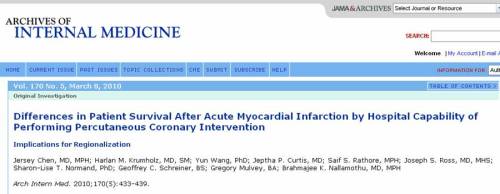
This is not a small study ,  it  is a huge study involving 5 lakh patients with STEMI spread all over the United states.

The conclusion from  his article indirectly supports the view , an early non PCI approach in STEMI can be superior  even if  infra structure and technical expertise are available  for PCI.
Read Full Post »

Drug eluting stents are liberally used  worldover .

It is very unfortunate ,while the jury is still confused about the role of DES  “even”  in chronic coronary syndrome ,

There has been widespread use of DES in  the   potentially hazardous    thrombotic milieu  of STEMI  . It is well known  the DES ( polymer and drug)   has a dangerous liaison  with the thrombus.

Even as the evidence base was about to accumulate against the DES in STEMI , there was  an undue haste in the use of  this stent in STEMI .

Now in 2010 the results are out the DEDICATION trial

  • The culprit is out
  • The truth exposed
  • DES kills more life than bare metal stents   during primary PCI

Read this article  ,just released in Atlanta 2010

http://www.cardiosource.com/clinicaltrials/trial.asp?trialID=1618

Read Full Post »

” This is post is 5 years old , Newer developments should be given considerations”

STEMI is the “Numero Uno” of  cardiovascular emergency .The  treatment has evolved over decades,  right from   the primitive  arm chair approach to the  air dropping of  patients  over the cath  lab  roofs  for primary PCI ! We realise by now ,both are extreme forms of treatment and  may  have unique  hazards. What we forget is the , the natural history of STEMI is too  much dependent on the degree of initial damage to the myocardium , and it is very difficult to alter this,  however good is the therapeutic strategy .  We are yet to find an answer regarding the mechanism of primary VF and modes of preventing it. We also have no answer for  ,  why  some  develop myocardial damage  very fast and  the  cardiogenic shock occur in an  accelerated fashion. (Fate ?)

Many would consider  ” non availability of   infrastructure and expertise ”  is the major issue  for  primary PCI . But the real problem is much more than that .When an  illusion of knowledge is  created by constant bombardment of data  , it is natural for human beings to believe whatever is told or printed in books and journals. We cardiologists are made to believe thrombolysis is a far . . .  far  inferior treatment than primary PCI in STEMI .  It is not so in any stretch of imagination !

The fact that,there is no entity called ” Failed primary PCI ” in cardiology literature  , would  suggest how biased we are against thrombolysis. Every cardiology  resident will  recognise  thrombolysis fails  at least 40% of time .Yes , it is  a  fact  , but the irony is , this   is  often  used   to convey a surrogate  meaning , that  is , primary PCI is  near 100% successful !

How  do you assess success of primary PCI ?

Unlike elective PCI where the criteria is too liberal, we can not afford to adopt the same in an emergency PCI. Here the aim of the procedure is entirely different (Salvaging dying myocardium vs pain relief  ).

It’s still a  mystery ,  while  thrombolysis is vigorously assessed  for it’s  effectiveness   primary  PCI is rarely  subjected to the same scrutiny  . A check angiogram  after the procedure ,  is all that is done . . . and every one  leaves the cath lab happily. The  effect of primary PCI on ST segment ECG resolution must be documented immediately after PCI. While ,  It is mandatory to take ECG after 60 -90 mts after thrombolysis , this sort of protocol is rarely  followed after PCI.

If the ST segment  fails to retract  > 50% immediately  following PCI  the procedure  should be  deemed to have failed . Further , unlike thrombolysis  in primary PCI , the ST segment has to regress within 10  mts , as IRA patency occur instantly .If we apply this criteria , the success rate of primary PCI would be far less than what we believe*

* Not withstanding the official lesion , hardware, related failure. If we encounter a severe triple vessel disease , with a bifurcation lesion and thrombus it’s  a tough exercise as we are racing against time .

Primary PCI  Camouflaging  in semantics

  • A successful but  delayed   primary PCI  is actually a failed PCI
  • A  complicated  primary PCI  often  reach the equivalence  of   failed PCI
  • No  reflow is almost synonymous with failed primary PCI as successful correction of no reflow occur in minority.
  • Not all TIMI 3 flow is converted into myocardial flow.
  • Renal dysfunction following excess dye has a  high  morbidity
  • If patient  develops significant  LV dysfunction following primary PCI it is a failed PCI.
  • Finally if the cost of primary PCI exceeds the insurance limit it is  economically a  failed primary PCI as the patient  has to spend double or triple  the amount of sum insured .This stress has resulted in many recurrent coronary events .

Why is it important to recognise failed primary PCI ?

For failed thrombolysis we have a strategy . Unfortunately , even in this modern era  we have  no useful  strategy for failed primary PCI . Handing over a patient to a surgeon in a such a situation is considered by many as a great rescue strategy but in real world it does no good in most of the patient.

Doing an emergency CABG in a sinking patient with a battered coronary artery is no easy job /Many times it only rescues the cardiologists from the embarrassing situation of facing the relatives who ask for explanation.

So , what can be done at best , in failed primary PCI ?

  • CABG can be an option but still questionable !
  • Most times  there is  no other option except to fall back on the medical management.
  • Intensive anticoagulation and one need to consider even a rescue thrombolytic treatment !
  • Some times we can only prey !  Failed primary PCI for a patient in cardiogenic shock with IABP support is near death sentence !

Final message

  • Remember ,  success of primary PCI   is  not in  wheeling out a  patient  alive out of cath lab   , with a TIMI 3 flow  in the IRA ,  but in  garnering significant   myocardial salvage   which  should have an impact on   intermediate and long term  outcome .
  • Do not ever think primary PCI is a sacred treatment modality in STEMI  and the job of the cardiologists ends there. It is vested with  lots of important complications – defined, undefined , recognised,  unrecognised, reported, and unreported ,  concealed ,denied, poorly understood, etc etc.
  • There are  equally  effective, less dangerous treatment modality available .
  • Decision  to do primary PCI  must not be based   only on the  “affordability and  availability”  of  cath lab and expertise !
  • In  clinical cardiology practice,  no  procedure  is  great   & nothing is inferior either  !  Every thing has to be used judiciously , appropriately  and  intelligently (Intelligence is synonymous with common sense many times!)

Coming soon

Surgeon’s real time experience of operating  on a failed primary PCI. To our surprise , only a handful of surgeons  have this experience

Read Full Post »

Persistent ST elevation is the  general technical term for  failed thrombolysis.Regression of 50%  of admission ST elevation is the required criteria for susccesful thrombolysis .

Thrmobolysis fails in about 40-50% .

Main determinant is the timing of thrombolysis – not the thrombolytic agent ! do not get carried away with all those curent hoopla  about Tenecteplase stuff

If we take 100 patients with persistent ST elavation 90-95 will be in anterior LAD territory .

This is a stunning a cardiology secret no book of cardiology address . . . Implication of which could be very significant . Primary PCI  will always struggle to  prove it’s superiority over thrombolysis  in the right coronary artery .(Note LCX STEMI is different , infact it is more tricky than even even LAD .This issue will be addressed seperately in my blog.)

Read the following link  for  answer to the title question .

How common is persistent ST elevation in inferior leads following STEMI ? https://drsvenkatesan.wordpress.com/2008/09/22/why-thrombolysis-rarely-fails-in-right-coronary-artery/

Read Full Post »

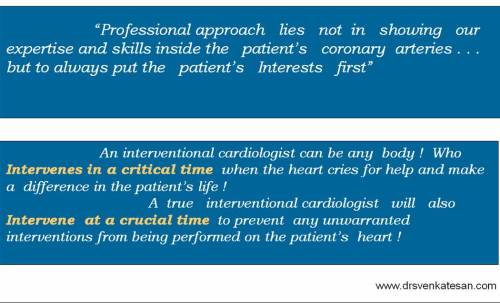
cardiologist Is he a person who puts  a   metal coil  coated with a synthetic fungus   in  a   incidentally  detected  block  inside a  small coronary artery and sends the bill to the Insurance company ?

Is he a person in a  cosmopolitan  hospital  who opens up a    chronically   closed  coronary artery , in an asymptomatic patient  and  live telecasts  his achievement trans continentally ?

Is he a person who   checks in by  the early morning flight and  puts multiple wires in  an  aged   patient   with  class 3 heart failure and  make  him walk  20 meters extra at a cost of  1000$ / Meter ?

Is he a person living in   Wall   street  ,   who   looks  for variety of holes In  the heart and trying to occlude  it  with   exotic   devicespci ptca stent

Is he the unknown   physician   who Intervenes in the natural history of Rheumatic heart disease   and arrests   immune mediated   valve damage by giving the  monthly injections  penicillin in remote parts of our country ?

Is he the person   who   Intervenes to prevent young   persons   from  smoking and help maintain  their  coronary endothelium  enriched with nitric oxide  & arrest  the coronary epidemic ?

cardiologist 2

Is he the small town doctor  who  Intervenes  to treat a breathless cardiac failure patient  with  digoxin and frusemide  and  dramatically alleviate the  symptoms and  prolong the  life of our poor country men?

Is she the village health nurse from an inaccessible health  centre  located in a  hilly terrain ,  Intervening  successfully, by   pulling out  live babies  from  severely anemic pregnant  mothers with failing hearts ?

pci ptca cardiologist coronary angiograms

Read Full Post »

Fundamental principle  of  human biological system is to live in harmony with nature and environment.Each cell  has a unique reaction  when it comes into contact with  external  material. This reaction can be acute or chronic  ,   local or systemic. The most severe form of allergy is called anaphylaxis  that can result in instantaneous loss of life. There  is a whole gamut of disorders  that  resulted  in a  separate  speciality called allergic medicine .

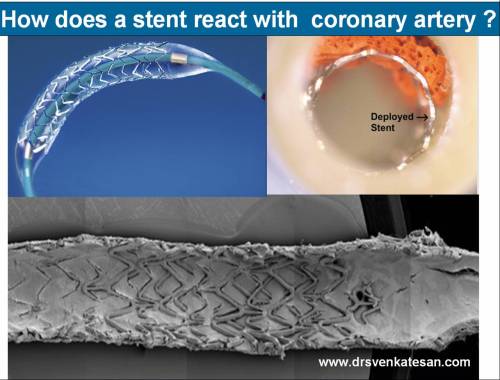
Further ,the transplantation  science have   taught us  an  organ or cell can be rejected at any point of time after implantation (Hyperacute -chronic) .With advancement of science we have started implanting a variety of devices  with complex metallurgy ,inside human body, metal clips, prosthesis, valves, wires, etc .How the body handles them .The consequences can be a mild reaction to major ones occasionally.

Consider ,a local allergy due to a orthopedic prosthesis  in one of the leg bones  is far less serious than a metal within a coronary artery  irritating the intima .

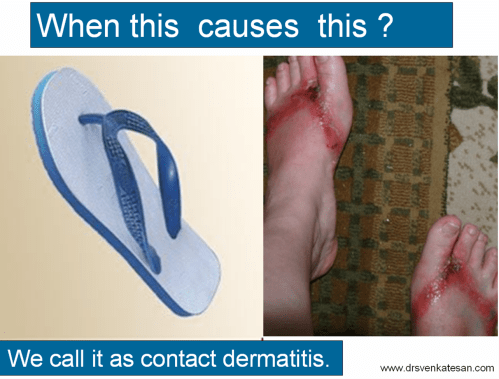
Remember hypersensitivity reactions can be severe . This lady reacted  like this to a sandal slipper -A  fiery red  infiltration

contact dermatits stent allergy pci coronary

Imagine  if a stented coronary artery react like this what would be the possible consequence ?

In susceptible  individuals  , can a metal cause

  • Intimal hyperemia
  • Intimal induration
  • Intimo-medial edema  following stent deployment

pci stent coronary angiogram thrombosis des

Why drug eluting stents are more prone for hypersensitivity ?

The answer is simple , while metal allergy is a comparatively rare phenomenon, the drugs we  coat and the polymers used are  many fold likely to result in hypersensitivity reaction.

While  the world is worried  more  about penicillin , sulpha allergy which occurs in 1 in 100000 ,  we tend to ignore the metal and drug  reactions within  the tender coronary arteries.

stent des rejection virmani  pci

What is  the clinical expression of  stent hypersensitivity ?

It is  often a coronary event in the acute phase and restenosis in chronic phase.

How much of acute stent thrombosis is related to stent allergy mediated reaction ?

The exact incidence  will  never be known. It could be high. Whenever a sudden unexpected early stent occlusion can be a suspect .

Is stent allergy a local reaction or systemic reaction ?

It is most often local .The drugs the stent elute can elicit a systemic reaction occasionally.

So what can be done to prevent this complication ?

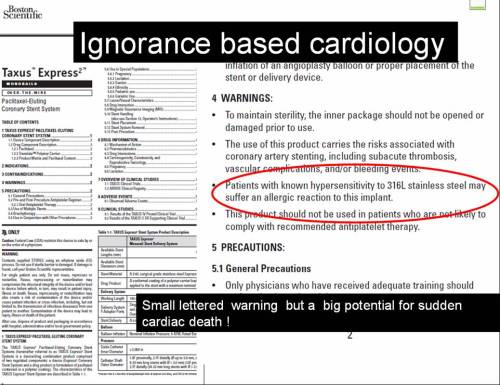
Drug companies in it’s  package regularly  include the warning  message ! What does it imply to have a caution  on the covers ? .This warning simply represent about our ignorance in this issue. We presume it is a minor problem.

pci stent thrombosis stent allergy metal

Questions unanswered

  1. How does a cardiac patient knows whether he is hypersensitive to stainless steel or nickel ?
  2. Is it practical to have a stent allergic test in every patient before PCI ?
  3. Is routine administration of corticosteroids for few days after PCI an answer ?

Reference

R.Virmani , circulation 2004

http://circ.ahajournals.org/cgi/content/full/109/6/701?maxtoshow=&HITS=10&hits=10&RESULTFORMAT=&fulltext=stent+%27allergy%22+&searchid=1&FIRSTINDEX=0&resourcetype=HWCIT

Read Full Post »

Myocardial infarction (STEMI)  occurs in two distinct arterial  territories .The anterior LAD circulation and postero- inferior RCA/LCX circulation.The incidence is equally shared.

There has been some  learned and unlearned perceptions about Inferior MI.

Inferior MI is less dangerous than anterior MI.  True or false ?

Answer: Essentially true in most situations.

Reasons.

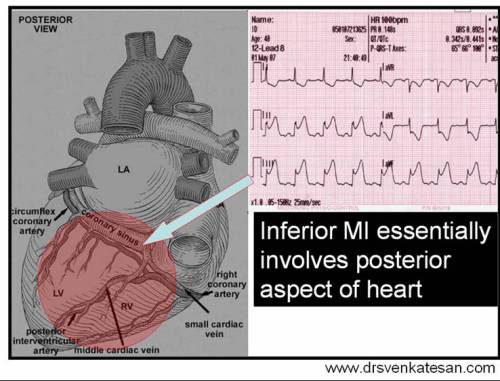
Inferior wall of the heart (strictly speaking there is no walls for heart , only surfaces , which blends with adjacent areas)  inferior wall  is formed by diaphragmatic surface and posterior surface.Inferior MI can occur by either RCA or LCX obstruction.The outcome of inferior MI is determined by mainly by  the extent  of   LV myocardial   damage it inflicts.To  quantitate this  we need to know , how much of LV is supplied by RCA , or LCX or combination of both ? This depend on the coronary dominance .It is estimated , the bulk of the LV is supplied ( up to 75%  ) by LCA. This becomes further high in left dominant circulations . In fact , it is believed LV can never get involved in non dominant RCA occlusions. This has brought in a new terminology  called “Small inferior MI”.Inferior STEMI due to PDA  occlusion or in a co -dominant circulation is not yet studied

Apart from the above  anatomical considerations the following clinical observations  have  been made regarding inferior MI.

  • When thrombolysis was introduced , many studies  suggested the the ST elevation in inferior  leads toched the isolectric levels  in most situations even without thrombolysis.Technically, this implies spontaneous , successful thrombolysis are more common in RCA. Among the thrombolysed ,persistent ST elvation is a rare phenomenon.
  • The well known difference in the conduction defect between anterior and inferior MI  is an important contibutor for better outcome in the later.(AV blocks in inferior MI , are often transient, non progressive, supra hisian location rarely require permanent pacemakers)
  • During acute phase cardiogenic shock occurs in a minority (That too , only if RV shock is included )
  • Even in the follow up the ejection fraction in inferior MI is  almost always above  40%. In many EF is not affected at all.
  • Progressive adverse remodelling of LV is rare

When can Inferior MI be dangerous ?

Anatomical factors

Inspite of the  above  factors  inferior MI can not be taken lightly . Especially when it  extend into posterior, lateral , (Rarely anterior) segments.

While  posterior extension  is often  tolerated , lateral extension is very poorly tolerated .This is probably explained as  the extension involves the vital free wall of LV and the laplace forces could precipitate LVF. Free wall rupture is also common in this situation.

Posterior extension , predominantly involves the surface of RV which is less important hemodynamically. Of course incidence of MR  due to it’s effect on posterior mitral leaflet can be trouble some.

inferior MI ECG

High risk clinical catagories.

Out of hospital STEMI  are at  equal  risk irrespective of the territories involved  .This is because,  primary VF does not differentiate , whether  ischemia comes from RCA or LAD .

  1. In elderly , dibetics and co existing medical condtions  the the established  benign   character  of  inferior MI disappear, as  any  muscle loss  in LV has equally adverse outcome.
  2. Even though  inferior MIs are immune  to cardiogenic shock  , a equally worrisome  prolonged hypotension due to high vagal tone, bradycardia, plus or minus RVMI can create trouble. Fortunately , they respond better to  treatment. Except a few with extensive transmural RVMI outcome is good.
  3. Presence of  mechanical complications of  ventricular septal rupture , ischemic MR can bring  the mortality on par with large anterior MI.

How different is the clinical outcome of infero-posterior  MI with reference  to the  site of  coronary arterial  obstruction   ?

The sequence of  outcome  From  best to worse  : Non dominant RCA* → Dominant RCA but distal to RV branch → LCX dominant with large OMs

* It is believed   an  acute proximal  obstruction of a  non dominant RCA may not be mechanically significant, but can be electrically significant as it retains the risk of primary VF and SA nodal ischemia. The ECG changes  can be very minimal or  some times simple bradycardia is the only clue. One should be able to recognise this entity (Non dominant  RCA STEMI)  as the outcome is  excellent and these patients  would never require procedure like primary  PCI

** A inferior MI due to a dominant LCX and a large OMs have comparable outcome as that of extensive anterior MI. The ECG will reveal ST elevation in both inferior and lateral leads.

***In patients with prior CAD  and collateral dependent  multivessel disease  the  inferior anterior sub classification does not make much sense as  entire coronary circulation can be mutually interdependent.

Final message

Inferior STEMI  generally lacks the vigor  to cause extensive damage to myocardium in most situations .Further they respond better to treatment. Risk stratification of STEMI based on the location of MI has not been popular among mainstream cardiologists. This issue needs some introspection as  the costly and complex treatment modalities like primary PCI  is unwarranted in most of the low risk inferior MIs.

Related posts in my blog:

1.Why thrombolysis is more effective in RCA?

Read Full Post »

« Newer Posts - Older Posts »