Feeds:
Posts
Comments

Archive for the ‘cardiology- coronary care’ Category

Post myocardial infarction revascularistation either by PCI or CABG forms the bulk of the coronary interventions world wide.There has been considerable controversy in selecting the patients for the procedure.

Certain basic rules are to be applied.

  • Never do any thing on a totally asymptomatic and fully functional patient.(Functional , means good exercise capacity of atleast( 10Mets).Just medical treatment with good doses of statins, beta blockers will do.
  • If a patient has persistent angina  following MI  ,the issue is relatively simple as  they are  candidates  for CAG  and intervention .
  • The issue becomes little complex when the primary complaint is breathlessness and echo showing  LV dysfunction.

This dilemma is due to a  simple fact

coronary revascularisation has a  great impact in relieving angina but has  less impact in reversing

left ventricular  dysfunction

So,  how do you approach a patient with LV dysfunction and exertional  breathlessness and absolutely no chest pain ?

  1. Do a  CAG
  2. Assess the lesions if any (Some times,  to our surprise there may not be any critical lesions at all ! )
  3. If there is / there are critical lesions try to corroborate with infarct segments.(Use Echo for this correlation)
  4. Don’t bother much,  if a  vessel has a lesion  that is supplying a scarred myocardium.
  5. If there is gross LV dilatation, mitral regurgitation and LV clot refer these pateints  may benefit  from surgical management

One of the rules written by the cardiology community over the past few decades has been

We must document viable myocardium before doing a revascularisation procedures on them.

This rule was self imposed ,  to prevent inappropriate revascularisation in  post MI population.

So , a  gamut of investigations (Both invasive and non invasive came into vogue) to identify viable myocardium in post MI population. Stress echo, Thallium-sesta MIBI, PET  to name a few .

Even after liberal usage of these invesitgations , we realised ,  the confusion in the  optimal selection of candidates for revascularisation has not settled.

In fact,  the correlation between viabilty and subsequent interventional benefit is  inconsistent .Not withstanding this  issue  ,cardiologists inspite of the negative results of OAT and TOAT trials ,  started  opening or by passing any occluded vessel irrespective of viability status.

Unanswered  &  Unasked questions in myocardial revascularisation ?

1.Why viable myocardium is viable even in the adverse compromised vascular  environment ?

It  is viable for the simple reason it has some capacity to be alive . By it’s inherent survival capacity (Survival of the fittest ) or it somehow gets the nutrients by cell to cell perfusion.

2. It is viable allright  ,  why it is not contracting ?

Because ,  it is biochemically and metabolically alive (Can be documented by FDG PET scan mismatch ) but it can not synthesise adequate ATPs to make the muscle contractile.

3.”Viable myocardium is viable ” what more you want from it   ?

Simple viability is not suffice . How to make it mechanically active and contractile ?

4.Is viable  myocardium    synonymous with ischemic myocardium ?.

No,  it is not (Contrary to the popular perception ) .

5. Is it not  common to find dysfunctional segments with good TIMI 3 flow ?. So what is the purpose to document viability ?

It is not suffice to simply document viable myocardium but it is an absolute necessity to prove this viable segment is also  critically ischemic .

7.If angina is  a sign of viabilty why most of viable myocardium is painless ?

This again confirms the fact , much of the viable myocardium in the post MI phase is not ischemic but” still dysfunctional” waiting for healing time. This concept  was  introduced with great fanfare* as  stunned myocardium ,  20 years ago , which was subsequently rejected my mainstream cardiologists , as this concept tend to  restrict the  freedom of interventionists. * Even though ,the concept was genuine and proven scientifically !

6.Are we  certain , the  viable ,  non contractile myocardium  (Which we painstakingly document )  will get back the contractility once the  segment is    revascularised?

Absolutely not. (With lot of PET study doumentation )  This,  we can not guarantee even in ischemic, viable segments  ,  while in the  non ischemic, viable segment it is all the more unlikely.

7. What are the chances of these viable but  non contractile myocardium  regain the contractility  by natural course ?
Very significant chances .In fact every patient recover some LV  function spontaneously over time .

Final message.

  • Revascularisation is non controversial in patients with angina
  • In patients with  primary symptoms of dyspnea  ,  it is less effective and documentation of myocardial viabilty per se will not guarantee successful outcome following revascularisation.Out come depends on  multiple factors .
Read Full Post »

Left main coronary artery disease (LMCAD) often evokes  a panic reaction  among cardiologists .Not every LMD deserve that re. To  label  it as  significant, we have a criteria ,  that is 50% diameter stenosis.  So what you do , for a tapering  or narrowed left main with 40% stenosis. Isolated insignificant left main is rare *, but real incidence is not known.  LMCAD  is  most often due to  , atherosclerosis of left main coronary artery without limiting the flow.

What are the options ?

  • Leave it alone, with intensive medical management assisted by high dose statin(80mg)
  • Elective PCI with stenting , even though the lesion is not significant.

*If associated LAD  or LCX is there decision making is easier .

How  significant is a coronary stenosis ?

The significance of a coronary lesion with reference to “lumen diameter obstruction” is basically flawed. The significance of a coronary stenosis, by tradition is  based on it’s hemodynamic impact ,right from the  CASS days in early seventies.Unfortunately our mind set has not changed even after realising    non obstructive – sub critical lesion is more prone for acute coronary syndrome.  Is it not ironical to call a  40% lesion a non significant one !

So, the  significance of coronary stenosis is two fold.

  1. Hemodynamic  significance
  2. Clinical and  pathologic significance

The former predisposes to often chronic stable angina, later likely to result in ACS.

How will you approach a apparently insignificant left main disease ?

A 40 % lesion in left main is hemodynamically not significant , but pathologically very significant.It needs intensive treatment. Plaque passification with medical approach is first choice.If the lesion morphology is eccentric,  has irregular margins or involves  LAD  or LCX ostium doing a PCI or even a CABG is to be considered in spite of the lesion is  hemodynamically insignificant .

Why , PCI is   considered  “not appropriate”  for   less tighter lesions , even though these lesions  have great clinical significance ?

The answer is simple, The risks  and the  potential cost are more than the benefit !

And further ,  stents are  not innocuous devices  either  , they  always carry a risk of sudden occlusion as like  a sub critical lesion  !

Answer to the title question

True incidence is not known . Our experince (Class 1 c evidence) would suggest Left main disease constitutes up to 10 % of CAD.Among this one third would be hemodynamically insignificant

Suggested reading

Handbook of Left Main Stem Disease


edited by Seung-Jung Park

hbleftmn

//

Read Full Post »

                                         Ventricular  tachycardia is considered as a dangerous electrical rhythm abnormality .It can immediately degenrate into ventricular fibrillation and result in SCD in many.Ironically, it is also a fact , a patient with VT can  present silently  without any symptom  .Some VTs are slow and recurrent without much affecting The hemodyanmics.


In chronic recurrent, beningn VT (Some may consider it , ” height of  absurdity ” to call a VT beningn ! but it  is a reality , the term beningn denotes –  very remote chance of converting into VF) ” Is there any other therapeutic option other than convertng into sinus rhythm. “(  Read related topics)


The following paper was presented in the Annual scientific sessions of  Cardiological society of India,  Kochi , seven years ago in  2002


VENTRICULAR RATE CONTROL  IN  VENTRICULAR TACHYCARDIA 

S.Venkatesan,,. Madras Medical College. Chennai


                           Mangement of  hemodynamically  stable  recurrent   ventricular tachycardia  remains a  delicate clinical problem. Reverting to  sinus rhythm  is  considered as  the only aim  of  treating  VT.While rate control is accepted as a therapeutic  option  in atrial fibrillation,  it is not  so,  for  ventricular tachycardia.In this  context  we attempted to analyse  the effect of  Amiodarone on   ventricular  rate  in stable ventricular tachycardia  which fail to convert  to sinus rhythm.


                            The  study cohort consisted of 49 patients with stable VT  who were admitted in the coronary care unit  of  Govt. General Hospital  between 1998 to 2002.The criteria for inclusion   were systolic BP>100mmHg and absence of  hypoperfusion of vital organs  The mean age was 52 years (range 26-68)  with a male female ratio  of 4:1.   Of the study group 36 patients  were either reverted with  IV lignocaine , Amiodarone ( 150-300mg   bolus )  or  DC  cardioversion . 13  patients  who did not respond to   either of these   were  followed up  with  Amiodaroneinfusion(1000mg)  for 24 hours.  The baseline  diagnosis were old MI (6)) DCM (3)  Arrhythmogenic RV displasia(2). Idiopathic VT was diagnosed in  2 patients.All these patients had  VT  during  most part of  the   24 hour  follow up.


                         The pre Amiodarone mean  ventricular rate was  152  (124 –196).  Post amiadaorne (at 24hrs) mean ventricular rate was 128(88-142). The time taken for   50% heart  rate reduction was  6.6h (4-24h).  The average  systolic blood pressure  improved from  100   to  112mmhg . These patients were  discharged  in stable clinical status with oral Amiodarone and  were  referred for  EP study.


                          It is concluded that Amiodarone, apart from it’s cardioverting ability , has a distinct ventricular  rate controlling  effect  which  can be of therapeutic value in  at least certain subset of chronic recurrent VT.

Final message


Some of  the patients  with VT carry a very low risk of VF  and SCD .In these  patients , the only  other major  aim is to prevent tachycardiac cardiomyopathy  that can be done with drugs which  controls  the ventricular rate whenever  VT occurs !

Corrrecting the primary cause like cardiac failire , revascularisation ,detailed EP study  ,tachycardia mapping , followed by RF ablation and ICD implantation is  the state of the art approch in the management of VTs.But this small clinical observation was made to  impress rate control could also be an option  in patients  in whom these procedures are  contraindicated  or not  available . 


Read Full Post »

Lignocaine , probably has saved more lifes  world over  than any other cardiac drug .

It was the only choice for ventricular tachycardia  till 1990s, both in pre and post  thrombolytic era.Every coornary care unit has reverted tens of thousands of  unstable VTs with this simple and cheap intravenous drug.the utility value of lignocaine is not limited to ischemic VT alone it is effective in in almost all forms of VT.It was classically administered in two or more boluses followed by an infusion.

What happened to this wonder drug  with great performance record ?

The  power of   statistics , and inappropriate interpretation by the scientific community  has left a serious blow to this wonder drug .Now the drug has been made redundant, and mainstream cardiac literature has made everyone feel  guilty , if  anybody  uses this drug for VT .

Why did lignocaine lose the battle ?  The reason is three fold

  1. The advent of  much fancied Amiodarone
  2. One negative study  for antiarrhythmic drugs in post MI period (CAST) 
  3. And two so called  positive studies  for Amiodarone (ALIVE & ARREST) has sounded the death bell for this drug  which has resuscitated millions of life !

CAST study http://content.nejm.org/cgi/content/abstract/321/6/406 

All , CAST  said was routine suppression of  asymptomatic ventricular arrhythmias  in the post MI period is unwarranted. But you know , how this  world interpreted it  “Lignocaine  has no role in ventricular arrhythmias in post MI setting ”  The most funny thing  was  lignocine was never used in CAST study .

The  studies involving one to one comparison  of Lignocaine and Amiodarone (ALIVE and ARREST study) was also not interpreted  properly.These studied only shock resistant VTs. What about the role of lignocaine where defibrillator was not available ?

Link to ALIVE and ARREST  read and make your own conclusion.

http://content.nejm.org/cgi/content/abstract/346/12/884

http://content.nejm.org/cgi/content/full/341/12/871?ijkey=8fa241f3cebb86a177632ec6ccadfb5a3ded7bc2

 Final message

  • Lignocaine is not  only a topical anesthetic  , it is powerful and gentle myocardial anesthetic when administered in post MI period.
  • With this property it  successfully cardioverts and prevents dangerous ventricular arrhythmias.
  • Time tested and worthiness proven.
  • While , we are made to believe  the success rate of  Amiodarone in VT is far superior than ligncaine .It is a falsehood.
  • Any experienced cardiologists will recognise ,  many times even  Amiodarone resistant VTs often respond to Lignocaine .
  • The fact of the matter is , without a good quality  one to one study  , lignocaine was ditched. One reason for this could be  Lignocaine ,  is a generic drug and has no market value.

Let us take home , the message (scientific or unscientific ! ) Lignocaine still has a great role to play in the management of dangerous ventricular arrhythmias .The only caution is ,  it should not be used routinely and indiscriminately in all asymptomatic patients with  VPDs or nonsustained VT . (Acknowledging CAST conclusion.)

Read Full Post »

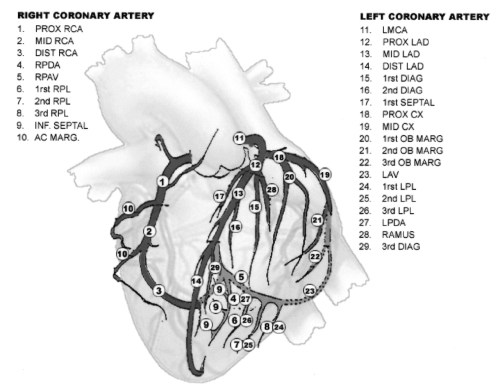
                                         Coronary arteries are the major site for human atherosclerosis .CAD is considered the ultimate determinant of  cardio vascualr health of our global population.Coronary atherosclerosis has a predilection for proximal sites and branching points.Typically it occurs in leftmain, LAD ostium, LCX ostium, proximal LAD, diagonal origins, OMs RCA  and its branches .

4010940_766_gr1

Septal branches , even though divide very early  from the LAD , it  is  uncommon  to get affected by coronary atherosclerosis.  Even for an experienced   interventional cardiologist  , it  would be very rare to have  performed a  PCI for septal disease.

Why septal branches of LAD is rare to suffer from atherosclerosis ?

We don’t know the answer yet.

But , it is thought,septal branches are near perpendicular branches .The branching angle and incidence of atherosclerosis has a peculiar relationship.IAt any bifurcation  point , the atherosclerosis tend to occur ,  if the angle is more acute , and is  less common in abtuse angles .It is  almost rare  ,  if branching happens at   exact  90 degree angle or so !

The other reason for septal branches being immune to atherosclerosis is  , it runs within the muscle in its major course. The constant squeezing action(. . . and possibly bridging also)  makes it difficult for the  process of atherosclerosis to sustain and grow .

Can you still get a  septal CAD ?

Yes,  usually as  a component of bifurcation or trifurcation lesion. Some times a diagonal and septal are very close together and  atherosclerosis involves  both ostia.

What is  the implication for the  cardiologist to perform  a PCI with stenting in a septal branch of LAD  ?

PCI and stenting in the septal branches are more prone for crushing and fracture   as it is constantly exposed to the mechanical effects of muscle contraction.

Any other significance for septal branches of LAD ?

  • Isolated septal myocardial infarction can occur.This could be even a embolic manifestation.
  • Septal branches of LAD are potential target for therapeutic embolisation (By injecting alcohol)  in patients  with hypertrophic obstructive cardiomyopathy(HOCM) .This manover aims to produce a controlled septal myocardial infarction and thus paralysing the left ventricular outflow tract and reduce the dynamic LVOT gradient. This form of treatment, was glorified till recently now considered experimental !

Read Full Post »

Contrary to popular belief ,great things happen only rarely in medicine . It takes  only  few  months of  training  or  workshops ,  for a  wrong or inappropriate concept  to  percolate  our  brains !  But , it  would require,   decades  of  time , energy  and  efforts  ,  for  correcting  that  wrongly  assimilated concept  in medicine !

Interventional cardiologists are  among the  rare breed of physicians,   who always believe in evidence !  But ,  the quality of  the  evidence  is rarely questioned  !  30 years of PCI  & 20 years of stenting has failed  our  common senses ! Fortunately , today,  we have 135 pages of new evidence ( Not really new , old evidence interpreted with  sound logic !)

Hats off to ACC and associates for bringing out this much belated appropriateness guidelines for the interventional cardiologists.

ACCF/SCAI/STS/AATS/AHA/ASNC 2009 Appropriateness Criteria for Coronary Revascularization

A Report of the American College of Cardiology Foundation Appropriateness

Criteria Task Force, Society for Cardiovascular Angiography and Interventions,

Society of Thoracic Surgeons, American Association for Thoracic Surgery,

American Heart Association, and the American Society of Nuclear Cardiology

Endorsed by the American Society of Echocardiography, the Heart Failure Society of America, and the

Society of Cardiovascular Computed Tomography

Click here to get guidelines

http://circ.ahajournals.org/cgi/reprint/CIRCULATIONAHA.108.191768v1.pdf

If you don’t have time to read the entire document (135 pages  )

Just remember only one point

Common sense,  more  often  prevails  over  evidence ,  in medicine . Apply it  , frequently  in your patients .They will reep the benefits !

Read Full Post »

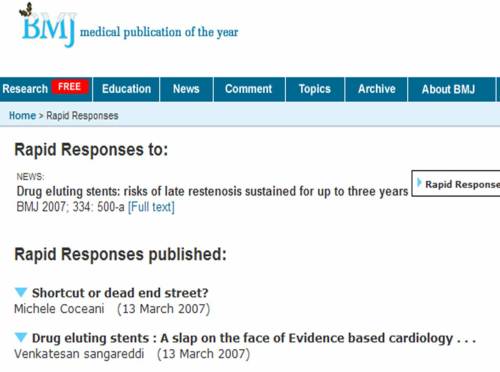
Drug eluting stents : A slap on the face of Evidence based cardiology . . .

Click the BMJ link or read below


venkat-bmj

It is often said science is sacred and unfortunately we forget ,  science is not a heavenly creation and it is the creation of scientist of varying grades of integrity fueled by the vested interest of medical industry . It has been a almost a daily affair , some of the devices and drugs are recalled or found to be unsafe on patients.

Now the big cat has come out .The Drug eluting stent has fallen from Hero to Zero in a short span of 5 years. It was projected to have zero percent restenosis in 2002 . And now we realize it is Zero percent truth.

What has started as anecdotal reports of late stent thrombosis has indeed become an epidemic in all DES patients. The five studies that has been published in the NEJM this month (March 2007) has convincingly proved how unsafe these stents are in most of the coronary population .

Millions of patients in whom this stent was implanted will carry an impending stent thrombosis and possibly an SCD . Who is to take care of them ?

The DES story is a clear cut case of getting premature approval for a dangerous form of treatment inside human coronary arteries.

It is amazing how the scientist’s eyes are shut by the illusion of knowledge and lure of wealth. How foolish they were to think drug which was administered via the stent will selectively prevent vascularisation and leave the normal endothelium intact . Now they realized , one should not suppress the endothelial growth around the stent and got the fundamental point wrong. Which was the key reason for the astonishing episodes of late stent thrombosis. When we play with biology of nature we have to be little more careful .God has created man and his heart for over a million years . One can not alter it by a 6 month follow up study of DES .

When ICDs were exposed last year , of similar disastrous outcome they were recalled and explanted . How are we going to unstent the millions of coronary arteries ?

Somewhere along the line the medical professionals have lost the battle against the Wall street and NASDAQ . Or how else we can explain repetition of similar events.

The wages for the modern technology , the patients have to pay a heavy price.

Let us all hope common man with common sense will reign supreme over the sixth sense of the uncommon man . . .

“Ignorance is better than illusion of knowledge”

Dr Venkatesan Sangareddi MD , Assistant Professor of cardiology , Madras medical college Chennai, India

Read Full Post »

Anginal pain is a type of visceral pain.It is carried by type  C  unmylinated  nerve fibres.The perception of angina is a complex process.It is a combination of visceral and cutaneous referral pain.

How often is angina silent in diabetes mellitus ?

Presence of  diabetes per se does not make an angina silent. In fact,  if  one takes 100 patients with diabetes  , if angina occur in them , it is more often  , manifest than silent. So , only few of  the  diabetic patients who develop diabetic autonomic neuropathy fail to have angina.The exact incidence is not known.It could be around 20%.

If angina can be silent in diabteics , can they have anginal equivalents ?

This again is not answered in literature. Among the anginal equivalents , the most common is  dyspnea , which  can occur in diabetics.But now , we know dyspnea also needs thoracic nerve signals  from the intercostal muscle spindle and colgi organs.This can also be impaired in diabetics.

Can silent and mainfest episodes occur in a same  patient  ?

Yes.

Once silent does not mean always silent, and similarly once angina is felt it  does not mean he is going to feel the next episode as well !

This  strongly reminds us medical science  is  much a complex  subject and what we know is very little in pain perception.

How is silent ischmia different from silent angina ?

There is considerable  overlap  between  silent ischemia and silent angina

The questions to be answered are 

Which is silent  ?  Is it the angina or is it the ischemia or both ?

Silent ischemia can occur in any individual ,  this is also called as silent CAD . When  ischemia occurs  but  fails  to generate pain it is silent ischemia .Undiagnosed  CAD in asymptomatic individuals is also called silent ischemia or CAD.In this population  Exercise stress testing detects  CAD which was otherwise silent and masked.These patients may develop angina during EST.

During exercise stress testing many times patient has significant ST depression  more than 2mm but still chest pain may not occur.These episodes may either be silent ischemia or  ngina. Many times the EST is terminated before angina is manifest .( Chest pain is the last to occur in the chain of events following ischemia- Concept of ischemic cascade )

What are the other situations where angina can be silent ?

  • Pain perception  and threshold  level is  high ,  so patient indeed has anginal  signals but fails to feel it .
  • Patients on  antianginal medication , fail to feel the angina.
  • Chronic betablocker therapy can exactly mimic  autonomic neuropathy

Is it a blessing for the patient  to have painless episodes of angina ? 

When their  ischemic colleagues , suffer a lot with chest pain it is tempting to think these diabetic patients  are blessed!

Scientifically , this could be true in at least in  some  especially in a patients  who’s coronary anatomy is known  and devoid of any critical proximal lesions. For example a small PDA  lesion can produce  severe angina  , but may be silent  in diabetic and be comfortable .This lesion is  insignificant other wise * !

It should  also be recalled , pain relief has been an important goal for treatment  of CAD .In olden days,  thoracic sympathectomy was done for angina . In fact ,  even in  CABG  , one of the the  mechanisms  for  angina  relief  is attributed  to cardiac denervation.

Caution: Even a small  episode of ischemia can trigger an electrical event .But it is rare.

 How common is silent infarct (STEMI) in diabetic patients ?

In a simple questionnaire we asked the diabetic patients in our CCU how they felt their pain during MI.Most felt it normally as do other non diabetic .  Diabetes  does not make  all anginal episodes  silent. Severe episodes of ischemia may be painful while less severe episodes may be painless. Diabetic autonomic neuropathy  is a  least recognized and  poorly understood complication of diabetes.Diabetes , involves  the vasanervorum of the autonomic nerves.

 The other mechanisms postulated in diabetic neuropathy are

  • Reduction in neurotrophic growth factors.
  • deficiency of essential fatty acids .
  • Reduced endoneurial blood flow and
  • Nerve hypoxia .

Is diabetic autonomic neuropathy treatable ?

Very difficult problem indeed.Controlling diabetes may partially correct  the neural dysfunction.Many add on neuro vitamins and aminoacids are having a good market !

If you successfully treat diabetic autonomic neuropathy will my patient  start feeling the  hitherto silent episodes of angina ?

We don’t know.Logic would answer ” YES”

What is the ultimate effect of cardiac autonomic neuropathy.

Cardiac denervation.  The manifestations  are

  • Tachycardia, exercise intolerance
  • Orthostatic hypotension


Silent Myocardial Infarction : A complete list


Read Full Post »

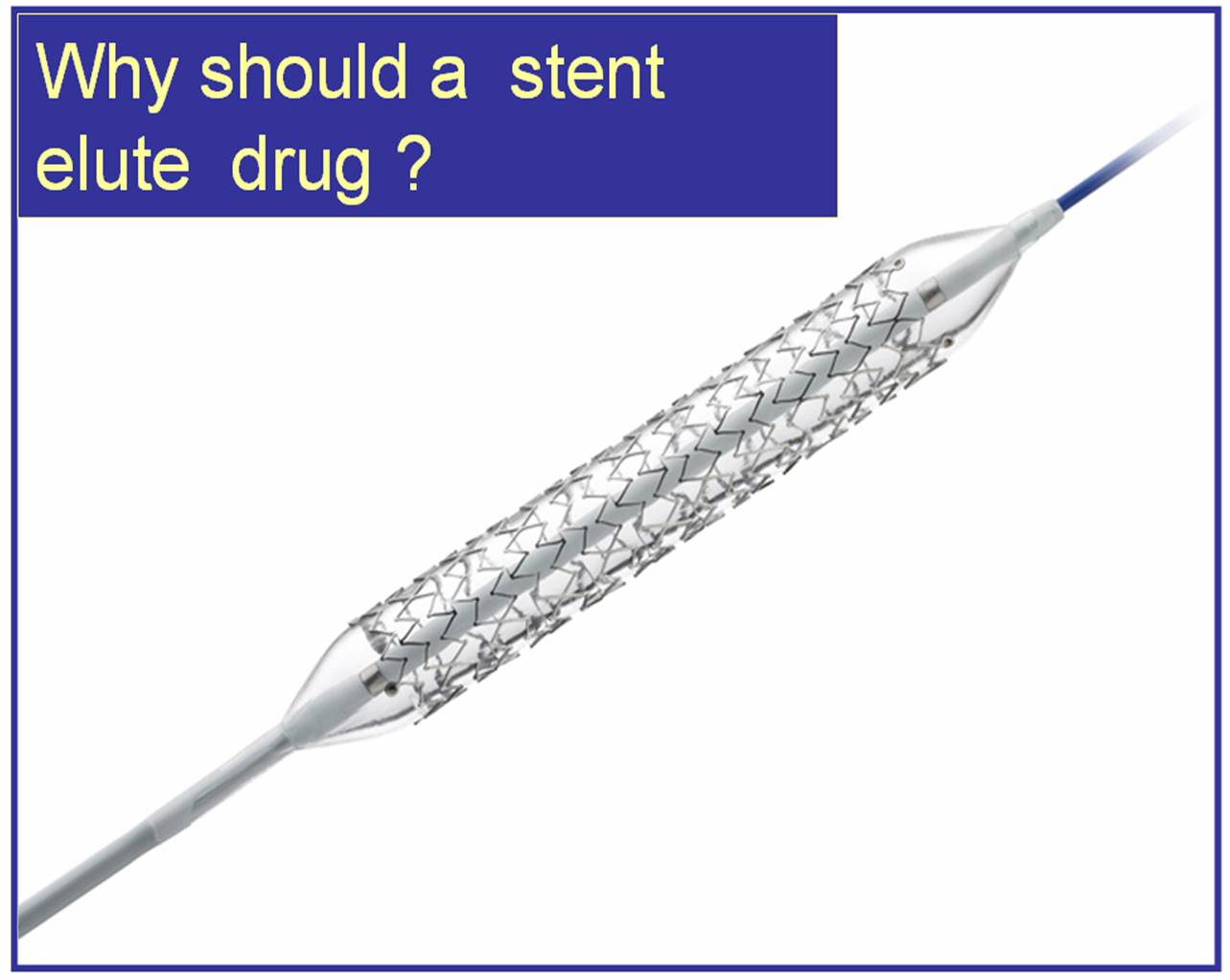
Stents are mechanical  devices like  a  spring ,  used to  keep an artery open after a PTCA or PCI.

des-why4

                                Bare metal stents(BMS) were found to have restenois rate of about 25%.  So it was perceived a stent should have it’s own protective coat , so that it won’t get restenosed.For this the researchers thought  anti cancer drugs are ideal as they block cell proliferation and thus neovascualrisation and restenosis.Alas, they were found dismally wrong ,  after all , neointiaml proliferation is only a part of the problem of restenosis  and simple blocking of cell growth is insufficient . The issue doesn’t stop with that, the anti cancer drugs incorporated within the stent simply can not differentiate normal from abnormal cells and

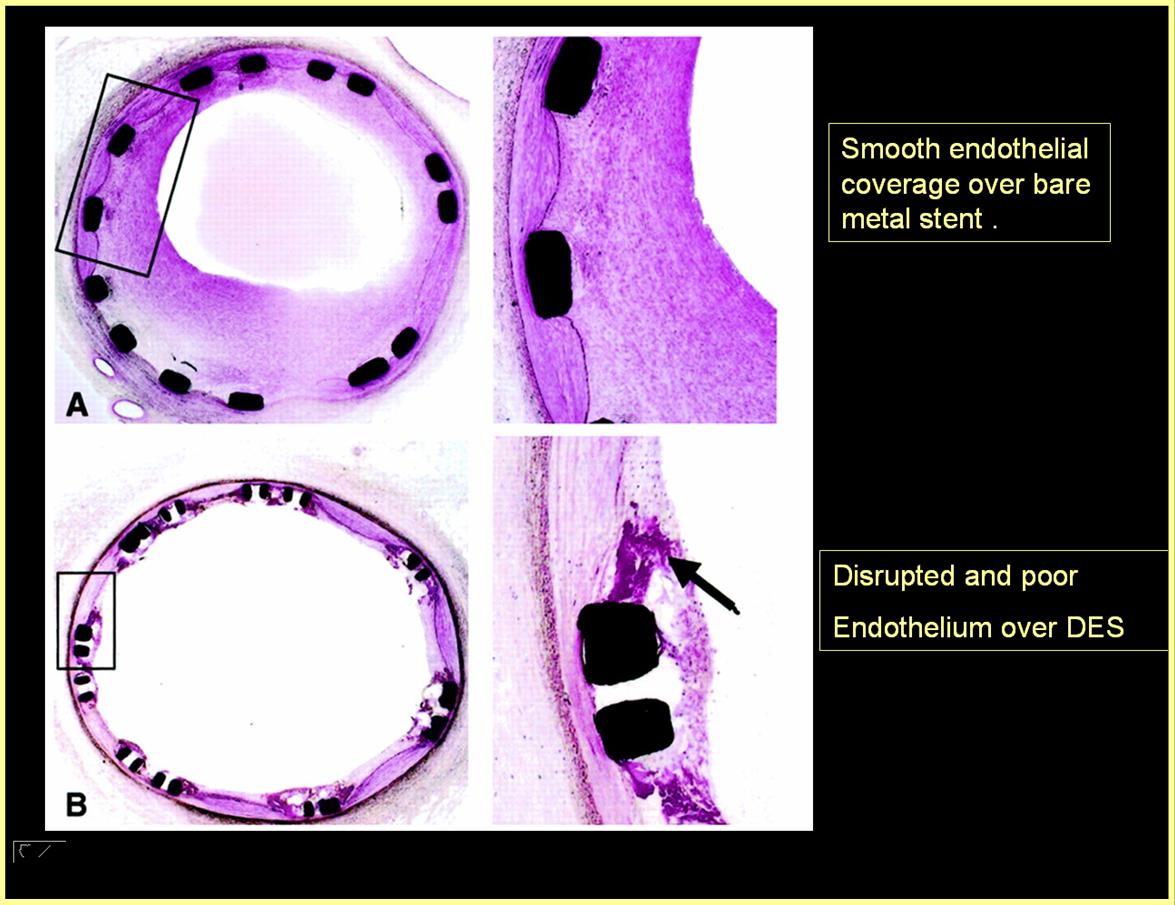
DES effectively blocks the normal endothelisation over the stents and make this highly vulnerable for acute stent thrombosis .

This complication is unique to DES and can result in SCD.Further ,during the last 6 years of DES , we recognised the restenosis rate has increased form the much hyped O % to almost 15% and it’s still growing . These  complications  has made a huge question mark over the future of drug eluting stents !

des-coverage

The concept of DES may not die , but which drug it should elute should be answered ! This  again is  going to be a long battle. So it is currently   adviced,  based  on common sense ( With due respects to  those RCTs  funded by industry )

Whenever you encounter a block within the coronary artery* Ask the following  questions in sequence  ,

  • Whether we can leave it alone  with medical therapy  ,  if the answer is no , proceed  to the next step !
  • Is there a possibility for plain balloon angioplasty in a given vessel (POBA, Yes !  the concept is not dead yet !)
  • If you decide a stent is required , Will  the  bare metal  do the job ?
  • In multivessel CAD  , Did the issue of increased metal load on the  long term outcome was considered ?
  • If lesions appear complex,  should we  not strongly consider CABG as an option ?

However  if we  have the habit of  ask ing the following  question  you are likely to deviate from scientific approach  

Is it possible to put a stent  across  the block ?

Yes , will be the answer most of the time ,and the patient will invariably get one or more stents  and carry a life long  stent related problems.

*The rule does not apply in Acute coronary syndromes

Also read this letter  posted by the author published in  British medical journal

Read Full Post »

This paper was presented in the just concluded 60th Annual scientific sessions of cardiological society of India , Chennai.India

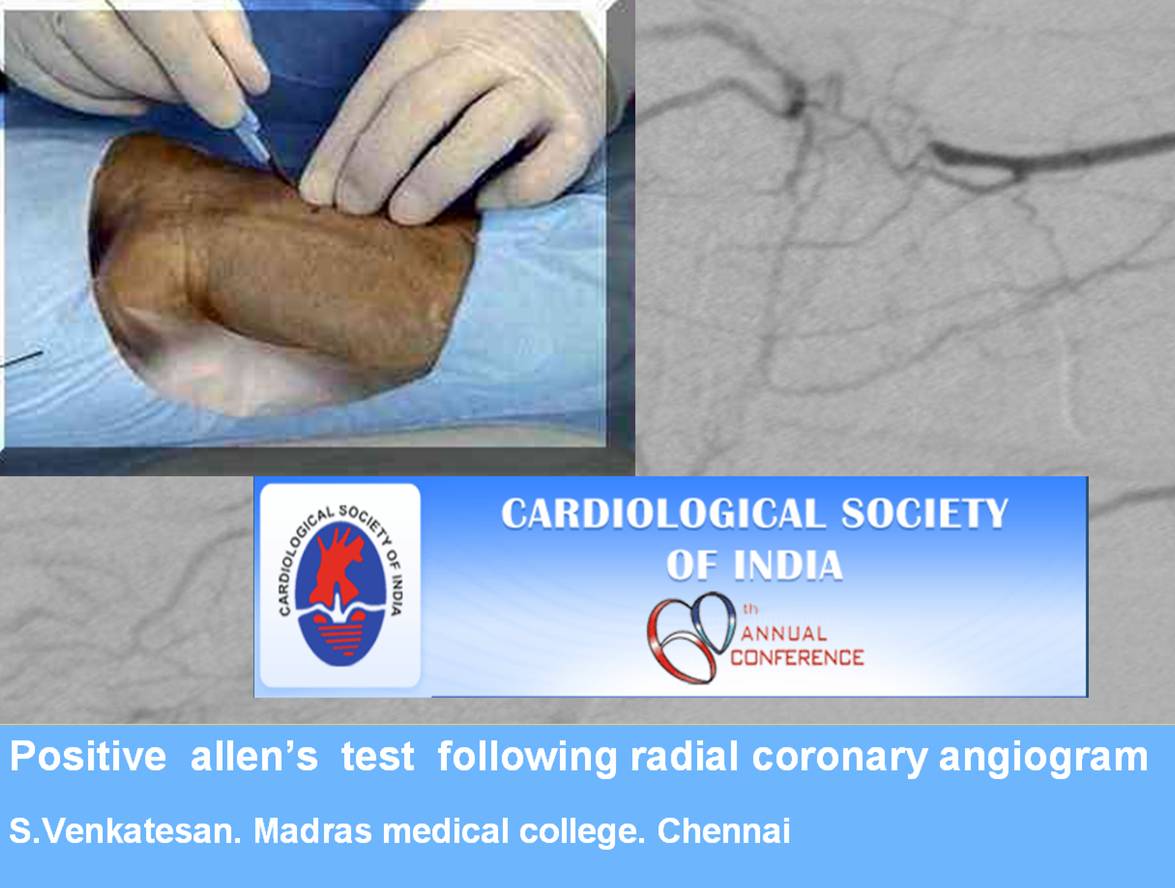
POSITIVE  ALLEN’S  TEST  FOLLOWING RADIAL CORONARY ANGIOGRAM

Venkatesan  sangareddi , G.Gnanavelu, R.Alagesan,V.Jaganathan.

Department of cardiology, Madras Medical College, Chennai.


                          Radial  artery  has become the  major access  site for the interventional cardiologist in recent years. Radial approach has provided increased patient comfort and  less access site complication. Many  of  the   complications  are  unique to radial approach mostly due to  anomalies of origin, and course while others are  hardware related .Unlike femoral arterial access ,  compromise of blood supply to hand is never considered a  threat because of dual blood supply to hand  .But the fact  is that,  it  could be sub-clinical  and the hand is rarely assessed for vascular insufficiency after a radial procedure.

             The aim of the study is to assess the  impact of   radial  procedures  on the  blood flow  to  hand . 20 patients who had undergone routine  radial coronary  angiogram  formed the study population. All patients had negative Allen’s test prior to the procedure. The mean procedure time was   25mts (18-45) .Standard  hardwares were used. Difficulty in crossing at forearm and   subclavian   was observed in  4  patients. Extravasation of dye  in forearm was observed in two. Allen test  was  done 24 hours  after sheath removal and  repeated 48 hours after the procedure .  4 patients   showed positive Allen test  at 24hrs. One  patient   regained  Allen negativity at  48hours. The incidence of positive Allen test at  24 hours is 20%. The compromised blood flow was correlated with the  procedure time, and a difficult catheter course .

                 We propose,  radial procedures especially , when prolonged has a potential to compromise palmar arch flow .This phenomenon  is  either  permanent  or transient  and  may be attributable to enhanced  endothelial tone and sheath related injury. Irreversible  compromise  of blood flow to  palmar arch  may  also occur  in radial dominant hands. Further enhanced  sympathetic tone can  spill over to ulnar artery as well . 

             It is concluded, interventions through radial route has hitherto unreported adverse effect  of  “Post procedural  positive  Allen test”  . It  implies , radial  procedures  could  convert  a dual blood supply  pattern of the  hand to ulnar dependent  uni-modal  blood flow  in a significant  subset of patients. This is important   to recognise, as it   precludes further radial procedures in the same patient.


Final message

Hand function could be as vital as our heart’s ,   please handle with care to avoid this complication


Click on the slide to download PPT presentation

radial2

Read Full Post »

« Newer Posts - Older Posts »