Feeds:
Posts
Comments

Archive for the ‘cardiology- coronary care’ Category

All is not well,  that ends well !

                                       Treatment guidelines in cardiology  practice  are periodically published by ACC/AHA/ESC.These guidelines  represent the current scientific practice. They are called some times as recommendations. Medical professionals tend to adhere to this guidelines whenever possible.They are not legally binding in most of the countries.In USA some states believe it, to be legally binding.


The problem with these guidelines  are , they are classified as class 1 ,class 2 , class 3 recommendations.


Class 1, A  drug , device  or a procedure  Is definitely useful and must be prescribed.

Class 3,   A  drug , device  or a procedure  Is not useful and should not be used .

Class 2*, A  drug , device  or a procedure  may be useful  or may be harmful , and hence may be used or may not be used . (Vaguest possible guideline!)

 *Altered to convey the meaning

What are the  guideline violations that can be sued in court of law  ?

A person with established  CAD who is not been prescribed a  statin (Cholesterol lowering drug)  can be sued straight away,  even if the patient has no adverse outcome due to the nonprescription of that drug. The issue here is , the doctor  has not prescribed  a drug which has  proven benefit .The law is clear on that .Most will  agree that,  the  doctor is at fault ,  and he  is never protected  even by their  colleagues .He  can’t defend his action.

What are the medical errors that can never* be sued in court of law !

But the same doctor who opens up a totally occluding coronary artery in an asymptomatic patient(CTO -chronic total occlusion) and lands up  in a complication and the  patient dies. This could be  major guideline violation as opening a CTO in an incidentally detected , asymptomatic patient is a class 3 recommendation. Neither the physician, patient , institution  nor  the regulatory authorities bother about this even though there is strong case for censure , in reality it never happens. Number  of  experts from leading hospitals do this procedure in live work shop all over the world with full media glare, It is an irony the same  experts are only  writing  in their  guidelines  that  these procedures should not be done inappropriately.

And this medical  error ( Should we call it a  crime if it is knowingly done ! )   keeps growing as the physician never feels guilty about it .

The message here is

 A physician of a state of the art hospital,  in a scientifically advanced  country  goes scott free and guilt free  even if he openly violate the scientific guidelines and do a inappropriate procedure that result in a patient death. Mean while a small time physician in a remote place in the same country can be taken to task  for not prescribing a officially  recommended drug (By standard guidelines) .He will be labelled unscientific and unethical even if his non prescription , had not caused any untoward health outcome .

In short , in today’s modern medical practice 

 Even a  ” Minor error of  ommision”   attracts guilt and perceived fear among the physicians. Meanwhile  many  of the ” Major errors of commission”  done by professionals are rarely frowned upon and thus these  mistakes continue to perpetuate !

*There should be a strong provision in medical law to address the issue of inappropriate procedures even if the procedure has not resulted any untoward effect to the patient.
Read Full Post »

                    Lateral myocardial infarction is not a common site when compared to anterior and inferior MI. But the lateral MI has some unique features, since it involves free wall of the ventricle.The laplace law mediated wall stress is more as the dyskinetic segments bulge with a long radius .Due to this,  lateral MI has a distinctly high risk for free wall rupture .Further pericardial rub is more common in thse patients.Ischemic mitral regurgitation and vulnerability to LVF is also more prevalent if the lateral wall is involved.  Generally lateral MI pateints have a turbulent and complicated course than a simple inferior or anteroseptal MI.

The angiographic correlation of  lateral MI is rarely reported in literature.

The following leisons are commonly observed.

1. Proximal  LAD with large D1  involvement

2. Isolated large D1/D2 disese

3.A left dominat LCX  with large OM1 disease

4.Large ramus disease

5.LAD total and RCA to LAD/D1 collateral pattern

Final message

If we encounter a lateral MI either alone or in combination with inferior/  posterior MI , it is better to manage these patients  aggresively with early triaging for CAG and revascularisation.

Read Full Post »

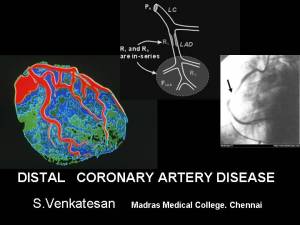
Coronary artery disese  predominantly  occur in the proximal segments of coronary artery.The fact that CAD is mainly a proximal disese , implies  that  clincal impact is likely to be more . But we now recognise distal coronary artery system is equally affected .But isolated distal CAD  is a not a common finding .We describe our analysis on the topic .

distal-cad-csi-2005

Click on the slide to download

Read Full Post »

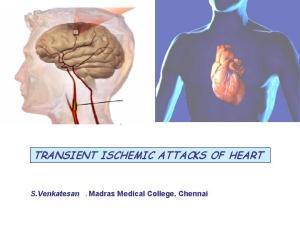
Transient ischemic attacks are not exclusive to cerebral circulation.

Many such episodes can occur in coronary circulation also .

TIA of heart PPT presentation

Click here to download  tia-of-heart

Read Full Post »

CCU’S can also save  patients with cardiogenic shock

Many of us would say ” never” or some may say “rarely” but in reality the answer is “yes it can ” slightly lower than  Primary PCI . One could save atleast  few  lives every month by  intensive medical  management alone (Inotrope, vasodilator,pacing if needed ) in any coronary care unit.

So the message here is, not offering or doing  a primary PCI in a patient with cardiogenic shock is not  synonymous with  inferior treatment or death.  After all, in the much hyped SHOCK  trial a significant no of patients survived in medical limb .

Read Full Post »

Plaque fissure ,rupture and subsequent thrombois is the hallmark of acute coronary syndrome . Are these events painful ? We always attribute any chest pain in an ACS patient to ischemia of myocardium.Is that always true? Coronary artery also has a rich vasa nervorum that could be activated by plaque disruption.

Why  we need an answer to this question ?

We are triaging patients for early invasive apporach based on chestpain .

Many patients may be subjected to revascularisation process for an non ischemic coronary pain !

Read Full Post »

Coronary artery disease has a strong   predilection  to involve proximal segments.

But in a significant population it affects only the distal vascular bed ! What is the extent of this problem ?

This paper was presented in  the annual sessions of Cardiological society of India , Mumbai 2005

Down load presentation

distal-cad-csi-2005

Read Full Post »

« Newer Posts
