Feeds:
Posts
Comments

Archive for the ‘Uncategorized’ Category

CABG is the most common cardiac surgery done world wide. Traditionally saphenous vein graft and LIMA are used .Now radial artery is being used often. The life of venous grafts is short, so total arterial graft is preferred.The issue here is lack of good arteries for grafting especially when a second CABG is required  .

So what  are the options ?

  • Cardiac surgeons often use synthetic conduits for many of the congenital heart diseses.
  • But some how this has never been thought as an option for CABG.
  • This may be due to small nature of the vessels, but now there has been some developments on this .
  • In future sunthetic grafts might replace the conventional grafts.


Chronoflex, is one such graft under trial  and is engineered to be pulsatile, biostable, torque-resistant and suturable. Once implanted, the graft is able to incorporate the patient’s own cells and tissue, so that the inner surface mimics the normal environment for blood contact. The material is also flexible, so that the graft can pulsatile like a  vein as it carries blood to the heart.

www.cardiotech-inc.com

Read Full Post »

Why PCI  in   left main CAD is considered  an inferior modality than CABG ?

CABG is superior to PCI for the  simple reason it provides complete revascularisation virtually in all  patients with LMCAD , while PCI is possible only in a fraction of patients with LMCAD.

If  we take 100 patients  with left main  disease may be ten (At best !)   would be  suitable for PCI ! In other words PCI is contraindicated in vast majority of LMCAD  by technical criteria alone , while there can never be a contraindication for CABG in patients with LMCAD.(Except  when , comorbidity precludes surgery )

Why  PCI in  LMCAD difficult ?

It is  dependent on  technicalities

CABG does not tackle a lesion,  it simply avoids it  and by passes it ” No great brains required”

while PCI takes on the plaque frontally ,  in the dangerous  terrain of  left main artery  itself !

so,  much caution,  planing ,  logistics are required . Further ,  if there is a complication there is a potential

for catastrophe  as the only  supply line is cut off . This is the reason , cardiologists were worried to try this on

unprotected left main. (Protected LMCAD refers to left main disease following CABG  wherein atleast   LAD or LCX is  grafted )

Points to ponder in LMCAD

  • PCI is suited for isolated discrete LM disease.In realty  this is seen in less  than 5-8 % CAD.
  • LMCAD is very often associated  with  critical and multivessel distal CAD . So these patients will be candidates for CABG.
  • Left main ostium or LAD ostial  involvement makes PCI a tougher exercise
  • Calcification is more common in LMCAD that  again makes PCI difficult.

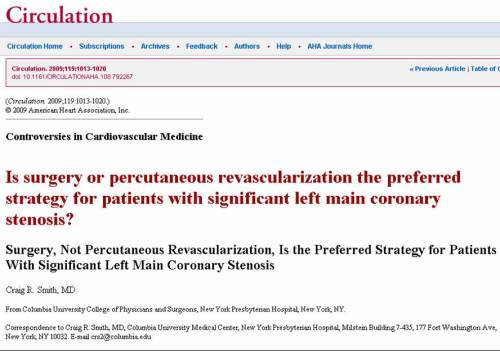
The following article in Feb 2009 is a major blow for proponents of  PCI for left main

http://circ.ahajournals.org/cgi/content/extract/119/7/1013

left-main

http://content.onlinejacc.org/cgi/content/abstract/51/5/538?ijkey=84c977d189e84327c3abbd4c1228de17dd99048a&keytype2=tf_ipsecsha

Final message

  • Conquering left main disease is an interventionist’s  ultimate dream.
  • But, before that they have  to tackle the bifurcation lesions .This is of vital importance, because 2/3 rd of left main  patients have  some form of bifurcation lesions. Current techniques , hardware  and outcomes are far below the idealistic solutions in bifurcation lesions.
  • Till that time ,  CABG would  remain the only choice for all , but for  a small fraction of isolated  left main disease where PCI may be possible.

Read Full Post »

Left main coronary artery disease (LMCAD) often evokes  a panic reaction  among cardiologists .Not every LMD deserve that re. To  label  it as  significant, we have a criteria ,  that is 50% diameter stenosis.  So what you do , for a tapering  or narrowed left main with 40% stenosis. Isolated insignificant left main is rare *, but real incidence is not known.  LMCAD  is  most often due to  , atherosclerosis of left main coronary artery without limiting the flow.

What are the options ?

  • Leave it alone, with intensive medical management assisted by high dose statin(80mg)
  • Elective PCI with stenting , even though the lesion is not significant.

*If associated LAD  or LCX is there decision making is easier .

How  significant is a coronary stenosis ?

The significance of a coronary lesion with reference to “lumen diameter obstruction” is basically flawed. The significance of a coronary stenosis, by tradition is  based on it’s hemodynamic impact ,right from the  CASS days in early seventies.Unfortunately our mind set has not changed even after realising    non obstructive – sub critical lesion is more prone for acute coronary syndrome.  Is it not ironical to call a  40% lesion a non significant one !

So, the  significance of coronary stenosis is two fold.

  1. Hemodynamic  significance
  2. Clinical and  pathologic significance

The former predisposes to often chronic stable angina, later likely to result in ACS.

How will you approach a apparently insignificant left main disease ?

A 40 % lesion in left main is hemodynamically not significant , but pathologically very significant.It needs intensive treatment. Plaque passification with medical approach is first choice.If the lesion morphology is eccentric,  has irregular margins or involves  LAD  or LCX ostium doing a PCI or even a CABG is to be considered in spite of the lesion is  hemodynamically insignificant .

Why , PCI is   considered  “not appropriate”  for   less tighter lesions , even though these lesions  have great clinical significance ?

The answer is simple, The risks  and the  potential cost are more than the benefit !

And further ,  stents are  not innocuous devices  either  , they  always carry a risk of sudden occlusion as like  a sub critical lesion  !

Answer to the title question

True incidence is not known . Our experince (Class 1 c evidence) would suggest Left main disease constitutes up to 10 % of CAD.Among this one third would be hemodynamically insignificant

Suggested reading

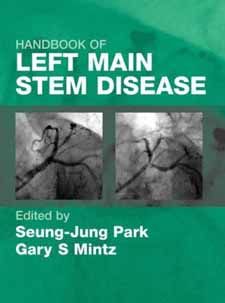
Handbook of Left Main Stem Disease


edited by Seung-Jung Park
hbleftmn

//

Read Full Post »

Ventricular tachycardia as a group , constitute a major  group of cardiac arrhythmias. Most of the VTs are managed  by cardioversion  followed by medical management.  Few require , implantable defibrillator when there is severe LV dysfucntion .(ICD) Localising the origin of  VT and subsequent , ablation is the treatment of choice in some of the  patients  with VT.

Traditionally VT was thought to arise fro the endocardial aspects of myocardium. Now  we realise many times VT originate from the epicardial aspects of  ventricle.

Epicardial VT : Defintion

Epicardial ventricular tachycardia (VT) is defined as VT in which the critical sites of the reentrant circuit (or the ‘sites of origin’) are located exclusively in the subepicardial tissue, as shown by entrainment manoeuvres or VT that is terminated within 10 s with standard radiofrequency (RF) pulses, or both.  E. SOSA,M. SCANAVACCA et  all  http://www.springerlink.com/content/w608142674154tp5/ 


 How to recognise epicardial origin of VT by surface ECG ?

  • Terminal S wave in V2 and q in lead 1 strongly suggest VT of sub epicardial origin.
  • Pseudodelta wave 
  • Intrinsicoid deflection time of  85 ms
  • RS complex duration of  >120msec

Suggest   epicardial origin of the VTs.

Important Links

http://www.circ.ahajournals.org/cgi/content/full/113/13/1659 

Berruezo      criteria ,http://circ.ahajournals.org/cgi/content/full/109/15/1842  ( Must  read)

http://cogprints.org/4222/2/tada.pdf


What is the clincal significance of epicardial VT ?

Endo cardial ablation  not likely to be successful

Trans pericardial approach may be needed.

Read Full Post »

Ventricular  tachycardia (VT)  is one  of  the   dangerous form of  cardiac arrhythmias.

When it occurs , it may present  in  many ways

  • Cardiac arrest with immediate degeneration into ventricular fibrillation. 
  • Pulseless VT in a  conscious patient but in  in shock.
  • With pulse, relatively stable , not much fall in blood pressure.
  • Incidentally detected.*(Rare)

This , gives us  an idea  that VT  as an electrical abnormality has wide clinical presentations , life threatening  at one end and,  patient walking into the hospital with minimal palpitation on the other hand !

The management issues

  • In patients with hemodynamic instability , decision making is easy as there is only option of DC shock.
  • In patients with stable VT, it is natural for the physicians to get tentative or even confused.This is because , dangers of shocking a stable patient has to be weighed against the currently available excellent antiarrhytmic drugs( Amiodarone, Ibutilide etc) .


The major issue here is  in  ruling out underlying structural heart disease.

Never shock a stable VT, without knowing the myocardial and valvular function.There has been many occasions underlying  severe LV dysfunction is missed   and they may go for asystole.

VT in the setting of cardiomyopathy, Post MI(Scar mediated) are often refractory even to DC shocks.It is the drugs that will  ultimately control the arrhythmia.DC shock is just used to terminate the VT.

VT  structurally normal heart , especially arising the outflow tracts of LV or RV  behave very differently (Fortunately they are more benign)

  • Have less hemodynamic  impact as it involves the outflow tract and  not over the  the pumping  zone of LV as in conventional ischemic myocardial VT .
  • They  respond to calcium blockers  verapamil to be precise (As they share properties of SVTs)
  • Sensitivity to verapamil by no way convey a meaning of Amiodarone resistance.Out flow tract VTs will also respond to Amiodarone many times.
  • Degeneration into VF is rare.


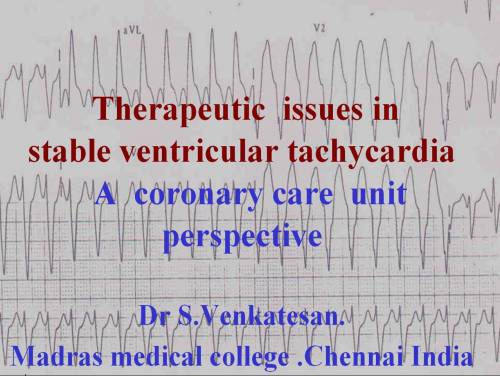
Also  read  Therapeutic issues in stable ventricular tachycardia

Presented and published in Indian heart journal

vtvt-therapeutic-issues1

Click  on link download PPT ventricular tachycardia


Related topics

Why some ventricular tachycardias are resistant , even to multiple DC shocks ?

Read Full Post »

                                       Aortic dissection is a complex cardiac problem and a  killer disease .Even though it is a fancier to make a  diagnosis  of aortic dissection in any intractable chest (or back )pain   the  most common error  committed by physicians is failure to recognise it  .

Is it possible to diagnose or atleast suspect aortic dissection  by a rapid screening biochemical test ?

Yes,  it seems so

  1. D Dimer , a product released consequent to  intravascular thrombosis is elevated  by >500ng in most of the patients with dissection.
  2. Aortic smooth muscle heavy chain estimation is the other option.

aortic-dissection-d-dimer

Read this original article by Patrick Ohlmaan

Click on the link

http://www.medscape.com/viewarticle/530783_print   Courtesy Medscape

 What happens once a diagnosis of aortic dissection is made ?

It is not a great achievement to make a diagnosis of aortic dissection.It is only, a  beginning of a long  and often   tedious decision making process . A real tough task , on hand for the cardiothoracic  surgeons. It is a team work , needs the interaction of cardiologists, radiologists and cardiac surgeons to bring an optimal outcome.

The major issues are

  1. Never try to  manage this problem in a small hospital or facility. Always send the patient to a teaching hospital ( of course , not all teaching hospital can  tackle  this   either , so enquire about their expertise ! )
  2. No credits for making a simple diagnosis of dissection.One has to exactly locate the entry point and exit points if any.
  3. Aortic root and arch  involvement  is of major importance in determining the modality of therapy.
  4. Debaky classification is not  of academic interest ! it has a purpose . Generally type A dissection(Proximal ) require emergency surgery
  5. Differentiating true lumen from false lumen is of critical importance , it needs a meticulous transesophageal echocardiogram.( Some times one may , never  be  sure which is true and which is false lumen  , funnily .in descending aortic  dissection it may never matter for the patient !) Self healing of many dissections with thrombus is possible. 
  6. Controlling hypertension with powerful parentral antihypertenive drugs (Labetalol . . . ideally )  is vital.
  7. Side branch  involvement (spiral dissections) especially arch vessels and renal arteries  make this entity much more complex
  8. Isolated distal dissections and some low risk proximal dissections  can indeed  be managed conservatively(Also called non surgical ! ) Some cardiologists or even institutions  hesitate to  put a aortic dissection with medical management .They feel it is inferior form of treatment . . . but realise , it is not  necessarily so !)


What is the other bichemical marker for disscetion ?

The aortic smooth Muscle Myosin Heavy Chain was proposed as a useful marker for diagnoisng dissection.

Diagnostic Implications of Elevated Levels of Smooth-Muscle Myosin Heavy-Chain Protein in Acute Aortic Dissection: The Smooth Muscle Myosin Heavy Chain Study  Toru Suzuki, MD; Hirohisa Katoh, PhD; Yasuhiro Tsuchio, MD;  Annals of internal medicine 3 October 2000 | Volume 133 Issue 7 | Pages 537-541

 The abstract from annlas of internal medicine follows Readers from India can get the full text article free

  1. http://www.annals.org/cgi/content/abstract/133/7/537 
  2. http://www.annals.org/cgi/content/full/133/7/537
  

Read Full Post »

                                                    Drugs are poisons , whenever it is administered without valid purpose. it can enter human body  in many ways (Oral, intravenous, percutaneous etc ) And now we have another route namely intracoronary !

                                                   In quest for prevention of restenosis, many of the anti cancer drugs are now delivered directly inside the coronary arteries .These drugs are secreted  like a sustained release  tablet from the drug coated stents.These drugs are expected to prevent restenosis within the stented segment.But, after years of  intense debate and research  , we realised that ,  drugs  eluted from the stent  could damage the distal coronary vascular bed and coronary microcirculation.( And thus came the epidemic of acute stent thrombosis ! )

                                                The tender and sensitive coronary microvasculature  is constantly exposed to  these  powerful anticancer and immmunosuppresive  drugs .It is a great surprise , no body thought of  this dangerous drug -coronary artery interaction ! It required the genius of Renu virmani and others to point out this.

But still , the cardiology community by and large , fails to consider  this an important issue.This is proven by the fact, usage of DES is  still increasing  and used mainly as an off label indication.

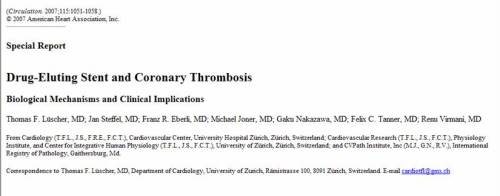
Read this land mark article from circulation

picture1

http://circ.ahajournals.org/cgi/content/full/115/8/1051?maxtoshow=&HITS=10&hits=10&RESULTFORMAT=1&author1=renu+virmani&andorexacttitle=and&andorexacttitleabs=and&andorexactfulltext=and&searchid=1&FIRSTINDEX=0&sortspec=relevance&fdate=1/1/2007&tdate=12/31/2007&resourcetype=HWCIT


Questions that need to be answered

  • What is the long term effects of drugging a coronary artery ?
  • Is no reflow or slow flow  more common after DES , because of the adverse drug reaction in the distal vascular bed ?
  • If a patient  with  DES  undergoes a CABG later what  would be  the impact of the  drug on the graft ? Will the functional vasodilatation   affected ?

Final message

                                  A drug , to get a legal clearance it has to undergo  hundreds of rigorous tests . Finally it is cleared for that  specific indication for which it is tested  .Just because a drug is cleared for one purpose ( Paclitaxel for malignancy ) it does not mean it is safe to use for any other  purpose for which it is deemed to be useful . Exactly the  opposite is happening   in the  the field of interventional cardiology . No body wondered to think what would be the effect of these drugs on the normal coronary endothelial cells and vasculature.Is it not a crime ,  without analysing this particular issue  , dozens of drug eluting stents have been released in the market . And now,  sounds of crying  foul is heard world wide !

Let us thank  , the so called negative forces in cardiology  for making this an  issue . In science ,  the watch dogs should bark  at  times of danger not wag the tail !

Read Full Post »

 Selected on the basis of ,  impact  on survival , relief of  human suffering index and also innovation

10.Percuateneous interventions

9.  Electrocardiography

8 . Hemodynamics of cardiovascular system

7.Fruesemide

6.Thrombolysis

5.Pacemakers

4.Defibrillation

3.Heparin

2.Prosthetic valves

1.Coronary care units


Waiting list

Concept of vascular biology

Statins

RF ablation

Nitric oxide

Total Artifitial heart

Echocardiography


Ten least important concepts and  inventions in cardiology

Selected based on duplication of research, futile scientific concepts and   of course impact on survival

10.Low molecular weight heparins

9.Cardiac resynchronisation

8.Rotablator

7.Multi  chamber pacing

6.Newer ARBs

5.C reactive protein

4.Three dimensional echocardiography

3.

Comments welcome  and please contibute

Read Full Post »

A poorly deployed drug eluting stent is far inferior to a properly deployed bare metal stents

  • Doing a plain old balloon  angioplasty ( POBA)  is not a scientific crime , millions of coronary lesion just  need that! ( Click here -Why POBA is important ? )
  • PCI is most effective during an ACS than a chronic coronary syndrome
  • Primary PCI is a race against time and muscle , not a race against money ! Don’t do it  for a  evolved   MI
  • Recognise , from the patient point of view  the term no reflow is  generally  synonymous with   failed primary PCI( It is semantics !)
  • Side branch  can be more important than main branches , so don’t sacrifice it often
  • Attempting a trifurcation  angioplasty is generally not in  the interest of the patient but  to show interventional expertise
  • Make sure surgical back up means, a table is reserved with a surgeon fully informed and ready

When in  doubt , it is always  better to err on a longer stent than a shorter one

Read Full Post »

The irony of medicine is unlimited !  100 years of active clinical  research   failed  to find a specific cure for the rhino virus mediated common cold.In fact  US Govt stopped funding for this .

While ,   complete cure is possible  for many of the cancers, especially hematological ones !

Message 

In medicine there are thousands  of disorder  which have no cure ! 

Cancers ,  constitute  only a  fraction of  them !

Read Full Post »

« Newer Posts - Older Posts »