Feeds:
Posts
Comments

Posts Tagged ‘pci’

Fundamental principle  of  human biological system is to live in harmony with nature and environment.Each cell  has a unique reaction  when it comes into contact with  external  material. This reaction can be acute or chronic  ,   local or systemic. The most severe form of allergy is called anaphylaxis  that can result in instantaneous loss of life. There  is a whole gamut of disorders  that  resulted  in a  separate  speciality called allergic medicine .

Further ,the transplantation  science have   taught us  an  organ or cell can be rejected at any point of time after implantation (Hyperacute -chronic) .With advancement of science we have started implanting a variety of devices  with complex metallurgy ,inside human body, metal clips, prosthesis, valves, wires, etc .How the body handles them .The consequences can be a mild reaction to major ones occasionally.

Consider ,a local allergy due to a orthopedic prosthesis  in one of the leg bones  is far less serious than a metal within a coronary artery  irritating the intima .

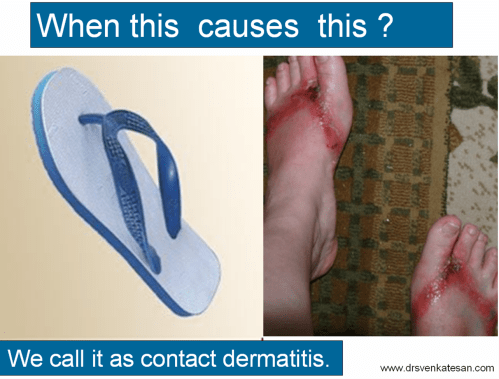
Remember hypersensitivity reactions can be severe . This lady reacted  like this to a sandal slipper -A  fiery red  infiltration

contact dermatits stent allergy pci coronary

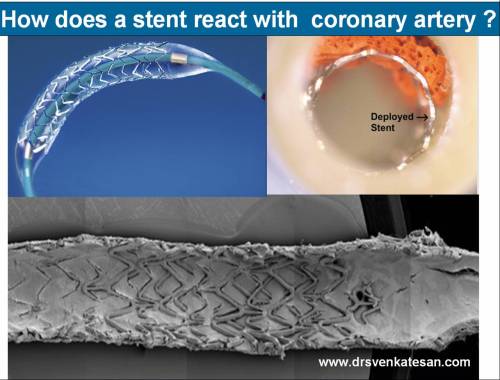
Imagine  if a stented coronary artery react like this what would be the possible consequence ?

In susceptible  individuals  , can a metal cause

  • Intimal hyperemia
  • Intimal induration
  • Intimo-medial edema  following stent deployment

pci stent coronary angiogram thrombosis des

Why drug eluting stents are more prone for hypersensitivity ?

The answer is simple , while metal allergy is a comparatively rare phenomenon, the drugs we  coat and the polymers used are  many fold likely to result in hypersensitivity reaction.

While  the world is worried  more  about penicillin , sulpha allergy which occurs in 1 in 100000 ,  we tend to ignore the metal and drug  reactions within  the tender coronary arteries.

stent des rejection virmani  pci

What is  the clinical expression of  stent hypersensitivity ?

It is  often a coronary event in the acute phase and restenosis in chronic phase.

How much of acute stent thrombosis is related to stent allergy mediated reaction ?

The exact incidence  will  never be known. It could be high. Whenever a sudden unexpected early stent occlusion can be a suspect .

Is stent allergy a local reaction or systemic reaction ?

It is most often local .The drugs the stent elute can elicit a systemic reaction occasionally.

So what can be done to prevent this complication ?

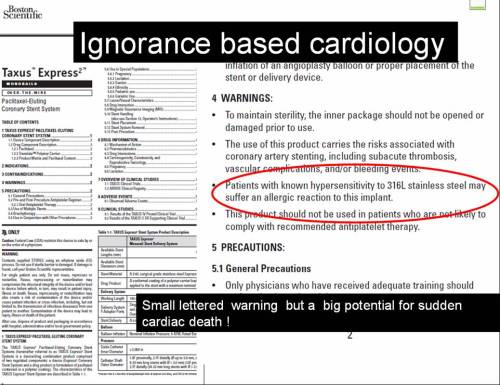
Drug companies in it’s  package regularly  include the warning  message ! What does it imply to have a caution  on the covers ? .This warning simply represent about our ignorance in this issue. We presume it is a minor problem.

pci stent thrombosis stent allergy metal

Questions unanswered

  1. How does a cardiac patient knows whether he is hypersensitive to stainless steel or nickel ?
  2. Is it practical to have a stent allergic test in every patient before PCI ?
  3. Is routine administration of corticosteroids for few days after PCI an answer ?

Reference

R.Virmani , circulation 2004

http://circ.ahajournals.org/cgi/content/full/109/6/701?maxtoshow=&HITS=10&hits=10&RESULTFORMAT=&fulltext=stent+%27allergy%22+&searchid=1&FIRSTINDEX=0&resourcetype=HWCIT

Read Full Post »

Total coronary artery occlusion is a common finding in CAD  especially in chronic stable angina. Normal coronary blood flow is 5 % of cardiac output  that amounts to 250-300ml/mt.At an average  heart rate of  70/mt  , each  beat  injects  about 5cc blood into the coronary circulation.This is shared between two coronary arteries.  This means , only few CC (2-3cc) of blood enters  each coronary artery with each cardiac cycle .

When one of coronary artery is totally occluded what happens to the coronary

blood flow ?

A.Total coronary blood flow  can be be  maintained   normal  at rest  as it  forms  only about 5% of cardiac output  (or it is only  slightly reduced )

B. It is believed , the unobstructed coronary artery  could receive the blood meant for the contralateral coronary artery. This  possibly explains the increased coronary artery diameter in the non obstructed artery.

C. It’s nature’s wish ,  that the  contralateral  coronary artery  shall share  50% of  it’s  blood through  collaterals if available.

D.If collaterals are not formed it , the unobstructed coronary  artery  may be over perfused with double the amount  of blood flow.

E. Some times , the collaterals steal  much more than what  the  obstructed coronary artery  deserves and make the feeding coronary artery ischemic. This is many times observed in  total RCA occlusion with well formed  collaterals  from LAD/LCX.

F.The collateral flow  in CTO also depend on whether flow is directed from LAD system to RCA or from RCA -LAD system. The LAD is better placed to assist RCA than vice versa.This is for two reasons.1.LAD blood flow is higher than RCA so it can share it.2.The driving pressure is more  from LAD -RCA , as RCA can receive  blood flow even during diastole .

F.During exertion , the coronary hemodynamics become further complex.The collateral’s are traditionally thought to be less than adequate during times of exercise.But it is more of a perception than solid scientific data.This rule  may be applicable in only certain group of patients. We know CTO patients with very good exercise tolerance who have documented collateral’s.

G.Collaterals can be either  visible or invisible by CAG. The strength of collateral circulation is not in it’s visibility but it’s capacity to dilate and  respond to neuro humoral mediators at times of  demand.  Currently  , there is lot to be desired  regarding  our knowledge about  the physiology  of visible collaterals , no need to  mention about invisible collaterals !

Final message

The above statements  are based  on logics and observations .

Is it not a  irony  in cardiac literature ,  where  thousands of articles  are coming out every month  to tackle  totally occluded coronary artery(CTOs) ,  there is  very little data   regarding the coronary hemodynamics in chronic total occlusion .   How  does a patient with CTO can manage a active life with only one functioning  coronary artery ?

Read Full Post »

When  a doctor is confronted by serious  doubt  ,  what will be the outcome for the patient  ?

Can  doubting  be beneficial for a patient ?  . It seems so ,  according to  EBM which  stresses   about statistical outcome at every turn of events in a  patient who  is critically  ill .

Is  something ,  always  better than  nothing   ?   Our  limbic  system tends to think so .  It  may not be true. But  in  dire situations ,   many  things  (Proven , unproven)  need to  be tried  however doubtful it ‘s  efficacy  may be  .This is  akin to an  emergency in an  airplane. Even here there need to be a logic.

Then ,this question  arises . How do we make  sure ,  we have a  dire situation on hand  ?

This is the key issue ,  in  the  decision making  for the   critically ill patients .  It  needs  experience ,  only experience !  Though the principle of uncertainty  is the fundamental rule in medicine ,   EBM  aims to bring some degree of certainty in medical therapeutics.

ebm evidence pci coronary

Benefits of doubting in coronary care unit.

In  a  sinking patient  with cardiogenic  shock  , try  the maximum treatment . Even if , the patient is  in severe shock  , take him to the  cath lab ,  try  open the coronary artery . Give the benefit of doubt  to him even though the chances of reviving him is less than 10%.

Risk of doubting in Coronary care unit.

A.Elderly STEMI  with SHT,(Arriving late ,  with  an unknown time  window  after an MI ) To thrombolyse or not ?  . There is  no benefit of doubt here.  Do not thrombolyse. Here , apply  the benefit of doubt against thrombolysis .

B. Chest pain with  LBBB (Thought to be new onset LBBB ) don’t ever rush to thrombolyse.  Wait for the enzyme result . Don’t try to thrombolyse your doubt , instead  thrombolyse the  confirmed thrombus !

C. Patient with persistent ST elevation following thrombolysis ,in an  otherwise asymptomatic and stable patient. Don’t  pass on  ” your doubt ” of salvaging   at least  some myocardium  by rescue PCI .Rescue  should be done before death. You can not resuscitate  dead myocytes.

Final message

The concept of   giving  the  benefits of doubt  to the patient   is a widely prevalent practice  in medicine .This concept is alive  and popular , not because it has proved effective, but because of the primitive   human perception and cognition  , namely “Something is better than nothing ” !

Common sense and logic would suggest , whenever  there is  a benefit  for doubting there would be a  equal (  or  even  more ) unmeasured  hazards and risks . This  becomes  especially  true ,  when   a   physician makes  a therapeutic move  based on doubting than on conviction .

Read Full Post »

Can we advice CABG for single vessel disease  ?

Yes, CABG  may be indicated  in

  • Critical , proximal , complex  LAD disease   with or without  ostium involvement.
  • Many of the bifurcation lesions with large and significant  side branch
  • Small caliber LAD with diffuse disease .

When these occur  in diabetic  subjects , the  indication for CABG is more certain .

* Present generation cardiologists  would feel  every  lesion  is  stentable and should not be referred to the surgeon .But it should be emphasized here,   technical feasibility alone  ,  does not  imply  PCI is superior and ideal in all coronary interventions.

Can we do a CABG  in  single vessel disease  with  normal  LAD ?

CABG is  very rarely  indicated   for isolated RCA or LCX disease. It should be consciously avoided in this patient population.

This is because the at risk myocardium  supplied by these vessels are far less than that of LAD. PCI  is  preferred    in these vessels .(Ofcourse , after considering medical management  ) .

CABG is  ,  too traumatic a  surgery , to  offer  in this  low  risk  coronary  lesions.

Exceptions

CABG  can still be done in following situations  for non LAD single vessel disease.

  • Left dominant circulation  with  complex lesions in LCX /OMs.
  • It is common to see diffuse , long segment  and severe disease of RCA with normal LAD /LCX system .PCI is not feasible in this subset.
  • Failed PCI
  • Recurrent instent restenosis.
  • Bail out CABG after a acute complication during PCI

One should remember ,  inability to do a PCI  does not  mean ,  the patient  should   land in surgeon’s table .We should recall , from our memory medical management is an effective and established form of treatment in single vessel disease ( Mainly for non LAD , and some cases of LAD also !)


Read Full Post »

pci-ptca-ebm-stent

Scientifically ,  the  indication for coronary revascularisation   should be  based on following

  1. Patient’s  symptom ( more specifically angina , dyspnea is less important !)
  2. Prov0kable  ischemia  ( A significantly positive stress test )
  3. Signifcant LV dysfunction with  documented  viable myocardium &  residual ischemia
  4. A revascularisation eligible coronary anatomy * TVD/Left main/Proximal LAD etc ( *Either 1, 2 or 3 should be  present  in addition )
  5. All emergency PCI during STEMI /High risk NSTEMI

Practically ,

A CAD  patient  may fulfill  “Any of the above 5 or  “None of the above 5” ,  but ,  if   a coronary obstruction  was  revealed  by coronary angiogram  and if he  fulfils The 6th criteria , he becomes  eligible for  revascualrisation

6th criteria

If the patient has  enough monetary   resources (by self  ) or by  an  insurance company  to take care of PCI /CABG *

*The sixth  criteria overrides all other criteria in many of the cath labs .Of course , there are few genuine ones still  fighting hard , to keep the commerce out ,  from contaminating cardiology !

Read Full Post »

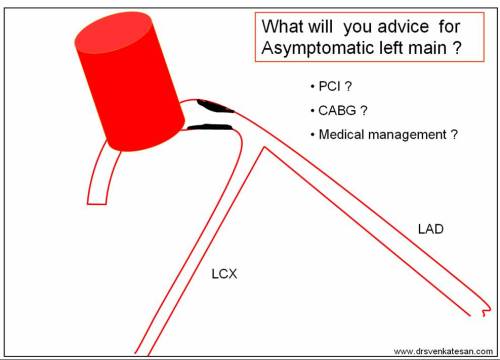
Left main disease is the  most dangerous subset of CAD population .The danger is attributable more on the perceived fear  of  sudden occlusion .How often this occurs in stable , left main plaques is not known.

There is a significant group of patients with isolated ,  asymptomatic ,  non flow limiting , leftmain  disease with stable , smooth plaques. The ideal management for this group of CAD is not clear.

left-main-d

Advising a  CABG /PCI  is  an easy and very practical  decision ! That’s what the current guideline also suggest

But is there scientific evidence  to do that ? Many times practical approach  could be    synonymous with  an  unscientific approach.

  • PCI has a potential to  convert  a stable plaque into  a vulnerable one (Metalled plaque is not inert )
  • CABG will reduce the flow across , the  already narrowed left main and  there is  a likely hood of rapid  progression of native left main disease

So what is left  ?

If it is a stable plaque ,  and does not limit the flow both at rest on exercise * medical management will be optimal.

* Excercise stress test must be done

Read this article from the circulation ,  that suggests  a role for medical management for left main disease

http://circ.ahajournals.org/cgi/content/full/118/4/422

left-main-circualtion1

Read Full Post »

The answer to this question  is not  easy  , as   one  would tend to believe . In fact this question , takes it for granted     revascularisation  will  improve the LV dysfunction in patients  with severe LV dysfunction.

The truth is , we  are not sure   about the mechanisms . How   revasculariastion  will have an effect  on  chronically dying or dead myocardium  ? (Acutely dying myocardium is a different story, where revascualrisation has a profound effect , that is called salvaging the myocardium )

This  issue is  of great clinical significance  in end stage ischemic heart disease  .A typical  myocardial segment in ischemic cardiomyopathy  has millions of  the dead cells  interwoven with dying cells  with  occasional  clusters if live cells scattered all over .Once the process of myocardial apotosis sets in ,  myocardial cell death does not result  in segmental destruction  instead  an universal cell death.(Paracrine signals of  cell death that spills over to adjacent segments  )  The current standards of revascualrisation (PCI and CABG) aims to provide blood flow  in a segmental fashion. Even if the blood flow is restored in an obstructive vessel it is not clear , how it is going to enter the chronically atrophied myocytes.

Meanwhile , many studies are available   suggesting  coronary revascularisation does indeed improve LV dysfunction. These  evidence has never been  conclusive .Real world experience would also  confirm this  simple fact , that   angina relief is definite following revascularisation but not dyspnea  relief  in patients  with LV dysfunction .

So ,  when seeking the  guidelines  for revascularisation  ( PCI or CABG )  in patients  with CAD one need to ask  this  specific  question

Does the patient has

A.Angina alone

B.Angina and dyspnea

C.Only  dyspnea

If the answer is C ,  assess the patient again , rule out systemic causes of dyspnea (Anemia, renal function etc)  rethink  or postpone  revascularisation.If primary  or secondary LV muscle dysfunction has set in revascularisation has little value.

Also read

Viable myocardium

Read Full Post »

Coronary collateral circulation is the most poorly understood, and often neglected concept among the cardiology community.There is a general perception , in obstructive CAD ,  coronary collaterals are an inferior modality of  back up blood supply than artificial collateral (Also called CABG ) ! One of the reasons,  it is   been ridiculed by many  mainstream cardiologists is   because  , it comes by nature , and also free of cost !

The often quoted statement* ,collateral blood flow can not sustain blood flow during exercise ,  is not based on solid scientific data. In the real world , there are thousands of patients actively pursuing life with chronic total occlusion and good collaterals.

It is surprising , there is no  physiologically valid ,  controlled study available to compare CABG with natural collaterals

*When repeatedly told , a  statement becomes a fact !

It can be assumed (Unscientifically ofcourse ! )   the  remarkable  success  of medical therapy  in COURAGE  and the OAT * study  can be attributable to the naturally occurring coronary collateral circulation.

* Summary of COURAGE & OAT : A   block  in the coronary artery  need not be opened  to prolong human survival !

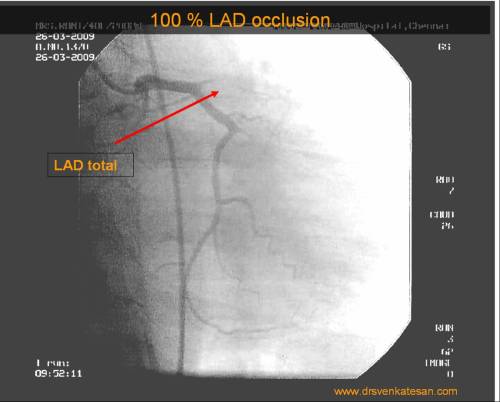
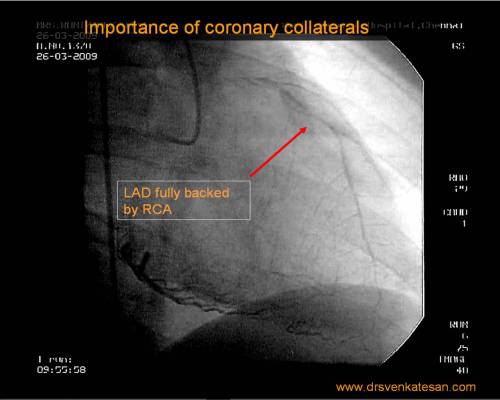
You draw your own conclusions from the  following case study

A 40 year old women , with stable angina and good physical activity

Her angiogram shows.

coronary-collateral-2

RCA injection

coronary-collateral

Read Full Post »

Coronary artery  perforation is a dreaded complication of PCI. Perforations are the Interventional cardiologists ultimate worry   as they need to  manipulate their  hardware for  long periods in many complex lesions.  Especially  it is a  real threat in chronic total occlusions.

Still , an important fact is ,  many of the coronary perforations are not life threatening ?

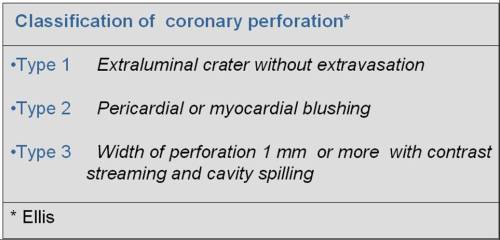
How is this possible ?  (Type 1 Ellis has zero mortality Read below)

As the guide wire injures and perforates the cor0nary vessel,  it results in  small puffs of dye extravasating  into peri coronary space .

The coronary artery , which is located   within the  atrioventricular groove  (LAD), or AV groove (LCX, RCA) have  two distinct anatomical relationship with reference to epicardium and pericardial space.

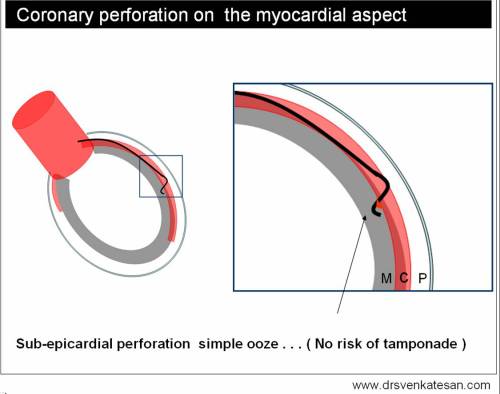
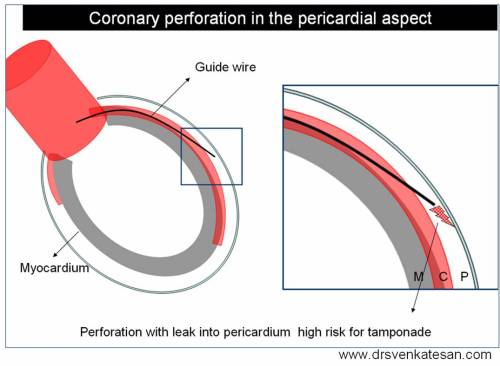
50 % 0f circumference of the coronary artery is  hugged  by the myocardium  another 50% or so is related directly to the pericardial aspect.

Guide wires hitting on the myocardial aspects face a stiff resistance than the pericardial aspect. So , generally the risk of perforating pericardial aspect is more than myocardial aspect

Even if , the coronary artery is punctured on myocardial aspect , no great danger occur as there is no potential space for the blood to drain and further,  the  elastic nature of myocardial muscle plane effectively seals the leak. At the most , mild myocardial staining is noted .

coronary-perforation-2

While ,  perforations  into  the pericardial space  , often threaten with a tamponade. The fact that pericardial space has negative pressure and  the mean  coronary arterial pressure around 40mmhg ,  it is  , all the more likely blood is sucked into the pericardial  space. Of course , very minute  perforations  even into the pericardial space ,  could  be self limited and  benign.

coronary-perforation

What is unrecognised coronary perforation?

Many times , the guidewire goes in a false track in the tissue plane.This is  nothing,  but perforation without hemodynamic implication. Most often , these are the instances of guide wire entering the epicardium.They mimic , false lumen entry , dissections, etc. There are occasion , where false lumen of the  coronary artery were  stented.

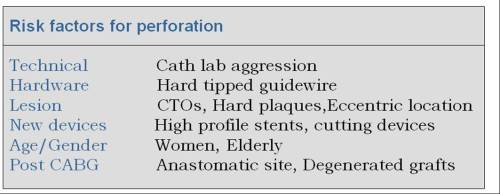
What are the  factors which increase risk of perforation ?

perforation-6

 How do you classify coronary perforations ?

perforation-3

*Ellis SG, Ajluni S, Arnold AZ,  Increased coronary perforation in the new device era. Incidence, classification, management, and outcomeCirculation. 1994;90:2725–2730


How do you manage coronary perforation?

Simple guide wire induced perforations are less trouble some unless we have crossed it with balloon without realising the fact the wire has entered the pericardial space. So, caution is required and always watch for guide wire tip movement which is often funny looking wihtin false lumens or very freely moving within pericardial space. Anticipate the complication especially so when you do CTOs and venous graft PCI.  Keep one cath lab  tamponade crash  bin  in ready mode before embarking upon a complex PCI

  • Neutralise the heparin action with protamine is the first step
  • Most are self limited, no intervention is required  but requires close observation for next 24 hours.
  • Temporary balloon occlusion may be suffice in many cases
  • Tamponade requires immediate tapping. Small collection without fall in BP can be observed.
  • keep doing the echocardiogram liberally to assess the leak and watch for any new collection.
  • PTFE covered stents if prolonged leak.
  • Emergency surgery may required in few.

2018 update 

This is  nearly 10 years old article. Now, we have gained much experience and hardware utilisation have rapidly expanded. While expertise has minimised this complication , more PCIs in complex lesion subset tend to keep the incidence static , if not higher.(Its around .5% )

Tips to use balloon occlusion during perforation

Perforations which are active and flowing should be immediately occluded with a balloon either at the site of leak or just proximal to it. Doing a proximal occlusion is easier in emergency , as often times its technically difficult to reach the site of leak especially in CTOs where the leaky site is not defined clearly or forward looking (Local balloon inflation across the leaky site is not feasible )


How long to occlude , Intermittent /complete, proximal ? or at the site of perforation ? These queries are answered in Ref 4

Reference

1.Largest report (1762 cases) of perforation from British Cardiovascular Intervention  Society Database Circ Cardiovasc Interv. 2016;9:e003449.

2.Al-Lamee R, Ielasi A, Latib A,. Incidence, predictors, management, immediate and long-term outcomes following grade III coronary perforation. JACC Cardiovasc Interv. 2011;4:87–95.

3Xiangfei Wang and Junbo Ge Balloon Occlusion Types in the Treatment of Coronary Perforation during Percutaneous Coronary Intervention   Cardiology Research and Practice Volume 2014, Article ID 784018,

4.A very good review comes from Royal Hospital, Muscat, Sultanate of Oman


iFAQs in coronary perforations

1.Does the plane of the coronary artery (Sub epicardial within the fat layers)  determine the likely hood of tamponade ?

While myocardial tissue can resist flow we are not sure about sub-epicardial fat on the pericardial aspect.

2.How common is Intra-cavitory perforation ?

Perforations into chamber is invariably associated with septal branches (PCI to septal branch itself is less common )

Read Full Post »

First and foremost is

Avoid the procedure if  not really indicated.A lesion which  has more thrombus load  than a plaque and it is ,  subcritical and not limiting the flow  , PCI may be inappropriate  especially if the ACS is stabilised.

  • Adequate anticoagulation  along with  2b 3a blockers should be used
  • Predilatation should be minimally used or to avoided.Direct stenting preferred.
  • In primary PCI suction devices (Export etc may be useful)
  • Distal protective devices  are  “hyped up devices” rarely useful in an occasional patient with good distal vessel diameter.
  • Pseudo stent approximati(fig 1) may occur. A Layer of thrombus may get plastered between stent and the vessel wall.In the post PCI  phase , with intense anticoagulation and antiplatelet regimen this layer may get dissolved and stent  may lose it’s grip and may dislodge or migrate.Another possibility is the dead space  beneath the stent  becomes a potential site for future  thrombus and ACS.

thrombus-and-pci

Fig 1

  • To prevent this complication , high pressure inflations and Post procedure IVUS (Intra vascualr ultraound may be done to ascertain lack of thromus between stent/vessel wal  interface)
  • Drug eluting stent evoked a special concern , when used in thrombotic milleu.This , has now been  proven to be  safe

Read Full Post »

« Newer Posts - Older Posts »