Feeds:
Posts
Comments

Posts Tagged ‘ptca’

Can we advice CABG for single vessel disease  ?

Yes, CABG  may be indicated  in

  • Critical , proximal , complex  LAD disease   with or without  ostium involvement.
  • Many of the bifurcation lesions with large and significant  side branch
  • Small caliber LAD with diffuse disease .

When these occur  in diabetic  subjects , the  indication for CABG is more certain .

* Present generation cardiologists  would feel  every  lesion  is  stentable and should not be referred to the surgeon .But it should be emphasized here,   technical feasibility alone  ,  does not  imply  PCI is superior and ideal in all coronary interventions.

Can we do a CABG  in  single vessel disease  with  normal  LAD ?

CABG is  very rarely  indicated   for isolated RCA or LCX disease. It should be consciously avoided in this patient population.

This is because the at risk myocardium  supplied by these vessels are far less than that of LAD. PCI  is  preferred    in these vessels .(Ofcourse , after considering medical management  ) .

CABG is  ,  too traumatic a  surgery , to  offer  in this  low  risk  coronary  lesions.

Exceptions

CABG  can still be done in following situations  for non LAD single vessel disease.

  • Left dominant circulation  with  complex lesions in LCX /OMs.
  • It is common to see diffuse , long segment  and severe disease of RCA with normal LAD /LCX system .PCI is not feasible in this subset.
  • Failed PCI
  • Recurrent instent restenosis.
  • Bail out CABG after a acute complication during PCI

One should remember ,  inability to do a PCI  does not  mean ,  the patient  should   land in surgeon’s table .We should recall , from our memory medical management is an effective and established form of treatment in single vessel disease ( Mainly for non LAD , and some cases of LAD also !)


Read Full Post »

pci-ptca-ebm-stent

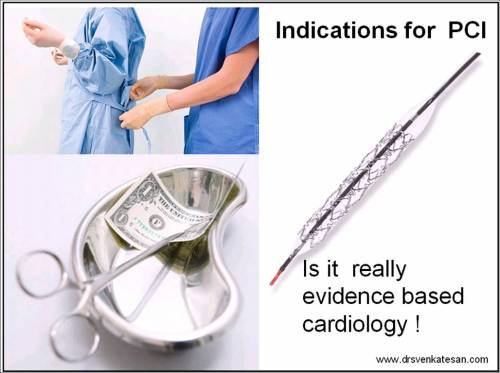
Scientifically ,  the  indication for coronary revascularisation   should be  based on following

  1. Patient’s  symptom ( more specifically angina , dyspnea is less important !)
  2. Prov0kable  ischemia  ( A significantly positive stress test )
  3. Signifcant LV dysfunction with  documented  viable myocardium &  residual ischemia
  4. A revascularisation eligible coronary anatomy * TVD/Left main/Proximal LAD etc ( *Either 1, 2 or 3 should be  present  in addition )
  5. All emergency PCI during STEMI /High risk NSTEMI

Practically ,

A CAD  patient  may fulfill  “Any of the above 5 or  “None of the above 5” ,  but ,  if   a coronary obstruction  was  revealed  by coronary angiogram  and if he  fulfils The 6th criteria , he becomes  eligible for  revascualrisation

6th criteria

If the patient has  enough monetary   resources (by self  ) or by  an  insurance company  to take care of PCI /CABG *

*The sixth  criteria overrides all other criteria in many of the cath labs .Of course , there are few genuine ones still  fighting hard , to keep the commerce out ,  from contaminating cardiology !

Read Full Post »

Coronary artery  perforation is a dreaded complication of PCI. Perforations are the Interventional cardiologists ultimate worry   as they need to  manipulate their  hardware for  long periods in many complex lesions.  Especially  it is a  real threat in chronic total occlusions.

Still , an important fact is ,  many of the coronary perforations are not life threatening ?

How is this possible ?  (Type 1 Ellis has zero mortality Read below)

As the guide wire injures and perforates the cor0nary vessel,  it results in  small puffs of dye extravasating  into peri coronary space .

The coronary artery , which is located   within the  atrioventricular groove  (LAD), or AV groove (LCX, RCA) have  two distinct anatomical relationship with reference to epicardium and pericardial space.

50 % 0f circumference of the coronary artery is  hugged  by the myocardium  another 50% or so is related directly to the pericardial aspect.

Guide wires hitting on the myocardial aspects face a stiff resistance than the pericardial aspect. So , generally the risk of perforating pericardial aspect is more than myocardial aspect

Even if , the coronary artery is punctured on myocardial aspect , no great danger occur as there is no potential space for the blood to drain and further,  the  elastic nature of myocardial muscle plane effectively seals the leak. At the most , mild myocardial staining is noted .
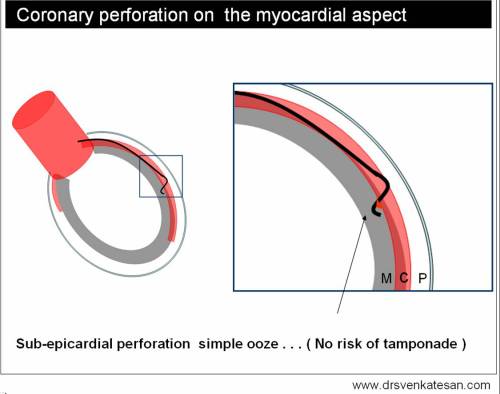
coronary-perforation-2

While ,  perforations  into  the pericardial space  , often threaten with a tamponade. The fact that pericardial space has negative pressure and  the mean  coronary arterial pressure around 40mmhg ,  it is  , all the more likely blood is sucked into the pericardial  space. Of course , very minute  perforations  even into the pericardial space ,  could  be self limited and  benign.
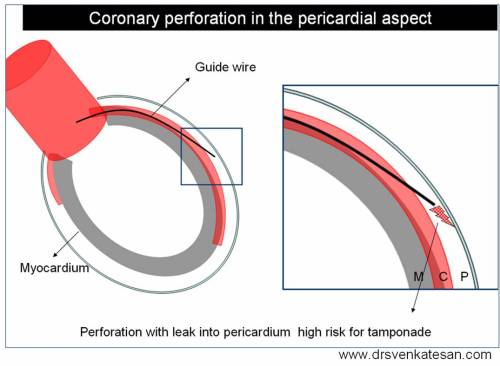
coronary-perforation

What is unrecognised coronary perforation?

Many times , the guidewire goes in a false track in the tissue plane.This is  nothing,  but perforation without hemodynamic implication. Most often , these are the instances of guide wire entering the epicardium.They mimic , false lumen entry , dissections, etc. There are occasion , where false lumen of the  coronary artery were  stented.

What are the  factors which increase risk of perforation ?
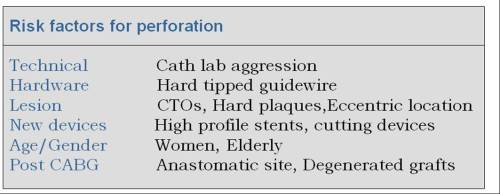
perforation-6

 How do you classify coronary perforations ?
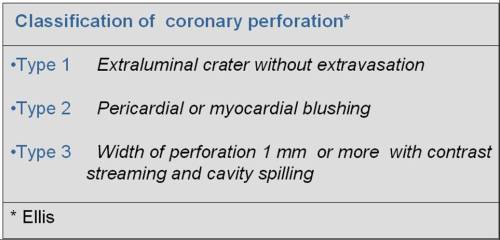
perforation-3

*Ellis SG, Ajluni S, Arnold AZ,  Increased coronary perforation in the new device era. Incidence, classification, management, and outcomeCirculation. 1994;90:2725–2730


How do you manage coronary perforation?

Simple guide wire induced perforations are less trouble some unless we have crossed it with balloon without realising the fact the wire has entered the pericardial space. So, caution is required and always watch for guide wire tip movement which is often funny looking wihtin false lumens or very freely moving within pericardial space. Anticipate the complication especially so when you do CTOs and venous graft PCI.  Keep one cath lab  tamponade crash  bin  in ready mode before embarking upon a complex PCI

  • Neutralise the heparin action with protamine is the first step
  • Most are self limited, no intervention is required  but requires close observation for next 24 hours.
  • Temporary balloon occlusion may be suffice in many cases
  • Tamponade requires immediate tapping. Small collection without fall in BP can be observed.
  • keep doing the echocardiogram liberally to assess the leak and watch for any new collection.
  • PTFE covered stents if prolonged leak.
  • Emergency surgery may required in few.

2018 update 

This is  nearly 10 years old article. Now, we have gained much experience and hardware utilisation have rapidly expanded. While expertise has minimised this complication , more PCIs in complex lesion subset tend to keep the incidence static , if not higher.(Its around .5% )

Tips to use balloon occlusion during perforation

Perforations which are active and flowing should be immediately occluded with a balloon either at the site of leak or just proximal to it. Doing a proximal occlusion is easier in emergency , as often times its technically difficult to reach the site of leak especially in CTOs where the leaky site is not defined clearly or forward looking (Local balloon inflation across the leaky site is not feasible )


How long to occlude , Intermittent /complete, proximal ? or at the site of perforation ? These queries are answered in Ref 4

Reference

1.Largest report (1762 cases) of perforation from British Cardiovascular Intervention  Society Database Circ Cardiovasc Interv. 2016;9:e003449.

2.Al-Lamee R, Ielasi A, Latib A,. Incidence, predictors, management, immediate and long-term outcomes following grade III coronary perforation. JACC Cardiovasc Interv. 2011;4:87–95.

3Xiangfei Wang and Junbo Ge Balloon Occlusion Types in the Treatment of Coronary Perforation during Percutaneous Coronary Intervention   Cardiology Research and Practice Volume 2014, Article ID 784018,

4.A very good review comes from Royal Hospital, Muscat, Sultanate of Oman

 

iFAQs in coronary perforations

1.Does the plane of the coronary artery (Sub epicardial within the fat layers)  determine the likely hood of tamponade ?

While myocardial tissue can resist flow we are not sure about sub-epicardial fat on the pericardial aspect.

2.How common is Intra-cavitory perforation ?

Perforations into chamber is invariably associated with septal branches (PCI to septal branch itself is less common )

Read Full Post »
First and foremost is

Avoid the procedure if  not really indicated.A lesion which  has more thrombus load  than a plaque and it is ,  subcritical and not limiting the flow  , PCI may be inappropriate  especially if the ACS is stabilised.

  • Adequate anticoagulation  along with  2b 3a blockers should be used
  • Predilatation should be minimally used or to avoided.Direct stenting preferred.
  • In primary PCI suction devices (Export etc may be useful)
  • Distal protective devices  are  “hyped up devices” rarely useful in an occasional patient with good distal vessel diameter.
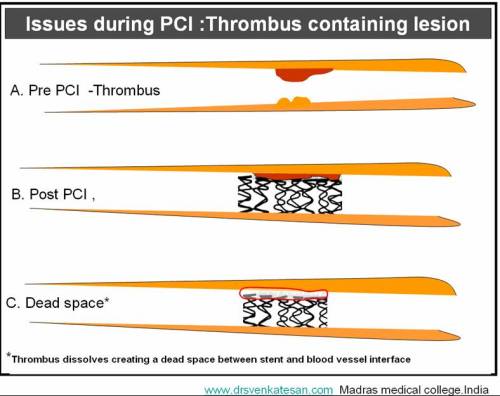
  • Pseudo stent approximati(fig 1) may occur. A Layer of thrombus may get plastered between stent and the vessel wall.In the post PCI  phase , with intense anticoagulation and antiplatelet regimen this layer may get dissolved and stent  may lose it’s grip and may dislodge or migrate.Another possibility is the dead space  beneath the stent  becomes a potential site for future  thrombus and ACS.

thrombus-and-pci

Fig 1

  • To prevent this complication , high pressure inflations and Post procedure IVUS (Intra vascualr ultraound may be done to ascertain lack of thromus between stent/vessel wal  interface)
  • Drug eluting stent evoked a special concern , when used in thrombotic milleu.This , has now been  proven to be  safe

Read Full Post »


Coronary stents have revolutionised the management of CAD. Stents are metallic scaffolding devices that help keep the atherosclerotic plaque  plastered within the coronary arterial wall.Thus it gained the name angioplasty. Stents have aradial strength that  exerts a constant force on  the plaque . Since metals are unfriendly partners for coronary artery , we need to have minimum metal within the coronary artery.The stent struts weave around the lumen generally the stento/ artery area ratio should be as less as possible (15%).

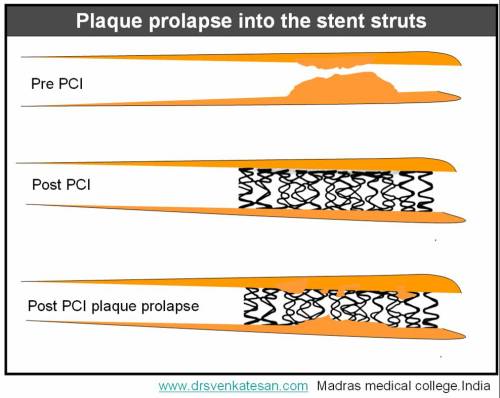
But this has a trade off .The uncovered area of plaque tend to project into the lumen .This is many times not significant.But can be a problem if the plaque is very soft and bulk of the lipid core may reenter the lumen.this event is called plaque prolapse.

plaque-prolapse

What is the time taken for plaque to prolapse ?

Generally it is late event.But it can happen immediately after the procedure also.

Which type of lesions are more likely to have plaque prolapse ?

Eccentric and complex lesions especially with overhanging edges are prone for prolapse

What is the sequale ?

It can be benign.If there is a erosion due to stent struts can precipitate an ACS.It progresses into instent restnosis in many.

What is the angiographic appearnce ?

Angiographically it often appears as luminal  irregularity withi stented segment .

Many times , it may appear as a filling defect also.

Is there any specific issues in plaque prolapse in drug eluting stents ?

Coornary artery is not drugged uniformly by the drug eluting stents.In fact contact  lines of metalic struts  , through it’s micropore oozes the drug with polymer.Pathological studies have revelaed non homogenous drug penetration and resultant irregularity on the plaque surface.This could amplify the plaque penetration preferentially in few areas.

How to manage plaque prolapse ?

It should be managed as any other instent restenosis.Plaque resection with atherectomy devices has not solved the problem to the desired levels.A second stent is the most common approach advocated by the cardiologists.(Whic is not ideal though !)

Read Full Post »

Left main coronary artery disease (LMCAD) often evokes  a panic reaction  among cardiologists .Not every LMD deserve that re. To  label  it as  significant, we have a criteria ,  that is 50% diameter stenosis.  So what you do , for a tapering  or narrowed left main with 40% stenosis. Isolated insignificant left main is rare *, but real incidence is not known.  LMCAD  is  most often due to  , atherosclerosis of left main coronary artery without limiting the flow.

What are the options ?

  • Leave it alone, with intensive medical management assisted by high dose statin(80mg)
  • Elective PCI with stenting , even though the lesion is not significant.

*If associated LAD  or LCX is there decision making is easier .

How  significant is a coronary stenosis ?

The significance of a coronary lesion with reference to “lumen diameter obstruction” is basically flawed. The significance of a coronary stenosis, by tradition is  based on it’s hemodynamic impact ,right from the  CASS days in early seventies.Unfortunately our mind set has not changed even after realising    non obstructive – sub critical lesion is more prone for acute coronary syndrome.  Is it not ironical to call a  40% lesion a non significant one !

So, the  significance of coronary stenosis is two fold.

  1. Hemodynamic  significance
  2. Clinical and  pathologic significance

The former predisposes to often chronic stable angina, later likely to result in ACS.

How will you approach a apparently insignificant left main disease ?

A 40 % lesion in left main is hemodynamically not significant , but pathologically very significant.It needs intensive treatment. Plaque passification with medical approach is first choice.If the lesion morphology is eccentric,  has irregular margins or involves  LAD  or LCX ostium doing a PCI or even a CABG is to be considered in spite of the lesion is  hemodynamically insignificant .

Why , PCI is   considered  “not appropriate”  for   less tighter lesions , even though these lesions  have great clinical significance ?

The answer is simple, The risks  and the  potential cost are more than the benefit !

And further ,  stents are  not innocuous devices  either  , they  always carry a risk of sudden occlusion as like  a sub critical lesion  !

Answer to the title question

True incidence is not known . Our experince (Class 1 c evidence) would suggest Left main disease constitutes up to 10 % of CAD.Among this one third would be hemodynamically insignificant

Suggested reading

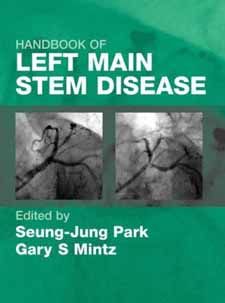
Handbook of Left Main Stem Disease


edited by Seung-Jung Park

hbleftmn

//

Read Full Post »

                                                    Drugs are poisons , whenever it is administered without valid purpose. it can enter human body  in many ways (Oral, intravenous, percutaneous etc ) And now we have another route namely intracoronary !

                                                   In quest for prevention of restenosis, many of the anti cancer drugs are now delivered directly inside the coronary arteries .These drugs are secreted  like a sustained release  tablet from the drug coated stents.These drugs are expected to prevent restenosis within the stented segment.But, after years of  intense debate and research  , we realised that ,  drugs  eluted from the stent  could damage the distal coronary vascular bed and coronary microcirculation.( And thus came the epidemic of acute stent thrombosis ! )

                                                The tender and sensitive coronary microvasculature  is constantly exposed to  these  powerful anticancer and immmunosuppresive  drugs .It is a great surprise , no body thought of  this dangerous drug -coronary artery interaction ! It required the genius of Renu virmani and others to point out this.

But still , the cardiology community by and large , fails to consider  this an important issue.This is proven by the fact, usage of DES is  still increasing  and used mainly as an off label indication.

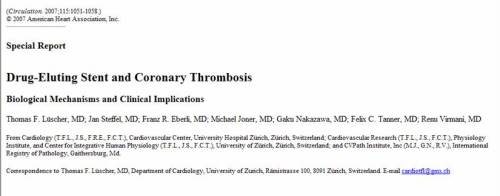
Read this land mark article from circulation

picture1

http://circ.ahajournals.org/cgi/content/full/115/8/1051?maxtoshow=&HITS=10&hits=10&RESULTFORMAT=1&author1=renu+virmani&andorexacttitle=and&andorexacttitleabs=and&andorexactfulltext=and&searchid=1&FIRSTINDEX=0&sortspec=relevance&fdate=1/1/2007&tdate=12/31/2007&resourcetype=HWCIT


Questions that need to be answered

  • What is the long term effects of drugging a coronary artery ?
  • Is no reflow or slow flow  more common after DES , because of the adverse drug reaction in the distal vascular bed ?
  • If a patient  with  DES  undergoes a CABG later what  would be  the impact of the  drug on the graft ? Will the functional vasodilatation   affected ?

Final message

                                  A drug , to get a legal clearance it has to undergo  hundreds of rigorous tests . Finally it is cleared for that  specific indication for which it is tested  .Just because a drug is cleared for one purpose ( Paclitaxel for malignancy ) it does not mean it is safe to use for any other  purpose for which it is deemed to be useful . Exactly the  opposite is happening   in the  the field of interventional cardiology . No body wondered to think what would be the effect of these drugs on the normal coronary endothelial cells and vasculature.Is it not a crime ,  without analysing this particular issue  , dozens of drug eluting stents have been released in the market . And now,  sounds of crying  foul is heard world wide !

Let us thank  , the so called negative forces in cardiology  for making this an  issue . In science ,  the watch dogs should bark  at  times of danger not wag the tail !

Read Full Post »

Contrary to popular belief ,great things happen only rarely in medicine . It takes  only  few  months of  training  or  workshops ,  for a  wrong or inappropriate concept  to  percolate  our  brains !  But , it  would require,   decades  of  time , energy  and  efforts  ,  for  correcting  that  wrongly  assimilated concept  in medicine !

Interventional cardiologists are  among the  rare breed of physicians,   who always believe in evidence !  But ,  the quality of  the  evidence  is rarely questioned  !  30 years of PCI  & 20 years of stenting has failed  our  common senses ! Fortunately , today,  we have 135 pages of new evidence ( Not really new , old evidence interpreted with  sound logic !)

Hats off to ACC and associates for bringing out this much belated appropriateness guidelines for the interventional cardiologists.

ACCF/SCAI/STS/AATS/AHA/ASNC 2009 Appropriateness Criteria for Coronary Revascularization

A Report of the American College of Cardiology Foundation Appropriateness

Criteria Task Force, Society for Cardiovascular Angiography and Interventions,

Society of Thoracic Surgeons, American Association for Thoracic Surgery,

American Heart Association, and the American Society of Nuclear Cardiology

Endorsed by the American Society of Echocardiography, the Heart Failure Society of America, and the

Society of Cardiovascular Computed Tomography

Click here to get guidelines

http://circ.ahajournals.org/cgi/reprint/CIRCULATIONAHA.108.191768v1.pdf

If you don’t have time to read the entire document (135 pages  )

Just remember only one point

Common sense,  more  often  prevails  over  evidence ,  in medicine . Apply it  , frequently  in your patients .They will reep the benefits !

Read Full Post »

 Selected on the basis of ,  impact  on survival , relief of  human suffering index and also innovation

10.Percuateneous interventions

9.  Electrocardiography

8 . Hemodynamics of cardiovascular system

7.Fruesemide

6.Thrombolysis

5.Pacemakers

4.Defibrillation

3.Heparin

2.Prosthetic valves

1.Coronary care units


Waiting list

Concept of vascular biology

Statins

RF ablation

Nitric oxide

Total Artifitial heart

Echocardiography


Ten least important concepts and  inventions in cardiology

Selected based on duplication of research, futile scientific concepts and   of course impact on survival

10.Low molecular weight heparins

9.Cardiac resynchronisation

8.Rotablator

7.Multi  chamber pacing

6.Newer ARBs

5.C reactive protein

4.Three dimensional echocardiography

3.

Comments welcome  and please contibute

Read Full Post »

A poorly deployed drug eluting stent is far inferior to a properly deployed bare metal stents

  • Doing a plain old balloon  angioplasty ( POBA)  is not a scientific crime , millions of coronary lesion just  need that! ( Click here -Why POBA is important ? )
  • PCI is most effective during an ACS than a chronic coronary syndrome
  • Primary PCI is a race against time and muscle , not a race against money ! Don’t do it  for a  evolved   MI
  • Recognise , from the patient point of view  the term no reflow is  generally  synonymous with   failed primary PCI( It is semantics !)
  • Side branch  can be more important than main branches , so don’t sacrifice it often
  • Attempting a trifurcation  angioplasty is generally not in  the interest of the patient but  to show interventional expertise
  • Make sure surgical back up means, a table is reserved with a surgeon fully informed and ready

When in  doubt , it is always  better to err on a longer stent than a shorter one

Read Full Post »

« Newer Posts - Older Posts »