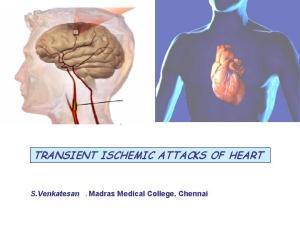
Transient ischemic attacks are not exclusive to cerebral circulation.
Many such episodes can occur in coronary circulation also .
TIA of heart PPT presentation
Click here to download tia-of-heart
Posted in cardiology- coronary care, My presentations, tagged angina, drsvenkatesan, nstemi, stemi, syncope, tia, transient ischemic attacks on August 6, 2008| Leave a Comment »
Transient ischemic attacks are not exclusive to cerebral circulation.
Many such episodes can occur in coronary circulation also .
TIA of heart PPT presentation
Click here to download tia-of-heart
Posted in Cardiology -Interventional -PCI, Infrequently asked questions in cardiology (iFAQs), tagged acute myocardial infarction, angioplasty, balloon angioplasty, cardiology, chronic stable angina, ebm, emprical medicine, evidence based cariology, gruentzig, heart, is poba dead, pci, poba, poba pci, poba ptca, primary angioplasty, ptca, slr, stemi, stent like result, what is poba on August 5, 2008| 1 Comment »
Plain balloon angioplasty, the greatest innovation in cardiology when it was introduced in 1977 in a Zurich cath lab , has now become an ugly word for most of the cardiologist !
Why this turn around ? Has technology , really overtaken a great procedure and made it obsolete now ?
The answer is a definite ” No”
The restenosis which was the villian in the plain old angioplasty has never been overcome even today. Stents initally used as a bail out procedure during abrupt closure , later it was used conditionally, followed by provisional stenting and now in 2008 we are made to believe it is mandatory.
When we realised , bare metal stents are equally bad (If not slightly better ) in arresting the restenosis drug eluting stents came into vogue with a big bang in 2002. It was projected as the ultimate breakthrough in interventional cardiology and in 5 years the truth was exposed and it not only failed to prevent the restenois but also had a dreaded complication of acute stent thrombosis.
Now we know , metals inside a coronary artery carry a life long risk of sudden occulusion , and we talk about biodegradable stents (With poly lactic acid ).
Common sense ( Unscientific truths) would suggest
Plain balloon angioplasty still has a major role in our global cardiovascualr population.
Since restenosis is the only issue here, ( about 30% ) we can choose patients in whom even if restenosis is likely to happen no major harm is done . A vast majority of chronic stable angina patients fall in this category.
Aggressive lipid lowering with plain balloon angioplasty has never been tested properly . In future also it is unlikely, such trials will be done as it would be considered unethical . But that would be a premature conclusion.
The other major issue is the cost of stenting , the procedure of PCI/PTCA has become unaffordable for most of the population in developing countries .The primary reason being the PCI without stenting is considered ” A untouchable” . If only we remove this stigma from the cardiology community a signiificant population will be benefited.
A patient with chronic stable angina treated with POBA ,if develop further angina after few years , he is likely to get a recurrence of relatively safe stable angina. While in a post PCI patient any angina after the procedure becomes a unstable angina ( Braunwald classification) and requires emergency care . Angina in a stented patient is can not be taken lightly as the the course of angina is unpredictable .
POBA in primary PCI ?
Many may think it is a foolish idea . It has been found many times, when we rush the pateint to cath lab after a STEMI we are in for a surprise !. About 30% of times it is a very complex lesion profile like diffuse disese, tight bifurcation lesions , loaded with thrombus or a left main disese.
We fail to realise a basic fact , the initial aim of primary PCI is to salvage the myocardium ,and the next comes the prevention of restenosis . It may even , be argued salvaging myocardium is the only aim ! Myocardial salvage sould be done urgently . And even removing the thrombus and opening a IRA can be suffice in a patient who is crashing on table. Of course stenting can be done whenever possible. But for IRAs which has complex anatomy attempting a perfect stent PCI (Some may require more than few stents) as an emergency procedure invariably affects the outcome. One should spend shortest possible time inside the illfated coronary artery. Prolonged manipulations within the coronary artery in an unstable patient aiming at longterm patency of an IRA is to be avoided .The pending procedures can always planned in a next stage.
So it is not a crime to think about plain balloon angioplasty in some of our patients with acute or chronic coronary syndromes . Hope Gruentzig is listening from the heaven and hopefully agree with me !
Dr.S.Venkatesan, madras medical college, chennai, India .
Posted in Cardiology -Interventional -PCI, Infrequently asked questions in cardiology (iFAQs), Uncategorized, tagged acs, anti coagulation, cabg, cardiology, drsvenkatesan, LV clot, madras medical college, myocardial infarction, primary pci, stemi, thromboembolism, warfarin on August 4, 2008| Leave a Comment »
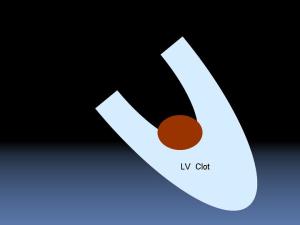
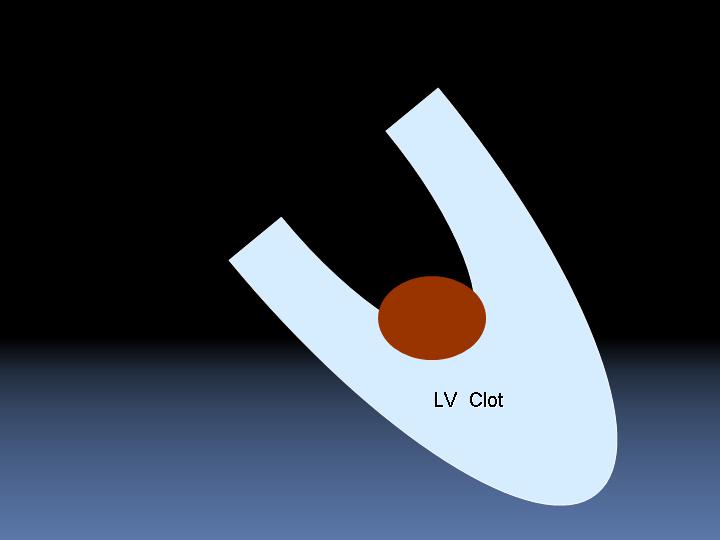
LV clot formation is one of the important complications of acute myocardial infarction. Preventing this is difficult and managing this problem is still more difficult.Some of these clots are linear and laminar along the shape of LV apex and carry less risk of dislodging.
While mobile LV clots , even if it is small can cause a embolic episode. Most of these patients have a significant LV dysfunction and they are candidates for early CAG and revascularisation. Even If the coronary anatomy is very ideal for a PCI these patients are often sent for CABG and physical removal of LV clot . If only ,we have an option to remove these LV clots by a catheter based modality, we can offer them a totally non surgical cure.
This is not impossible, considering we are in the era of percutaneous implantation of prosthetic valve in Aorta ! The only issue is potential embolism into carotids and periphery .A temporary distal protection at the level of aortic root will prevent that .
Device companies shall produce one such exclusive catheter system to remove LV clot.
Dr .S.Venkatesan, Madras medical college, Chennai,India
Posted in Cardiology - Clinical, cardiology -Therapeutics, cardiology- coronary care, tagged acs, cardiogenic shock, cardiology, drsvenkatesan, heart, myocardial infarction, stemi, ventricle on July 19, 2008| Leave a Comment »
CCU’S can also save patients with cardiogenic shock
Many of us would say ” never” or some may say “rarely” but in reality the answer is “yes it can ” slightly lower than Primary PCI . One could save atleast few lives every month by intensive medical management alone (Inotrope, vasodilator,pacing if needed ) in any coronary care unit.
So the message here is, not offering or doing a primary PCI in a patient with cardiogenic shock is not synonymous with inferior treatment or death. After all, in the much hyped SHOCK trial a significant no of patients survived in medical limb .
Posted in Cardiology -Interventional -PCI, tagged acs, aorta, cardiology, cath lab, chest pain, coronary, dissection, drsvenkatesan, heart, madras medical college, nstemi, pci, stemi on July 19, 2008| 1 Comment »
Thousands of dissections happen in cath labs all over the world every day very rarely it is painful . The answer is not clear. Both have rich vasa nervorum. Aortic dissection involves media and smooth muscle . Coronary dissection may also be a equally painful , probably we are not recognising it ! or we attribute all chest pain in ACS to ischemia .
Deep dissections into the smooth muscle should be painful. Type c nerve fibers carry pain signals from heart
Answers welcome.
Posted in cardiology- coronary care, tagged acs, chest pain, coronary plaque, dissection, drsvenkatesan, interventional cardiology, nstemi, stemi on July 19, 2008| Leave a Comment »
Plaque fissure ,rupture and subsequent thrombois is the hallmark of acute coronary syndrome . Are these events painful ? We always attribute any chest pain in an ACS patient to ischemia of myocardium.Is that always true? Coronary artery also has a rich vasa nervorum that could be activated by plaque disruption.
Why we need an answer to this question ?
We are triaging patients for early invasive apporach based on chestpain .
Many patients may be subjected to revascularisation process for an non ischemic coronary pain !
Posted in cardiology -Therapeutics, tagged acute pulmonary embolism, drsvenkatesan, pulmonary infarction, stemi, thrombolysis, time window on July 15, 2008| Leave a Comment »
Salvaging lung tissue is not the aim in pulmonary embolism , Hence Time window is a myth !
There is a time window for thrombolysis in myocardial infarction ( STEMI). This time window is to salvage myocardium before it dies.The average time window in STEMI is 12 hours. When does the lung start dying in Pulmonary embolism ?.Is salvaging lung tissue an aim in the management of pulmonary embolism ?. Not really .Lung parenchymal death occurs only in minority of patients with pulmonary embolism .
The bronchial artery continue to supply the lungs.
So the aim here is to restore pulmonary circulation and oxygenation. Hence there is no strict time window in the management of pulmonary embolism.
The General consensus is , one can attempt thrombolysis up to 7 days after diagnosing pulmonary embolism.
Beyond this time, it is believed thrombus gets organised and thrombolytic agents may be ineffective.
But this is only an assumption, in an individual patient thrombolysis may be done even beyond this period if warrented by clinical intuition .
Posted in cardiology -Therapeutics, tagged acs, aspirin, clopidogrel, nstemi, stemi on July 2, 2008| Leave a Comment »
Aspirin confusion spreads to clopidogrel !
It all started with 75 mg clopidogrel in CURE study and others.
It went up to 150, 300, 600, and in some centres 900 mg.
No body knows how much clopidogrel optimally inhibits the platelet.
Aspirin had the same story three decades ago. It started from 40mg went up to 1200mg
and finally settled at 162mgs.
Why this confusion?
It is because there is no simple platletlet function tests available in bedside.
and also the wide safety margin of this drug.At what level clopidogrel is unsafe
is also not clear !
Answers are expected soon .
Posted in acute coroanry syndrome, Cardiology -Interventional -PCI, Primary -PCI, STEMI, STEMI -Managment, STEMI-Primary PCI, tagged acs, captim, captim study, cardiology, drsvenkatesan, fibrinolysis, myocardial infarction, stemi, thrombolyis on July 2, 2008| Leave a Comment »
.The forgotten “Gem of a study” from lancet 2002 .
The fight between Primary angioplasty and thrombolysis was actually over in 2002 itself. But the cardiology community failed to ,( rather reluctant ) to accept the truth. The issue is being dragged without any useful purpose (for the patient !) still trying to keep up the non existing superiority of pPCI.
A bolus thrombolytic agent (TPA/RPA) or even streptokinase can do almost the same if not better than a highly complex procedure called Primary PCI with lots of logistics issues and most important an unacceptable early procedure related hazard.
Timely lysis can kick pPCI out of the ring . . . in three aspects with 100% certainty !
1.If symptom to TIMI 2/3 flow in IRA is the true parameter of success .pPCI can never ever come closer to pre hospital lysis.
2.The poor lytics do not differentiate in the efficacy . It simply acts whoever administer it. While results of pPCI are never reproducible and lots of expertise involved.
3.Thrombolytic agents never need to bother about the complexity of lesions , (or where is the IRA dilemma ? Is it a CTO or ATO confusion etc ) for the simple reason it doesn’t need to think before acting. It does its job fast.
What did CAPTIM prove ?
Final message
It is an irony, a simple intravenous push of a drug (Thrombolytic agent) very early after an STEMI can save many patients and reduce complication rate .But because it is simple ,it is considered inferior .
Probably the only role for pPCI is high risk complicated STEMI at presentation or after an attempt of lysis has not stabilised the patient.(Where its referred to as Pharamco Invasive strategy )
2018 update
This post was originally posted in 2008. Now as I see this in 2018 . It is shocking to know we haven’t learnt any lesson from this study for 16 years since its published.
In this era of medical commerce and simple ,cheap ,and effective treatment can never compete with sophisticated , glamorous , less effective treatment modalities !
Read the full version of CAPTIM and comments
Comparison of Angioplasty and Prehospital Thrombolysis in Acute Myocardial Infarction (CAPTIM) study group, are published in the September 14, 2002 issue of theLancet.
London, UK – In a finding that would appear to go against the swelling tide of support for primary angioplasty as the treatment of choice for acute MI, investigators comparing primary angioplasty with prehospital administration of alteplase with rescue angioplasty have concluded that the 2 strategies are comparable. The results, from the Comparison of Angioplasty and Prehospital Thrombolysis in Acute Myocardial Infarction(CAPTIM) study group, are published in the September 14, 2002 issue of theLancet.1
“Our findings indicate that primary angioplasty is no better than prehospital fibrinolysis followed by transfer for possible emergency coronary angioplasty in patients presenting within 6 hours of an acute myocardial infarction,” the researchers, led by Dr Eric Bonnefoy and Dr Paul Touboul(Hopital Louis Pradel, Hospices Civils de Lyon, Lyon, France), write.
However, they point out that cessation of funding during the trial resulted in a lower-than-expected enrollment, 840 of 1200 planned patients, reducing their statistical power. “The CI (confidence interval) for the primary end point shows that there could be a real difference in the treatment effects,” they write.
Still, the researchers feel their conclusion is valid. “This was and is for us a very pragmatic question for our care system in France,” Bonnefoy told heartwire. “Is our current management, with prehospital thrombolysis with transfer, in a time when primary angioplasty is promoted as the best-of-the-best treatment, still sufficient? Even if the power of the study is lower than expected, we think that we have our answer, and we can go on with that practice.”
The strategy also means less strain on their cath labs, Bonnefoy added, since only 1 in 4 patients underwent rescue angioplasty. A cost analysis comparing the 2 strategies is currently being carried out.
Time to treatment, as expected, was longer in the primary angioplasty group: the median delay between onset of symptoms and treatment was 130 minutes in the prehospital fibrinolysis group, and time to first balloon inflation was 190 minutes in the angioplasty group.
At 30 days, there was no significant difference in the primary end point between groups. Overall mortality was lower than expected, they note. Deaths were fewer in the prehospital thrombolysis group, but mortality was not significantly different between groups. There was a trend toward less reinfarction and less disabling stroke favoring the primary angioplasty strategy.
CAPTIM: Primary end point
| Outcome
|
Prehospital fibrinolysis
|
Primary angioplasty
|
Risk difference (95% CI)
|
p
|
| Composite end point | 8.2% | 6.2% | 1.96 (-1.53-5.46) |
0.29 |
| Mortality | 3.8% | 4.8% | -0.93 (-3.67-1.81) |
0.61 |
| Reinfarction | 3.7% | 1.7% | 1.99 (-0.27-4.24) |
0.13 |
| Disabling stroke | 1.0% | 0 | 1.00 (0.02-1.97 |
0.12 |
To download table as a slide, click on slide logo below
Among secondary end points, the researchers noted a nonsignificant trend toward a higher frequency of cardiogenic shockthe most common cause of death in this studyin the primary angioplasty group, noting that cardiogenic shock between randomization and hospital admission occurred only in that group.
The CAPTIM results were first presented at the European Society of Cardiology Congress in September 2001 and reported by heartwire.
“Thus, until the large trials of facilitated PTCA are completed (none of which have even begun enrolling), the best therapy for most patients with evolving AMI should no longer be debated; administer antiplatelet therapy (aspirin, a thienopyridine, and possibly abciximab), withhold thrombolytic therapy, and transfer the patient for primary PTCA, regardless of whether the nearest catheterization suite is 3 floors or 3 hours away,” Stone concludes.
“To do less should no longer be considered standard care. Strong words, yes, but it is time for a wake-up call.”
Posted in Cardiology-Coronary artery disese, tagged acc, acs, cardiology, europcr, jacc, nejm, nstemi, pci, ptca, scai, stemi, tctmd, time window for unstable angina, unstable angina on June 26, 2008| Leave a Comment »
ACS is the most common cardiac emergency . Management of STEMI is relatively straight forward. The only decision that to be taken is the modality of reperfusion. (Primary PCI or thrombolysis.) There is no need to risk stratify STEMI on arrival. All STEMI patients are considered high risk on admission. Whereas NSTEMI consists of a heterogeneous population. They need to be triaged into low intermediate or high risk categorizes on arrival.There is two management approaches for unstable angina .All high risk UA should enter early invasive strategy . And low risk and intermediate risk group will get early conservative management.
The principle of management of UA differ from STEMI in a fundamental way , as there is no issue of myocardial salvage in UA .The primary aim is to provide relief from pain and prevent an MI. So in the strict sense there is no time window in unstable angina /NSTEMI.
But it is generally considered 48 hours is the time limit for an early invasive approach.If the patient has crossed this time there is apparently no great difference in outcome for conservative and invasive approach.