Feeds:
Posts
Comments

Posts Tagged ‘unstable angina’

Anginal pain is a type of visceral pain.It is carried by type  C  unmylinated  nerve fibres.The perception of angina is a complex process.It is a combination of visceral and cutaneous referral pain.

How often is angina silent in diabetes mellitus ?

Presence of  diabetes per se does not make an angina silent. In fact,  if  one takes 100 patients with diabetes  , if angina occur in them , it is more often  , manifest than silent. So , only few of  the  diabetic patients who develop diabetic autonomic neuropathy fail to have angina.The exact incidence is not known.It could be around 20%.

If angina can be silent in diabteics , can they have anginal equivalents ?

This again is not answered in literature. Among the anginal equivalents , the most common is  dyspnea , which  can occur in diabetics.But now , we know dyspnea also needs thoracic nerve signals  from the intercostal muscle spindle and colgi organs.This can also be impaired in diabetics.

Can silent and mainfest episodes occur in a same  patient  ?

Yes.

Once silent does not mean always silent, and similarly once angina is felt it  does not mean he is going to feel the next episode as well !

This  strongly reminds us medical science  is  much a complex  subject and what we know is very little in pain perception.

How is silent ischmia different from silent angina ?

There is considerable  overlap  between  silent ischemia and silent angina

The questions to be answered are 

Which is silent  ?  Is it the angina or is it the ischemia or both ?

Silent ischemia can occur in any individual ,  this is also called as silent CAD . When  ischemia occurs  but  fails  to generate pain it is silent ischemia .Undiagnosed  CAD in asymptomatic individuals is also called silent ischemia or CAD.In this population  Exercise stress testing detects  CAD which was otherwise silent and masked.These patients may develop angina during EST.

During exercise stress testing many times patient has significant ST depression  more than 2mm but still chest pain may not occur.These episodes may either be silent ischemia or  ngina. Many times the EST is terminated before angina is manifest .( Chest pain is the last to occur in the chain of events following ischemia- Concept of ischemic cascade )

What are the other situations where angina can be silent ?

  • Pain perception  and threshold  level is  high ,  so patient indeed has anginal  signals but fails to feel it .
  • Patients on  antianginal medication , fail to feel the angina.
  • Chronic betablocker therapy can exactly mimic  autonomic neuropathy

Is it a blessing for the patient  to have painless episodes of angina ? 

When their  ischemic colleagues , suffer a lot with chest pain it is tempting to think these diabetic patients  are blessed!

Scientifically , this could be true in at least in  some  especially in a patients  who’s coronary anatomy is known  and devoid of any critical proximal lesions. For example a small PDA  lesion can produce  severe angina  , but may be silent  in diabetic and be comfortable .This lesion is  insignificant other wise * !

It should  also be recalled , pain relief has been an important goal for treatment  of CAD .In olden days,  thoracic sympathectomy was done for angina . In fact ,  even in  CABG  , one of the the  mechanisms  for  angina  relief  is attributed  to cardiac denervation.

Caution: Even a small  episode of ischemia can trigger an electrical event .But it is rare.

 How common is silent infarct (STEMI) in diabetic patients ?

In a simple questionnaire we asked the diabetic patients in our CCU how they felt their pain during MI.Most felt it normally as do other non diabetic .  Diabetes  does not make  all anginal episodes  silent. Severe episodes of ischemia may be painful while less severe episodes may be painless. Diabetic autonomic neuropathy  is a  least recognized and  poorly understood complication of diabetes.Diabetes , involves  the vasanervorum of the autonomic nerves.

 The other mechanisms postulated in diabetic neuropathy are

  • Reduction in neurotrophic growth factors.
  • deficiency of essential fatty acids .
  • Reduced endoneurial blood flow and
  • Nerve hypoxia .

Is diabetic autonomic neuropathy treatable ?

Very difficult problem indeed.Controlling diabetes may partially correct  the neural dysfunction.Many add on neuro vitamins and aminoacids are having a good market !

If you successfully treat diabetic autonomic neuropathy will my patient  start feeling the  hitherto silent episodes of angina ?

We don’t know.Logic would answer ” YES”

What is the ultimate effect of cardiac autonomic neuropathy.

Cardiac denervation.  The manifestations  are

  • Tachycardia, exercise intolerance
  • Orthostatic hypotension


Silent Myocardial Infarction : A complete list


Read Full Post »

                                        Angina pectoris , classically occur on exertion and gets relieved on rest .This is called typical chronic stable angina as described by Heberden (CSA ) .  Unstable angina(UA), the term originally described by Noble O Fowler in early 1970s. ( Also being referred as  intermediate coronary syndrome , preinfarction angina etc).The definition for unstable angina has evolved  over the years  and currently  refers to .

 1.All new onset angina of any degree* Some include severe angina only ! New onset angina of very mild degree on exertion could be the onset of the first episode of  stable  angina. 

 2.Rest angina of more than >30 mts not relieved by taking sublingual nitroglycerine.

 3.All Post MI angina

 4.Any angina in patients who have been stented by PCI.

How to recognise a patient  who is shifting from  stable angina to  UA ? 
UA is  to be suspected when  a patient develops. 
5.More frequent episodes than usual
6.Angina occurring at lesser level of exertion than before 
7.Angina radiating to new site ( Example : Chest pain radiating  to jaw rather than to the usual left arm or vice versa)

Why the first episode of angina is given a special status and often considered critica ?

Angina is the  clinical expression of   myocardial ischemia.The course of  the  first  episode of angina , can not be predicted.It could be a the beginning of a chronic disease process, or it could be a progressive coronary occlusion as in unstable angina /NSTMEI , or the onset of even a STEMI.
In contrast a patient with chronic stable angina  has a predictable chest pain , at a particular level of exertion, radiation to same site, same character, and the patient knows for sure the pain  would promptly dissappear  when he takes rest or nitroglycerine  tablets.

What is the underlying pathology in UA ?  

Generally it is very rare for  a stable plaque to produce a  serious episode of unstable angina .It  requires  an unstable plaque* to  precipitate an unstable angina !
Unstable plaque refers to any plaque which is eroded, fissured, ruptured or  hanging  eccentrically ,  with
an active thrombus.

What is the significance of post PCI angina?

It is an irony, any angina following PCI is to be considered unstable as sudden occlusion of stent is quiet common.This is a paradox of sorts as one would wonder in a patient  with CSA who undergoes PCI with stenting  of left anterior descending coronary artery  (LAD)  all his subsequent episodes of angina  will be labelled as UA  even if a stable angina occur in his other coronary artery.And these patients would go for early invasive approach and potentially inappropriate interventions even if they are at low risk !

Is all angina at rest can be termed as unstable angina ?

No, but many times ,  rather most of the times  cardiologist believe all rest angina to be unstable.

What are the situations where stable angina can occur at rest?

An episode of angina during mental stress, or post prandial* state are very common in patients with CSA. This gets relieved after the stress. Some times  patients with CSA during episodes of fever may get angina at rest .These are considered variants of stable angina.
Post prandial angina , may be considered by some as unstable

How often a diagnostic confusion occur between CSA and UA ?

Generally, this issue is rarely addressed in cardiology literature , for the  simple reason it is never considered an  issue at all !
According to Canadian cardiovascular society grade 4 stable angina  is almost similar to unstable angina , as it denotes angina occurs with minimal effort or even at rest. In fact CCSC grade 4 should be termed as UA.

Can ECG be useful to identify stable angina from unstable angina ?

                                    ECG will some times  come to our rescue when one is confused between stable and unstable angina even though resting ST depression can occur in both stable and unstable angina . Statistically , if ST depression is noted during an episode of angina it is more likely to be UA rather than CSA. . Apart  from ECG , Troponin T or I levels may be elevated in some of the patients with unstable angina. Rarely stable angina can also show elevated troponin.

In patients with systemic hypertension and LVH or cardiomyopathy resting ST depression may not indicate UA 

So differentiation between, stable and unstable angina even though appear simple and  straight forward, it requires a diligent appraisal of history , physical examination (Aortic stenosis /HCM  may cause stable angina)  and ECG, enzyme evaluation.

Final message

In any coronary care unit ,  admissions with initial diagnosis of  ACS/UA/NSTEMI , subsequently turn out to be simple stable coronary artery disese . This error happens because the chest pain  or ECG changes  are aggravated by non cardiac factors like a mental stress or a post operative stress  or fever etc.
There could  be another school of thought, that is to err on the side of  safety, and manage all  rest angina as UA  .But the hazards of unwarranted therapy might exceed the risks of leaving these patients alone.
In this context ,there is a need for a new definition for unstable angina .
One ideal version could be . . .
  • Any angina , of any degree  which is caused  mainly by the supply side defect (By a acute thrombotic /disruptive plaque   occluding the  coronary lumen  with a imminent danger of myocardial infarction is to termed as real UA.
  •  All post MI and post PCI angina are unstable angina
  •  Rest angina which occurs due to increased demand situations need not be  labelled  as unstable angina for the simple reason  there is neither an active plaque nor a  fresh thrombus likely  in these patients. They rarely develop  recurrent angina or MI . The mechanism of angina at rest here is most often due to a tachycardia and resultant increase in MVO2 .(myocardial oxygen consumption) .Currently they are called as secondary unstable angina.In fact , anti thrombotic drugs are misused in these situations as they satisfy the criteria of UA/NSTEMI.

Read Full Post »

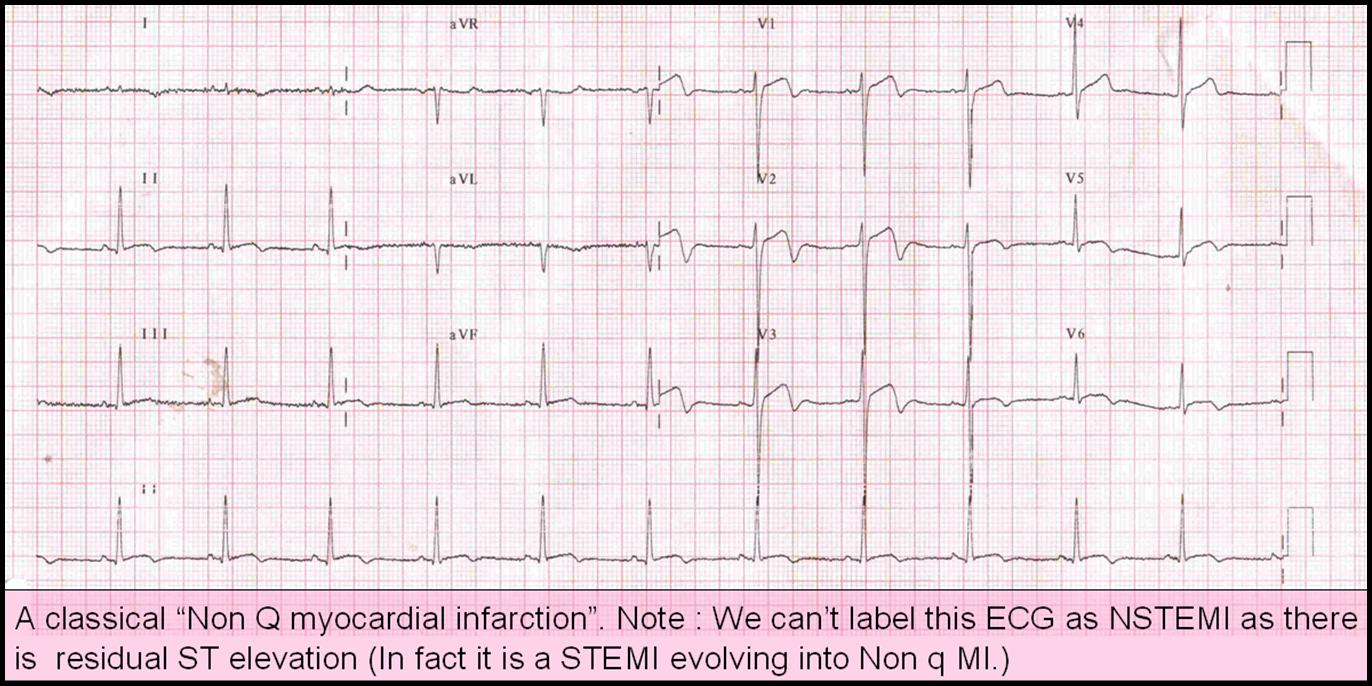
                                Acute coronary syndrome (ACS) is currently classified as STEMI and NSTEMI.This classification came into vogue  primarily to  triage patients for thrombolysis eligibility , as ST elevation is the  only criteria for thrombolysis.The  earlier term  non q MI  is largely used  to denote the  present day NSTEMI. In the past q  MI was referring to transmural MI non q MI  to non transmural  pathologically.(Of course , now we know  the relationship between q waves and transmurality is not good )

So when can we still use term non q MI ?

These terminologies of STEMI and NSTEMI are made on admission  at the emergency room.  ACS being a dynamic entity these  patients can  have rapidly changing  ST shifts , from depression to elevation and vice versa. Fresh T wave changes can also occur .Q waves  may or may not develop ,  depending upon the damage sustained to the myocardium and the efficacy of thrombolysis / PCI. So it should be emphasised here STEMI,  NSTEMI ,  q  MI ,  non q MI are the  descriptions of the  same group of patients in different time frames. The common mode of  evolution  of  STEMI  is  to q MI and NSTEMI  into non q MI. Cross overs can occur.


 The problem here is NSTEMI getting converted into STEMI  is quiet common and has no nomenclature issues . But  when   STEMI down grades  into NSTEMI  there is apparent  nomenclature incompatibility .This category of  patients have  no other labelling option other than “A STEMI evolving into non q MI”. Because one can’t label  STEMI  evolving into NSTEMI as  many of  them  will  have a residual ST elevation as well.

What is the final message ?

The term non q MI is still relevant and is used at discharge , in a patient with STEMI when he or she evolves without a q wave .In the setting of unstable angina , NSTEMI has largely replaced  the term  non q MI either on admission or at discharge.

Before I close

                 The important point to remember here  is NSTEMI getting converted into STEMI  is an adverse outcome and  in fact, it is  a complication and the patient should get an immediate  thrombolysis or PCI , while a STEMI getting converted into non Q MI is generally a  major therapeutic success.( Effective salvaging and preventing q waves )

//

Read Full Post »

During acute  ischemia the most immediate requirement for the heart is

A.Blood

B.Oxygen

C.Glucose

D.High energy ATPs

E.Free fatty acid

Answer : A  will be considered  by most , as  correct answer .  A can provide B to E . But it is also a fact heart can survive without  A.  

Myocardium requires energy first  ! it does not in fact bother about from where it is coming at the time of crises.It may be right if you restore the coronary blood flow all other components (B-E) are made available to the heart .

The heart can survive off  the coronary circulation with only chemical support during cardiac surgery and also a during  heart transplantation  explanted  donor heart survives on a ice box during transit and till it is transplanted into the recipient heart

But ironically we spend much of our energy and efforts in restoring blood flow.One need to spare a thought about the quality of blood also . This is especially important  in the setting of ischmia  where a  metabolic centric approach will add further benefit.

Energy based approach to ischemia : Is it relevent ?

Heart is a fascinating  mechano biological organ  pumping   millions of  gallons of blood  .Fuel for this is self generated  on a continuous basis  from the circulation blood .So  the key to human survival is the coronary blood flow that supplies the fuel and nutrients to the heart. When this key supply line is under threat  during  acute coronary syndrome cardiologist have  the only option of restoring the compromised blood supply by any means . But during chronic ischemia there is  no  urgency. There has always been an option of enriching the  blood with energisers like ATPs,  glucose,  hemoglobin etc .Providing energy support to the failing heart has never captured the imagination of cardiac physicians until recently.Still most are skeptical about  the concept of biochemical ischemia.

Click to download full PPT presentation

Metabolic manipulation of  CAD( Will be available shortly)

Read Full Post »


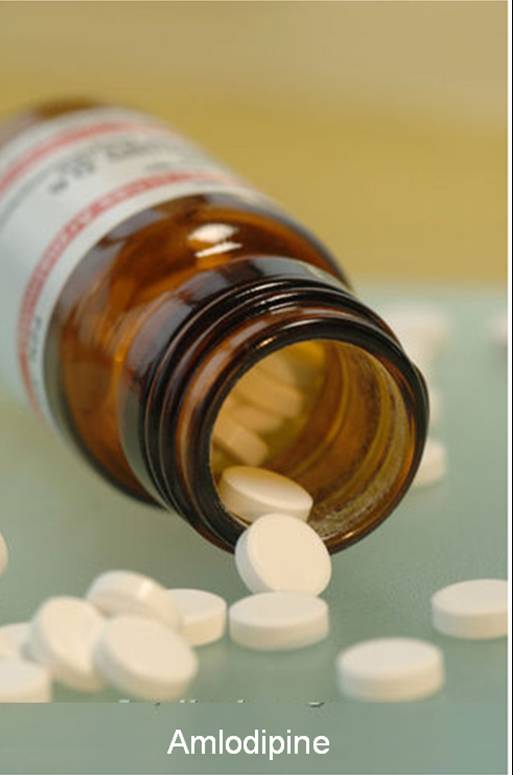
                            Amlodipine , the most popular anti hypertensive drug  used world wide has an very important action on coronary blood flow.When nifedipine was introduced three decades ago it was  known for it’s powerful anti anginal properties. Subsequently  amlodipine was introduced with almost similar action. But over the years, amlodipine was projected primarily as anti hypertensive drug and gradually many of the physicians are made to believe it is a drug that  should be used only if the blood pressure is high.The fear of reflex tachycardia in few was exaggerated.


                              In fact a cross section of  today’s general physicians were queried  about amlodipine  and none of them acknowledged  using this drug as an anti anginal drug. And few of them went to the extent of withdrawing amlodipine if it was used for the purpose of angina relief !

Why amlodipine’s  anti anginal action is in doldrums ?

The single word answer is unfortunate!   Marketing bias ,coupled with  the fact  that mainstream cardiology texts have ignored this aspect.

Final message

                                    Amlodipine , can still be used as a antianginal drug especially  in a patient who has angina with associated bradycardia  , significant LV dysfunction . Some reserve amlodipine and nifedipine exclusively for vasospastic angina where beta blockers alone are theoretically contraindicated .

Read Full Post »

Chest pain is one  of the commonest presenting symptom  in any  hospital both as  an emergency  or non emergency. Reaching an accurate diagnosis is very important. The main  purpose of evaluation of chest pain is to recognise it as cardiac or non cardiac origin . Cardiac chest pain almost always means ischemic chest pain . That is called angina. (Of course there are few important causes for non ischemic cardiac chest pain which Will be discussed later).

Standard features of typical angina.

Chest pain which falls short of typical features are called atypical chest pain . Some recommend at least three typical features to label it as angina.
After the clinical examination patients  should be categorised in one of the following .

  • Typical angina
  • Atypical chest pain
  • Non cardiac chest pain** Non cardiac chest pain is not a diagnosis. Any physician (or a specialist)  should take some effort to localise it. (Muscle, nerve , pleura , anxiety  etc) . But  generally once these patients are ruled out of cardiac pain  they become less special and are simply referred back to their  family physician, only to return back  with  another cardiac  pseudo-emergency  in a different hospital .

    Why we are diagnosing atypical chest pain liberally ?

    Currently   more number of  patients as well as  the physicians  are   aware of the looming epidemic of CAD. The other major reason is the  lack of application of mind during  foirst clinical appraisal  and examination. Many of the patients with non cardiac chest pain  (Muscle, nerve , pleura )  are termed as atypical chest pain. Though some of the popular texts use atypical  chest pain  and non cardiac chest pain interchangeably , it is not  correct to do so. For example don’t ever label a  patient with chest pain with chest wall tenderness as atypical chest pain and order a cardiac work up .It  is a poor model to  emulate , that consumes time and resources!.Instead they should be diagnosed a confident non cardiac chest pain and dealt properly.

Once a patient is diagnosed  atypical chest pain what’s next ?

They should get a  complete physical examination,ECG, and  undergo exercise stress test.   In the  screening of CAD , angina can be termed a hard sign,  atypical chest pain is a soft sign,  resting ECG is surprisingly  a soft sign again (unless you record it during chest pain). Exercise stress testing is  the ideal  investigation in evaluation of  chestpain.( 70-80% accuracy). This can be improved upon by Thallium, SPECT, stress echo etc. As of now coronary angiogram is considered the ultimate gold standard (Not pure gold !) to rule out  CAD.

It is also worthwhile to remember non anginal  chest pain can also be an emergency and life threatening

  • Pulmonary embolism
  • Pneumothorax
  • Thoracic tumors
  • Aortic aneurysm (Dissection and non dissection)  The list is not  exclusive

Final message

What do we really mean by  atypical chest pain ?

In reality we don’t mean any thing !

When a  cardiac  physician is confused or rather , unable to  rule out angina , at the same time he is not confident of calling it as non cardiac chest pain,  he has the luxury of using this terminology . It is obvious  this terminology  should  minimally  be used.  Once diagnosed  these patients  can’t carry on with this tag  for long. They should be reinvestigated , (Right from history  and clinical ex) .They should either enter the cardiac work up  protocol  or  a non cardiac source for pain should be fixed  immediately.

Read Full Post »

              Intra coronary thrombosis is the sine qua non of acute coronary syndrome ( Both STEMI and NSTEMI.) But thrombolysis is the specific therapy in STEMI and is contraindicated in NSTEMI/UA.

Why is this apparent paradox ? What is basic differnce between UA and AMI ?

In STEMI there is a sudden & total occlusion of a coronary artery usually by a thrombus with or without a plaque .The immediate aim is to open up the blood vessel . Every minute is important as myocardium undergoes  a continuous process ischemic necrosis. So thrombolysis (or more specifically fibrinolysis should be attempted immediately) .The other option is primary angioplasty,  which will not be discussed here.

The thrombus in STEMI  is RBC &  fibrin rich and often called a red clot. Number of fibrinolytic agents like streptokinase, Tissue palsminogen activator,(TPA) Reteplace, Tenekteplace etc have been tested and  form the cornerstone of STEMI management.The untoward effect of stroke  during  thrombolysis  is well recognised , but usully the risk benefit ratio favors thrombolyis in most situations except in very elderly and previous history of stroke or bleeding disorder.

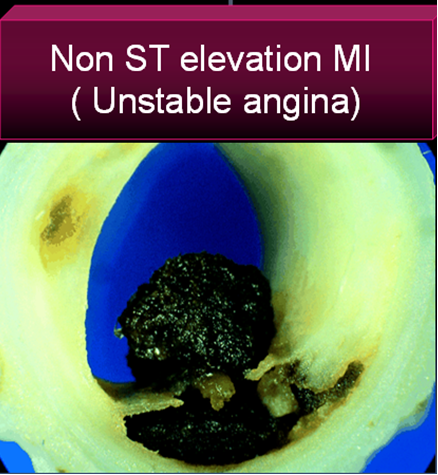
Unstable angina is a  close companion of STEMI . Many times it precedes STEMI often called preinfarction angina. During this phase blood flow in the coronary artery  becomes sluggish gradually,and patients develop  angina at rest .But unlike STEMI there is never a total occlusion and myocardium  is viable but ischemic,  and emergency salvaging of myocardium is not a therapeutic aim but prevention of MI becomes an aim. It is a paradox of sorts ,  even though thrombus is present in  UA ,  It has been learnt by experience thrombolytic agents are not useful in preventing an MI .


Why  thrombolysis is not useful in UA ?

1.In unstable angina  mechanical obstruction in the form of plaque fissure/rupture is more common than completely occluding thrombus. So lysis becomes less important.

2. Even if the thrombus is present , it is often intra plaque  or intra lesional and the  luminal  projection of thrombus is reduced  and hence thromolytic agents have limited area to act.

3.Further in UA/NSTEMI since it is a slow and gradual occlusion (Unlike sudden & total occlusion in STEMI) the platelets  get marginalised and trapped within the plaque .Hence in UA  thrombus is predominantly  white  . Often, a central platelet core  is  seen over which fibrin clot may also be  formed.

4.All available  thrombolytic agents act basically as a fibrinolytic agents,  and   so it finds   difficult to lyse the platelet rich clot.There is also a small risk of these agents lysing the fibrin cap and exposing underlying platelet  core and trigger a fresh thrombus.This has been documented in many trials( TIMI 3b to be specific) So if we thrombolyse in UA , there could be a risk of recurrent ACS episodes in the post thrombolytic phase.

5. UA is a semi emergency where  there is no race against time to salvage myocardium .Administering a  stroke prone thrombolytic agent tilts the risk benefit ratio against it.

6. Among UA, there is a significant group of secondary /perioperative UA   due to increased demand situations. Here there is absolutely no role for any thromolytic agents,  the  simple reason is , there is  no thrombus to get lysed. 

7.Many of the UA patient have multivessel CAD and might require surgical revascualarisation directly .


So fibrinolytic  agents are contraindicated in UA so what is the next step ?

The emergence of  intensive and aggressive platelet-lytic agents.

A combination of aspirin, clopidogrel, heparin, glycoprotien 2b 3a antagonist formed the major therapeutic protocol in these patients.Even though these are called antiplalet agents some of them  like 2b/3a antagonist eptifibatide, tirofiban, and many times even heparin has a potential to dissolve a thrombus. So technically one can call these agents  as thrombolytic agents.

What are the unresolved issues

                                       Even though clinical trials have convincingly shown thrombolytic agents  have no use in UA .There is a nagging belief  THAT  there could  be group of patients  with UA , still might benefit from thrombolysis as total occlusions have been documented  in some cases with UA.This is  especially true in peri-infarction unstable angina (Pre & post) as there is a fluctuation  between total and subtotal occlusions ) .But bed side recognition of this population is very difficult.

Many would consider this issue as redundant now,  since  most of  these patients  are taken up for emergency revascularisations

Read Full Post »

CURRENT   CARDIOLOGY  PRACTICE: EVIDENCE  OR  EXPERIENCE  BASED ?    AN  ANALYSIS OF  ACC/AHA  GUIDELINES.

S. Venkatesan,  Madras Medical College. Chennai


If  a  major therapeutic procedure is adviced based on simply by experience or expert opinion  how can we say evidence based medicine is practiced !


                                    Evidence based cardiology  is  the  buzz word  in global cardiovascular  health care  organizations. All diagnostic  and therapeutic  interventions are  undergoing  rigorous randomized  trials  for  proof of  efficacy  and  safety. ACC/AHA   have published  management guidelines and it  has been accepted  as de-facto standard of clinical cardiology practice world wide.  In these guidelines  class  1  indication  is defined as Conditions for which there is evidence for and/or general agreement that the procedure is useful and effective. These indications are supported by three levels of evidence.(A,B,C) .It has been observed,   many of the recommendations  in  class 1  were supported by only level  C  evidence. (Expert consensus or  agreement  ). We  analysed how much of todays guidelines is  agreement based  and  how much is evidence based. The  latest  practice  guidelines  of  ACC/AHA   for  Acute myocardial infarction , Unstable Angina and Non–ST-Segment Elevation Myocardial Infarction , chronic  stable angina  ,coronary angiography  were analysed. The  no  of  class 1  indications  were counted  in each set of guidelines  and  each  of the indication were  sub grouped with reference to the  levels of  evidence  to which it was supported. There  were a total  of 210  class 1  indications.


Class  1

Level A

Class   1

Level  B

Class  1

Level  C

P value

1A vs 1C

AMI(54)

7

25

22

<.0001

UA  (66)

11

26

29

<.0001

CSA(59)

8

29

22

<.0001

CAG(31)

3

12

16

<.0001

Total(210)

29(13.9%)

92(43.8%)

89(42.4%)

<.001

 13.9%   of class 1  indications were based on  level  A evidence.  42.4%  of class 1 indication were based  on Level C  ( agreement  of experts).Though evidence based cardiology   is   considered  to  define  the  standards in  Cardiology  practice  in reality  we lack evidence in most of the situations. 

                                       We  conclude  that  consensus or  agreement  based cardiology  practice is the dominant theme in current   ACC/AHA 

Read Full Post »

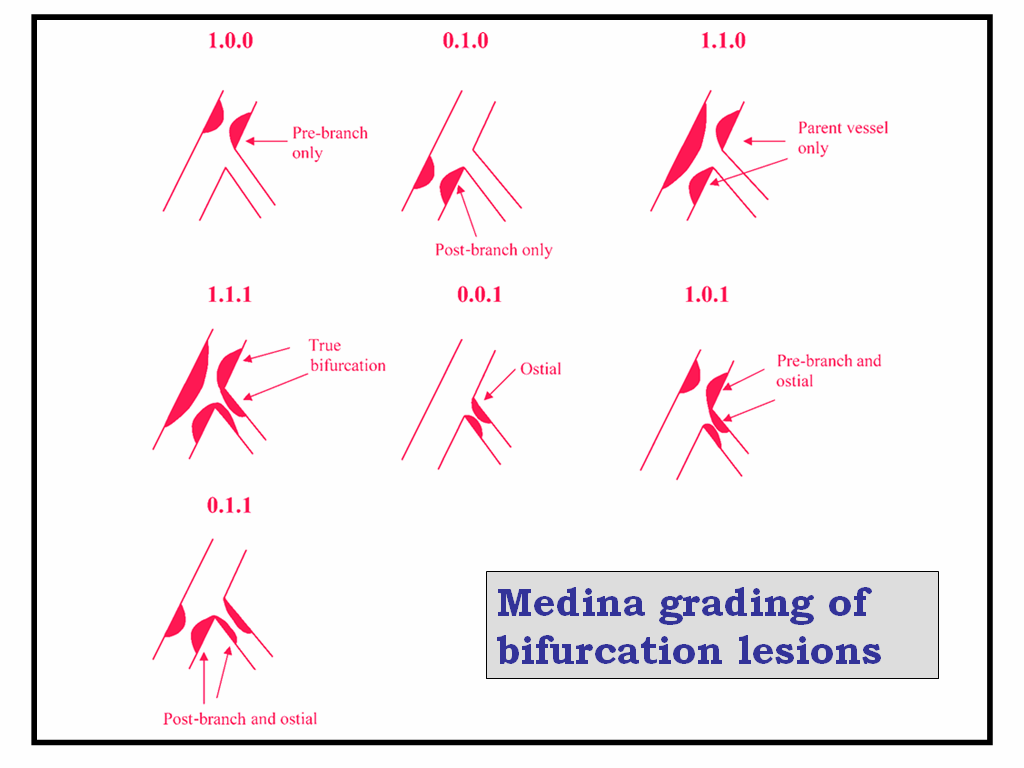
There are numerous complex grading for bifurcation lesions available.

The one proposed by Medina is simple and most useful.

In this grading three segments

  • Proximal main vessel
  • Distal main vessel
  • Branch vessel

Are given a code 0, and 1 if  lesion is present or absent .

This grading gives simple and fast method to label a bifurcatiuon lesion and to asssess the response to PCI. The only issue here is the individual  lesions are not graded , for example branch vessel ostium just involved about 20 % is not addressed . Further TIMI flow in these vessels may also be incorporated

How medina grading can be used to assess effectiveness of

angioplasty  ?

A patient with 1.1.1  after the treatment should revert back to 0.0.0.  if converted into 0.0.(.5) may indicate a residual side branch lesion  .5 shall indicate 50% residual lesion, .3 , 30% etc


What is the best management strategy for bifurcation lesions?

The topic has been discussed extensively for over a decade in various forums.

Though the lesions and intervention techniques  appear complex the basic concept is simple.

Following is the 8 point algorithm

1. Assess the bifurcation lesion accurately.

2. Apply the general rule and ask the first question whether PCI is neccessary at all ? if decided for PCI

3. Stent the main vessel.Protect the side branch.  

4. Dilate the side branch with a balloon.(KIss or through the struts) 

5. Very rarely,  if the side vessel is more significant and large  stent it and balloon the main vessel.

6. Use drug eluting stents with caution .

7. Resist the temptation of using two stents unless the situation demands and is absolutely required.

8. Never attempt to do bifurcation angioplasty during ACS as apart of primary angioplasty.( Unless you’re extremely competent, even then aim of primary PCI is to salvage myocarium quickly , not to provide TIMI 3 flow in non IRA vessel.)

Dr.S.Venkatesan.Madras medical college.Chennai.

Read Full Post »

Is reciprocal ST  segment changes  occur  only in STEMI ? Can it occur in UA/NSTEMI ?   


                      Even   after   100 years of electro cardiology   the electrophysiological mechanism of ST elevation in STEMI  and ST depression in Unstable  angina is   still in the hypothetical stages. One popular theory   says that the   current of injury   as we see   as  ST  segment elevation  in surface ECG  is  actually   an illusion. It’s   apparently due to   constant negative current    pushing down the   rest of ECG segments. Ironically   the concept   of  reciprocal ST depression in patients who have  ST elevation is well debated  for over 3 decades and  is considered  a  settled issue. It   probably   represents , a  purely electrical phenomenon where the  tail end  of the  lead   picks up the opposite vector. Even   as   conflicts   continue to confront the basic electro physiological   concepts management    strategies   of   acute coronary syndromes is witnessing   great strides.
Aim
                                     We   hypothesized   if   ST depression occurs as response to ST elevation it’s logic to expect strong ST depressive forces should  possibly elevate The ST segments in the reciprocal leads .
In fact  we have seen this phenomenon in three distinct  clinical situations. 
1) ST   elevation   in posterior leads: Patients who present   with isolated   ST depression in V1,  V2 , V3  and  ST elevation in posterior chest leads V7, V8 .These patients were initially thought to have isolated posterior MI. But later the cardiac enzymes were found to be normal   indicating no myocardial necrosis   echo evaluation revealed wall motion defects in anterior segments rather than in posterior segments. CAG revealed critical   LAD disease .  This we believe a pure reciprocal ST elevation in the posterior leads to  a  ST depressive forces in anterior leads.
 2) Inferior  ST   elevation   with ST depression   in   V4- V6 : Few  patients who present with  infero    lateral STEMI   later  do not  evolve into  Q  MI but as a NSTEMI .The initial ST elevation  was found  be transient and  disappeared  much earlier,  while the  ST depression  lateral leads persisted.
 3) ST elevation in AVR   in high risk unstable angina :As   already reported in the literature,  we have seen  ST  elevation in AVR  in patients with  high risk unstable angina. This was   more often observed when there is > 3mm ST depression in V4-V6. The AVR  ST elevation  possibly   represents   the  reciprocal  vector.
    Conclusion
                                            ST elevation in certain   specific leads in   some of the patients with ACS,   could   be   a pure reciprocal   electrical phenomenon   to   dominant ST depressive forces in Opposite leads .  And hence   ST elevation in the surface ECG during early hours of ACS   should be interpreted more cautiously. The   sanctity   assocociated with ST segment   elevation   could  be  opened   for debate. 
 
                                     To down load full PPT  click on  the slide

//

Read Full Post »

« Newer Posts - Older Posts »