Feeds:
Posts
Comments

Archive for the ‘Cardiology-Coronary artery disese’ Category

Stable angina is graded by Canadian cardiovascular society classification ( CCSC ) by 4 grades. Angina at rest  usually  denotes unstable angina. But,  patients with stable angina  may also experience rest angina according to CCSC ,  still this is   not considered as  unstable angina by many . Post prandial angina is one such  example.

Few consider post prandial angina as unstable angina . This sort of reasoning can not be faulted .

In  the logical sense ,  we are dealing with varied  categories of unstable angina.  The importance of diagnosing unstable angina is to intervene early ,  so that we can avoid  major adverse outcome .

The problem in CAD is , often , the plaques and angina do not  obey the conventional  rules  !

.The following permutations and combinations could be  observed in any coronary care unit .

  1. Unstable angina –  stable plaques  – stable ECG – stable patient
  2. Unstable angina – unstable plaques  –  unstable patient
  3. Unstable Angina  – unstable plaque  –  stable patient
  4. Stable Angina –  unstable plaque  –  unstable patient
  5. Stable angina  –  stable plaque  –    stable patient
  6. Stable angina –  unstable  plaque  – stable patient

Among the above 6 categories  2nd  is   probably  the most dangerous group and category 5 is most benign.

Post prandial angina is a serious  form of angina.It implies  , even   diversion of  little blood to GI system immediately after a meal can provoke an episode of  ischemia  .This infers a  very tight  lesion somewhere in the coronary tree,  very often it could be the  left main or proximal LAD.

Of course ,  there is  another mechanism for post prandial angina, namely GI neurotransmitters  like gut peptides acting as a coronary vasoconstrictor.

Snippets on  post prandial angina  .

It is also recognised , post prandial angina occurs more often during dinner, followed by lunch and breakfast. Carbohydrate foods are  more likely to precipitate it .

Does PPA cause ST depression ?

Logically it should .In reality It happens in few .

How to manage it ?

It is very important to recognise , even though this article  argues  for including  PPA  as UA, there is no acute thrombotic process during  an   episode of  post prandial angina . In fact , it is  more of a secondary UA due to altered  blood flow pattern.

So , do not admit these patients  in CCU and administer  heparin or 2a 3b blockers.  (Unless of course ,they have other forms of rest angina )

Link to reference

1 PP angina angiographic correlation

2.Effect of carbohydrate diet on postprandail angina

3.Hemodynamics of eating !

Final message

Post prandial angina has all the characters  of a severe form of angina  .There  is every reason to label it as UA .It is suggested , ACC,ESC, AHA  should consider including  post prandial  angina as  UA or at least  UA equivalent .This would help intervene this entity early.

Read Full Post »

Thrombus formation  and subsequent lysis  either spontaneous or pharmacological is the key events in acute vascular emergencies .We know both STEMI and acute strokes can get aborted  naturally.

The thrombus which initially forms , triggers a natural lytic mechanism and this fights vigorously against the clotting process , and tries to get rid  of the intravascular clot.

The early  minutes are vital. (Like the T 20 cricket )  the win or loss is decided in the first few overs . The mantra is unrelented attack of the ball . . .ie thrombus !  In some patients  the clot  can never grow big to fill the lumen.These are lucky few .The mechanisms are common in both cerebral and coronary circulation. Here is were comes the role of antiplatelet agesnt .An aspirin or clopidogrel administered within minutes can prevent the genesis of  central core of the thrombus .(This is the  secret of aspirin scoring over stretokinase in STEMI in ISIS2 study done three deaceds ago !)

It should be realised,  our understanding about spontaneous lysis is very little considering explosive growth of other aspects of cardiology. It is mediated by circulating  TPA and antithrombin 3  .  Remember  every humans have it in their  blood .But how much ? How to augment it ‘s power at times of thrombotic crises ?

What could be the clinical correlates of spontaneous thrombolysis ?

  1. In brain classically it is TIA .
  2. In heart do we have TIA equivalents ?  .Yes it transient rest angina

Link to video on TIA of the heart

Read this article to get a glimpse of  natural cerebral thrombolysis  and shall we   extrapolate it to coronary spontaneous thrombolysis  .Why not ?

Arch Neurol — Nonocclusion and Spontaneous Recanalization Rates in Acute Ischemic Stroke: A Review of Cerebral Angiography Studies, December 2002, Kassem-Moussa and Graffagnino 59 (12): 1870

Read Full Post »

Chest pain as a symptom in  acute MI is vitally important as it only  brings the patient  to the ER. (Realise ,silent MIs  can never reach the hospital in time ! ). Heart is  located  few  centimeters beneath the chest wall and extend up to  15 cm posteriorly.The location heart within the chest wall  , make it a  three dimensional structure .Theoretically  pain can initiate in one focus and radiate to any direction. Traditionally , when we say  chest   pain , we mean the anterior chest wall on either side .Technically , chest contains a lateral  and a posterior wall .The posterior  surface of the chest is called back of chest , or some times simply the  back .

We know , chest pain can radiate to many sites , of course the  much hyped  (May not be common yet !) being  the radiation to left shoulder , and arm.

The ischemic chest pain , even though described  as classical angina over a century ago . It applies mainly to stable exertional  angina .In    STEMI  or  unstable angina  these rules are   can not be expected to be followed  strictly.

We often think the pain of MI comes only from the myocardium ,  but there are many potential sources

  • The adjacent pericardium
  • coronary artery dissection, plaque fissures
  • Neuralgic pain from the  ischemic  nerve terminals
  • Finally dermatomal  reference pain

What is the quantum of pain signals  arise from each of these  components ?   Obviously ,  myocardial pain should be the dominant one .Here again ,  there is a dichotomy .Whether   the infarct segment elicits more  pain or the surrounding  ischemic   segment is also not clear. The  is an important difference the character of pain infarct pain is a  severe continuous  dull  aching .Some believe in   a fully infarcted segment where the nerve terminals are dead can not carry  pain  signals and pain is absent, while partially dead muscle produce maximum pain.

The somatic nervous system , that mirrors the visceral pain  into the dermatomes that the patient  feels as if the pain is originating from these sites. Heart is a huge middle mediastinal structure , primarily reflects the pain to the anterior chest wall , but  no surprise if it deflects  the pain signals posteriorly  also. Of course , the spine and the thick posterior chest muscle walls tend to  block this transmission.

But , on many occasions  patient who are admitted with ACS in CCU complain pain in the   back of chest

the following things has been observed.

  • Severe back pain in  a patient with large STEMI invariably indicate a myocardial tear .
  • Mesentric and coeliac artery occlusion
  • Aortic dissection

Back pain only STEMI

Every cardiologists would have seen atleast   few cases of STEMI presenting only as back pain.The problem here is they land up in varied departments .We have on instance of  a STEMI landing to a ortho surgeon .He was good enough to suggest an ECG and that showed an extensive infero posterior MI and later shifted to coronary care unit.

Back pain as marker of impending rupture

Severe back pain in an established STEMI is a ominous  sign as it is often a  marker of impending rupture. Here the patient is in extreme distress, and may become violent and restless .(Hypoxia adds to woes!)

Does posterior  MI  more likely to produce back  pain or posterior chest pain ?

Not proven  but distinctly possible.  ( posterior MI -Posterior pericarditis- Back  pain .)We emphasize  posterior  chest leads  in  ECG V7  to V10 in inferoposterior MI .  We  expect  the injury current to  flow to  the back , is it not logical  some of the neural signals would  also  reach the back.

Final message

Never underestimate back pain. We are tuned to think chest  has only one surface that is anterior .This is a gross missense .After all , there is a huge area(> 30X 30 cm )  of chest wall located behind us .

Take an ECG in all patients with  acute  pain  in the back of the chest . Even though this may look a  funny advice   . . . it is  an  important clinical tip   for all those  budding physicians  of this world. If  one life   is  saved per 100 innocent back pain cases ,  this article  acheives it’s purpose !

Read Full Post »

STEMI is the commonest cardiac emergency . Many believe , we  are close to  conquering  it .  It is hardly the truth .

  • The  mortality is  up to  30 % out of hospital and another 6-8  % within CCU  and another 2 %   at  30 days due to recurrent ACS   .This  is followed by an   annual attrition rate OF 25  due to progressive LV failure  .
  • The commonest mode of death is electrical,  ie primary VF.
  • Mechanical deaths are also equally important. Free wall rupture carries 100% mortality . Ischemic MR, Ventricular  septal rupture (VSR ) may also result in deaths.

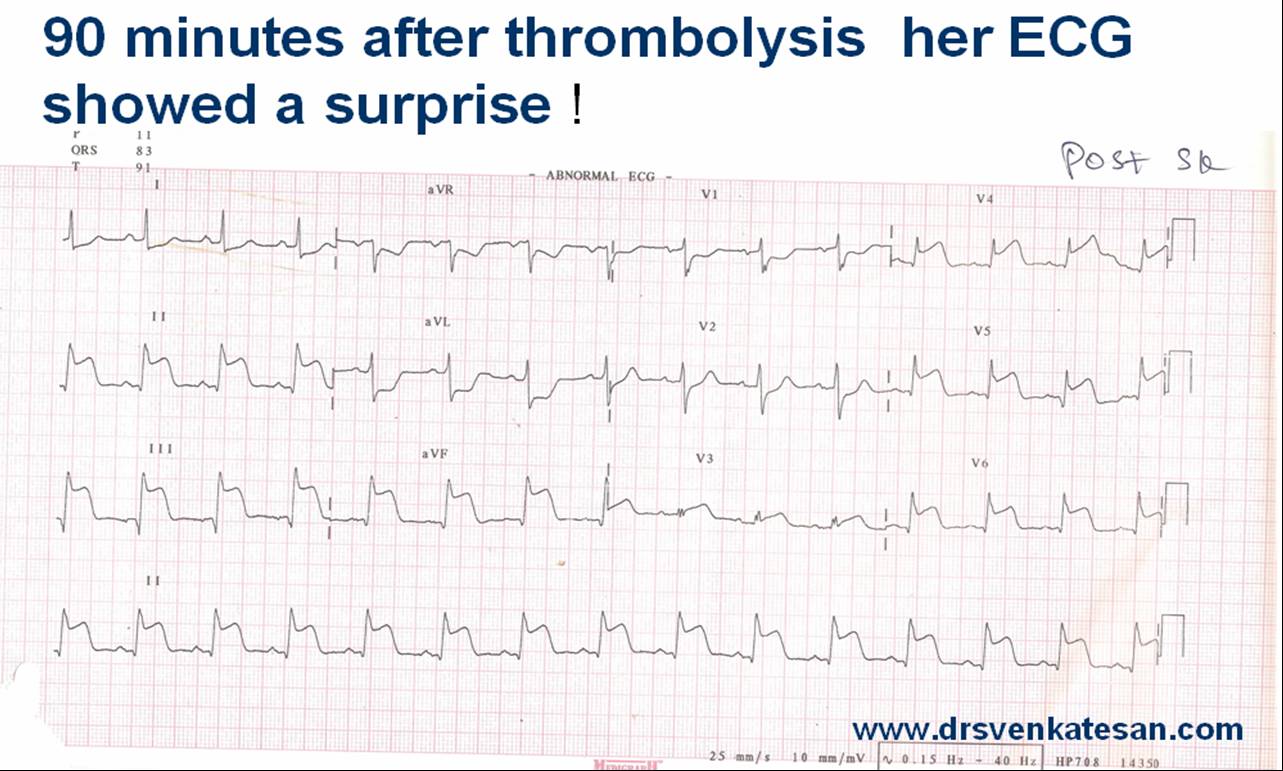
Here is a case history and ECG of a  patient with STEMI .

After thrombolysis , the paradox happened . ST elevation  increased by 4mm and soon the patient became restless with worsening pain and became silent instantaneously ,  with monitor showing EMD and asystole .A diagnosis of free wall rupture was made.

What we used refer  in our CCU (Madras medical college Chennai .One of the oldest CCU in  South Asia )

as   “Action pontentialisation”  of surface ECG . This ECG finding has  great  clinical significance .

Here is a zoomed up view of a qrs complex of  the patient , which is very

closely resembles an action potential

Picture courtesey  http://ocw.tufts.edu/Content/50/lecturenotes/634488/634591

Pathological basis of  “Action potenial”  Like ECG

  • When the ST elevation is huge and wide it mimics  an action potential .
  • Myocyte action potentials are normally recorded epicardially in physiology lab where a  micro electrode with glass pipettes directly enter the myocyte.
  • A giant ST elevation and a sustained dome indicate , the quantum of  electrical injury is  very large and the  ECG electrodes is picking up the myocyte electrical events like that of a intra cellular electrode.
  • It is to be recognised  ,  ST elevation in chest leads is substantially taller than limb leads   because the exploring electrode  is located just above the myocardium . But,    when a  huge  ST elevation  is recorded  over a limb lead (as in this patient )  one can imagine ,   how intense the electrical  charge  of  the myocardium  should  have been  !

This heavy downpour of electrical energy that  emanate from the myocardium   means two things

  • The area of infarct is very substantial
  • The tissue in question is  very unstable .

Clinical correlates of  action potential ECG

  1. Damage is transmural , the   infarcted area is soft, friable and often hemorrhagic .
  2. The pericardium is also  likely to get involved in the injury process .
  3. The myocardium is  rupture prone or already torn .
  4. Even minor hemodynamic stress can be fatal in these patients
  5. An episode of vomiting, a fall in blood pressure,   an episode of  LVF or a short run of VT is suffice  to result in a fatality.

The death happens by a sudden rupture ,  EMD and asystole .

Can a life be saved  by the much fancied Emergency PCI  ?

Not really. The PCI  can not reverse the myocardial damage ,  so it’s role is little . But , any way it should be done and  .  .  . it  will  be done  in most institutions to give the benefit of doubt (Of course , with  a definite the risk of doubting  !)

What is the risk  of  PCI in these situation ?

The infarct related artery * if opened up can convert a bland infarct into a  “angry red”  hemorrhagic  infarct .This   is as good as  giving  the patient ,  a  farewell  party for his journey to heaven !

Note : Primary PCI  definitely  saves life in STMI . The  * is applicable only in persistent ST elevation , late after an acute MI.

How could  have the above death prevented ?

As one of the comments to this article  suggested, we need to have methods to identify impending rupture early and accurately .This should  followed by a prophylactic  surgical intervention (Reinforcing the friable myocardium – with a patch or mesh  )  .This is again not  a easy decision to make .

Final message

When the ECG  assumes  a shape of an  action potential ,  it is often a sign of  imminent  death  . Even though it may sound a pessimistic  view  it is often the truth  . Of course , an  emrgency PCI or  CABG  are  the only options available , we have  to be remember the above truth  ,   as we   play  those sophisticated  games  within their coronary arteries.

Read Full Post »

As the name suggests   dilated cardiomyopathy  would imply  cardiac chambers will dilate , at least some time in the course of the disease .It can be minimal, mild or massive. A new entity called  non dilated cardiomyopathy is also gaining wider acceptance . (That will be dealt seperately )

Logic would suggest , the first chamber to dilate in DCM  should be the left ventricle because it is  facing the direct load of systemic blood. But we also know , whenever  LV is stressed , left atrium comes to it’s assistance .

Left atrium does this    by total self sacrifice ( by all  means!)  increases  it’s  force of contraction, elevating it’s  mean pressure or even increasing it’s rate (AF) .

Like most  other critical questions in cardiology  ,  the factors that determine LV dilatation in DCM ,  is  also poorly understood !

  1. Is it the after load ?
  2. Is it the  muscle mass ? or it’s turgid  or flabbiness ?
  3. Is it the interstitial integrity?
  4. Is it the blood volume ?(LVEDV ,  LV residual volume )

When the issue is complex , it is  usual  to  make the   the unknown  genetic defects  ,  the scapegoat !

As of now the most important determinant of LV dilatation  could be  the behavior of the desmins, the gap junctions and myosins the titins etc

If  the LV of a DCM patient  refuses  or  resists  dilatation what  might happen ? Is it good or bad for the patient ?

Here is a catch .  A  LV  that does not dilate  obviously should be  be good for the patient  is in’t ? Medicine is not that simple.

When   LV  fails to  dilate  it means it has become  too  stiff and rigid    and pass on the  burden to  to LA which  faces the music. And in the process it dilates.This is the reason , we  observe  diastolic dysfunction in vast number of DCM patients.( Currently it is estimated > 75% DCM will have significant diastolic dysfunction )

So , now we can imagine how complex the sequence of hemodynamic stress in DCM that determine the chamber enlargement.( RA, RV  dimension in DCM is a separate issue !)

So now answer this question :  Which chamber dilates first in DCM ?

  1. Left ventricle
  2. Left Atrium
  3. Any of the above
  4. Both of the above dilate simultaneously

The answer must be 3 .

Why  recognising this sequence of  chamber enlargement  in DCM   is important ?

  • It gives us an opportunity to assess the dominant mechanism of LV dysfunction.There are reports , where some  DCMs  have more diastolic dysfunction than systolic dysfunction  .This will have important therapeutic implication.Further , many of the infiltrative   disorders of LV can have features of both DCM & RCM .
  • When a RCM begins to dilate it is usually  a harbinger of terminal heart failure. But,  it need not be always true .  A small restrictive LV  , when  dilates ,   may acquire a  slightly improved diastolic properties , as the  LV becomes more placid . And ,  if it happens the LA size may regress.
  • The role of LV restriction devices like, Acron mesh, Dor procedure, plication  in refractory  DCM is not well defined. All these   modalities actually  adds  a small dose of diastolic dysfunction in these patients who have grossly dilated ventricles. This fact is  very important  , as presence of any preexisting  significant diastolic dysfunction in DCM makes  the role of LV restrictive devices and surgery a big question mark !

Read Full Post »

” This is post is 5 years old , Newer developments should be given considerations”

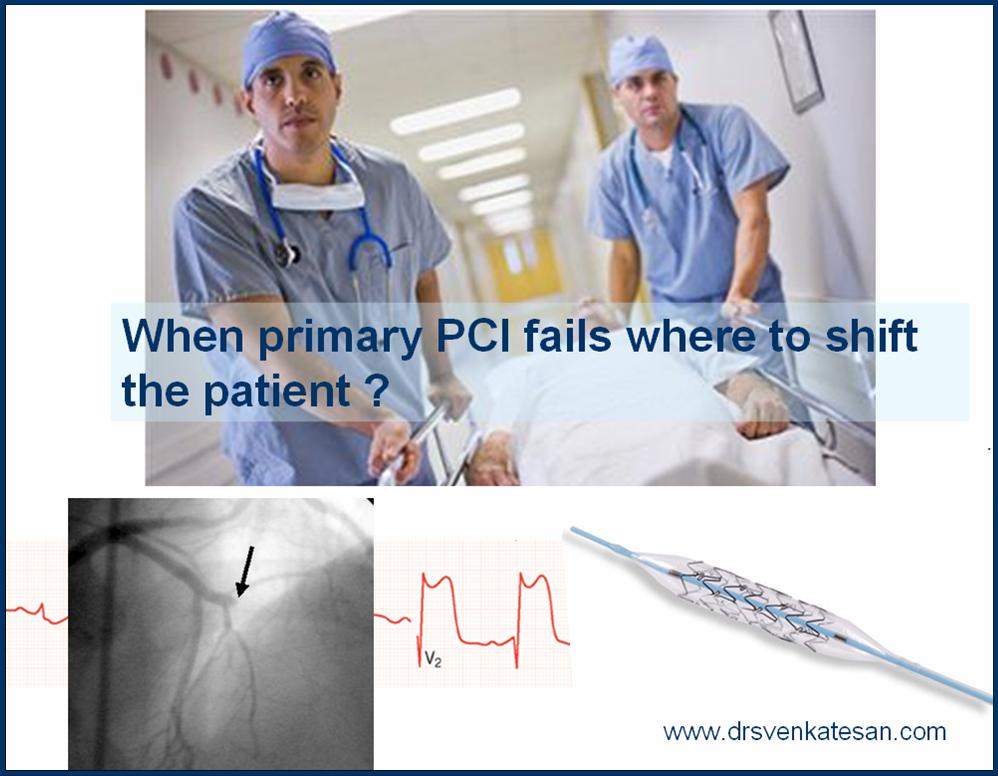
STEMI is the “Numero Uno” of  cardiovascular emergency .The  treatment has evolved over decades,  right from   the primitive  arm chair approach to the  air dropping of  patients  over the cath  lab  roofs  for primary PCI ! We realise by now ,both are extreme forms of treatment and  may  have unique  hazards. What we forget is the , the natural history of STEMI is too  much dependent on the degree of initial damage to the myocardium , and it is very difficult to alter this,  however good is the therapeutic strategy .  We are yet to find an answer regarding the mechanism of primary VF and modes of preventing it. We also have no answer for  ,  why  some  develop myocardial damage  very fast and  the  cardiogenic shock occur in an  accelerated fashion. (Fate ?)

Many would consider  ” non availability of   infrastructure and expertise ”  is the major issue  for  primary PCI . But the real problem is much more than that .When an  illusion of knowledge is  created by constant bombardment of data  , it is natural for human beings to believe whatever is told or printed in books and journals. We cardiologists are made to believe thrombolysis is a far . . .  far  inferior treatment than primary PCI in STEMI .  It is not so in any stretch of imagination !

The fact that,there is no entity called ” Failed primary PCI ” in cardiology literature  , would  suggest how biased we are against thrombolysis. Every cardiology  resident will  recognise  thrombolysis fails  at least 40% of time .Yes , it is  a  fact  , but the irony is , this   is  often  used   to convey a surrogate  meaning , that  is , primary PCI is  near 100% successful !
How  do you assess success of primary PCI ?

Unlike elective PCI where the criteria is too liberal, we can not afford to adopt the same in an emergency PCI. Here the aim of the procedure is entirely different (Salvaging dying myocardium vs pain relief  ).

It’s still a  mystery ,  while  thrombolysis is vigorously assessed  for it’s  effectiveness   primary  PCI is rarely  subjected to the same scrutiny  . A check angiogram  after the procedure ,  is all that is done . . . and every one  leaves the cath lab happily. The  effect of primary PCI on ST segment ECG resolution must be documented immediately after PCI. While ,  It is mandatory to take ECG after 60 -90 mts after thrombolysis , this sort of protocol is rarely  followed after PCI.

If the ST segment  fails to retract  > 50% immediately  following PCI  the procedure  should be  deemed to have failed . Further , unlike thrombolysis  in primary PCI , the ST segment has to regress within 10  mts , as IRA patency occur instantly .If we apply this criteria , the success rate of primary PCI would be far less than what we believe*

* Not withstanding the official lesion , hardware, related failure. If we encounter a severe triple vessel disease , with a bifurcation lesion and thrombus it’s  a tough exercise as we are racing against time .

Primary PCI  Camouflaging  in semantics

  • A successful but  delayed   primary PCI  is actually a failed PCI
  • A  complicated  primary PCI  often  reach the equivalence  of   failed PCI
  • No  reflow is almost synonymous with failed primary PCI as successful correction of no reflow occur in minority.
  • Not all TIMI 3 flow is converted into myocardial flow.
  • Renal dysfunction following excess dye has a  high  morbidity
  • If patient  develops significant  LV dysfunction following primary PCI it is a failed PCI.
  • Finally if the cost of primary PCI exceeds the insurance limit it is  economically a  failed primary PCI as the patient  has to spend double or triple  the amount of sum insured .This stress has resulted in many recurrent coronary events .

Why is it important to recognise failed primary PCI ?

For failed thrombolysis we have a strategy . Unfortunately , even in this modern era  we have  no useful  strategy for failed primary PCI . Handing over a patient to a surgeon in a such a situation is considered by many as a great rescue strategy but in real world it does no good in most of the patient.

Doing an emergency CABG in a sinking patient with a battered coronary artery is no easy job /Many times it only rescues the cardiologists from the embarrassing situation of facing the relatives who ask for explanation.

So , what can be done at best , in failed primary PCI ?

  • CABG can be an option but still questionable !
  • Most times  there is  no other option except to fall back on the medical management.
  • Intensive anticoagulation and one need to consider even a rescue thrombolytic treatment !
  • Some times we can only prey !  Failed primary PCI for a patient in cardiogenic shock with IABP support is near death sentence !

Final message

  • Remember ,  success of primary PCI   is  not in  wheeling out a  patient  alive out of cath lab   , with a TIMI 3 flow  in the IRA ,  but in  garnering significant   myocardial salvage   which  should have an impact on   intermediate and long term  outcome .
  • Do not ever think primary PCI is a sacred treatment modality in STEMI  and the job of the cardiologists ends there. It is vested with  lots of important complications – defined, undefined , recognised,  unrecognised, reported, and unreported ,  concealed ,denied, poorly understood, etc etc.
  • There are  equally  effective, less dangerous treatment modality available .
  • Decision  to do primary PCI  must not be based   only on the  “affordability and  availability”  of  cath lab and expertise !
  • In  clinical cardiology practice,  no  procedure  is  great   & nothing is inferior either  !  Every thing has to be used judiciously , appropriately  and  intelligently (Intelligence is synonymous with common sense many times!)

Coming soon

Surgeon’s real time experience of operating  on a failed primary PCI. To our surprise , only a handful of surgeons  have this experience

Read Full Post »
Acute MI is a major medical emergency encountered in ER . Prompt adminstration of thrombolytic agents or rapid   triaging for a  primary PCI   may be required . The whole concept of management of STEMI  revolves around time as a therapeutic   target .Every minute counts . The beneficial effects of  reperfusion   and the resultant  myocardial salvage  rapidly declines over time . Hence ,  the symptom to door time  remains the ultimate determinant of  outcome in most situations.

So , estimating the  time window of  “Symptom to door time ” becomes an all important parameter. This is often done by paramedics .

The apparently  simple  job  measurement of time window  can be  misleading at times especially in elderly, diabetic and alcohol abusers .

When  a patient  says he has chest pain since yesterday straightaway he is excluded from reperfusion strategies as 12 hours  would have elapsed

When a patient  describes  chest  pain since two days , but  more intense  only since today morning what does it imply ?

  • The first episode of pain could  either  preinfarction angina or infarct
  • The second episode of pain could again be the continuation of same  angina or conversion of that angina into infarct

So ,  calculating the time window  when a  patient has recurrent episodes of angina prior to an MI is a real difficult issue.For the benefit of doubt, we have to take the last episode of chest pain  which was continuous and more severe as the infarct pain.

How does ECG help to time STEMI ?

When it is difficult  , to differentiate pre infarction angina from infarct pain, the ECG may give  useful clues to time the STEMI.

  • Degree  ST elevation
  • T wave inversion
  • Q waves

Among the  above three ,T wave inversion is most useful to time an infarct. If T wave begins to invert, it can generally assumed the acute  infarct process is  almost complete . Q waves are less reliable  to time a acute MI as ischemic stunning can in the  very early phase of STEMI   inscribe a q wave over the infarct territory.

How will you time a STEMI in silent MI ?

There is no symptom to door time in patients with silent MI . Many do not even reach the door , for the simple reason there is no symptom that drives them to hospital. Those who are refered  have vague non cardiac symptoms and incidental ECG  which shows STEMI like changes. Here , the decision to thrombolyse is taken entirely on the basis of ECG *finding .

Note : Cardiac enzymes are can also be  used  to  diagnose  to estimate the time window .

Read Full Post »

Can  modern technology  bring back  the life from a   dead person ?

Yes it is possible  ,  not in the near future !  but  in the present era  . . .

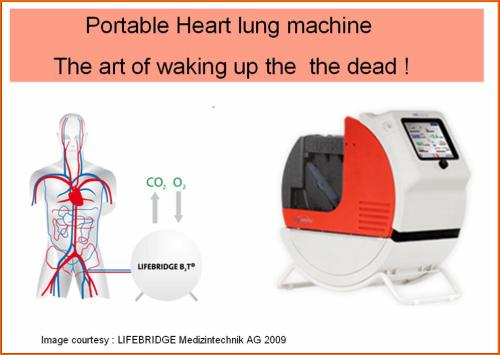
This revolutionary new portable heart lung machine may just do that .

Imagine  this scenerio : A cardiac arrest  victim  – failed resuscitation  with  ACLS  ,   the patient  needs  to be taken for an emergency cardiac surgery or intervention .You need time at least ,  few hours .Till that time  this simple device   takes  over the  role  of GOD    i e  sustaining life   by   pumping  and oxygenating  6 liters of blood !

Learn more about this award winning wonder machine from lifebridge .Germany

LIFEBRIDGE Medizintechnik AG / Product / LIFEBRIDGE B2T®

Read Full Post »

Current data from TCT

TCTMD – The Source for Interventional Cardiovascular News and Education

Read Full Post »

  1. Do 64slice MDCT  in all patients who has  a coronary event and follow it up with catheter based CAG.
  2. Use liberally the new biochemical marker ,  serum  B-naturetic peptide (BNP) to diagnose cardiac failure in lieu of basal auscultation.
  3. Advice  cardiac resynchronisation therapy in all patients  who are in class 4 cardiac failure with a wide qrs complex .
  4. As it is may be considered a  crime to administer empirical  heparin, do ventilation perfusion scan in all cases with suspected pulmonary embolism.
  5. Do serial CPK MB and troponin levels in all patients with well  established  STEMI .
  6. Open up all occluded coronary arteries irrespective  of symptoms and muscle viability.
  7. Consider  ablation of pulmonary veins as an  initial strategy in  patients with recurrent idiopathic AF. If it is not feasible  atleast occlude their left atrial appendage with watch man  device.
  8. Never tell  your patients   the  truths  about the  diet , exercise &  lifestyle modification (That can  cure most of the early hypertension) . Instead encourage the  use of  newest ARBs  or even  try direct renin antoagonists   to treat all those patients in  stage 1 hypertension.
  9. Avoid regular heparin in acute coronary syndromes   as  it  is a disgrace to use it  in today’s world. Replace all prescription of heparin with  enoxaparine  or  still better ,  fondaparinux  whenever  possible.
  10. Finally never discharge  a  heftily  insured patient   until  he completes all the  cardiology investigations  that are available in your hospital  .

Coming soon :  10 more ways to  increase cost of cardiology care . . .beyond common man’s reach

Read Full Post »

« Newer Posts - Older Posts »