Feeds:
Posts
Comments

Archive for the ‘cardiology-ethics’ Category

Stents are mechanical  devices like  a  spring ,  used to  keep an artery open after a PTCA or PCI.
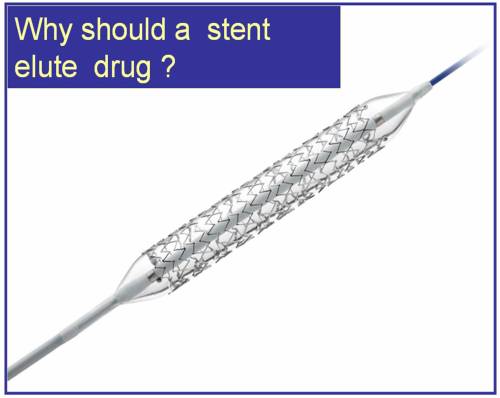
des-why4

                                Bare metal stents(BMS) were found to have restenois rate of about 25%.  So it was perceived a stent should have it’s own protective coat , so that it won’t get restenosed.For this the researchers thought  anti cancer drugs are ideal as they block cell proliferation and thus neovascualrisation and restenosis.Alas, they were found dismally wrong ,  after all , neointiaml proliferation is only a part of the problem of restenosis  and simple blocking of cell growth is insufficient . The issue doesn’t stop with that, the anti cancer drugs incorporated within the stent simply can not differentiate normal from abnormal cells and

DES effectively blocks the normal endothelisation over the stents and make this highly vulnerable for acute stent thrombosis .

This complication is unique to DES and can result in SCD.Further ,during the last 6 years of DES , we recognised the restenosis rate has increased form the much hyped O % to almost 15% and it’s still growing . These  complications  has made a huge question mark over the future of drug eluting stents !
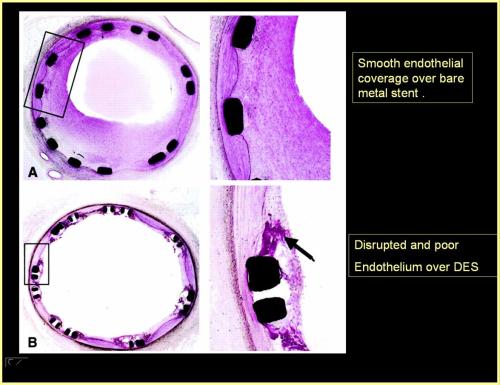
des-coverage

The concept of DES may not die , but which drug it should elute should be answered ! This  again is  going to be a long battle. So it is currently   adviced,  based  on common sense ( With due respects to  those RCTs  funded by industry )

Whenever you encounter a block within the coronary artery* Ask the following  questions in sequence  ,

  • Whether we can leave it alone  with medical therapy  ,  if the answer is no , proceed  to the next step !
  • Is there a possibility for plain balloon angioplasty in a given vessel (POBA, Yes !  the concept is not dead yet !)
  • If you decide a stent is required , Will  the  bare metal  do the job ?
  • In multivessel CAD  , Did the issue of increased metal load on the  long term outcome was considered ?
  • If lesions appear complex,  should we  not strongly consider CABG as an option ?

However  if we  have the habit of  ask ing the following  question  you are likely to deviate from scientific approach  

Is it possible to put a stent  across  the block ?

Yes , will be the answer most of the time ,and the patient will invariably get one or more stents  and carry a life long  stent related problems.

*The rule does not apply in Acute coronary syndromes

Also read this letter  posted by the author published in  British medical journal
Read Full Post »

                                                 It is now mandatory for all  journals  to declare the  conflict  of interest by the authors  who are involved in medical research .The purpose apparently is to make all transactions or links  between the researchers and their funding agencies transparent .Even major journals  do not go beyond this . Some ensure it , to appear in the first page of  the article.

 What does the the journals tend to  convey to the reader by publishing the conflicts of interest ?

  •  Does it  mean the article in question  may have a bias or indeed have a bias  ?  and readers are warned  hereby !
  •  Do they send across a message  that the  article may not be really a genuine one and the judgement is left to the the consumers of the articles ?

How often a journal article is rejected purely on the basis of  conflicts of interest ?

Most of  journal articles are rejected  for poor methodology, statistical analysis and so forth .We don’t know how often a paper is rejected  due to a conflict issue per se.If this could happen ,bulk  of drug trials would face a torrid time from the editors.

Why , even the leading scientific  journals never indulge in grading the significance of the conflict ?

Here is an example .

accomplish

nejm1

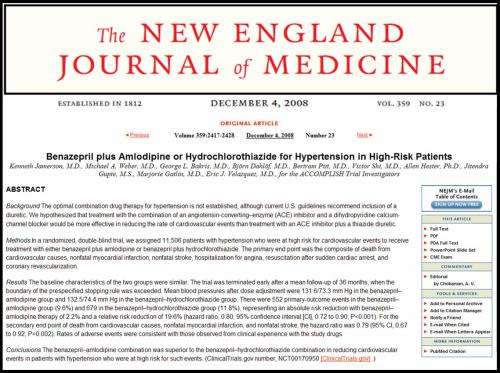
The much hyped drug trial on Hypertension “ACCOMPLISH”  was published in the  world’s most prestigious medical journal recently .It  left  it to the readers to  have their  own assessment  on the conflict issue.

  The consequence of not , grading and investigating  about the conflicts could have  serious  global health  implications both financially and academically .

This study was designed, formulated, completed and published  with a single hidden aim of neutralising the land mark trial  of ALLHAT which recommended diuretics as a first line drug in HT.Apparently diuretics are very  cheap  , effective  generic drugs.

 Is it a scientific rule  that  the  latest evidence  ,  should always prevail over the older evidence ?

No. Science can never have such a rule ! The question is how good and genuine is the evidence.
Just because an evidence is current , it does not  attain a scientific sanctity !

Read Full Post »

One of the important principles of medicine  is  “Diagnosis should  always precede treatment”

This quote , though appear reasonable , can not be practiced always especially in emergencies,  where we  have to first stabilise the patient   without a  prior diagnosis  .(Like administering IV fluids in hypotension , acetaminophen for fever , etc)

Modern medicine  considers treating a patient without a diagnosis as unscientific.

But,  it is a well recognised fact ,  millions  of decision in everyday medical practice is not based on scientific diagnosis  but on clinical acumen and empirical therapy . There are many  instances  wherein , we are never near the  diagnosis  even after exhaustive investigations. 

prescription3

                       Ironically , in this era of evidence based medicine , when  we are  unable to  conclude ,  we are forced  to do the most  funniest  thing , namely converting patient’s symptom itself as disease entity and  be happy  in labelling them. Like , Motion sickness ,  poly-arthritis, , chronic fatigue syndrome, adult respiratory distress syndrome ,  pre mature ejaculation, fever of unknown origin  , attention deficit disorder , etc (The list is endless . . .)

               This happens because physicians always feel guilty if they are unable to label a patient with a disease entity.

Is the guilt  justified ?  Not necessarily so !  Symptomatic treatment without  diagnosis  is the most dominant theme even today (Fever, pain etc ).So don’t feel unduly negative* when one is not able to fit a patent’s  symptom into a disease entity  but ensure  he  gets relief from his symptom.

 *Except of course , one has to rule out a serious disorder.

 Comments welcome

Read Full Post »

What is herd behavior ?

It is a behavioral pattern where in animals and humans in large numbers , tend to behave in the same way at the same time without application of mind .


Herd behavior in human societies

Herd behaviour describes how individuals in a group can act together without planned direction. The term pertains to the behaviour of animals in herds, flocks, and schools, and to human conduct during activities such as stock market bubbles and crashes, street demonstrations, sporting events, episodes of mob violence and even everyday decision making, judgement and opinion forming. This is very much applicable to medical profession also.(Ref:Wikipedia)

Herd behaviour in animals and human how they are different ?

“surprise ! surprise ! There is  very little difference  noted , according to Hamilton”

A group of animals fleeing a predator shows the nature of herd behavior. In the often cited article “Geometry For The Selfish Herd,” evolutionary biologist W. D. Hamilton said each individual group member reduces the danger to itself by moving as close as possible to the center of the fleeing group. Thus the herd appears to act as a unit in moving together, but its function emerges from the uncoordinated behavior of self-seeking individuals.

Among humans for example when panicked individuals confined to a room with two equal and equidistant exits, a majority will favor one exit while the minority will favor the other.

Medical professionals as a herd


The practicing habits of  medical professionals  move , symmetrically as a herd . When a top journal or a opinion leader utters something every one tend to move in that direction .

If a herd leader says a particular treatment is great, every one will say yes . If he says nay every one will say nay !

No one will really question the direction they move ? Unless the correction occurs from within the herd. No external forces usually are effective.Herding is also benefitial many times as rapid propogation of scientific facts needs such behavior ,but it needs constant scrutiny.


Herd behavior example 1 : The most  typical example is the drug prescribing pattern of anti hypertensive agents over the past half century.The movement  from diuretics to beta blocker , from beta blockers to calcium blockers and to ACE inhibitor and again to diuretic  , then to ARBs and currently shying strongly away from beta blockers, in between  have a brief encounter with alpha blockers and finally  back to diuretics.

If a  particular physician by his insight , had clinged onto  diuretics ( Away from the herd ) for over three decades he is a real exemption , although branded old timed  and unscientific , he has been the most scientific medical professional indeed !

Herd mentality example 2 : Every one says so !  so it must be true ! Hormone replacement therapy good or bad goes with the leader of the herd . 

Herd mentality example 3: Very few cardiologists will be ready to agree the fact that , simple digoxin and diuretic ,ACEI, beta blocker,  administration could be as effective as  the costly cardiac resynchronisation therapy in atleast some of patients with wide QRS cardiac failure ( As we know up to 30 %  wide QRS CHF population do not respond to CRT) 

Defying Herd mentality resulted in major break throughs in medicine

               When every one was  saying beta blocker was harmful in CHF one person from Briton defied it ( Wagenstein, and now beta blockers are the mainstay in the management of CHF! )

There are hundreds of treatment modalities popularised by such herd behavior

Who is the watch dog  , whether science is moving in the correct direction ?


Read this land mark article  how medical research can be distorted by such learned behavior  and how scientific research should not be done .

Click on the image .

 This post is not intended to hurt anyone . It  reflects , human beings are not  fully evolved  yet , in the onging  process of evolutionary biology.

Read Full Post »

                Human civilisation has met so many challenges.Man kind has enjoyed the benefits of modern medicine for over a century.Now comes the new threat.Threat from within.The onslaught of marketing force has contaminated the medical science .

              It is widely  recognised  commerce is masquereading as science , from stem cell research to futile and costly  drugs, and  questionable  devices and procedures . 

How is the medical  community responding to this  issue ? 

Silence  is the response !  Why silent ? Are we the part of the problem ?  Occasional articles in the  Annals of medicine, Lancet, BMJ, or JAMA talk about these issues and nothing happens next .

Click below  to read one such article from the recent issue of Annals !


Let us hope the world financial crisis currently we are witnessing , would be good for human health as all futile market driven  , enforced medical expenditure goes bust !

Read Full Post »

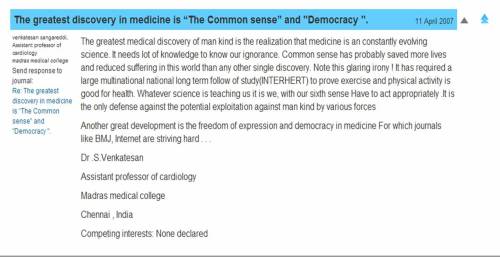
     The greatest discovery in medicine is  “ common sense” and

    “democracy”.           

                       The greatest medical discovery  is the realization that medicine is an constantly evolving science. It needs lot of knowledge to know our ignorance . Common sense has probably saved more lives and reduced suffering in this world than any other single discovery. Note this glaring irony ! It has required a large multi national long term follow  up study (INTERHERT) to prove exercise and physical activity is good for health. Whatever science is teaching us it is we, with our sixth sense have to act appropriately .It is the only defense against the potential exploitation against man kind by various forces.

Another great development is the freedom of expression and democracy in medicine,  for which journals like BMJ, Internet are striving hard . . .

Dr .S.Venkatesan ,Assistant professor of cardiology . Madras medical college Chennai , India


 Click on the title to view the article and all nominations . 


Read Full Post »

CURRENT   CARDIOLOGY  PRACTICE: EVIDENCE  OR  EXPERIENCE  BASED ?    AN  ANALYSIS OF  ACC/AHA  GUIDELINES.

S. Venkatesan,  Madras Medical College. Chennai


If  a  major therapeutic procedure is adviced based on simply by experience or expert opinion  how can we say evidence based medicine is practiced !


                                    Evidence based cardiology  is  the  buzz word  in global cardiovascular  health care  organizations. All diagnostic  and therapeutic  interventions are  undergoing  rigorous randomized  trials  for  proof of  efficacy  and  safety. ACC/AHA   have published  management guidelines and it  has been accepted  as de-facto standard of clinical cardiology practice world wide.  In these guidelines  class  1  indication  is defined as Conditions for which there is evidence for and/or general agreement that the procedure is useful and effective. These indications are supported by three levels of evidence.(A,B,C) .It has been observed,   many of the recommendations  in  class 1  were supported by only level  C  evidence. (Expert consensus or  agreement  ). We  analysed how much of todays guidelines is  agreement based  and  how much is evidence based. The  latest  practice  guidelines  of  ACC/AHA   for  Acute myocardial infarction , Unstable Angina and Non–ST-Segment Elevation Myocardial Infarction , chronic  stable angina  ,coronary angiography  were analysed. The  no  of  class 1  indications  were counted  in each set of guidelines  and  each  of the indication were  sub grouped with reference to the  levels of  evidence  to which it was supported. There  were a total  of 210  class 1  indications.


Class  1

Level A

Class   1

Level  B

Class  1

Level  C

P value

1A vs 1C

AMI(54)

7

25

22

<.0001

UA  (66)

11

26

29

<.0001

CSA(59)

8

29

22

<.0001

CAG(31)

3

12

16

<.0001

Total(210)

29(13.9%)

92(43.8%)

89(42.4%)

<.001

 13.9%   of class 1  indications were based on  level  A evidence.  42.4%  of class 1 indication were based  on Level C  ( agreement  of experts).Though evidence based cardiology   is   considered  to  define  the  standards in  Cardiology  practice  in reality  we lack evidence in most of the situations. 

                                       We  conclude  that  consensus or  agreement  based cardiology  practice is the dominant theme in current   ACC/AHA 

Read Full Post »

All is not well,  that ends well !

                                       Treatment guidelines in cardiology  practice  are periodically published by ACC/AHA/ESC.These guidelines  represent the current scientific practice. They are called some times as recommendations. Medical professionals tend to adhere to this guidelines whenever possible.They are not legally binding in most of the countries.In USA some states believe it, to be legally binding.


The problem with these guidelines  are , they are classified as class 1 ,class 2 , class 3 recommendations.


Class 1, A  drug , device  or a procedure  Is definitely useful and must be prescribed.

Class 3,   A  drug , device  or a procedure  Is not useful and should not be used .

Class 2*, A  drug , device  or a procedure  may be useful  or may be harmful , and hence may be used or may not be used . (Vaguest possible guideline!)

 *Altered to convey the meaning

What are the  guideline violations that can be sued in court of law  ?

A person with established  CAD who is not been prescribed a  statin (Cholesterol lowering drug)  can be sued straight away,  even if the patient has no adverse outcome due to the nonprescription of that drug. The issue here is , the doctor  has not prescribed  a drug which has  proven benefit .The law is clear on that .Most will  agree that,  the  doctor is at fault ,  and he  is never protected  even by their  colleagues .He  can’t defend his action.

What are the medical errors that can never* be sued in court of law !

But the same doctor who opens up a totally occluding coronary artery in an asymptomatic patient(CTO -chronic total occlusion) and lands up  in a complication and the  patient dies. This could be  major guideline violation as opening a CTO in an incidentally detected , asymptomatic patient is a class 3 recommendation. Neither the physician, patient , institution  nor  the regulatory authorities bother about this even though there is strong case for censure , in reality it never happens. Number  of  experts from leading hospitals do this procedure in live work shop all over the world with full media glare, It is an irony the same  experts are only  writing  in their  guidelines  that  these procedures should not be done inappropriately.

And this medical  error ( Should we call it a  crime if it is knowingly done ! )   keeps growing as the physician never feels guilty about it .

The message here is

 A physician of a state of the art hospital,  in a scientifically advanced  country  goes scott free and guilt free  even if he openly violate the scientific guidelines and do a inappropriate procedure that result in a patient death. Mean while a small time physician in a remote place in the same country can be taken to task  for not prescribing a officially  recommended drug (By standard guidelines) .He will be labelled unscientific and unethical even if his non prescription , had not caused any untoward health outcome .

In short , in today’s modern medical practice 

 Even a  ” Minor error of  ommision”   attracts guilt and perceived fear among the physicians. Meanwhile  many  of the ” Major errors of commission”  done by professionals are rarely frowned upon and thus these  mistakes continue to perpetuate !

*There should be a strong provision in medical law to address the issue of inappropriate procedures even if the procedure has not resulted any untoward effect to the patient.

Read Full Post »

« Newer Posts