Feeds:
Posts
Comments

Archive for the ‘Cardiology hypertension’ Category

The much fancied criteria   “suspect secondary  HT” if the  onset of  hypertension  is   before 30 years   later than  55  years ,may be useful  .But a caution about this criteria  : It does not mean you should not hesitate to  diagnose renal HT  between 30 -55 years.  The  real onset may be   < 30years , but  the patient may report to the physician  late  in his /her  40 or 50s !

  1. Diastolic blood pressure > 120
  2. Sudden acceleration blood pressure
  3. Blood pressure which is  resistant to control with three or 4 drugs ,that shall typically include a  diuretic.
  4. An episode of left ventricular failure (Often referred to as  called flash pulmonary edema)
  5. Presence of  Hypertensive retinopathy
  6. Para umbilical bruit
  7. HT associated with significant CAD
  8. Marked LVH in echocardiography
  9. Finally , most importantly , worsening of renal function with ACE inhibitor is a  strong clue the kidney is under perfused  and  the   renal circulation  is dependent on  elevated angiotenisn 2 (Which ,if blocked worsens the GFR ).This implies every physician should take a baseline serum creatinine  and urea before starting them on ACEI.(Which is rarely followed , as far as my country is concerned !)

Is there any simple way to  differentiate  reno vascular from renal parenchymal HT ?

It is very difficult to differentiate between these two clinically. It makes things more difficult , as  combination of both occurs. Prolonged renal ischemia can result in parenchymal damage as well.

The simplest way is to do a rapid ultrasound imaging to assess kidney size and texture (Loss of cortical-medullary differentiation indicating early renal contraction phase ).Of course , our nephrology colleagues are always there to help you out .

* It need to be remembered the functional renal HT -Renal tubular acidosis,  Adrenal HT (Conn’s /chromo-pheocytomas  has to be ruled out , as these entities also occur in the same age group ).The combination of hypokalemia and mild alkalosis is a  good clue to rule out many of these  defects.

* The CT scan image used in the above illustration  courtesy

http://www.ajronline.org/cgi/content-nw/full/189/3/528/FIG21
Read Full Post »

For medical science  to  defy   logic , is a not a great  new discovery . “Diabetes is a major  risk factor for heart disease   but controlling diabetes may not  remove this risk factor” Similarly  severe mulitvessel CAD  occurs without  any symptoms and compromise on LV function . It is a natural human  instinct  to open of  any thing  that is obstructing   on  their  path . The same logic applies in   physicians when we encounter blocks in the vascular highways  .

For a moment compare  it with an express way .

We realise many  roads have a  reserve capacity . Even if the road is  half  blocked , traffic  congestion  rarely happens  as the  original road’s width is  sufficiently  large for the projected traffic . Some other roads have emergency  service lanes (Collaterals) that can take care the flow of traffic.

Another  question to ask is , Where does the road  lead to ? and why  we are  traveling ?

If it leads to a “dead  sea”  or a “bottom less cliff’  there is no purpose  to travel further . Similarly , when you find a destructed kidney with little nephron mass( or dead myocardium  ) there is absolutely no purpose  in opening the block . (Some  may  believe  the act  of  opening  block , by itself   is a success /  sorry- story !)

This is what happened in the lase decade . Interventional    radiologists , vascularologists , cardiologists started  opening  renal artery obstructions , at their whims and fancies, in  many elderly and middle-aged population .To their surprise (This surprise is due to ignorance )  they found no worthwhile benefit  either in the BP reduction or worsening renal function .

Now comes the evidence  in  2009  as   ASTRAL  trial from UK . ( As usual   the evidence came   late after ,  few lakhs  of kidneys   been injured !*

* Renal interventions are notorious for many complications , which is often not reported . Read this article to know  it better.

http://www.nejm.org/doi/pdf/10.1056/NEJMoa0905368

Final message

Common sense can  work great wonders than the much hyped RCTs . (Except ASTRAL  of course !) In this era of scarcity of  such  sense we can expect another study soon , to nullify ASTRAL  and give us further license  to pursuit the  good old  human instinct  ! Already silent noises  are made in interventional  corridors questioning the  outcome of ASTRAL.

Read Full Post »

  1. Do 64slice MDCT  in all patients who has  a coronary event and follow it up with catheter based CAG.
  2. Use liberally the new biochemical marker ,  serum  B-naturetic peptide (BNP) to diagnose cardiac failure in lieu of basal auscultation.
  3. Advice  cardiac resynchronisation therapy in all patients  who are in class 4 cardiac failure with a wide qrs complex .
  4. As it is may be considered a  crime to administer empirical  heparin, do ventilation perfusion scan in all cases with suspected pulmonary embolism.
  5. Do serial CPK MB and troponin levels in all patients with well  established  STEMI .
  6. Open up all occluded coronary arteries irrespective  of symptoms and muscle viability.
  7. Consider  ablation of pulmonary veins as an  initial strategy in  patients with recurrent idiopathic AF. If it is not feasible  atleast occlude their left atrial appendage with watch man  device.
  8. Never tell  your patients   the  truths  about the  diet , exercise &  lifestyle modification (That can  cure most of the early hypertension) . Instead encourage the  use of  newest ARBs  or even  try direct renin antoagonists   to treat all those patients in  stage 1 hypertension.
  9. Avoid regular heparin in acute coronary syndromes   as  it  is a disgrace to use it  in today’s world. Replace all prescription of heparin with  enoxaparine  or  still better ,  fondaparinux  whenever  possible.
  10. Finally never discharge  a  heftily  insured patient   until  he completes all the  cardiology investigations  that are available in your hospital  .

Coming soon :  10 more ways to  increase cost of cardiology care . . .beyond common man’s reach

Read Full Post »

idh

  • Hypertension  is  major determinant of cardiovascular health  of our global population
  • Millions suffer,   hundreds of societies ,  and as many guidelines , and drugs are still struggling  to control the menace.
  • An important sub group of HT , (ie IDH ) population has been neglected and never received the scientific interest , which it deserves !
  • In our study it occured in 7.2% of all HT  patients.
  • JNC,  the world authority on HT never considered  IDH as a separate entity, and as of now there is no specific guidelines.
  • And the irony is complete . There is not  a  major study available to analyse the differential effects of anti hypertensive drugs on systolic and diastolic blood pressure.

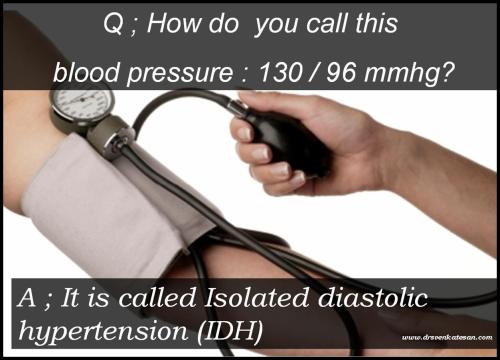
If  a patient with the BP of 120/96 asks you , “Doctor , will the drug,   you have prescribed , selectively lower my diastolic blood pressure ” what will be your answer ?

A clear ,  I don”t know !

The following paper was presented in the World congress of cardiology Sydney  2002

Isolated  Diastolic Hypertension

S.Venkatesan,S.D.Jayaraj.Gnanavelu, Madras Medical College. Madras, India.

Abstract : Systemic  hypertension  continues to  be a major determinant of cardiovascular  morbidity. While isolated systolic hypertension(ISH) has been identified as a specific clinical entity, isolated  diastolic  hypertension(IDH) has not been reported as a separate group. When we analysed our data from our hypertension   clinic  we found  a distinct subgroup of patients who had  elevated  diastolic blood pressure   with  normal systolic pressure. We report the clinical profile of these patients. 440 newly registered hypertensive  patients between the year 1998-99  formed the study population. All  patients with secondary hypertension  were excluded.. IDH  was defined as  diastolic BP more than 90mmhg and systolic BP less than 140mmhg.

IDH was present in 32(7.2%) patients.  The male female ratio was 3:1, mean age was 42(Range32-56) The mean diastolic pressure was 96 mm (Range 90-110).The mean systolic pressure was 136mm(Range 128-140). LVH was observed in 4 patients(12.5%). Diastolic dysfunction was detected by echocardiography   in 20patients.(62%)

We conclude that isolated diastolic hypertension  constitute a  significant subset among  hypertensive  patients and they need further study regarding the pathogenesis, clinical  presentation and  therapeutic implication.

Link to PPT  will be available soon .

Read Full Post »

Let us not forget the basics !

  • HT management has been made  easier with the availability of  many  good drugs , at the same time it has become a complex  issue with as many classification and guidelines.
  • The management of HT has evolved over the decades. Now we have realised  HT  is not a simple number game . Reducing the blood pressure to target levels is not  sufficient and is not the primary aim !.
  • In fact we now know controlling the numbers alone is never going to work  , combined risk factor reduction is of paramount importance.
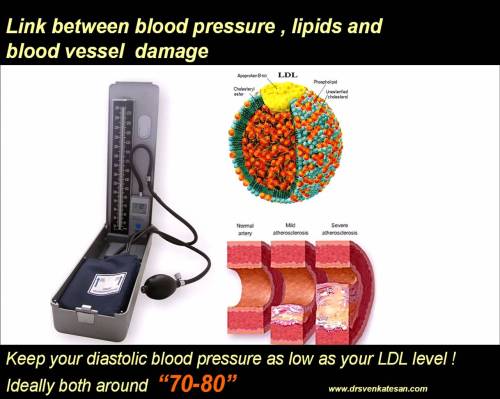
  • HT per se is less lethal but when it combines with hyperlipidemia and diabetes or smoking  it becomes  aggressive.The blood lipids  especially the LDL molecule  enjoy the high pressure environment  ,   penetrate and invade the vascular endothelium.
  • ASCOT  LLA  study has taught us,   for blood pressure reduction to  be effective and reduce CAD  events one has to reduce thier  lipid levels also.So , for every patient with HT there is not only a target BP but also a target LDL level .

picture1


Final message

The tip for better vascular  health is  , all  hypertensive patients should keep their lipids to optimal levels and all hyperlipidemia patients should keep their BP as low as possible .

“Keep your LDL  as low as  your diastolic blood pressure  and  let us  keep it around 70 -80

Read Full Post »

« Newer Posts