Feeds:
Posts
Comments

Archive for the ‘Uncategorized’ Category

Diabetes is a systemic disease affecting  almost every cell  that metabolises  glucose .What begins  as  a minor  functional impairment  ,   worsens gradually and ultimately   end up in severe  structural changes.The basement membrane of  cells  face  the brunt of the attack .  (In the strict sense every cell has a basement  but it is well  developed only in kidneys ) . We also  know , diabetes  is able to inflict universal damage by targeting the vascular endothelial cells.

In the kidneys DM makes the  glomerulus  more porous causing protein leak*  and ultimately damages the tubules and end up in CRF. In the retina it excretes the  proteinaceous  material into the vital layers  and result in  retinopathy and progressive visual loss.

* Micro/Macro albuminuria

In fact , there is  a very close link between eyes  and the kidneys  Nephrologists   hesitate to make a diagnosis  of diabetic nephropathy without ocular  changes. The peripheral vascular disease and diabetic foot are  another expression of this microvascular  dysfunction.

What is the impact on cardiac micro-circulation ?

Whenever significant diabetic nephropathy is present there must be a significant cardiac micro- angiopathy as well.This is now  a fact than an assumption. We are not recognizing it rather  ! (If only we have a cardiac  creatinine we can easily identify diabetic myocardial protein leak !)

When kidneys lose protein , cardiac capillaries  lose proteins to interstitial   space  and result  in progressive  fibrotic reaction . We know  extravasaation   of high osmolar  proteins   can play havoc  in cardiac interstitium  !

Proteins are the particles of life   . . . but in wrong places  it can  transform into deadly  molecules  in a fraction of time !

Hence ,  the cardiac protein leak in diabetes can cause  any of the following clinico -pathologic entities.

  • A mild left ventricular  hypertrophy .
  • Increase global  cardiac  mass (Similar to bulky kidneys  seen in early diabetic nephropathy )
  • Simple diastolic dysfunction.
  • Severe restrictive features
  • NDCM (Non dilated cardiomyopathy )
  • Finally a DCM  like  transformation

How to recognize cardiac protein leak ?

  • Clinically it presents either as  angina or early heart failure symptoms ( not both usually ) .Diastolic dysfunction  in echo,  positive stress test , patchy thallium uptake abnormality  often with  features  of   syndrome X  is also recognised.
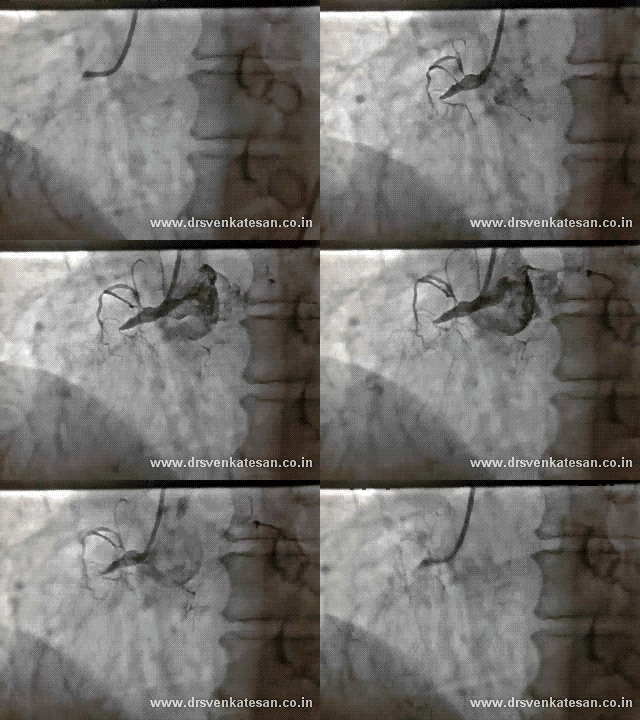
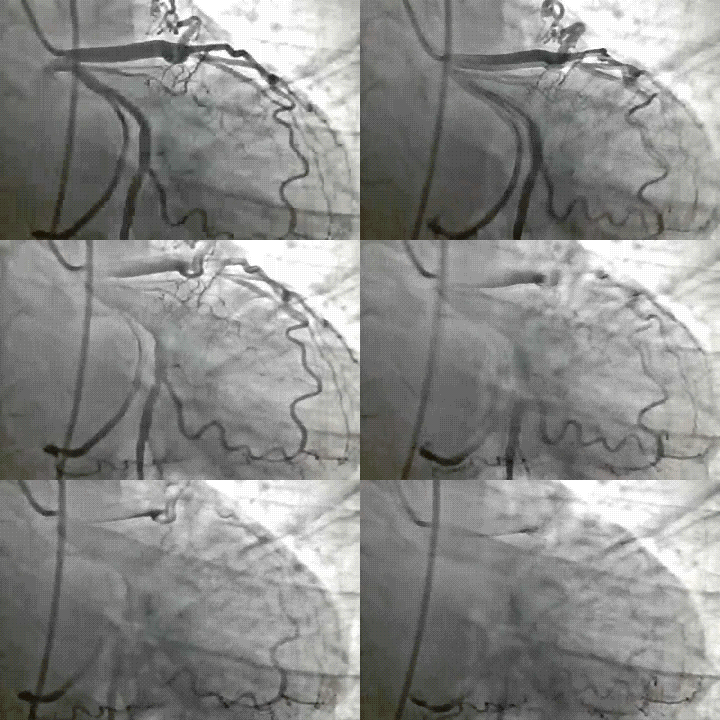
  • Many of the low flow or slow flow phenomenon  in coronary angiograms  might reflect micro-circulatory dysfunction .
  • This is recognised by prolonged TIMI frame counts  and  prolonged  coronary sinus filling and emptying time .

What about macro-vascular  complications  in diabetes ?  How is it different from micro-vascular complications ?

Though we expect a direct  link between  micro and macro  vascular complication ,   the later  appears  to a  patho-genetically  independent  process . This will be addressed later.

Read Full Post »

Read with caution . This  may either injure or cure your patient !

Click on the ECG to view what happend !


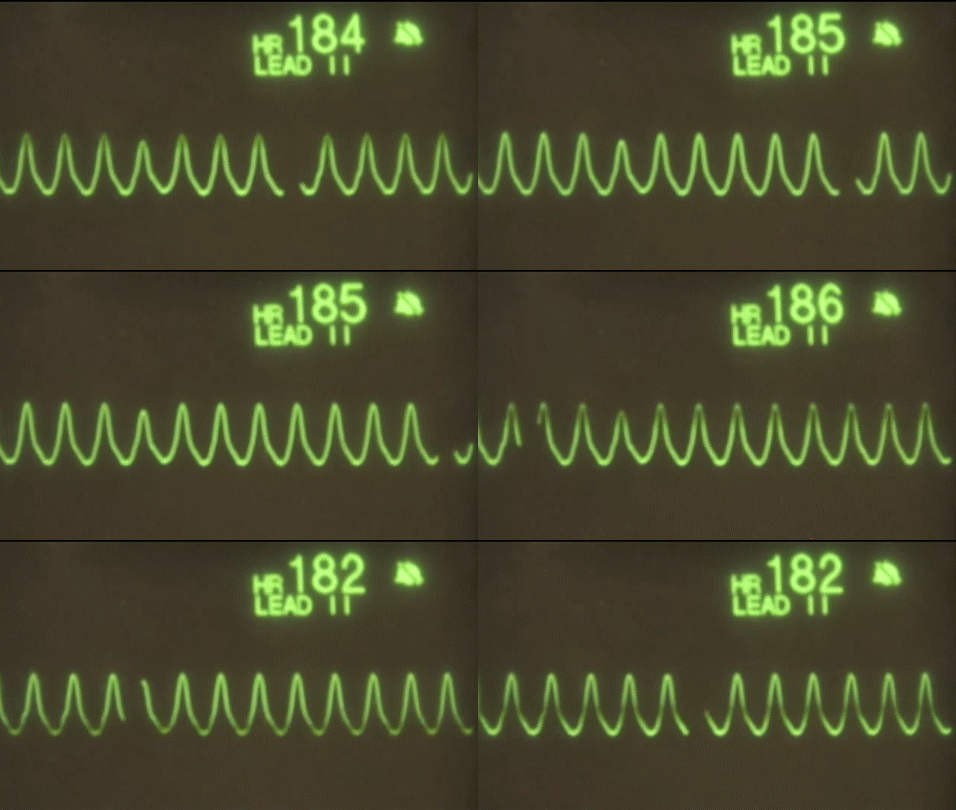
How does  verapamil  terminate a  VT  ?

Physicians  often  debate  vigorously before   labeling  a cardiac arrhythmia as ventricular , atrial junctional  , abberant or not etc etc .  But  for  an arrhythmia   it matters little  from what  chamber it is going to to originate . After all ,  any cell in the heart if excited can generate an arrhythmia .  The ion channel abnormality and the influx and efflux of ions  that determines how a drug is going to terminate an arrhythmia.

In fact , way back  in 1989 the Sicilian Gambit stressed this concept when classifying anti-arrhythmic drugs .This classification taught us  , even though there is a  huge list of  clinical cardiac arrhythmias  , from the therapeutic point of view there are only a handful of receptors  (scattered  all around ) to target  !

When we look at this angle , we realise  , many of  ventricular action potentials  have  important slow  calcium currents  similarly  junctional action  potentials do have some  sodium currents.  Calcium current  is present in every  myocardial cell  more so in the vicinity of AV junction.  Further , at times of ischemic or hemodyanmic stress these ion channels  may  take a different avatar altogether.Slow sodium channels and fast calcium channels etc !  (A wild imagination or is it a fact ?) Other important targets are potassium channels

Heart is a complex structure both macro and microscopically  .  In the three dimensional  histopathologic   interface between atrium  and ventricle (Especially in the  basal areas , outflow tracts  , around the AV grooves ) there  are  lot of sharing  and overlap of  different morphology  of cells . A high septal VT can behave  exactly like an SVT  which  includes the  tendency to get terminated by calcium channel blockers.

Amiodarone is a most popular  drug for VT termination ? Are we clear about the mechanism of it’s  action in terminating VT ?

It is  more of a perception and belief  that  class 3 action   may be   responsible for termination of VT by Amiodarone . In reality it is very difficult   to prove this point.  As Amiodarone  has all the  4 classes  action that includes beta and calcium blocking properties.. In fact ,  now  there is evidence  to  suggest   beta or calcium blocking action  may be more important in terminating  VT when  it is administered  IV  . (While  the class 3 action predominates in long term oral therapy )

A verapamil sensitive   VT may  successfully  be terminated by  Amiodarone  not by its  unique  action  instead it   may simply represent  its  calcium blocking  property.

Final message

Many  of the  VTs terminated by Amiodarone   could  also be verapamil sensitive . Since verapamil is never tried first we will never ever know the incidence of such phenomenon that gives pseudo credit  to Amiodarone

It may not be big crime to try injection verapamil in some of  the  stable ventricular tachycardias( As my fellow did ) especially  when we we know there is an entity called verapamil sensitive VT !


Q for the readers :

How many deaths are reported in cardiology  literature  regarding    fatality  following   verapamil  in   VT ?

I am trying to find  the answer the  data is very hard to come by !

Critical comments welcome.


Read Full Post »

Ever since Brugada found the unique pattern of ECG on right pre- cardial leads and its  association with  premature electrical death ,cardiac electro-physiology got a new impetus. Hundreds of articles(May be thousands !) on Brugada are  available . Many criterias  were proposed.  Brugada  and his colleagues should be credited for bringing  in such an interest in the  field of inherited ventricular arrhythmias.

On the down side ,  as we have a habit of  prematurely formulating criterias  ,  it brings  an artificial academic  barrier  Funnily , in medical  science  deviating   from a criteria (However hastily it  was  proposed  )   is a considered  big  offense Further . the hype surrounding  any new scientific  entity makes it difficult  for others  to overwrite  it .

Brugada recognized a ECG pattern with  a genetic predisposition for VT and VF  . Now , we know there are many etiologies  with a similar pattern  of ECG . What Brugada did was ,  he  exposed the tip of Iceberg called inherited ventricular arrhythmia . But the essential criteria –  Absence of structural heart disease ,  to diagnose Brugada   was  always questionable.

(Please realize , presence  or  absence of structural  heart disease depends , more  on  how advanced  our  imaging modalities are . If you can map a virtual histology of RV epicardium one may detect some  microscopic abnormality in every case of Brugada. In human biological system , God  usually bonds  structure and function too  closely  and hence  functional  abnormality rarely occur  in isolation )

Brugada is  not  a new disease ,   it is  a  recognition  of a  pattern of ECG  related  to sudden deaths . Subsequently , we  realized any dispersion in repolarisation in RV epicardial surface  , the   risk of sudden death  is increased. From the days of  Brugada  we  have  come  a long way.

What is new in Brugada syndrome  ?

(Not exactly new . . .  it is  known  for many years )

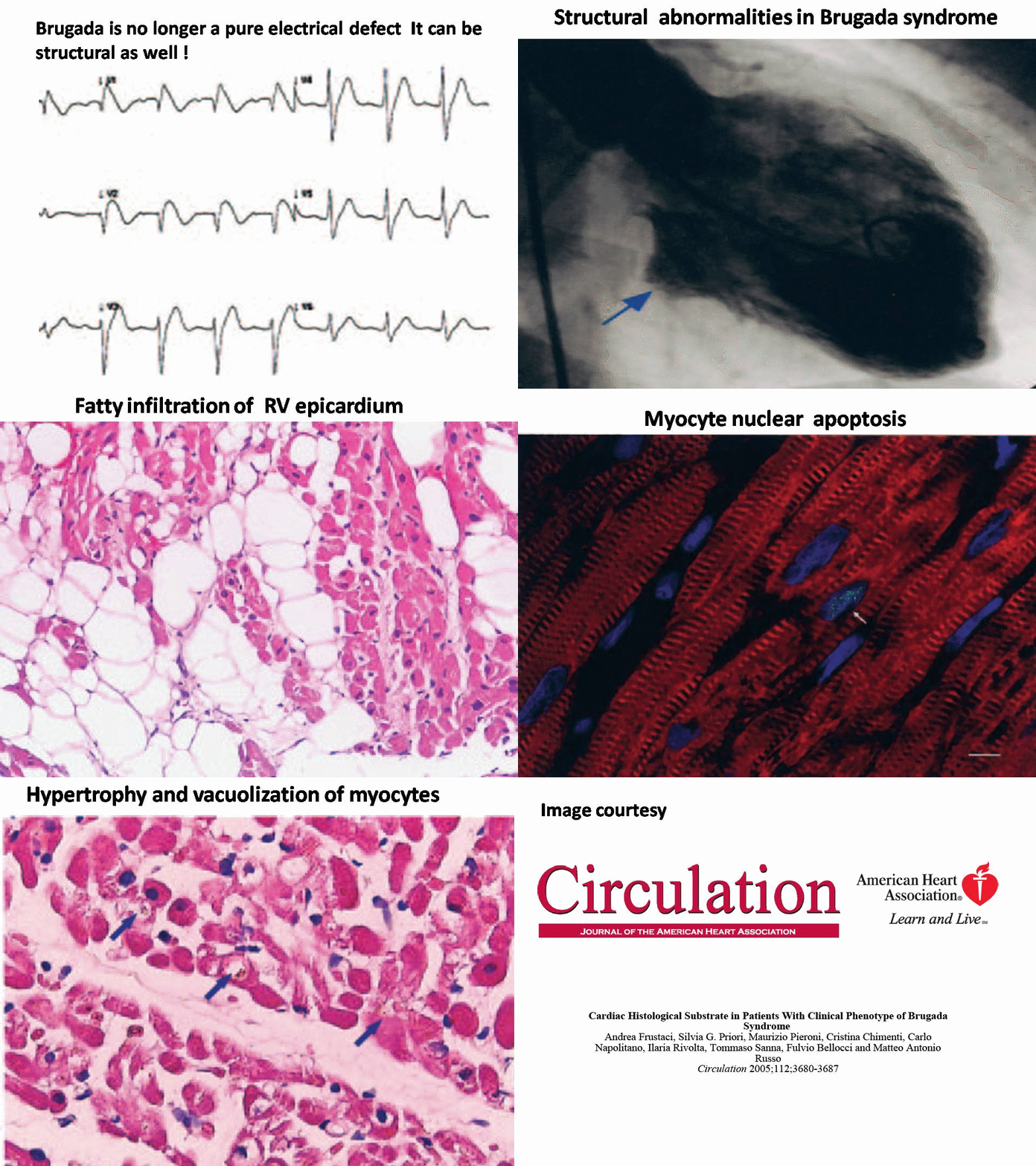
Brugada is no more an exclusive  functional disorder of  sodium channels of RV  epicardium .It can have structural defect (known & unknown ) .It may  have infective , degenerative etiology as well .

How does these structural changes appear ?

Chronic sodium channel malfunction  can result in cell membrane defects which can augment   Idio-osmole   inside  the cell and result in  apoptosis   etc .

Which comes first ,  electrical or structural abnormality ?

It is an  another  chicken- egg tale  waiting to be decoded   within the RV epicardial cells

Can wall motion defect occur in Brugada ?

Early observations done in out hospital (MMC Chennai ) has found anterior  RV free wall motion defects. Tissue Doppler studies are  being undertaken.

Final Message

The  following paper  wonderfully documents  the structural and histo-pathological  changes in RV epicardium .  This  implies ,  our belief   about this  unique electrical  disorder  is  bound to take a beating  and  we  expect a major perception makeover regarding Brugada  in the years to come .

Probably the most important paper on Brugada syndrome was published in circulation in 2005

*http://circ.ahajournals.org/cgi/content/full/112/24/3680

Read Full Post »

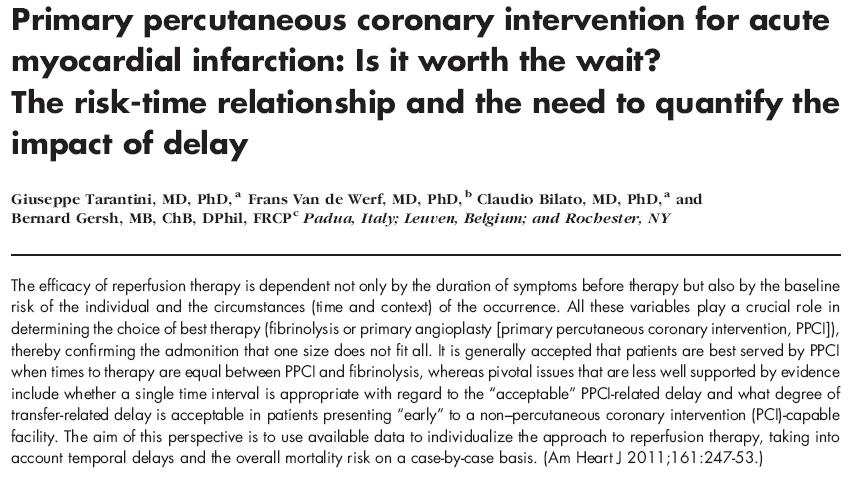
Acute STEMI is the numero uno of  all medical emergencies. Hundreds of life are lost every few hours in our planet.Significant  chunk of them  do not   even reach the hospital alive  . While the emergency crew has many vital responsibilities , the cardiologist job starts only after the patient reaches the hospital .  Hence  the ambulance  crew  need to act much more sharper. Please remember even the  skills   of the driver  will have a direct impact on the myocyte survival.

The symptom to first  medical ( or second  hospital ) contact could be as vital  as a primary PCI procedure itself . A 3 minute traffic jam can kill 3 thousand myocytes ! One could imagine the importance of  decision making process here.

Distance from  the point of contact to PCI lab , the anticipated delay ,   intensity of traffic  matters .

Is it not funny ,  to realise  when   we  have  a reperfusing agent on hand , within the ambulance and the vehicle stuck in  the traffic jam  waiting to reach a  reperfusion  room situated  50  km down the high way !

( One may wonder why can’t we thrombolyse every one  routinely  in the ambulance  and do  the PCI later in  . . . But surprisingly  this    concept  simply does  not work  !)

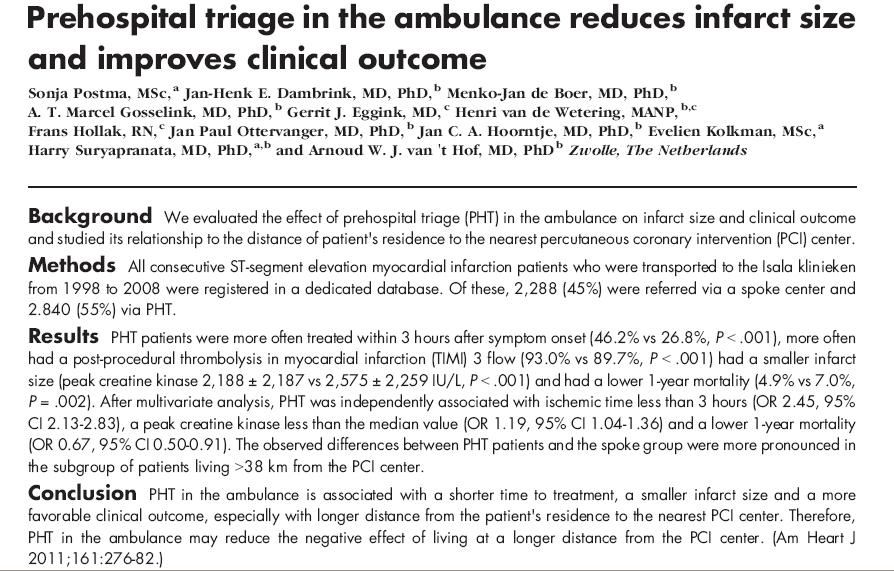
When we realise , even in  a well developed country like Netherlands ,  time to shift  to cath lab is a big issue (Read the following article )  we will never ever know , how much of myocardium  is consumed  by traffic jams  in  a  country like India  , where   the traffic   scenarios   can be  more chaotic  than a  VF  !

Events  that unfold following a STEMI  are crucial

It begins with chest pain recognition.

Call for first help Spouse/Family doctor /Neighbor

Call for 911/108 . Ambulance arrival time and boarding

Administration of  Aspirin + clopidogrel*

Meanwhile spontaneous thrombolysis will begin in most of them !

A promptly administered Aspirin and clopidogrel   a shot of heparin and a lytic agent within 30 minutes is distinctly possible and may be more  effective  at a fraction of cost.

Highway thrombolysis

Even though current studies still  . . .do not  favor primary PCI over thrombolyiss in the first hour ,  most of the cardiologist  do show some  favoritism  towards pPCI for some unknown reasons.

So by default ,  many of the   ill fated  STEMI patients    enter  an  unrealistic  hemodynamic   race  in the deadly highways and urban lanes our country !

For every minute  that goes by ,  the patient  not only loses  his  muscle but also the  golden opportunity to get salvaged by the thrombolytic agents .

Since ,  a delay  beyond  one hour eliminates the indication of thrombolysis  (if a cath lab is available in the vicinity  ) many times   traffic delays  convert a potential   hyperacute  thrombolysis  into a say . . .    3-6 hour old  PCI .(Should we feel happy about it ?)

Here , we need to know TIMI 2 flow achieved easily by thrombolytic  agents is  quiet effective in preventing myocyte death.

Fast  track   shift to PCI

Helicopter drop over cath lab -( Distant dream ?  or better to be in dreams )  It has been noticed even a helicopter was squarely beaten by the  thrombolysis  in terms of  early  and  timely  reperfusion.

Fast -Slow track PCI ?  (Like fast slow AVNRT !)

Unexpected delays on  road  , in  many countries  financial issues  /Insurance sanction etc  contribute to the time delay significantly . What starts as a fast track  protocol  peters out  into  slow race (Late primary PCI ) and may even  end  in a grinding halt.(No primary PCI )

Worse still  . . . some of these patients  are made   unsuitable  for  thrombolysis  as well !

Final message

Management of STEMI  is gradually becoming a team effort.  The emergency crew , the command , the destination hospital all need to be  alert  and proactive. When the  initial  anticipated delay  is getting prolonged , get the ground staff  in  cath lab  ready for  an  emergency landing .

A word of  advice  for  the ambulance crew .Involve them  more   in the decision making  as  they   are in a better position to calculate the  possible delay.  If delays  are anticipated  propose a thrombolytic order and get clearance from the command and administer the lytic agent as early as possible.

It is highly likely , restoration of   TIMI   2  flow  right in the middle of   national highways  is much  . . .   better than a   TIMI 3 flow  that  is going to come  later   . . .in  a distant  cath lab .

Finally use the common sense  liberally  before you  act   . . . unfortunately it has become  the most elusive  sense for man kind  !

References :

Here is a study that gives a fresh insight into this  enigmatic issue of pre-hospital thrombolysis vs primary PCI

http://www.ncbi.nlm.nih.gov/pubmed/21315205

Read Full Post »

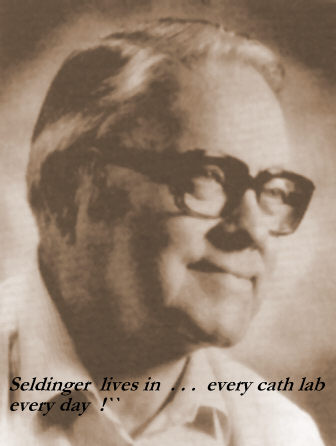
Interventional  cardiologists should revere  few  names for ever  . . .

They are

  1. Werner Forssman
  2. Masan Sones
  3. Andreas  Gruentzig
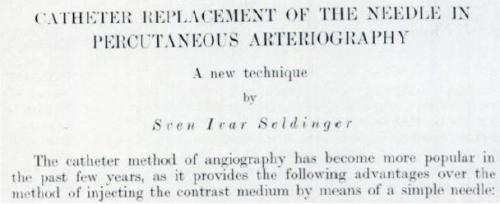
  4. Sven-Ivar   Seldinger

Sweden's Pride and cardiologist's ultimate Hero !

The  other men  in the  above  list  gave us insight  to enter the heart and do cardiac catheterization  and selective  angiograms

Ironically ,   the  man who  provided an easy access* to cardiovascular  system  from the  periphery is less often  remembered.  Still , it is because of him millions of procedure  are done every  year .

Every cardiologist should  read the life history of this great man.

*Previously all interventions are done in laborious  arterial or venous cut down

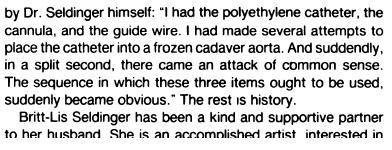
How the invention came about ?

“It is a  sudden attack of common sense”   That  is how seldinger described in his own words

Why not a Nobel prize for  Seldinger’s  sense which was so  uncommon to others  ?

If common sense has to be rewarded Nobel price ,  Seldinger’s    would probably will rank   first  among  all !

Reference

  1. http://ww.ajronline.org/cgi/reprint/142/1/8
  2. http://www.ajronline.org/cgi/reprint/142/1/8.pdf

Read Full Post »

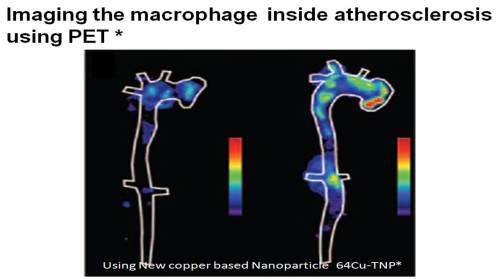
Non invasive imaging of inflamed macrophages  within athersclerosis

The medical  imaging science is  reaching new heights. With most of the  research so far within the anatomical arena we are moving into the  physiologic  and metabolic  imaging. Identifying vulnerable  plaques  within the coronary  artery is a separate field. Most of them are catheter based and invasive investigations.

We  have ben  searching for an  ideal PET scan based metabolic imaging of atherosclerosis. Macrophages are the key elements in an inflamed plaque.

Image Source : Circulation. 2008;117:379-387 .Note the Acttive Macrophages in the Aortic arch area and Coronary ostia

Can we take a photograph of these  inflamed zones   within  the  atherosclerotic plaque  ?

  • It seems we are approaching  that possibility. Every time we screen a person for CAD we can risk stratify on the basis of  percentage inflammation of their coronary artery or aorta .
  • This will complement the CT  or conventional angiogram .
  • If this technology is perfected it can be useful in the evaluation of response to medical interventions .
  • It  could also tel us  the  significance of  raised CRP /cytokines in other wise asymptomatic individuals

PET scan with newer tracers are constantly evolving . One such tracer is  based on copper molecule   64cu-TNP.

Reference

http://jnm.snmjournals.org/cgi/reprint/45/11/1898.pdf


Read Full Post »

Heart has three layers

  • Epicardium
  • Myocardium
  • Endocardium
  • Epicardium is same as visceral pericardium . If pericardial inflammation dissusely occurs ,  it is bound to injure  the epicardium and subepicardium .

    Does  the  troponins  located deep inside the  myocardium  ?

No .It  can  even be present just few microns below the visceral pericardium  . Hence  severe forms of pericarditis can elevate the troponin levels without any issues .

Is troponin  release related to ST elevation ?

 Ideally  most forms of  pericarditis can be termed as epicarditis. The mechanism of ST elvation in pericarditis is actually a sign of  epicardial injury.In fact ,  there is no easy way to  differentiate  a  slice of epicardial infarct from an   inflammatory pericarditis accurately .

Is there any form of pericarditis which invlove only parietal pericardium ?

We do not know as yet ,  about  existance of such  an entity. It is distinctly possible. However , if present it is unlikely to result in significant  ST elevation in ECG.

In pericarditis ,  troponin release is due to inflammation  or necrosis  ?

Both are possible .Even transient wall motion defects are reported in isolated pericarditis.

What is myopericarditis ?

It is  a general term used  to indicate the above situation . In practical terms Pericarditis + Troponin positivity can be termed as myopericardits. It is well known pericardits can extend to endo- myocardium but it is rare other way  around( ie endocarditis extending to pericardium )

What is pancarditis ?

It is the carditis  involving all three layers of heart ,Cassically occura in rheumatic fever. Fulminant carditis is known to raise the troponin to significant levels.

Does troponin elevation  in pericarditis  occur in all  ?

We are yet to collect adequate data about this .  Diffuse , extensive pericarditis ,gross ST elevation ,  and associated pericardial effusion  correlate with troponin.

Crazy questions in pericardiology

What is the pericardial blood supply ? Is there  an entity called ischemic pericarditis ?

Final message

Do not ever underestimate the  importance of  pericardium  whenever you encounter unexplained ST elevation in ECG.

Reference

Here is an article which has   meticulously studied this issue

Read Full Post »

For  a police officer who visits a crime site  every one looks like   a culprit. For a cardiologist  sitting in coronary  care unit  all chest pain  will have to look like  an infarct  !  Then only he is a cardiologist !

A rare , but costly mistake occasionally  happens . When a  patient with severe chest pain in the  retro sternal region with ST elevation in ECG , enters the ER  there is little  reason to suspect any condition other than STEMI !

This is how medical  errors takes place

Medicine is an art , we can not take it as granted .Acute MI can present with normal ECG and a dramatic ST elevation need not be MI

Here  was  a patient who presented with this ECG and one our fellows correctly diagnosed the condition .

Most  physicians would have thromolysed this patient or  might have wheeled into cath lab.  We have such events reported from primary  PCI registry .

Key differentiating points

  • Diffuse ST elevation not confining to a arterial territory
  • Absence of reciprocal changes
  • ST  segment with concavity upwards.
  • Echocardiogram and enzymes will be useful

iFAQs  in pericarditis

What is the mechanism of ST elevation  pericarditis ?

It is actually a zone of epicardial or Sub epicardial injury.

What will be the ECG finding if STEMI is associated with fibrinous pericarditis ?

Double dose of ST elevation .Mimics  a re infarction.

What are the dangers of thrombolysing a patient with diffuse pericarditis ?

It can bleed into pericardial  space

What happens

What will be the ECG finding in localised pericarditis ?

Read Full Post »

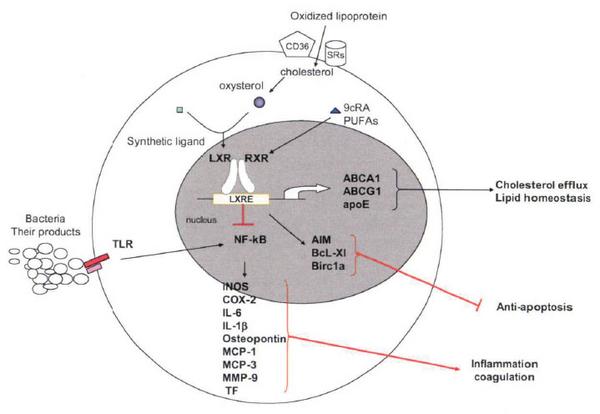
LXR are a unique group of nuclear receptor proteins located in liver as well many body tissues where lipid metabolism is active. They are first identified in liver with apparently no ligands ,  they are  hence referred to as  X (Also called orphan receptors ) .Later  these receptors can be termed as a target receptors for cholesterol metabolites like oxysterols .


How this nuclear receptors modify  the subsequent events could ultimately determine the toxic effects of cholesterol in human body.

An update in NEJM appeared in 2007

The the science of lipidology  is  confronted by  with  suspicious  ,  false targets .We are  biochemically still pitch blind  beyond a point . . . after cholesterol enters  the cell .

We have been targeting cholesterol synthesis by blocking HMGCOA.

Statins though claimed to be the God sent molecule , genuine researchers would agree statins  have a   huge  limitation  and it  is a  hyped up drug in controlling atherosclerosis. In fact ,  it is  believed  (In private ) nearly 50% of people who take statin  atherosclerosis goes  unabated.

Can we modify how  LDL  cholesterol is going to be utilised inside the cell ?

LXR family of proteins along with  RXR are expected to  break  the  barrier.In knock out mice models  LXR agonists are  able to control  and prevent LDL propagation within vascular cells .

The research is ongoing. Let us believe  the right target  has been identified . Nothing is guaranteed as of now . . . but out journey should continue .

http://en.wikipedia.org/wiki/Liver_X_receptor

http://www.nejm.org/doi/pdf/10.1056/NEJMcibr075951

Read Full Post »

ASD device closure as a modality is constantly improving  . . . but  the consensus is  , it is  yet to catch up with  of  good old surgical  outcome . The key to success is not only in the device but hugely dependent on the technique and pre-procedure evaluation  .In fact , the pre procedure TEE imaging technique  is as important as the procedure itself.

There are lots of discussion about this particular issue. TEE is mandatory we know  but now we realise it is  still better to have a  Real time 3dimensional  (RT3D ) TEE . Rim  size  and ASD  morphology estimation is  the primary aim.

There are  at least 6 named rims for ASD. For a circular  orifice  it  may not be logical to have a fixed number of  6  rims . Ideally the entire circumference must have a rim .( This happens in  central defects )In many,  the complex anatomy of IAS does not allow this. So we are compelled to fix the number of rims to six.

  1. Aortic (Superoanterior),
  2. Mitral (AV valve/ Inferoaterior)
  3. SVC  (Superoposterior),
  4. IVC  (Inferoposterior),
  5. Posterior ( Atrial free wall ).
  6. Coronary sinus rim

One can realise how important these rims are , as  they are the   foundation tissues on which the device is going to be seated for the rest of the patients life.

When do you call a rim is adequate sized ?

5mm is  considered suffice. But it varies depending upon the device and expertise.

Can we deploy an ASD device  in patients   with deficient rims?

Logically the answer is expected  is   “No” but  , many have liberalized the criteria now , after realizing   one may  not have 5mm rim in all six sites in a given patient. If you follow this criteria strictly   you can’t do more than few devices a year !

What is the resolution power of TEE can it miss a 3mm rim  ?

TEE has a good resolution it should pickup any thing equal to 2mm or more.

Which is most important rim and which is the least important rim ?


What are the potential complications that can arise if ASD device is deployed with a critically low rim ?

Having discussed  that every rim is equally vital  ,  we  need to answer this sort of questions  often .  I am waiting to get the  practical tips for the above issue from  my experienced colleagues .  I shall post it soon .

It is sometimes assumed Aortic rim may not be that important .Here is a   good discussion  for  ASD closure with deficient aortic rim from Saudi Arabia  . http://www.rmsolutions.net/rmfiles/SHA21/028002.pdf

Meanwhile let us learn . . .

How to perform the “all important” pre- procedure TEE ?

The following article which also  includes video clippings will be immensely useful for all those enthusiastic cardiologists.Thanks to JACC  for making this link free .

Three cheers to AMRITA team from India

http://imaging.onlinejacc.org/cgi/content-nw/full/2/10/1238/

A stylish article on the topic

Read Full Post »

« Newer Posts - Older Posts »