Feeds:
Posts
Comments

Acute coronary syndrome is the commonest cardiac emergency. STEMI and NSTEMI are the two clinical limbs of ACS. Generally they have distinct clinical, ECG, angiographic features.(Ofcourse, with some degree of overlap) . It is  a  mystery , both clinical presentations differ so much inspite of the common denominator  , namely ,  an injured plaque with add on thrombus  within the coronary artery. The primary difference between these two entities is, in  STEMI the occlusion occurs sudden and complete and in NSTEMI it occurs slow and incomplete

Cardiac arrhythmias in ACS

It is a  much published factoid  for  many decades, that  only one third of STEMI patients  reach the hospital alive ! The reason being , STEMI  is very much prone for primary VF.  Contrary  to this ,  most pateints with NSTEMI reach the hospital alive ! How ?

Both are ACS, if ischemia is a powerful trigger for dangerous ventricular  arrhythmia’s , NSTEMI should also behave  similarly .So what protects against arrhythmias in NSTEMI ?

  • We realise ,  by observational experience (Not EBM !)  It is the suddenness and totality of ischemia that trigger dangerous form of arrhythmia  .
  • Further, a balanced  ischemia in two contralateral segments (or global  ischemia) some how protects against development of ventricular  fibrillation .This may be due to preservation  of  electrical homogeneity  , and the spherical VT spiral waves are not sustainable.
  • In contrast , STEMI has a sudden  focal , ischemic  zone that initiates the VT and    ischemia free  contralateral segment  welcoming  and sustaining the  reentrant wavelet.
  • The observation of primarily single vessel disese in STEMI and multivessel disease in NSTEMI also give credence to this concept.
  • Further , ischemic preconditioning can exert an important anti arrhythmic  effect in NSTEMI as  patients with unstable angina have   slow, repetitive episodes of ischemia prior to the index event .
  • Post MI scar mediated VT/VF is independent of degree of overall ischemia
  • It is also established ,  a sub group of  STEMI pateints  who  had  preinfarction angina(  ie . a brief  period of UA/NSTEMI) have very low risk of SCD  supporting the concept of sensitising the myocardium against ventricular arrhythmias.

Final message

Even though , there is a convincing concept  of  Ischemia induced  cardiac arrhythmia in literature ,in real patients it is very difficult to link the two in many situations..UA/NSTEMI is the most common  acute ischemic event but the incidence of VT/VF here,  is far less than one would expect.In ACS , focal , total  ischemia is more likely to precipitate a VT/VF than multifocal and global ischemia.

Can we advice CABG for single vessel disease  ?

Yes, CABG  may be indicated  in

  • Critical , proximal , complex  LAD disease   with or without  ostium involvement.
  • Many of the bifurcation lesions with large and significant  side branch
  • Small caliber LAD with diffuse disease .

When these occur  in diabetic  subjects , the  indication for CABG is more certain .

* Present generation cardiologists  would feel  every  lesion  is  stentable and should not be referred to the surgeon .But it should be emphasized here,   technical feasibility alone  ,  does not  imply  PCI is superior and ideal in all coronary interventions.

Can we do a CABG  in  single vessel disease  with  normal  LAD ?

CABG is  very rarely  indicated   for isolated RCA or LCX disease. It should be consciously avoided in this patient population.

This is because the at risk myocardium  supplied by these vessels are far less than that of LAD. PCI  is  preferred    in these vessels .(Ofcourse , after considering medical management  ) .

CABG is  ,  too traumatic a  surgery , to  offer  in this  low  risk  coronary  lesions.

Exceptions

CABG  can still be done in following situations  for non LAD single vessel disease.

  • Left dominant circulation  with  complex lesions in LCX /OMs.
  • It is common to see diffuse , long segment  and severe disease of RCA with normal LAD /LCX system .PCI is not feasible in this subset.
  • Failed PCI
  • Recurrent instent restenosis.
  • Bail out CABG after a acute complication during PCI

One should remember ,  inability to do a PCI  does not  mean ,  the patient  should   land in surgeon’s table .We should recall , from our memory medical management is an effective and established form of treatment in single vessel disease ( Mainly for non LAD , and some cases of LAD also !)


04_16

How good is Troponin T or I  to rule out acute coronary syndrome in the emergency room  when a  patient presents  within two to three hours after the onset of symptoms ?

  1. Very useful
  2. Useful
  3. Rarely useful
  4. Not useful
  5. Not at all useful

The answer is  5 , can be 3 or  4 , never 1 or 2 !

If you are surprised with the answer

Findout why , read further

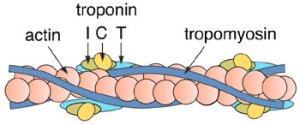
troponin-i-troponin-t1

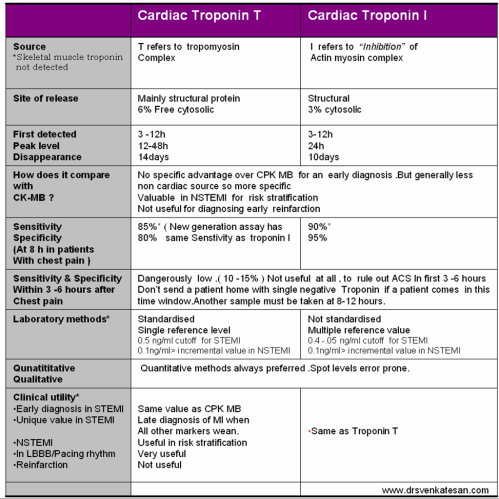
19_trop-t-sen1

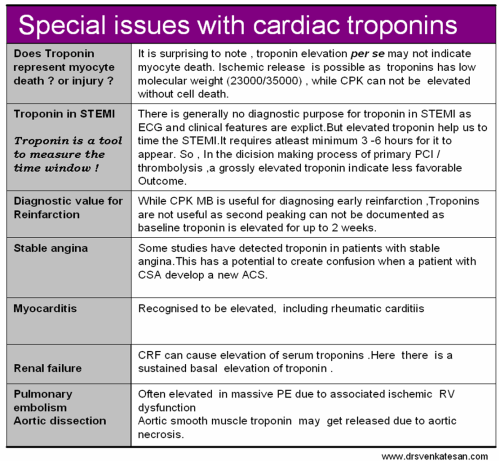
troponin-i-troponin-t-2Final message

Troponin has a definite diagnostic  and prognostic value in  STEMI or NSTEMI  but relying on a single normal troponin level very early after an ACS can be . . . futile.

Realis,   diagnosis of ACS , especially  STEMI , is primarily by ECG and clinical features . Even in NSTEMI biomarkers help primarily to risk stratify the event. Bio markers come into picture only in borderline  ECGs and in baseline ECG defect like LBBB/Pacing rhythm .

It should be recognised , the major draw back of cardiac markers is , it  does not represent real time cardiac myocyte  events. (But the good old ECG has this unique property !) .The myocyte secretion & release  kinetics , the effect of  native (and pharmocological ) reperfusion make it a unreliable  marker.Apart from the time lag  , the  laboratory methods to detect these  molecule needs further refinement.

For the current day cardiologists ,  it is  required to finish off the entire treatment  of MI  within 6  hours by doing a primary PCI . It is an irony , troponin begins to appear only by  then to be detected in the blood !

Further reading

A .All about troponin

http://www.annals.org/cgi/content/full/142/9/786

B.Troponin In aortic dissection

http://www.ncbi.nlm.nih.gov/pubmed/15887472

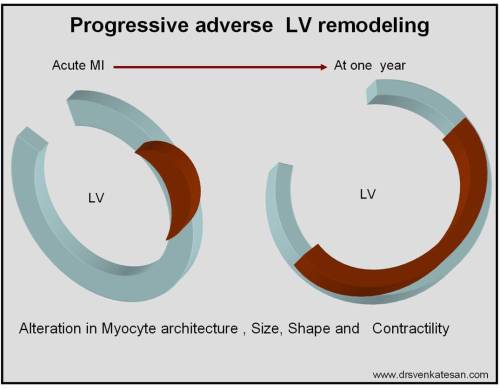
Ventricular remodeling  follows large myocardial infarction .This term denotes to  change in size , shape  and function  of the ventricle   due to altered  myocyte geometry .It is now believed  , this  process begins to occur very early  following a STEMI.(less than 24hours)

lv-remodeling

In which MI remodeling is more common ?

Any MI of large size , especially  anterior  and lateral MI.  Inferior and posterior MI are less affected by adverse remodeling.The incidence is up to 20% of all myocardial infarction ,  if left untreated. Ventricular aneurysm formation and dyskinetic segments can be termed as the worst form of remodeling. The old terminologies of infarct extension and expansion could by synonymous with ventrilar   remodeling .(Note : Every patient with STEMI undergoes some form of physiological remodeling that should not be confused with progressive pathological remodeling , we are discussing  here ! )

What is the clinical impact of remodeling ? How to prevent it ?

Progressive cardiac failure and a  poor outcome .  It may provoke ventricular arrhythmias. ACE inhibitors (CONSENSUS study 1992 )  has since revolutionized  the pharmacological  prevention of adverse remodeling.

How to recognise left ventricular remodeling ?

Many methods are available .

  • 2 D Echocardiography
  • Tissue doppler
  • LV angiogram
  • MRI

These imaging methods diagnose remodeling  only after it manifest* .We know remodeling is a cellular and molecular process .The earliest trigger for remodeling is the mechanical stretch and wall stress on the ventricles.Large areas of necrosed myocardium and  the adjacent normal myocardium sets a perfect stage for eccentric pulling of myocardial segments and unregulated slippage of myocytes.

* Diagnosing fully established  ventricular remodeling  serves ,  no great   purpose as it is very difficult to reverse it by pharmacological methods.it requires complex surgery.

What is the effect of mechanical stretch on cellular function ?

It is well known  myocyte granules secrete Type B  -Naturetic peptide  in response to stretch. It could be a very early sign of adverse remodeling. So monitoring of  BNP may give us an opportunity to intensively treat those patients who are likely to land in progressive cardiac failure.

A baseline level of NT-proBNP >120 pmol/L identified patients  prone for adverse remodeling .Serial measurements showed further increase. It is possible to identify adverse remodeling of LV by documenting fresh elevation of BNP following MI .

Reference :

1 )Nilsson JC, Groenning BA, Nielsen G, et al. Left ventricular remodeling in the first year after acute myocardial infarction and the predictive value of N-terminal pro brain natriuretic peptide. Am Heart J 2002;143:696-702.

2)http://content.nejm.org/cgi/content/full/352/7/666#R24

pci-ptca-ebm-stent

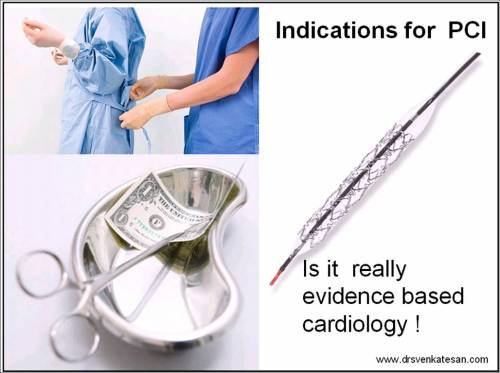
Scientifically ,  the  indication for coronary revascularisation   should be  based on following

  1. Patient’s  symptom ( more specifically angina , dyspnea is less important !)
  2. Prov0kable  ischemia  ( A significantly positive stress test )
  3. Signifcant LV dysfunction with  documented  viable myocardium &  residual ischemia
  4. A revascularisation eligible coronary anatomy * TVD/Left main/Proximal LAD etc ( *Either 1, 2 or 3 should be  present  in addition )
  5. All emergency PCI during STEMI /High risk NSTEMI

Practically ,

A CAD  patient  may fulfill  “Any of the above 5 or  “None of the above 5” ,  but ,  if   a coronary obstruction  was  revealed  by coronary angiogram  and if he  fulfils The 6th criteria , he becomes  eligible for  revascualrisation

6th criteria

If the patient has  enough monetary   resources (by self  ) or by  an  insurance company  to take care of PCI /CABG *

*The sixth  criteria overrides all other criteria in many of the cath labs .Of course , there are few genuine ones still  fighting hard , to keep the commerce out ,  from contaminating cardiology !

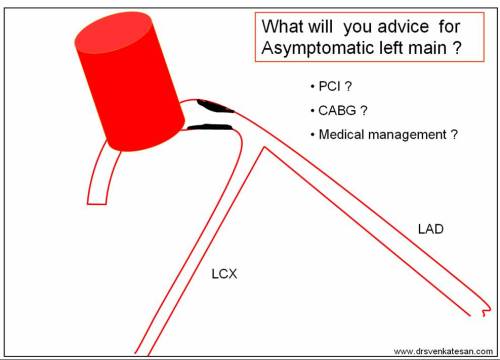
Left main disease is the  most dangerous subset of CAD population .The danger is attributable more on the perceived fear  of  sudden occlusion .How often this occurs in stable , left main plaques is not known.

There is a significant group of patients with isolated ,  asymptomatic ,  non flow limiting , leftmain  disease with stable , smooth plaques. The ideal management for this group of CAD is not clear.

left-main-d

Advising a  CABG /PCI  is  an easy and very practical  decision ! That’s what the current guideline also suggest

But is there scientific evidence  to do that ? Many times practical approach  could be    synonymous with  an  unscientific approach.

  • PCI has a potential to  convert  a stable plaque into  a vulnerable one (Metalled plaque is not inert )
  • CABG will reduce the flow across , the  already narrowed left main and  there is  a likely hood of rapid  progression of native left main disease

So what is left  ?

If it is a stable plaque ,  and does not limit the flow both at rest on exercise * medical management will be optimal.

* Excercise stress test must be done

Read this article from the circulation ,  that suggests  a role for medical management for left main disease

http://circ.ahajournals.org/cgi/content/full/118/4/422

left-main-circualtion1

Heparin was invented accidentally by a 26 year old  , Jay McLean, a  pre clinical  medical student  in 1916 .It was one of the greatest discovery  in  medicine .It helped us prevent blood from clotting.Frozen blood inside human circulatory system constituted one of important mechanisms  of  human  death.This ranged from acute myocardial infarction to cerebral thrombosis  .

heparin3

As we decoded the mechanism of action of heparin , it was clear it bound to the  naturally occurring molecule antithrombin 3 and effectively blocks the intrinsic coagulation mechanism and thus behaves as an important anticoagulation agent.

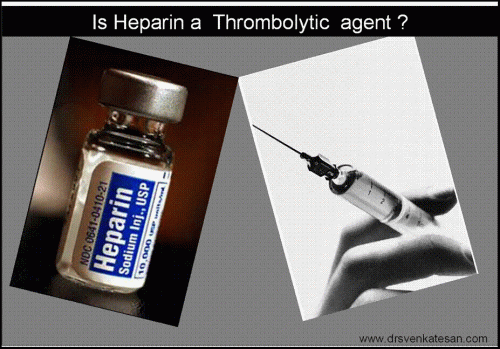
How heparin acts as a thrombolytic agent ?

We know , our hematological system has a powerful  natural  fibrinolytic mechanisms  to protect against unwarranted( pathological ) intravascular coagulation. This is mediated by  anti thrombin, protein C , protein S  ,  plasminogen  system etc  . Natural concentrations of tissue plasminogen activator (Tpa)  also  help in lysing intravascular clots.

There is a constant  , delicate balance between procoagulant , anticoagulant and antifibrinolytic molecules .Intra vascular  clots occur when a vascular  injury triggers  a clot formation and the clinical event occurs.

But,   once insulted ,   the  circulating blood   does not remain a silent spectator . It is  constantly  on the look out for a foe to attack the thrombus that is interfering  with its natural flow  . Antithrombin 3 is one such molecule. Success  of lysis depends on the power of natural forces. There are hundreds of episodes of microlysis that take place every day  (Which happen without our knowledge ) .In  patients with vascular  disease these episodes are likely to be further more.

What does  Intravenous heparin in high doses  do ?

Heparin immediately  blocks of powerful procaogualtion activity .One of the important heamatological principle  is “Thrombus begets thrombus “. It is  a vicious cycle. This is immediately  tackled by heparin .The powerful trigger of thrombus induced thrombus propogation is shut off .

This makes a  2 cm sized clot to remain  in  2cm . After  making sure of this , the blood in the immediate vicinity   start percolating the clot.  The heparinised blood   switches to  a pro- fibrinolytic mode as the balance of forces  is fully tilted in favor of fibrinolysis or thrombolysis.

Is there clinical evidence to call heparin as thrombolytic agent ?

Yes . Contrary to the popular scientific  principle we have only clinical evidence  . laboratory evidence is not convincing as heaprin lyses clot only in vivo . Since ,  evidnece based medicine requires  laboratory evidence  we hesitate to call this as  thrombolytic agent !

It has been a strong clinical observation ,   many  major intracardiac or  intravascular  clots  regress in size

(or totally dissolve )  with intensive heparin  regimen .The effect is seen in 48-72 hours.Some times in first 24 hours.

What are the clinical situations where heparin has successfully lysed the clots*?

  • Pulmonary embolism
  • LV clot
  • LA clot
  • Cortical venous thrombus
  • Deep vein thrombosis
  • Coronary thrombosis**
  • Portal vien thrombois
  • Renal vein thrombois

* Plenty of case reports available for each condition

** Sustained micro  thrombolysis  is the major mechanism of benefit in NSTEMI

If it is true ,  heparin dissolves thrombus , why  it is not called as thrombolytic agent ?

Why not ?  You decide yourself !

How does heparin compares with  the great thrombolytic agents*  like  Strepotiknase, Urokinase,Altepase, Retepalse , Teneckteplase (TNK TPA) ?

Many (Rather most . . .)  would consider it ,  as  foolish , to compare heparin with these agents .But the fact of the matter is except for streptokinase there is no comparison studies available. Attempting such a study  in humans will  be considered unethical. Without   a proper scientific  data  heparin  can not be ignored either.

But ,  some of the control groups in major  studies of thrombolysis  through some light !

In pulmonary embolism thrombolytic agents and heparin have similar effects on intrapulmonary thrombus

An important point to remember here is   , the powerful thrombolyic agents are administered  in as short duration (Bolus / 1  hour infusion ) .This is invariably  followed by heparin infusion . Why do we  do that ? because we know it is important . One may never know , how much of lysis is done  by the trhombolytic agent and how much by heparin .

if you analyse the  data  success rate of thrombolytic agents are infact attributable  to the follow up heparin

Thrombolytic agents  piggy packs on heparin and claims the  credit for thrombolysis *

In thrombolytic  therapy  , heparin  is considered  as an adjunct to streptokinsae but in reality  streptokinase  may an  adjunct to heparin

Importance of  heparin In Acute MI (HEAP Trial)

It should be realized  there is a time window for heparin too . . .  early administration  can have  great benefit

Early heparin prevents formation of  core  of the clot .The   importance of acute administration of  aspirin  in suspected STEMI  is well recognized  by paramedics  .  A bolus of heparin (10000 u)  immediately  could have great impact on the outcome as well  .Paradoxically we talk more  about emergency PCI,  on  transit TPA  etc . . . We have seen  number of patients  referred  with  STEMI   from   suburban areas traveling for hours with out any anticoagulants but promptly getting sorbitarate tablets ! Unfortunately prehospital heparin is rarely stressed in literature .

Watch the video : Heparin : The forgotten hero

Final message

  • Heparin is   an  under rated drug  as a thrombolytic agent.
  • Just because it has no direct action  on thrombus it is considered an inferior agent.( One other reason  for it to be  considered  inferior ,   it  is  very cheap  !)
  • Heparin too ,  has a time window effect in acute MI (Class 3 evidence ie   wide clinical experience)
  • It’s  usage should be early  and  liberal , especially  in out of hospital setting in vascular  emergency.
    Note of caution : This article is not meant  to  defame  the thrombolytic agents.It only stresses a point that , heparin has also a role , as a thrombolytic agent. *Whenever rapid thrombolysis is required in life threatening situations specific thrombolysis is indicated as per guidelines.

The importance of venous system

Cardiovascular system  consists  not only of  heart  but also   the blood delivery and retrieval   system namely  the arterial and venous circulation .As  the heart pumps , 6  liters   of blood  every minute  , it  has to   traverse the  entire venous circulation promptly ,  to  complete  the hemodynamic circuit.
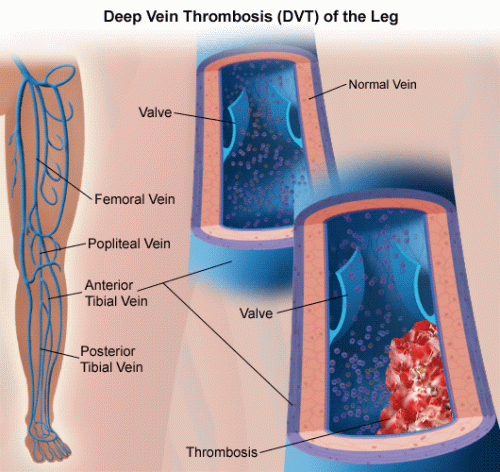
ei_2401

Source : From web. Thanks to whoever created this Image

While  physicians are preoccupied with disease  of heart there is an important  groups of disorder of venous system .The  deep vein thrombosis  (Also called venous thrombo embolism . VTE ) is the  most important  entity .This disorder even though is a cardiovascular  disease  ,  it   rarely presents to a cardiologist .

As  we tended  to ignore the  veins   for decades  now, “sudden venous deaths ” other wise called massive pulmonary embolism  is calling for our attention

What are the deep veins ?

Popleteal , femoral , iliac (External , Internal , common ) . Upper limb axillary and subclavian veins.

Clinical classification of DVT  :  Femoro popleteal  , Pelvic  ( Ilio femoral) , Mesentric DVT.

What are the high risk population for development  DVT ?

  • Genetic predisposition  constitute  the  strongest risk(Factor V lieden mutation )
  • Major orthopedic surgery
  • Pregnancy /Oral contraception
  • Disseminated  malignancy

And now  ,  the more fashionable risk factor “DVT after long distance flights”

What is key diagnostic issues in DVT ?

Key to diagnosis is clinical alertness .Local swelling  , edema legs and inflammation should alert the physician.

  • Homan’s sign(Pain on  dorsiflextion of  ankle) .
  • Louvel’s sign (Leg pain on coughing ),
  • Lowerberg’s sign  (BP cuff induced pain on affected leg at low level inflation  )

( Well’s score  is based on pre test propabilityLancet 1997 )

Many times DVT is diagnosed only after it embolises into lung.So remember shortness of breath and acute dyspnea  could be the first manifestation of DVT.

Once diagnosed  DVT  it should be  risk stratified either as low risk or high risk .

Biochemical diagnosis of DVT : DVT is a form of intra vascular coagulation and it activates fibrinolysis.D Dimer estimation has strong negative predictive value .If D dimer is negative it excludes DVT by 99% .Positive D dimer does not confirm it .

Is  it  necessary  t0 image  the venous clots ?

No . It is rarely required.  Instead we need to know the site of occlusion .Doppler and ultrasound scan can help locate the site of obstruction .

Other modalities *  may help evaluate the thrombus

Venous angiography (Filling defect, collateral )

MR angiogram

Fibrinogen tagged nuclear scan

Management

  • Acute management
  • Long term management .

Acute management

Immediate Heparin ,  bolus followed by infusion ( 5000U, 1000U/h) followed by oral anticoagulation forms the corner stone of  management of DVT .

Once a DVT is documented should we attempt  to  improve the venous circulation or try to slow down  the venous circulation ?

There is a paradox here.The therapeutic strategy is to improve the venous circulation . A sluggish venous circulation predisposes fresh thrombus. So even though ,  it is  logical to expect some  migration of  thrombus  proximally  with the standard  therapeutic methods of DVT  ,  it is the ultimate principle of management of DVT.

How heparin infusion achieves  it’s  therapeutic goal  of clearing  thrombus burden in the venous circulation is not clear .It is believed sub clinical PE  occurs in every case with large DVT and these thrombi get   microlysed either  within focus of  DVT or in transit circulation  or within the pulmonary vascular  bed.

What is effect of intensive anti coagulation on DVT ?

  • Lyses the thrombus
  • Dissolves the thrombus
  • Dislodges thrombus
  • It can prevent only fresh thrombus

Answer : All of the above can occur

Can we track the movement of deep vein thrombus ?

It is not an easy thing to track the movement. Doppler will give an idea. Invasive investigation to track the thrombus is neither practical nor necessary.

What is aggressive management * for DVT ?

* Aggression is rarely required in DVT management.

Interventional

  • Thrombolysis : Systemic/local catheter based
  • Venous angioplasty/Stenting
  • IVC filters

Surgical

Indication for thrombolytic therapy

Surprisingly,   thrombolytic therapy has limited role in the  management of  DVT. There  is absolutely no role for routine thrombolysis in DVT (Heparin does the same job , more consistently with less risk )

It is used only when there is limb threatening or lung threatening situation .

Pulmonary embolism already occured

Massive iliofemoral thrombosis .

When will you call a vascular  surgeon ?

Thromboembolectomy as a treatment for DVT is rarely advocated .

The 2004 American College of Chest Physicians consensus statement on the treatment of thromboembolic disease recommended against the routine use of venous thrombectomy in acute DVT except in cases of phlegmasia cerulea dolens . ( Severe necrotising venous edema )

The issues against surgery are

  • Generally these patients are more sick and co morbid conditions
  • Complex nature of surgery in deep iliac veins
  • Blood loss  from deep friable veins
  • The surgery further traumatizes the vein, recurrence  of DVT is  very much possible
  • Primary cause is not addressed by surgery

What are the indications for IVC filter ? What  are the types of filter available ?

The indication for IVC filter in the acute management of DVT * has been ( Rather continues to be  . . .) controversial .The major reason for the controversy is the risk  ( The wasted effort  too !)   to benefit ratio and  is not clear.
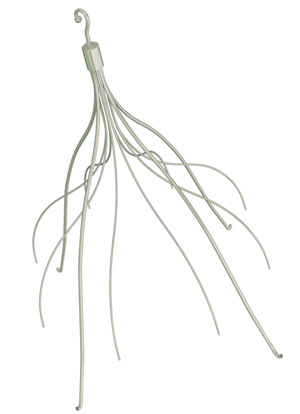
gunther-tulip-ivc-filter

There are three types of IVC filter available

  1. Temporary venous filters
  2. Temporary retrieval IV filters ( Gunther tulip ) Nitinol recovery filter Bard
  3. Permanent IVC filters

*In long term prevention of PE the indications are fairly established.

Differential diagnosis

Is there an entity  called  superficial venous Thrombosis (SVT)

Superficial venous thrombosis and thrombophlebitis are more common than DVT and should not be confused with DVT. ( Easier said, some confusion is bound to occur !especially ,  when it occurs  over  thighs ) .This is common  following IV line  and  varicose veins in lower limb Present with pain, tenderness, or an indurated cord along a palpable  superficial vein  with erythema. It is less likely to propagate into pulmonary circulation.

How often a superficial venous thrombosis convert into deep vein thrombosis ?

Patients with superficial phlebitis above the knee have an increased risk of deep venous thrombosis and should probably have ultrasonography.They may require  warm compression , NSAIDS and  local thrombectomy.

What is the post-thrombotic syndrome? How to differentiate it from recurrent  DVT ?

Post-thrombotic syndrome is  due to the damage  to the  valves in the veins  that leads to chronic venous edema of extremities. It may mimic like an DVT . usually occur within 2 years of DVT.

Unanswered questions

1. What will happen to  the thrombus following filter insertion ?

Large thrombus gets trapped in IVC .The problem gets shifted form the legs to the vena cava .This makes it mandatory  for these  IVC  clots  to be cleared either manually or  pharmacologically. Small thrombus and embolic showers continue to cross the filter without  difficulty.

2. IVC filters are recommended in DVT , if a patient has an absolute contraindication to heparin but , is it not a fact ,  filters also demand  anticoagualtion ?

It is true , filters demand anticoagulation. So ,  oral anticoagualtion should be given whenever possible in all  even after IVC filter. This is  , not only to make sure filter does not get clogged but also prevent further  clot formation in the legs and also   distal to the filter in   (Procoagualnt )  individuals .Further , anticoagulation forms the mainstay treatment in patients with chronic thromboembolic PAH ,  which the filter does not address to.

3. Is there safe venous clots that the pulmonary circulation can effectively tackle ?

Typically PE occurs  as

  • Massive acute PE
  • Sub acute PE
  • Chronic pulmonary thrombo embolism (Showers of microemboli lead to PAH )

Consider the following pulmonary  vascular anatomy : MPA 2.5cm ,  RPA,  LPA 1cm segmental pulmonary artery 5 mm ,  pulmonary arteriole 3  mm ,  pulmonary capillaries 200 microns . The  deep venous thrombus typically has  a diameter of  up to 1-1.5 cm . It needs a at least  2. 5 cm   diameter  clot to occlude the main pulmonary artery.Micro thrombus may get cleared by pulmonary vascular bed.There can be safe venous clots.

Final message

  • DVT and PE are the common venous emergencies.
  • Prevention of PE is the major aim of acute managment.
  • Identifying the underlying cause and prevention of DVT per se is the long term aim.
  • Aggressive local approach is largely  unnecessary except in leg / lung  /life  saving situations

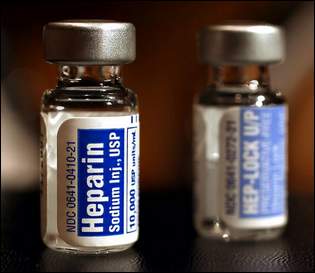
Intensive Heparin protocol  followed by long term oral anticoagualnats (1 year or more)  is  an excellent approach in most patients.
heparin

The most important point to remember is the treatment for high risk DVT and suspected  or established PE is exactly same

*Only 10% of PE  are candidates for thrombolytic or surgical  therapy so at times of real dilemma , there is nothing wrong in administering  heparin in all patients with suspected  high risk  DVT/PE  even without confirmation.

All those hi fi stuff of V/Q scan , pulmonary angiography may be a misadventure .Remember empirical (Some call it as unscientiifc ! )  therapy  too , can save many lifes

Further reading

Best Link for  IVC filters   http://www.tigc.org/eguidelines/VenaCava.htm

References

  1. Decousus H, Leizorovicz A, Parent F, et al. A clinical trial of vena caval filters in the prevention of pulmonary embolism in patients with proximal deep-vein thrombosis. N Engl J Med 1998;338:409-415.

What is new in catheter thrombolysis in DVT ?
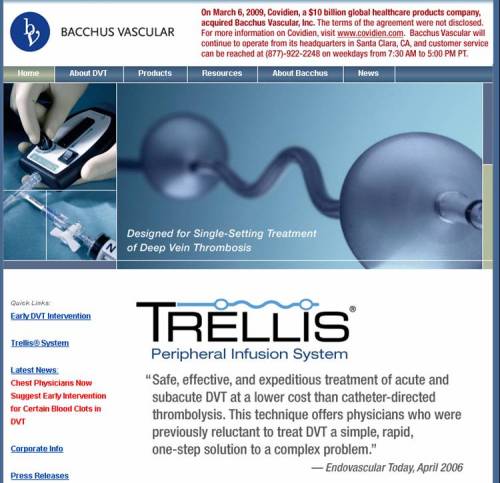
dvt thrombolysis

http://www.bacchus-vascular.com

A interventional catheter based clot lysis for  DVT

For the comprehensive  ACCP 2008 guidelines of managing DVT  reach the following site
Sick sinus syndrome  or sinus node dysfunction (SSS, SND ) is one of the common cause of  symptomatic bradycardia .The other cause for  pathological bradycardia is complete heart block.Together , these two entities share 99% of indications for permanentpacemaker implantation.

The sinus node can get affected in various diseases . The commonest cause for SND is age related.This is manifested  as inappropriate bradycardia .The  other common presentation of  SND is exaggerated bradycardia to betablockers and calcium blockers.In fact , some consider drug  induced bradycardia  is  nothing but  , unmasking of underlying SND.Pathological states that result in SND include  hypothyrodism , infiltrative   and inflammatory diseases . (Surprisingly ,  ischemic  SND  is a lesser  clinical problem when considering  the  rampant CAD in our population )

What is  is a fundamental difference between SND and complete  heart block* ?

Sinus node is the proximal most pacemaker of the heart. When it fails the chances of  a  subsidiary pacemaker coming to the rescue is far greater than  a complete AV block. Further the quality and stability of the escape pacemaker is better in SND. In fact , in pure SND  ( With out AV nodal disease)  a sinus arrest is rarely fatal as escape rhythm  occur without fail.

* It should be emphasised  ,  there can be associated AV nodal disease in  significant (10%)  number of patients with SND .This may be present either at the  time of diagnosis or it can develop later in the course .This has important implication in the selection of   pacemaker .The discussion here is confined to isolated SND .

How common is ventricular escape rhythm in SND ?

It is very rare. the ventricle never gets a chance to come to the rescue as invariably junctional pacemaker takes over at times of extreme sinus pause/arrest.For the same reason , pause dependent VT (Brady dependent ) is also less common in SND .

What is  stokes Adam’s attack ? How  common it is  seen in SND  ?

It is the cardiogenic  syncope due  to extreme bradycardia. This classically occurs in complete heart block , when

the the escape rhythm becomes either very slow or temporarily goes for sleep .This results in a huge  pause (unlike sinus pause  of   , the pause  here is  ventricular pause  , this is  actually an  asystole  )  it  can  immediately trigger an VT or VF .

If  SND is not life threatening why pace maker is indicated in them ?

The pacemaker is primarily indicated for prevention of dizziness , near syncope or syncope.So primary impact is on improving quality of life  , not reduction in mortality. While in CHB  pacemakers improve  symptoms and survival.

Which form of SND can be dangerous ?

When SND is associated with rapid atrial fibrillation  some times it can trigger a VT/VT if ,  these patients also have

a fast accessory pathway with short refractory period. (<250msec)

Final message

If you have only one pacemaker at your disposal , but there are  two patients ,  one with SND and other with CHB please put the pacemaker to  the patient with CHB , even if the later has insurance coverage and the former is not .You are justified in  diverting  the pacemaker !

LV dysfunction , perhaps  is  the most common  medical term used by  physicians  world over.But surprisingly , It is not easy to infer what they mean by it ! The term literally means left ventricle is not functioning all right .

LV dysfunction can be classified by many  ways.

  • Symptomatic vs Asymptomatic
  • Global vs  Regional
  • Reversible vs Permanent
  • Systolic vs  Diastolic
  • Ischemic vs Nonischemic
  • Primary vs  Secondary ( Muscle vs valve  etc)

If you analyse the above classification LV dysfunction can mean different things to different people , at different times.Though systolic dysfunction ,  as reflected by low EF % ( Less than 50% ) is the major cause of LV dysfunction  the issue is not simple.

Is coronary artery disease ( CAD  ) a must for LV to  become dysfunctional ?

No , not at all .CAD  is the leading cause of LV dysfunction .Primary muscle disorders -cardiomyopathy is an equally common entity. Valve disorders especially  aortic valve stenosis is   another common cause for LV dysfunction. Further ,  systemic hypertension, diabetes mellites, renal failure, can result in serious impairment of LV function .Some drugs ( Adriamycin ) can either precipitate or aggravate LV dysfunction.

If  physicians themselves are confronted with such complexity , how are ,  our other medical  colleagues  (Forget about the patients !   ) will understand  the concept of LV dysfunction.

But , the  crux of the matter is every doctor believes  LV dysfunction is synonymous with low ejection fraction. A surgeon or an anesthetist is quiet happy to operate  if the ejection fraction is above 60% .

Can a patient  have significant LV dysfunction with normal Ejection fraction ? (EF )

Yes , this can occur in advanced degrees of diastolic dysfunction, where cardiac contractility is normal but

fails to relax adequately .

Is diastolic dysfunction less dangerous than systolic dysfunction?

May be , that is the dominant opinion   , but  there are sufficient evidence  emerging  that opinion is wrong.The main reason for diastolic dysfunction  to send a ” not so sinister signal ” is over diagnosis of  grade 1 diastolic dysfunction in the general population  . The echocardiologists considered it fashionable for a quiet a longtime (Many have changed since then !)  to report all patients  with reversed E :A ratio in the mitral inflow doppler profile as diastolic dysfunction. This has resulted in  thousands  of  asymptomatic , healthy people getting  labelled  as grade 1 diastolic dysfunction  undermining the importance of this entity.

The fact of the matter is true diastolic dysfunction is indeed dangerous , if not more dangerous than systolic dysfunction  for the simple reason ,  there is  no specific treatment for this condition

To improve the specificity to diagnose genuine LV diastolic dysfunction it is suggested to remove grade 1 diastolic dysfunction from the literature .

Other causes of LV dysfunction with normal EF

  • Some times , there can be wall motion defects  and   mitral regurgitation but still the EF can be normal .
  • Mitral valve dysfunction can be a part of LV dysfunction .The EF is either  not affected as ischemic damage  might be confined to papillary muscle.
  • Vigorous compensation from non ischemic areas  can normalise an EF

What is the difference between LV dysfunction and  LV failure ?

Many times  both these terms are perceived  to convey the same meaning .But it  can  never be used synonymously .Cardiac failure is a clinical entity while LV dysfunction  is  a  derived  technical parameter  by and large an echocardiographic enity. Cardiac failure   is defined classically as a clinical syndrome .(elevated jvp, edema * S 3 rales etc)  Neuroueohormonal activation  can occur with both.

A patient with   LV dysfunction    when destabilsed  develops   LV  failure and after stabilisation of   LV failure he is brought  back to  the baseline  LV dysfunction

*What is the link between LV dysfunction and RV dysfunction ?

RV can not be silent companion when the LV fails  . There always have been link between the two.

LV dysfucntion begets RV dysfunction   and LV failure can trigger a total heart failure

Apart from the classical concept of ventricular interdependence  ,  where  inter ventricular  septum plays a pivotal role , now there is strong evidence  to  prove  both LV and RV myocardial muscle  bundles are interwoven . In fact failing LV drags the muscle bundles over RV also (Friendly pull , let us die together !)  and this is classically seen in idiopathic dilated cardiomyopathy where all four chambers of the heart dilate. There is also biochemical  evidence the RV myocytes deplete thier norepinephrine stores  in LV failure.

Is there an entity called transient  or temporary LV dysfunction ?

The classical chronic reversible LV dysfunction also called hibernating myocardium is a different topic shall be discussed later.

Can acute ischemia cause LV dysfunction  ?

Yes .This can occur during ischemic stunning of myocardium during NSTEMI .This can result in acute pulmonary edema* at times.This can be termed as ischemic LV dysfunction  as there is no myocardial necrosis .

* The pulmoanry edema mentioned here is the  flash pulmonary edema carries very dis prognosis.

What is the cause of LV dysfunction in critical aortic stenosis ?

Is it fibrotic ?

Is it necrotic ?

Is it ischemic ? (Associated CAD )

Or is  it simply  a mechanical inability* to contract  as the outflow is closed ?

There is no specific answer . All the above factors may contribute .*But the fact that  most patients recover full normal LV function  following aortic valve replacement would make the last explanation more likely.

What does the term LV  dysfunction mean to a  cardiac surgeon when he plans  for  a CABG ?

LV dysfunction becomes an important determinant of overall  outcome   in  patients who  are  going  to receive a CABG .The surgeon will have contingent strategies  during peroperative and post operative phase while operating  in hearts with severe LV dysfunction.

How much  of LV function  is going to recover after CABG  ?

This  can not be predicted accurately but CABG  may not  resucitate all dying myocytes and bring life in them .The buttressing effect of blood within the dysfunctional segement can improve contractility and  reduce the wall motion defect(This is an indirect mechanism of improving EF )