Feeds:
Posts
Comments

Posts Tagged ‘acs’

NSTEMI constitutes an important sub group of ACS. In fact it  forms the major  group. Real world data would indicate it   UA/NSTEMI could form up to 75% of all admissions for ACS in any cardiac emergency units. Risk stratification of NSTEMI is important and  is available. It is  one primarily with clinical features , ECG and troponin positivity. Classifying NSTEMI   with reference to underlying patho anatomy is not available.

Classifying  NSTEMI based on the following is  is suggested .

A.Based on the  extent  of infarct.( For example there is no entity called extensive NSTEMI  unlike STEMI)

B.Based on the Location of NSTEMI .

Currently , NSTEMI simply means there is an infarct some where in the heart ? Should we not localise it ? Is it not surprising , we have not attempted to localise  NSTEMI  so far ?

C.Based on the coronary anatomy : RCA NSTEMI vs LAD vs LCX NSTEMI.

The reason is two fold.

1.NSTEMI is often patchy , subendocardial . Some times  only islands of infarct can occur.But , .How common is segmental NSTEMI ? May not be common, still if wall motion defect occur it must be an segmental MI.Some estimate wall motion defect in NSTEMI is around 25%.

2.Is  there any clinical purpose for localising NSTEMI ?

Some would  think there is no real  purpose. That does not  mean ,  we should not attempt to do it. In fact there is an  important reason ,  we  need to  localise  NSTEMI. Triple vessel disease ,  is the common pathology underlying NSTEMI. They often have  multiple critical lesions as well. Identifying the  the  culprit lesion is not an easy task. If we know the site of infarct ,  however small it may be , it  helps us fix  the coronary artery.

A real dilemma could occur in patients  with NSTEMI , who has a  90 % lesion  in  RCA and  50 % proximal LAD lesion  . We ( tend to !)  take it as granted  ,  RCA  lesion is likely to be responsible for the NSTEMI. But  the real culprit  could be  the  recannalised LAD .  If it is so ,   the 50%  LAD lesion  could   be  more important and if you leave it free there is a strong  likely hood of recurrent UA. If we could some how located  the NSTEMI in the LAD region in this patient  , he could  get a PCI for LAD as well.

Of course , there is  an   universal approach available “Doing PCI for all suspected culprit lesion however mild it may be ”  . Unfortunately , it  increases the metal load for the  patient, which is an independent risk factor for a future ACS.

How to locate NSTEMI ?

So , it is often helpful to locate NSTEMI  . Of course ,  it needs little more efforts. A very meticulous echoc cardiography can aid in locating  the subtle  wall motion defects in NSTEMI . Perfusion studies/PET studies may be indicated in occasional patients.Myocardial contrast echo can be useful.

Coming soon

Difference between Anterior NSTEMI and inferior NSTEMEI
Read Full Post »

When  a doctor is confronted by serious  doubt  ,  what will be the outcome for the patient  ?

Can  doubting  be beneficial for a patient ?  . It seems so ,  according to  EBM which  stresses   about statistical outcome at every turn of events in a  patient who  is critically  ill .

Is  something ,  always  better than  nothing   ?   Our  limbic  system tends to think so .  It  may not be true. But  in  dire situations ,   many  things  (Proven , unproven)  need to  be tried  however doubtful it ‘s  efficacy  may be  .This is  akin to an  emergency in an  airplane. Even here there need to be a logic.

Then ,this question  arises . How do we make  sure ,  we have a  dire situation on hand  ?

This is the key issue ,  in  the  decision making  for the   critically ill patients .  It  needs  experience ,  only experience !  Though the principle of uncertainty  is the fundamental rule in medicine ,   EBM  aims to bring some degree of certainty in medical therapeutics.

ebm evidence pci coronary

Benefits of doubting in coronary care unit.

In  a  sinking patient  with cardiogenic  shock  , try  the maximum treatment . Even if , the patient is  in severe shock  , take him to the  cath lab ,  try  open the coronary artery . Give the benefit of doubt  to him even though the chances of reviving him is less than 10%.

Risk of doubting in Coronary care unit.

A.Elderly STEMI  with SHT,(Arriving late ,  with  an unknown time  window  after an MI ) To thrombolyse or not ?  . There is  no benefit of doubt here.  Do not thrombolyse. Here , apply  the benefit of doubt against thrombolysis .

B. Chest pain with  LBBB (Thought to be new onset LBBB ) don’t ever rush to thrombolyse.  Wait for the enzyme result . Don’t try to thrombolyse your doubt , instead  thrombolyse the  confirmed thrombus !

C. Patient with persistent ST elevation following thrombolysis ,in an  otherwise asymptomatic and stable patient. Don’t  pass on  ” your doubt ” of salvaging   at least  some myocardium  by rescue PCI .Rescue  should be done before death. You can not resuscitate  dead myocytes.

Final message

The concept of   giving  the  benefits of doubt  to the patient   is a widely prevalent practice  in medicine .This concept is alive  and popular , not because it has proved effective, but because of the primitive   human perception and cognition  , namely “Something is better than nothing ” !

Common sense and logic would suggest , whenever  there is  a benefit  for doubting there would be a  equal (  or  even  more ) unmeasured  hazards and risks . This  becomes  especially  true ,  when   a   physician makes  a therapeutic move  based on doubting than on conviction .

Read Full Post »

Primary PCI  has proven to be the   best  option for management of STEMI . But it need to be  done very early by a an experienced team in a good facility . (Note ,  it is not the individual expertise that matters !  Ronalodo alone can never guarantee a   match win  !  )

Any treatment ,  which has a great therapeutic potential also  carries a hazard .

So , these treatment must be used with caution.  Not every STEMI patient , has a high risk of death.  In fact the mortality  in some of the subsets of STEMI ,  can be less than 1%. If , a  STEMI patient with a likely 1% mortality   is going to get a procedure with  3-4% ,  risk it is bound to raise a  validity  question ?

primary PCI PTCA STEMI CORONARY ANGIOGRAMS

What are the situations in  STEMI , where primary  PCI could be dangerous*?

* The  term dangerous here  means ,  Risk > Benefit .

Side vessel STEMI : STEMI in  branch coronary arteries. Main vessel STEMI(LAD,RCA,LCX ) has higher risk than side vessel STEMI( Diagonals, OMs, Septal) .

Side vessel  STEMI is not easy to diagnose in ECG ,  but an MI with ST elvation restricted to  only  2 leads  could be a side vessel STEMI.

The following could be some examples.

  • 1 /AVL , High lateral
  • V2 V3 ,   Septal
  • 3 AVF ,  PDA/RV/ Acute  marginal
  • V5 V6     OMs/Ramus

A spontaneously evolving  STEMI , with  ST segment   returning   towards  baseline  and T wave  getting inverted .This indicates IRA is either partially patent and  the coronary blood flow is in the salvage mode. Here , thrombolysis is going to be very effective .

Final message

In the management of  STEMI  , primary PCI could be  consciously avoided in some of the patients   to improve the overall outcome .

Read Full Post »

04_16

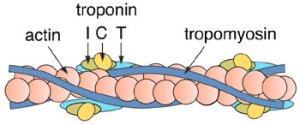
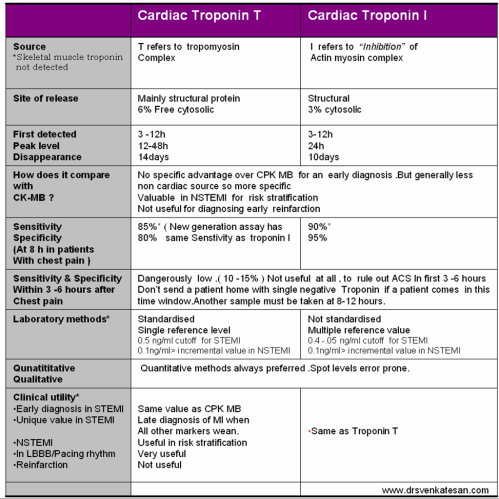
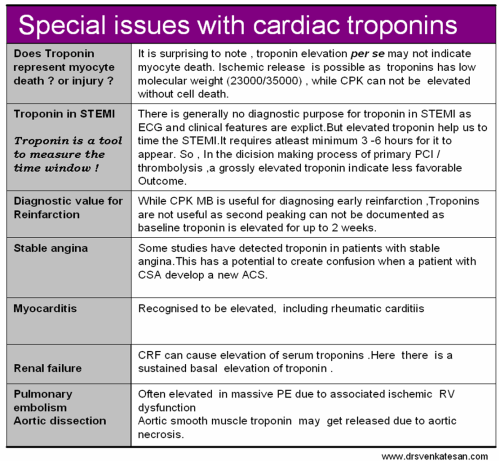
How good is Troponin T or I  to rule out acute coronary syndrome in the emergency room  when a  patient presents  within two to three hours after the onset of symptoms ?

  1. Very useful
  2. Useful
  3. Rarely useful
  4. Not useful
  5. Not at all useful

The answer is  5 , can be 3 or  4 , never 1 or 2 !

If you are surprised with the answer

Findout why , read further

troponin-i-troponin-t1

19_trop-t-sen1

troponin-i-troponin-t-2Final message

Troponin has a definite diagnostic  and prognostic value in  STEMI or NSTEMI  but relying on a single normal troponin level very early after an ACS can be . . . futile.

Realis,   diagnosis of ACS , especially  STEMI , is primarily by ECG and clinical features . Even in NSTEMI biomarkers help primarily to risk stratify the event. Bio markers come into picture only in borderline  ECGs and in baseline ECG defect like LBBB/Pacing rhythm .

It should be recognised , the major draw back of cardiac markers is , it  does not represent real time cardiac myocyte  events. (But the good old ECG has this unique property !) .The myocyte secretion & release  kinetics , the effect of  native (and pharmocological ) reperfusion make it a unreliable  marker.Apart from the time lag  , the  laboratory methods to detect these  molecule needs further refinement.

For the current day cardiologists ,  it is  required to finish off the entire treatment  of MI  within 6  hours by doing a primary PCI . It is an irony , troponin begins to appear only by  then to be detected in the blood !

Further reading

A .All about troponin

http://www.annals.org/cgi/content/full/142/9/786

B.Troponin In aortic dissection

http://www.ncbi.nlm.nih.gov/pubmed/15887472

Read Full Post »

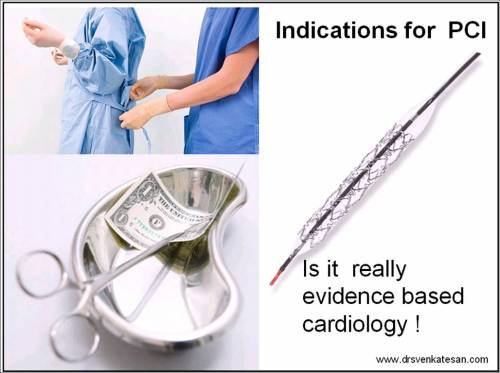
pci-ptca-ebm-stent

Scientifically ,  the  indication for coronary revascularisation   should be  based on following

  1. Patient’s  symptom ( more specifically angina , dyspnea is less important !)
  2. Prov0kable  ischemia  ( A significantly positive stress test )
  3. Signifcant LV dysfunction with  documented  viable myocardium &  residual ischemia
  4. A revascularisation eligible coronary anatomy * TVD/Left main/Proximal LAD etc ( *Either 1, 2 or 3 should be  present  in addition )
  5. All emergency PCI during STEMI /High risk NSTEMI

Practically ,

A CAD  patient  may fulfill  “Any of the above 5 or  “None of the above 5” ,  but ,  if   a coronary obstruction  was  revealed  by coronary angiogram  and if he  fulfils The 6th criteria , he becomes  eligible for  revascualrisation

6th criteria

If the patient has  enough monetary   resources (by self  ) or by  an  insurance company  to take care of PCI /CABG *

*The sixth  criteria overrides all other criteria in many of the cath labs .Of course , there are few genuine ones still  fighting hard , to keep the commerce out ,  from contaminating cardiology !

Read Full Post »

First and foremost is

Avoid the procedure if  not really indicated.A lesion which  has more thrombus load  than a plaque and it is ,  subcritical and not limiting the flow  , PCI may be inappropriate  especially if the ACS is stabilised.

  • Adequate anticoagulation  along with  2b 3a blockers should be used
  • Predilatation should be minimally used or to avoided.Direct stenting preferred.
  • In primary PCI suction devices (Export etc may be useful)
  • Distal protective devices  are  “hyped up devices” rarely useful in an occasional patient with good distal vessel diameter.
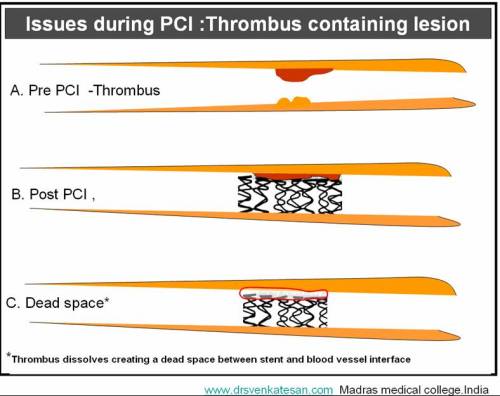
  • Pseudo stent approximati(fig 1) may occur. A Layer of thrombus may get plastered between stent and the vessel wall.In the post PCI  phase , with intense anticoagulation and antiplatelet regimen this layer may get dissolved and stent  may lose it’s grip and may dislodge or migrate.Another possibility is the dead space  beneath the stent  becomes a potential site for future  thrombus and ACS.

thrombus-and-pci

Fig 1

  • To prevent this complication , high pressure inflations and Post procedure IVUS (Intra vascualr ultraound may be done to ascertain lack of thromus between stent/vessel wal  interface)
  • Drug eluting stent evoked a special concern , when used in thrombotic milleu.This , has now been  proven to be  safe

Read Full Post »

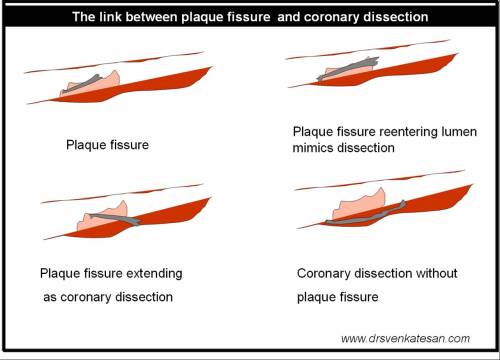
plaque-fissure-and-coronary-dissection

  • Plaque fissure is  the most common intra-plaque event that   precipitates  an acute coronary syndrome.
  • It is the  site of   attachment  for coronary thrombus
  • It can  either be spontaneous or PCI induced.
  • Plaque fissure can  either be  partial or complete and  may  reenter the lumen.
  • Eccentric plaques are likely  to fissure often  , as the  wall stress on the plaque shoulder region is  high  (Laplace law)
  • Angiographically  it is often difficult to differentiate  fissure from true coronary dissection.Both manifest as intraluminal filling defect.Coronary dissection  often extend beyond the length of plaque.
  • Many of the reported cases of spontaneous coronary dissection are thought to be  nothing  , but plaque fissures and their extensions.

Is plaque fissure a painful event ?

Plaques do not have neural innervation.So the plaque fissure is generally not painful.But when it extends into the media of vessel wall it can be severely painful.

Read Full Post »

Left main coronary artery disease (LMCAD) often evokes  a panic reaction  among cardiologists .Not every LMD deserve that re. To  label  it as  significant, we have a criteria ,  that is 50% diameter stenosis.  So what you do , for a tapering  or narrowed left main with 40% stenosis. Isolated insignificant left main is rare *, but real incidence is not known.  LMCAD  is  most often due to  , atherosclerosis of left main coronary artery without limiting the flow.

What are the options ?

  • Leave it alone, with intensive medical management assisted by high dose statin(80mg)
  • Elective PCI with stenting , even though the lesion is not significant.

*If associated LAD  or LCX is there decision making is easier .

How  significant is a coronary stenosis ?

The significance of a coronary lesion with reference to “lumen diameter obstruction” is basically flawed. The significance of a coronary stenosis, by tradition is  based on it’s hemodynamic impact ,right from the  CASS days in early seventies.Unfortunately our mind set has not changed even after realising    non obstructive – sub critical lesion is more prone for acute coronary syndrome.  Is it not ironical to call a  40% lesion a non significant one !

So, the  significance of coronary stenosis is two fold.

  1. Hemodynamic  significance
  2. Clinical and  pathologic significance

The former predisposes to often chronic stable angina, later likely to result in ACS.

How will you approach a apparently insignificant left main disease ?

A 40 % lesion in left main is hemodynamically not significant , but pathologically very significant.It needs intensive treatment. Plaque passification with medical approach is first choice.If the lesion morphology is eccentric,  has irregular margins or involves  LAD  or LCX ostium doing a PCI or even a CABG is to be considered in spite of the lesion is  hemodynamically insignificant .

Why , PCI is   considered  “not appropriate”  for   less tighter lesions , even though these lesions  have great clinical significance ?

The answer is simple, The risks  and the  potential cost are more than the benefit !

And further ,  stents are  not innocuous devices  either  , they  always carry a risk of sudden occlusion as like  a sub critical lesion  !

Answer to the title question

True incidence is not known . Our experince (Class 1 c evidence) would suggest Left main disease constitutes up to 10 % of CAD.Among this one third would be hemodynamically insignificant

Suggested reading

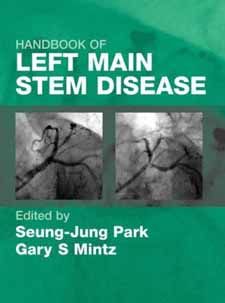
Handbook of Left Main Stem Disease


edited by Seung-Jung Park

hbleftmn

//

Read Full Post »

                                                    Drugs are poisons , whenever it is administered without valid purpose. it can enter human body  in many ways (Oral, intravenous, percutaneous etc ) And now we have another route namely intracoronary !

                                                   In quest for prevention of restenosis, many of the anti cancer drugs are now delivered directly inside the coronary arteries .These drugs are secreted  like a sustained release  tablet from the drug coated stents.These drugs are expected to prevent restenosis within the stented segment.But, after years of  intense debate and research  , we realised that ,  drugs  eluted from the stent  could damage the distal coronary vascular bed and coronary microcirculation.( And thus came the epidemic of acute stent thrombosis ! )

                                                The tender and sensitive coronary microvasculature  is constantly exposed to  these  powerful anticancer and immmunosuppresive  drugs .It is a great surprise , no body thought of  this dangerous drug -coronary artery interaction ! It required the genius of Renu virmani and others to point out this.

But still , the cardiology community by and large , fails to consider  this an important issue.This is proven by the fact, usage of DES is  still increasing  and used mainly as an off label indication.

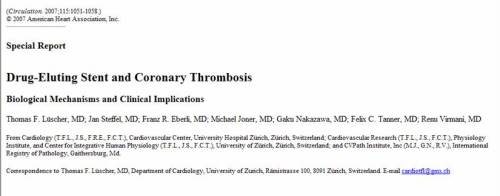
Read this land mark article from circulation

picture1

http://circ.ahajournals.org/cgi/content/full/115/8/1051?maxtoshow=&HITS=10&hits=10&RESULTFORMAT=1&author1=renu+virmani&andorexacttitle=and&andorexacttitleabs=and&andorexactfulltext=and&searchid=1&FIRSTINDEX=0&sortspec=relevance&fdate=1/1/2007&tdate=12/31/2007&resourcetype=HWCIT


Questions that need to be answered

  • What is the long term effects of drugging a coronary artery ?
  • Is no reflow or slow flow  more common after DES , because of the adverse drug reaction in the distal vascular bed ?
  • If a patient  with  DES  undergoes a CABG later what  would be  the impact of the  drug on the graft ? Will the functional vasodilatation   affected ?

Final message

                                  A drug , to get a legal clearance it has to undergo  hundreds of rigorous tests . Finally it is cleared for that  specific indication for which it is tested  .Just because a drug is cleared for one purpose ( Paclitaxel for malignancy ) it does not mean it is safe to use for any other  purpose for which it is deemed to be useful . Exactly the  opposite is happening   in the  the field of interventional cardiology . No body wondered to think what would be the effect of these drugs on the normal coronary endothelial cells and vasculature.Is it not a crime ,  without analysing this particular issue  , dozens of drug eluting stents have been released in the market . And now,  sounds of crying  foul is heard world wide !

Let us thank  , the so called negative forces in cardiology  for making this an  issue . In science ,  the watch dogs should bark  at  times of danger not wag the tail !

Read Full Post »

This paper was presented in the just concluded 60th Annual scientific sessions of cardiological society of India , Chennai.India

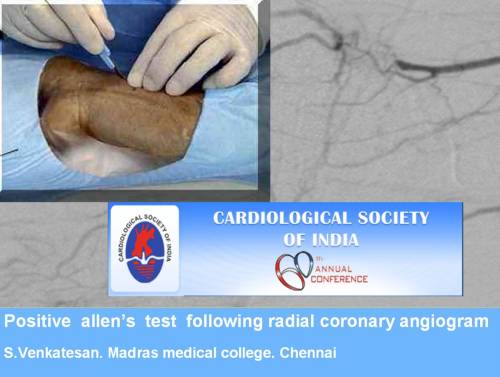
POSITIVE  ALLEN’S  TEST  FOLLOWING RADIAL CORONARY ANGIOGRAM

Venkatesan  sangareddi , G.Gnanavelu, R.Alagesan,V.Jaganathan.

Department of cardiology, Madras Medical College, Chennai.


                          Radial  artery  has become the  major access  site for the interventional cardiologist in recent years. Radial approach has provided increased patient comfort and  less access site complication. Many  of  the   complications  are  unique to radial approach mostly due to  anomalies of origin, and course while others are  hardware related .Unlike femoral arterial access ,  compromise of blood supply to hand is never considered a  threat because of dual blood supply to hand  .But the fact  is that,  it  could be sub-clinical  and the hand is rarely assessed for vascular insufficiency after a radial procedure.

             The aim of the study is to assess the  impact of   radial  procedures  on the  blood flow  to  hand . 20 patients who had undergone routine  radial coronary  angiogram  formed the study population. All patients had negative Allen’s test prior to the procedure. The mean procedure time was   25mts (18-45) .Standard  hardwares were used. Difficulty in crossing at forearm and   subclavian   was observed in  4  patients. Extravasation of dye  in forearm was observed in two. Allen test  was  done 24 hours  after sheath removal and  repeated 48 hours after the procedure .  4 patients   showed positive Allen test  at 24hrs. One  patient   regained  Allen negativity at  48hours. The incidence of positive Allen test at  24 hours is 20%. The compromised blood flow was correlated with the  procedure time, and a difficult catheter course .

                 We propose,  radial procedures especially , when prolonged has a potential to compromise palmar arch flow .This phenomenon  is  either  permanent  or transient  and  may be attributable to enhanced  endothelial tone and sheath related injury. Irreversible  compromise  of blood flow to  palmar arch  may  also occur  in radial dominant hands. Further enhanced  sympathetic tone can  spill over to ulnar artery as well . 

             It is concluded, interventions through radial route has hitherto unreported adverse effect  of  “Post procedural  positive  Allen test”  . It  implies , radial  procedures  could  convert  a dual blood supply  pattern of the  hand to ulnar dependent  uni-modal  blood flow  in a significant  subset of patients. This is important   to recognise, as it   precludes further radial procedures in the same patient.


Final message

Hand function could be as vital as our heart’s ,   please handle with care to avoid this complication


Click on the slide to download PPT presentation

radial2

Read Full Post »

« Newer Posts - Older Posts »