Feeds:
Posts
Comments

Archive for the ‘cardiology -Therapeutics’ Category

We know,  electrical deaths constitute the bulk of sudden cardiac deaths in MI.  Mechanical deaths due to pump failure, muscle rupture , valve leak , also cause significant deaths   .(Surprisingly many of the mechanical deaths   may also   fulfill  the sudden death criteria !)

Free wall rupture is  invariably a fatal event. Papillary  muscle trunk  rupture  leads to severe LVF and unless intervened sure to result in fatality.

The ones who tear their interventricular septum  are some what blessed ! Here ,  the rupture does not result in instant death as there is  no loss of blood ,   instead , there is an  volume over load of right ventricle  followed by the  left ventricle  after a  few beats. Hypotension is the  rule. Even though this is a major complication there is something about  VSR which makes it unique.

Sudden giving way of IVS has  a decompressing effect on the ailing left ventricle.This many times  bring a  temporary relief to LV and if the patient survives the first few hour he is likely to stabilise  further . In fact , sudden deaths within 24hours after the onset of VSR is an exception.This defect always gives the cardiologists and surgeon some time to plan the management. We need to use this time judiciously.

The natural history is delicate . Five themes are possible

  1. Very unstable Instant death( Fortunately a  rare theme )
  2. Unstable – Deteriorating further
  3. Unstable to Stable * fit for discharge even without surgery
  4. Stable from the onset and  continue to be stable* .
  5. Stable to Unstable (Probably the most common theme )

* Pleasant themes occasionally witnessed !)

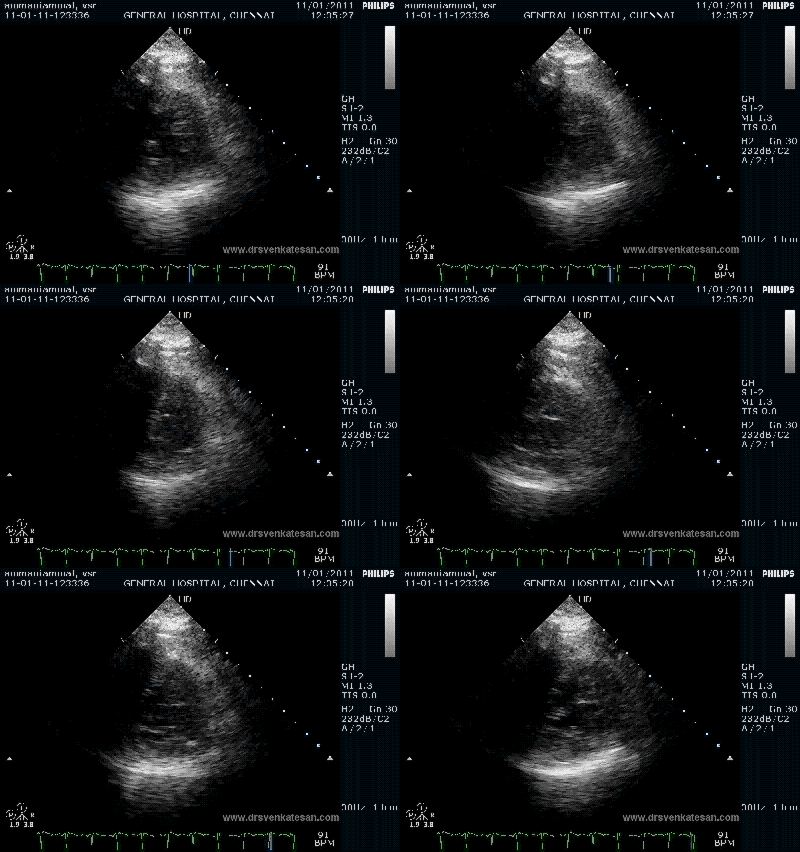
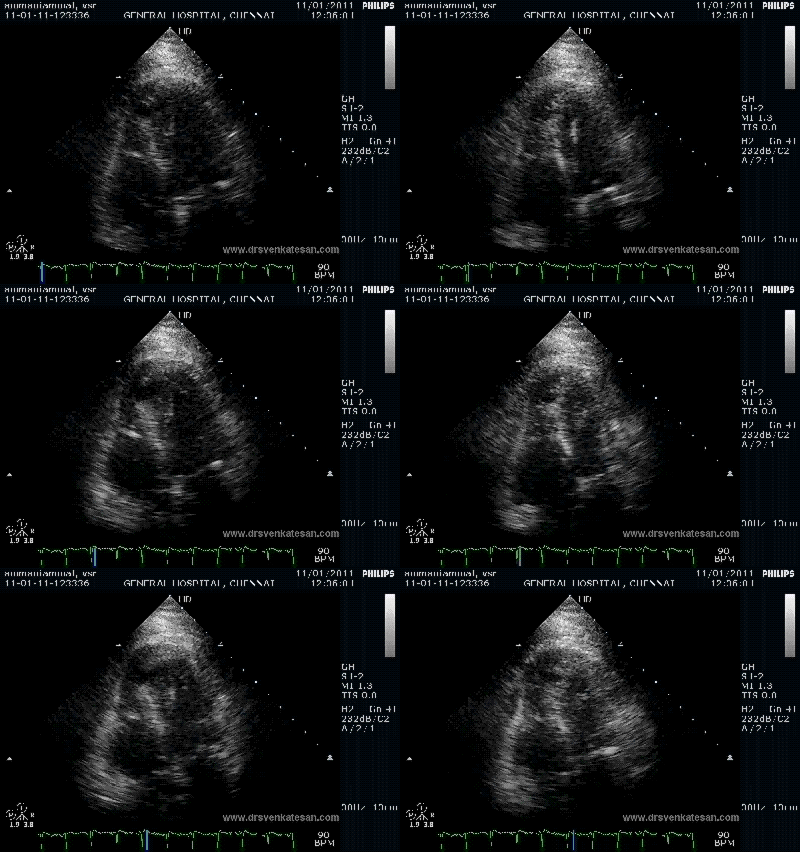
Here is 55 year old women came with extensive anterior MI with lower septal rupture.(She belonged to type 3 of the above scheme)
)

Note the septal rupture is visible even in 2D Echo
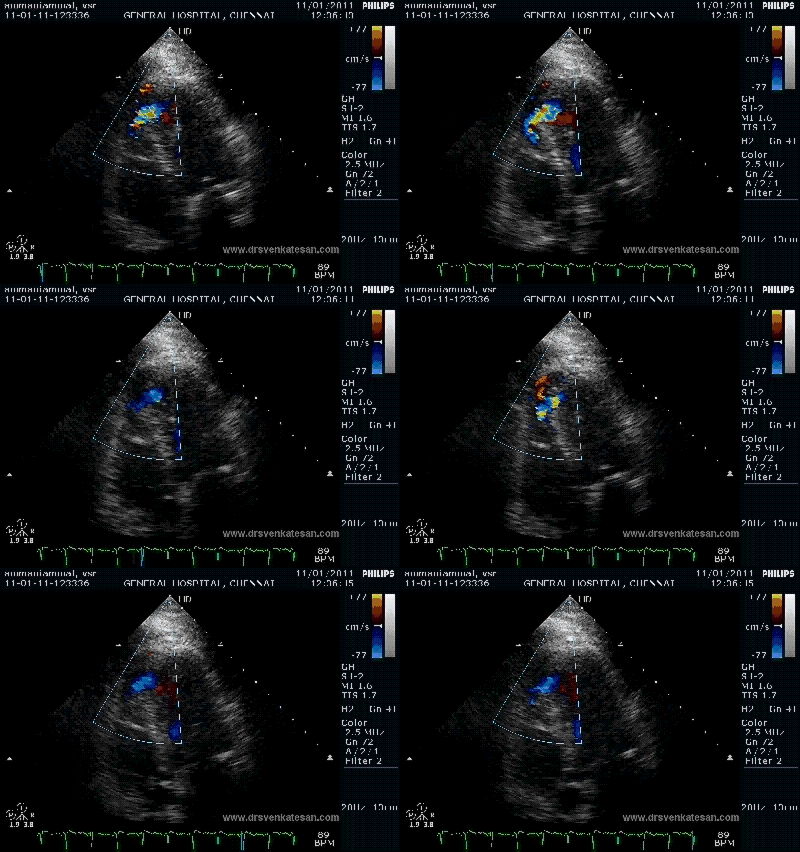
 

Color flow showing significant shunting from LV to RV.This shunt depends upon the LV contractile function, LVEDP and ofcourse the RV pressure
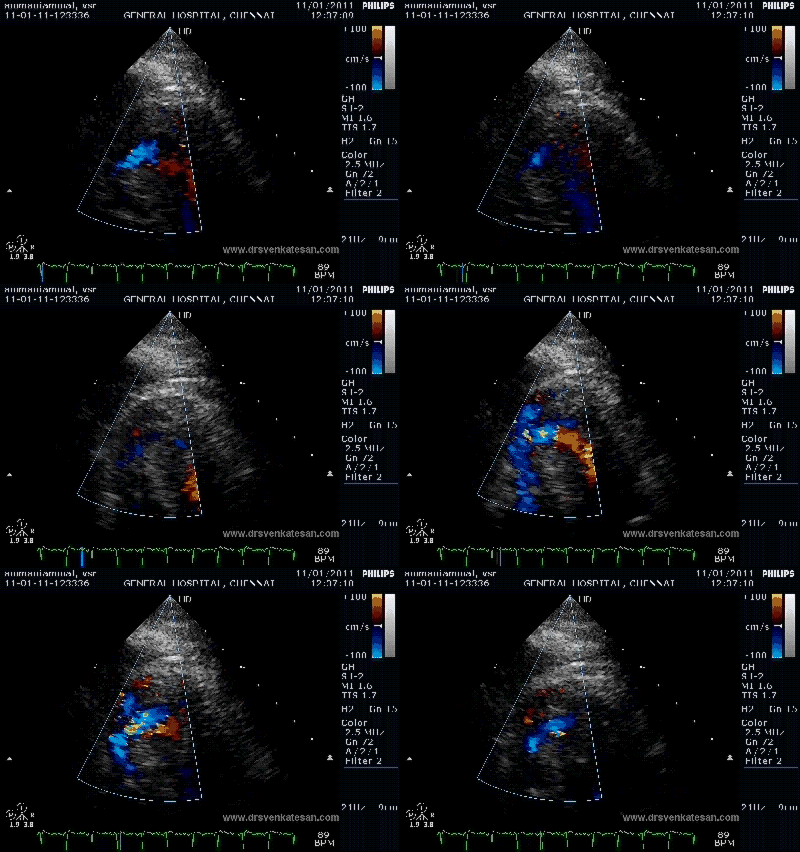
 

If there is severe RV dysfunction or bi ventricular dysfunction flow across the defect is inconspicuous.Brisk left to right shunting may be an indirect marker for good LV systolic function and absence of significant pulmonary hypertension.Both imply a better outcome.

The main determinant  of survival is the  underlying LV dysfunction and associated co morbidity(Renal function ) and complications .

Infero -posterior ruptures tend to be complex and  may have multiple irregular tracks  that makes it difficult to repair.

Investigations

Echo cardiogram is the mainstay .Serial echos should be done to assess the mechanical function and the progress of VSR.Hemodynamic monitoring may be done without injuring the patient .

Medical management

  • Often supportive , but  effective . Dobutamine infusion can maintain a life for few days.
  • Paradoxically , LV dysfunction and elevated LVEDP restricts volume overloading of VSD.
  • Associated MR, Arrhythmias  need to be taken care of .

Surgeons role

  • Very Vital.
  • Experience counts.(Individual as well as  Institutional )

Timing of surgery

Continues to be a controversy . Surgeons love to operate in a stable patient. But they need to realise , surgery is often needed to stabilise  many  patients. . The issue of tissue friability  is blown out of proportion in the literature .When a  life is  is at danger we can not worry about  friable tissues !

The rule of thumb could be

  • Operate as early as possible in unstable patient.
  • Post pone surgery in stable patient as late as possible ( Late here means . . .elective non emergent surgery )

Surgical options

  • Simple VSR closure without  knowing coronary anatomy
  • Simple VSR closure after knowing coronary anatomy
  • VSR closure with CABG ( total revascularization)
  • VSR closure with partial revascularization

In our experience  each of the above , has a role in a given patient depending upon the logistic , financial , social and even  the available expertise. (A good surgeon in bad Institution !)

Is coronary angiogram mandatory  before attempting to close VSR ?

Logically yes. If it is not available  just do not bother .  But, many times , when issue is saving lives , we can not afford to be too scientific , many lives have been saved by not following  such strict  protocols .A simple emergency  thoracotomy and closure of rupture site (Without even touching the LAD ) can be a distinct  and viable option in  a selected few .

Role of cardiologists

Contrary to the popular belief the role of cardiologists is minimal , except  to prepare  the patient and hand over to the surgeon.

Interventional approach to close  a VSR  is currently  be termed as an  adventurous option ! The VSRs  can assume unpredictable shapes  and the  tears can be multiple  in  different planes. The devices , catheters and  other hard ware are not specifically made to tackle these  issues  .An acquired VSR  should never be compared with congenital VSD.
Read Full Post »

Preamble

The much published TRANSFER -AMI study  has few important queries to ponder about.It was supposed to test the role of routine PCI following  thrombolysis. In other words it compared  rescue only strategy with routine strategy.The caveat is , even among  failed thrombolysis, the   rescue strategy has not convincingly proven superior to medical management  (if the time is lapsed ) as much of the damage is done .

In essence , Acute MI is  more about time management than drug or cath lab management

  1. Why the 67 % of  standard therapy cohort underwent PCI. Technically , you are supposed to transfer for rescue only if there is a  failed thrombolysis ?That is the standard approach , if  most of the cases are any way land up in cath lab , then you are trying to compare two similar groups .
  2. Why the rate of   failed thrombolyis with TNK-TPA in both arms not disclosed ?
  3. How can a 92% of study population be in class 1 Killip still considered to be high risk group ?
  4. Why the recurrent ischemia  was very vaguely  defined and still included and clubbed with primary end point along with deaths. If only recurrent ischemia was removed from primary end point . . .this study will straight away land in a regret bin.
  5. Why there were 6 additional deaths at 30 days  in routine early  PCI group ,  What was he cause of death ? Mind you these deaths have happened in a 92 %  Killip class  one cohort . Is it  not important ? The trend looks vitally   significant .We can not afford take refuge under a false  statistical roof .
  6. How many patients died or  developed MI  because of the early PCI in-spite of having  successful thrombolysis.This again could be vital . Complications during intervention  for a failed thrombolysis may be acceptable. While ,complications , when we try to  improve upon the already  successful thrombolysis is simply not acceptable .

Will the investigators share their experience ?

Finally

Why the title of the paper says it is about “Routine angioplasty” and  the conclusion emphasizes  it is indeed   “high risk subsets ofangioplasty” (While the study itself involves a 92 %  least risk Killip class 1 ) .  Why this double dose of confusion ?  (Is it deliberate  ! Which i think is unlikely )

NEJM please take note of this  . . .

All that glitters  are  not natural glitter . . .some are made to glitter !

Read Full Post »

T waves attract less  attention in STEMI ,except for the  fact   tall T waves  implies   hyper acute phase of  STEMI.

What is the duration of hyper acute phase ?

  1. Few seconds
  2. Few minutes
  3. An hour
  4. Few hours
  5. Any of the above

Answer

No one exactly knows  .It can  be highly variable .  So , 5  could be  the correct answer .  

 * Most importantly  hyper acute phase  need not occur in all patients with STEMI as suggested in experimental models.

Some  observations in T wave behavior in STEMI

Mechanism of hyper acute  T waves

It is the pottsium channel dynamics.Transient intracellular hyperkalemia  is thought to be responsible.

T wave as marker of  reperfusion

Inverted T wave in precordial leads are a good marker of IRA patency  especially in LAD

Slowly evolving STEMI

This is relatively  new concept . STEMI with a prolonged hyper acute phase  ,  ie ,  T waves ” dilly dallying”  for hours or even few days have been recognised. (This was  refered  to pre-infarction angina in the past )

This sort of T wave behavior makes it difficult to diagnose STEMI.Enzymes will help , still  thrombolytic guidelines  demand us to wait till ST elevation to occur. This is  unfortunate .But as physicians we are  justified to thrombolyse tall T waves with a clinical ACS .The other simple solution is to shift the patient to cath lab to find what exactly is happening in the LAD ! 

Now , what is new about  T waves in STEMI ?

It is  the localizing value  in LAD infarct

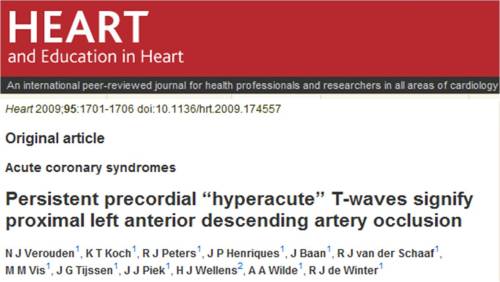
A tall persistent  hyper acute T wave  helps us to localise a LAD lesion .This paper from Netherlands ,  clearly  confirms this observation. The study was done from a primary PCI cohort,   a perfect setting to assess the  T wave behavior  in the early minutes /hours of  STEMI .

Other mysteries about T waves in STEMI

Does hyperacute T waves  occur in infero-posterior STEMI ?

I would believe it is very rare .Our CCU has not seen any tall T waves in inferior lead. Further analysis of the  data from the  above study could answer this question .

How often a  hyperacute T waves transform into NSTEMI ?

This again is not clear.Most of the hyper acute T will evolve as STEMI .But  , nothing prevents it to evolve as NSTEMI a well . After all , a hyper acute T   MI can  spontaneously lyse in a lucky few , ( Who has that critical  mass of natural  circulating TPA )  .If  these natural lytic forces are only partially successful , it may evolve into de nova NSTEMI.

Bi-phasic T waves in ACS.

A benign looking T waves with terminal negativity in precordial leads  can some times be a deadly marker of critical LAD disease.This has been notorious to cause deaths in young men which often correlates with the widow maker lesion in LAD.

What is a slowly evolving STEMI ?

Prolonged tall T wave phase  possibly   indicate , the myocardium is relatively resistant to hypoxic damage .

The most bizarre aspect in our understanding about ACS pathophysiology  is the concept of  time window , based on which , all our  ACS therapeutics revolve !

Does all myocardial   cells  have a same ischemic shelf  life ?  Can some patients  be  blessed with  resistant myocardial cells   when confronted with hypoxia or ischemia ?

                                 It is well-known  , in some hearts ,  the  muscles go for necrosis within  30 minutes of  ischemia,  while some hearts can not be infarcted even after 24 hours of occlusion .So , slowly evolving STEMI is a feature of  myocardial ischemic resistance .This is not  a new phenomenon as we have extensively studied about the concept   ischemic preconditioning .

We wonder there is something more to it . . .  the quantum of preconditioning  can be inherited .Further  , we are grossly ignorant about  the molecular secrets of  non ischemic metabolic  preconditioning  .

Final message

                         T waves attract less  attention in STEMI . Cardiologists are often tuned to look only the ST segment , after all ,  ACS  itself is classified based on  the behavior of this segment.(STEMI/NSTEMI) . We need to recognise ,there is a significant subset of ACS   affecting exclusively T waves.  Shall we call T elevation  MI ? ( TEMI )

Do not ignore T waves in STEMI. It has more hidden electrophysiological  treasures that  is waiting to be explored .

Read Full Post »

Rheumatic heart disease is rampant in India.  Advanced forms of mitral stenosis are  still common.

Critical mitral stenosis with LA clot formation is often seen.

But here is a  women in late twenties  presenting for the first time with syncope .

And what  you see inside is  not a fiction  . . .

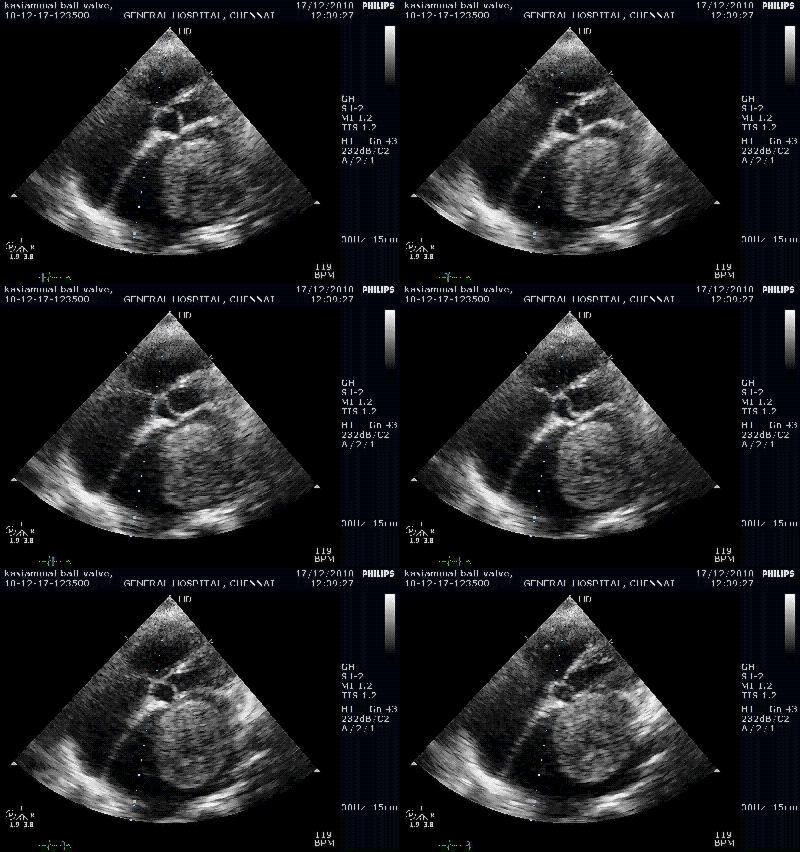
Left atrial clot occupying the whole cavity ! Where is the blood bound for left ventricle ?

4 chamber view

Luckily the clot is   so  big and MVO is less than 1 sq cm. It is highly unlikely the LA clot can negotiate the orifice.

Small fragments can dislodge .This patient developed syncope whenever she bends and lie down at a particular position.

What needs to be done in this patient  ?

Can it be lysed ? No ,Emergency surgery is required with concomitant mitral valvotomy or mitral valve replacement.

Is there a temporary aortic filter available to prevent systemic emboli from heart  ?

Distal protection devices are  available only temporarily in the coronaries and  carotids during interventional procedures.There is no aortic protection devices  for LA,LV clots in high risk patients .  When IVC filters  are used  block a potential pulmonary   clot why not aortic filters  for preventing systemic emboli  ?

Why we have not thought about  this  . . . is  surprising . May be intensive anti coagulation is as effective .

Read Full Post »

Calculating the pulmonary vascular  resistance (PVR)  has been a  big head ache for all those involved in pediatric and (for many )in adult cardiology as well  . The complex formulas , the delicate  oximeter samples, the catheters, a sick child , an arrhythmia prone right ventricle , restless staff  nurses , and  finally the mathematics  !  all make it a dreaded exercise .

Echo is a great physiological tool  . . . It is now been used  over 50 years . It is our earnest belief ,   Doppler can measure the flow and pressure any where within the heart   however dynamic  the chambers may be !

Then ,why can’t  we have a simple formula  by  this  non invasive method  to calculate PVR  ?

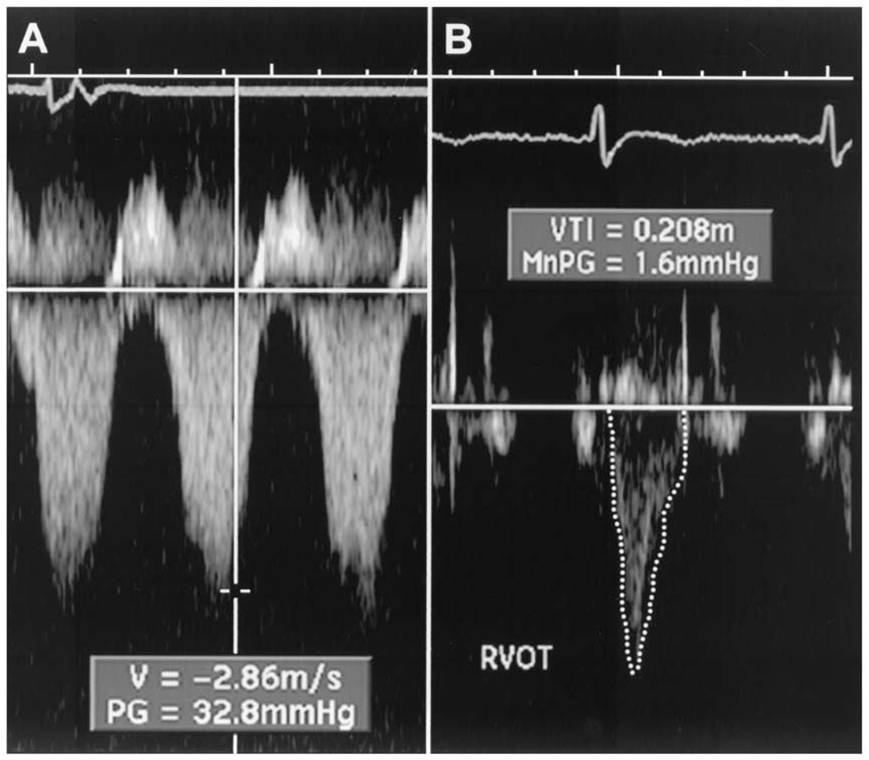
Yes ,  Dr Abbas et all  from the desert hospital  of Arizona  raised  this question and  reported a new equation to calculate PVR.

Their  hypothesis is as simple as this . . .

  • Pressure     =    Resistance X Flow
  • Resistance = Pressure /Flow

Pulmonary vascular resistance = PA Pressure/PA FLOW

Substitute PA pressure with TR jet

Substitute PA flow by   RVOT VTI (  Velocity time integral )

And  we  get

PVR = TR Jet velocity/ RVOT VTI x  10

This  is the simplest way to arrive at PVR at the bedside .

An example

Is it validated ?

Yes .

Then,why it is not being followed widely ?

It is  a  too  simple  method to  use   !  That  is  the biggest excuse ! We are tuned  to  think  ,  a  complex parameter can not be measured in a  simple manner  .  Any thing simple must be  wrong !

But the reality is  . . .

Cath calculations are   much more  complex with so many variables   which  can  get terribly wrong .

The irony  about this  hypothetical  science of PVR is ,  we do not know  which is  gold the standard ?   In fact , none can be  a standard .  So ,  to label PVR  derived by echo ,  as an   inferior modality  can not be accepted  .It is all the more funny ,  as  we are  trying to  define a new  formula    with  the help of   flawed and battered   parameter  namely  the cath derived PVR .

Final message

Abbas’s  formula  is  indeed a  realistic way of arriving at PVR by echocardiogram. If only we measure it routinely  /serially in as many patients as we can , a new data base  will  be created .Which can later be  proven as a fact.It is suggested every cath lab should try to validate this formula.

Link to full text article : Courtesy of JACC

Abbas AE, Fortuin FD, Schiller NB, Appleton CP, Moreno CA, Lester SJ. A simple method for noninvasive estimation of pulmonary vascular resistance. J Am Coll Cardiol 2003;41:1021-7.

Read Full Post »

STEMI is an cardiovascular emergency . We alert  instantly the services  of  911/108/1066 . What we fail to realise is , the  physician’s thought process  should also  be equally fast  . Before dispatching  a STEMI patient by ‘air mail” to the nearest cath lab ,   spend few thought full moments ! We have  a simple and   equally effective option  ,(If not superior )  of revascularisation  , right in your clinic or hospital ! Use it liberally , it is not a inferior treatment !

This article  is from the prestigious  journal  “Annals of emergency medicine” .It confirms a longstanding doubt regarding the efficacy of  air lifting of STEMI patients.

A shocking observation . . . is . . .  many of those patients who are air lifted  for primary PCI   receive none of revascularisation  modalities !  Learn  how  many  of our patients have a futile helicopter ride in the golden hour of STEMI  !

Final message

Even airdropping of STEMI patients to cath lab for primary PCI is not  enough in this unique   race against time  . So , in the management of STEMI ,  we need lots of non -medical  sense* !  .Please judge    “the delay”   due to transfer carefully   and  always consider administering  the thrombolytic agent  when a patient  with STEMI  arrives   within 30 minutes.

A definite primary thromolysis (Within 30 minutes ) is  often  better than a PPCI  (Potential primary  PCI), which  may  or may not materialize in time  !)

*Please  realise  even  inclement weather  and traffic jams can have a impact on coronary patency !

See  comment about this article in Heart wire

What next ?   On site  mobile cathlab ?

Read Full Post »

Cleveland clinic is a leading centre for cardiac care .Major technological breakthrough occurs from this institute than any other place. Thousands of articles come out every year. Some articles , get global attention and make  a huge impact. These are usually related to a new hi- tech modality like CRT devices or percutaneous aortic valve deployment etc ,etc.

                                                Some articles , which are very important  may not get the due  attention . Journal editorial boards often  have a scorecard called impact factor .That is ,   how  a  journal  is  impacting the practice habits of  medical professionals . Ideally we need to have to grade individual   articles with impact factor .Many articles may not have any significant  impact  however good the impact factor of the journal.

Here is an article,  which excellently depicts the principles of management of ACS.  It was published in 2003 JACC,  by Steven Nissen  from Cleveland,  Ohio .It deserves more attention . Every cardiologist , involved in ACS management should read this, especially the interventionist.

Link to article placed her with courtesey of JACC

Read Full Post »

Acute coronary syndrome  is primarily a disease of blood vessel , which perfuses  the heart.  It can even be a disorder of blood, often called vulnerable blood which predispose  for intra- coronary thrombus .

Mind you  , heart is an innocent bystander ! to the onslaught of  coronary atherosclerosis !

Hence , we  often use two terminologies .

CAD : Pure vascular (Coronary )  disease without  any structural and functional impairment of heart  ( No Angina, No myocardial damage ) Most of the asymptomatic plaques  , non flow limiting  lesions, incidentally detected by the modern coronary imaging gadgets  fall in this category.

When does  CAD becomes CAHD ?

CAHD : Coronary artery heart disease .Here not only the coronary artery is diseased , but it has it’s mission fulfilled   ie target organ either damaged structurally (STEMI, NSTEMI ) or functionally (EST positive , Chronic stable angina CSA )

Does the heart does any wrong to suffer from Acute coronary  syndrome  ?

No, it is simply not .The fault lies in one or more  of the following   .Generally at-least two these factors are enough to impede blood flow )  . They  combine to produce an ACS.

  • Blood defect
  • Vessel wall defect
  • Slowing of flow (Stasis)

This is called as Virchow’s triad   suggested over 100 years ago . Still valid in the era of per cutaneous  aortic valve implantation.

* The concept of de-linking  disorders of  coronary  vascular disease  from myocardial disease  is vital  in understanding the implications of current modalities of treatment. 

Even though we PCIs target the culprit ie blood vessel , it need to  realised , we  always fall short of real target . . .namely the heart . In coronary interventions  the catheters and wires roam around superficially over the heart  and they never even touch the heart .This is the reason PCIs are struggling to prove it’s  worthiness over medical therapy in many CAHD patients , which can reach deep  into the vessel, heart  and even every individual cells of heart.

Many (or . . . is it most ?)  Interventional  cardiologists have a bad  reputation for ” failing to look  look beyond the lesion” .  It is estimated  a vast  number  of cathlabs  and CABG theaters worldwide  are engaged in futile  attempt to restore coronary artery patency after a target organ damage is done .This is akin to building flyovers  to dead and closed highways .

Salvaging a coronary  artery and reliving a coronary obstruction is an entirely unrelated and futile  exercise to  a patient who has a problem  primarily in  musculature .

The much debated concept of  documenting  myocardial viability  , before revascularisation  died a premature death as the concept  by itself , was not viable commercially . (Viability studies   , tend to tie down the hands of device industry further , some  interventional   cardiologists began to see this concept  as an  interference to their freedom to adventure  )

Of-course , now  we have  other parameters  phenomenon  like  FFR estimation by Doppler , epicardial  -myocardial dissociation, slow  flow , no re-flow are  gaining importance.

Final message

ACS is primarily a disease of blood vessel but it’s impact is huge on heart. We need to look beyond the lesion .Restoring  a blood vessel  patency  to an ailing organ (Heart ) is not synonymous with total  cardiac intervention  and protection . There is lot more to cardiac physiology other than it’s blood flow. Heart muscle is a too complex organ to be controlled by few balloons and wires  which beat around the bush.

Read Full Post »

y

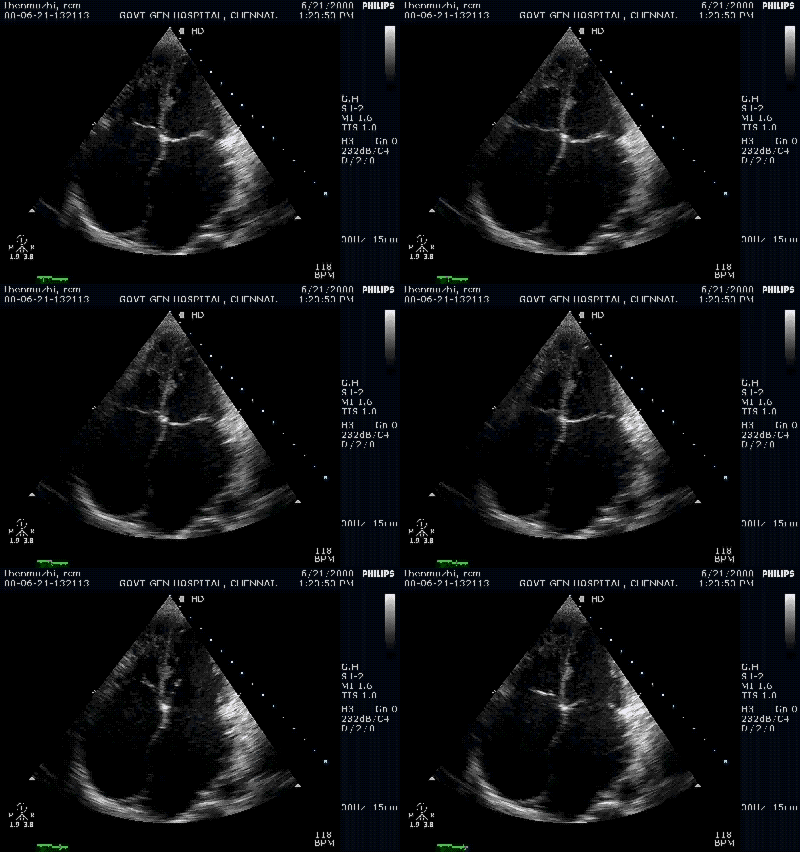
A classical restrictive cardiomyopathy . Both atria balloon out as they face stiff resistance from the ventricles

Restrictive cardiomyopathy(RCM) is a common form of myocardial disease which was difficult to recognise  in the past.It was also commonly confused with constrictive pericarditis. Today , one can easily recognise this entity.A simple clue is bi- atrial enlargement  with relatively normal ventricle size.The above case is a classical form of RCM.

In late stages of RCM ,both LV, RV begins to dilate and can mimic a dilated cardiomyopathy. Doppler filling pattern  , and tissue Doppler motion of mitral annulus are recently validated methods to identify RCM. Still ,  2D features  are  very useful .This implies , the anatomical changes in the chamber size  are as important as physiological AV filling profiles. It is generally believed , physiological impairment precedes anatomical defects.( But not proven concept yet ! )

Note: The ventricles are not dilated and retain good systolic function

In the above patient  , etiology could not be confirmed and was labeled as idiopathic RCM  as tests for amyloid and eosinophilic infiltrations were negative.

M -Mode of the same patient confirms good systolic function

One would  call  for doppler mitral filling profile here ,  to confirm restrictive physiology ( A short DT , Short IVRT  . A reversal in  pulmonary veins , E/E’ ratio etc etc ) But all these are redundant here.

How is RCM different from non dilated cardiomyopathy ?

A new entity is being recognised in the cardiac  muscle disease.This is often referred to as NDCM (Non dilated cardiomyopathy)  .Global  systolic LV dysfunction  with normal  LV dimension.This a similar to the terminology MDCM (Minimally dilated  cardiomyopathy  where LV dimension increases  not more than  15 % of basal size ) .

This is seen in CKD and diabetic individuals.Atria may be enlarged .Diastolic dysfunction may co exist.  It is no surprise,  this entity closely mimics RCM. But in RCM LV systolic function  is not greatly compromised till late stages , while NDCM it begins with systolic dysfunction. This is the only difference .There can be overlaps .

Many strongly believe ,  both  RCM  and NDCM are one and the same entities ,  that present in different time frames in their natural history.

Final message

Diagnosing RCM is no longer difficult in established cases* . The message from  this article is , 2 D echo can  strongly suggest  the possibility of RCM (or even clinch it)  .  Never ever  diagnose RCM with normal 2 D echo. Doppler filling profiles are useful  additional tools . We  can not diagnose RCM with doppler features alone , but we can  be fairly certain about RCM when we encounter  typical bi-atrial enlargement and a normal LV by  2 D echo.

Caution : Patients  with longstanding atrial fibrillation of any cause , can dilate their atria and could mimic RCM .They can be some compromise in LV function due to chronic tachycardia .

* Recognizing RCM ,  very early in the course is still a problem . Here the  newer modalities like Phase  MRI, tissue doppler, speckle tracking, and velocity vector imaging may be useful.

Read Full Post »

Acute massive  pulmonary embolism is a dreaded medical  emergency  . In the past,  surgical embolectomy was the main option . Now , we have thrombolysis as a viable option.But , it does not work in all cases.* (90% success ?). It is critical to evaluate the success of thrombolyis , before embarking upon rescue embolectomy.

As it is often in critical care  medicine , this decision making is not easy .

The key question is how long , we shall wait before labeling  thrombolysis a failure !

In-fact , premature  assessment is the commonest cause for failed thrombolysis. True failure is different from deemed to be a  failure . This  is often related  to  , lack of patience  among  the   members of  treating team . Unlike acute MI ,there is not a  strict time window to  follow .The issue hear is ,  not lung salvage but  restoring VP/VQ and  dead space ventilation . The assessment is made , by clinical ,   MDCT ,Echo  parameters.

When there is difficulty in judging success , clinical parameters will prevail over medical images !


Key clinical parameters for monitoring

  • Heart rate
  • Saturation
  • Blood pressure

There are  four  options  available to manage in  failed pulmonary thrombolysis.

1.Emergency embolectomy in an unstable patient *

2.Elective , planned embolectomy  in a sable patient **

3.Repeat thrombolysis ***

4.Continue Intensive heparin regimen  for up to a minimum of   72hours  and up to a week .

*  Dismal outcome .

** Best option (Ironically,  these are the  patients , who improve  with medical  management , as well !)

***This is especially useful  when  partial success  is noted in a stable patient . ( For rescue thrombolysis it is  logical tom use TPA if SK was used initially and vice versa.) The logic here is the initial dose was  either insufficient or ineffective  to lyse the thrombus completely. If TPA is not available /or not affordable,  repeat SK can still be considered .It can be  safely administered within the 5 days of initial dose.

**** Least popular and considered inferior but has worked wonders in many .

How to manage a relatively  stable patient with a large thrombus load  in his pulmonary artery ?

Option number 3 could be tried. Prolonged  monitored heparin

What  are the surgeons concern about  management in failed pulmonary thromolysis ?

Every  surgeon( Especially  the  cardiac  surgeons)  loves  to operate in a stable patient . If you hand over  a case  for pulmonary  embolectomy  ,  with  sinking  O2 saturation  and  falling  blood pressure  ,the outcome can be  easily predicted !

Further, RV dysfunction  is notoriously known    for pump dependency  .  CT surgeons are vastly experienced   in  the intra operative tips and tricks of  managing  LV dysfunction (They may not be  in  so  in RV dysfunction !)

Bleeding risk  is also high especially  in the milieu of   intensive anticoagualtion and thrombolysis .

The mortality could be as high  as 30 % in many centers.


Final message

  • The incidence  of failed pulmonary thrombolysis  is  often subjected to the whims and fancies of treating physician  and the imaging modalities used.
  • Timing of assessment is critical .One need to give a long rope for medical management  , in spite of the urge , to do something more. .
  • Clinical improvement should be the main guiding force.
  • Normalisation of tachycardia   ,  improving  trend  of  o2 saturation(  >90-95%)  , regressing  RV size are useful parameters.
  • Thrombus load  detected by a repeat  CT scan  ,  need not be  the   sole guiding parameter.In -fact , mobilising these patients for CT scan by itself is fraught with a risk of  worsening the hypoxia.
  • The issue of  tackling the source of thrombus should  be addressed separately .Luckily, the same anticoagulant protocol takes care of this issue also. It is rarely a emergent issue.
  • Deploying an  IVC filter as an emergency procedure is a bigger controversy .At best , it is useful in few high risk individuals with high risk mobile ileo-femoral clots .
  • Finally, not every one can handle this  situation .Ideally such  patients  should be  to be  shifted to a well established cardiac surgical  set up .

From Chest journal

http://chestjournal.chestpubs.org/content/129/4/1043.full.pdf+html

Read Full Post »

« Newer Posts - Older Posts »