Feeds:
Posts
Comments

Archive for the ‘cardiology -Therapeutics’ Category

Coronary collateral circulation is the God’s gift to mankind.It has potential  benefits  ( and  of course real benefit !)  both during acute and chronic coronary syndrome.

Collaterals in CCS

The classical role of coronary collateral is in patients with chronic stable angina.It is quiet common to see patients with totally occluded  LAD or RCA with normal  LV function maintained  by extensive collaterals .

Collaterals during ACS.

An intact and functional  collateral circulation can prevent an NSTEMI  from converting into STEMI.In fact many of the patients with unstable angina patients carry on with viable myocardium just because thaey have good collaterals.It gives us a time window to intervene .Some times the col laterals are good enough and help us avoid a revascularisation in toto.

Collateral’s in  STEMI.

This is not well understood. Some  researchers  reported opening up of collateral channels very early after a STEMI. Logic would suggest , anatomically patent functionally closed collateral channels are  always available at time of crisis. But not every one is blessed with such rescue mechanism.

What determines  the native collateral channel development in human cor0nary circulation ?

When  the answer is unknown , it moves to  the  genetic domain also called  – God’s domain .

Our ignorance in decoding coronary collaterals is vast.

The chief cause of this ignorance is we always  tend , not believe things which we don’t see.

Coronary collaterals channels need to atleast 1mm  to be visualised by CAG.There could be a vast network of micro collaterals out there within the myocardium invisible to current imaging methods. (In fact , this has a link with outcome  of the COURAGE study )

Is coronary collaterals have all the three layers of an artery ?

Yes .But the media lacks muscle.

Is coronary collateral less prone for spasm ?

May be.

The drugs we give , Calcium blockers , betablockers, and nitrates have same  hemodyanmic effects  as in native coronary circulation ?

We don,t know as yet. Nitrates are supposed to improve collateralisation

How common is atherosclerosis to involve the coronary collaterals ?

How often is an ACS precipitated by an collateral occlusion ?

May be more common than we think.

Can we stent a  2mm wide  collateral to maintain  the patency in case of a CTO  ?

A question need to be answered by current generation interventional cardiologists.

Is coronary collateral gives protection against primary VF ?

In one sense ,  the number one killer of mankind is  in fact not STEMI but the VF that follows it .

Why only a few develop a VF following an MI ? What determines the arrhythmic response to ischemia ?

Some anecdotal observation  of     suggest a role for early coronary collateral  opening in the prevention of VF .
Read Full Post »

Diagnostic issues in cardiac failure : A  febrile pleural effusion in a patient with LV dysfunction .

Is it a transudate or exudate ?  How to confirm the pleural effusion is primarily cardiac failure related ?

When the classical protein criteria is inadequate or prone for errors

Try this more specific marker  within the pleural fluid

N-Terminal Brain naruretic peptide

Pleural fluid NT-proBNP is very useful in establishing the diagnosis of HF-associated effusions, and it confirms this diagnosis . The measurement of NT-proBNP rather than serum to pleural protein gradient is recommended for identifying mislabeled cardiac transudates.

Reff :Biomarkers of Heart Failure in Pleural Fluid. Chest. 2009 Apr 10.

Read Full Post »

Beta blocker use in cardiac failure has come a full circle from a “contraindication to indication”

You don’t need gimmicks of statistics for science to progress. What you require is meticulous observation.

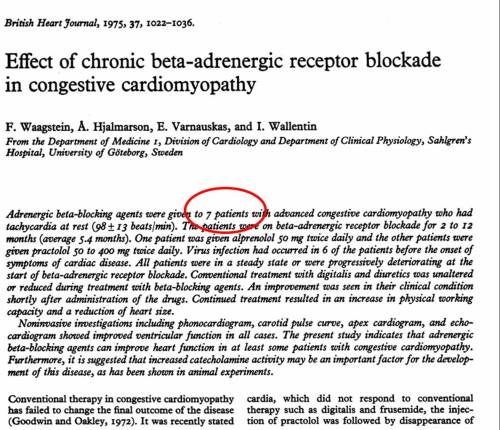
F .Waagstein of    Sweden just did this  with a  study population of seven  patients .

This land mark study , was least significant statistically , but most significant clinically

Today , as on 2009 , if any one submits a manuscript of a study  to a journal  ,  done with seven patients   he or she   will be called as a  fool  !  BMJ  , in 1975 had a courage in not  doing  so  and thus a break through concept was born.

So young scientists , should not  get bothered about sophisticated statistical method.

Science is not about number gimmicks it is about truth and nothing but truth  ! Truths  may  come out from  single digit study or even a single patient study

beta-blocker

To read & download  this land mark article click here

Read Full Post »

Dopamine and dobutamine are  the most commonly used inotropic agents in clinical cardiology.

The following table represents a simple comparison of the two drugs.

dopamine-dobutamine

Read Full Post »

First and foremost is

Avoid the procedure if  not really indicated.A lesion which  has more thrombus load  than a plaque and it is ,  subcritical and not limiting the flow  , PCI may be inappropriate  especially if the ACS is stabilised.

  • Adequate anticoagulation  along with  2b 3a blockers should be used
  • Predilatation should be minimally used or to avoided.Direct stenting preferred.
  • In primary PCI suction devices (Export etc may be useful)
  • Distal protective devices  are  “hyped up devices” rarely useful in an occasional patient with good distal vessel diameter.
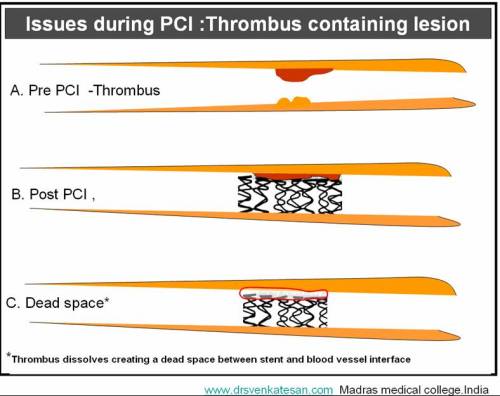
  • Pseudo stent approximati(fig 1) may occur. A Layer of thrombus may get plastered between stent and the vessel wall.In the post PCI  phase , with intense anticoagulation and antiplatelet regimen this layer may get dissolved and stent  may lose it’s grip and may dislodge or migrate.Another possibility is the dead space  beneath the stent  becomes a potential site for future  thrombus and ACS.

thrombus-and-pci

Fig 1

  • To prevent this complication , high pressure inflations and Post procedure IVUS (Intra vascualr ultraound may be done to ascertain lack of thromus between stent/vessel wal  interface)
  • Drug eluting stent evoked a special concern , when used in thrombotic milleu.This , has now been  proven to be  safe

Read Full Post »

CABG is tretment of choice for left main and  complex proximal LAD  lesions. So most patients get CABG in these situations.

The hemodynamic effects of LIMA graft on native left coronary artery can be tremendous and some times deterimental.

  • One of the consistent observation has been , the moment LIMA is bypasssed into distal LAD the antegrade flow through left main is reduced .This is still more significant if circumflex is also grafted .
  • For inital few weeks there is competition between LIMA flow and LAD flow and invariably LIMA wins  , and native leftmain or LAD  flow regresses and many times  closes totally.
  • Some studies have observed accelerated left main and LAD atherosclerosis.
  • The native LAD and leftmain could be a source for thrombi and atheromatous debri and these migrate distally and have potential to block the LIMA entry point  into LAD
  • The advantage of having a patent native left main and LAD  is that if the LIMA  graft occludes later on native circulation may assist.

Read Full Post »

Why PCI  in   left main CAD is considered  an inferior modality than CABG ?

CABG is superior to PCI for the  simple reason it provides complete revascularisation virtually in all  patients with LMCAD , while PCI is possible only in a fraction of patients with LMCAD.

If  we take 100 patients  with left main  disease may be ten (At best !)   would be  suitable for PCI ! In other words PCI is contraindicated in vast majority of LMCAD  by technical criteria alone , while there can never be a contraindication for CABG in patients with LMCAD.(Except  when , comorbidity precludes surgery )

Why  PCI in  LMCAD difficult ?

It is  dependent on  technicalities

CABG does not tackle a lesion,  it simply avoids it  and by passes it ” No great brains required”

while PCI takes on the plaque frontally ,  in the dangerous  terrain of  left main artery  itself !

so,  much caution,  planing ,  logistics are required . Further ,  if there is a complication there is a potential

for catastrophe  as the only  supply line is cut off . This is the reason , cardiologists were worried to try this on

unprotected left main. (Protected LMCAD refers to left main disease following CABG  wherein atleast   LAD or LCX is  grafted )

Points to ponder in LMCAD

  • PCI is suited for isolated discrete LM disease.In realty  this is seen in less  than 5-8 % CAD.
  • LMCAD is very often associated  with  critical and multivessel distal CAD . So these patients will be candidates for CABG.
  • Left main ostium or LAD ostial  involvement makes PCI a tougher exercise
  • Calcification is more common in LMCAD that  again makes PCI difficult.

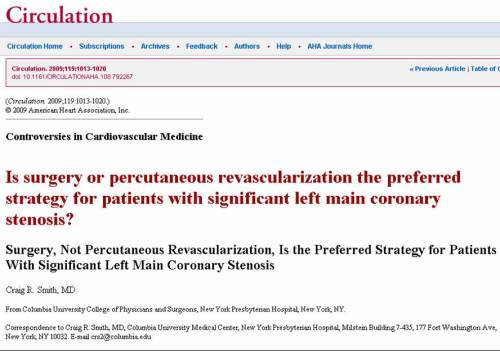
The following article in Feb 2009 is a major blow for proponents of  PCI for left main

http://circ.ahajournals.org/cgi/content/extract/119/7/1013

left-main

http://content.onlinejacc.org/cgi/content/abstract/51/5/538?ijkey=84c977d189e84327c3abbd4c1228de17dd99048a&keytype2=tf_ipsecsha

Final message

  • Conquering left main disease is an interventionist’s  ultimate dream.
  • But, before that they have  to tackle the bifurcation lesions .This is of vital importance, because 2/3 rd of left main  patients have  some form of bifurcation lesions. Current techniques , hardware  and outcomes are far below the idealistic solutions in bifurcation lesions.
  • Till that time ,  CABG would  remain the only choice for all , but for  a small fraction of isolated  left main disease where PCI may be possible.

Read Full Post »

Ventricular tachycardia as a group , constitute a major  group of cardiac arrhythmias. Most of the VTs are managed  by cardioversion  followed by medical management.  Few require , implantable defibrillator when there is severe LV dysfucntion .(ICD) Localising the origin of  VT and subsequent , ablation is the treatment of choice in some of the  patients  with VT.

Traditionally VT was thought to arise fro the endocardial aspects of myocardium. Now  we realise many times VT originate from the epicardial aspects of  ventricle.

Epicardial VT : Defintion

Epicardial ventricular tachycardia (VT) is defined as VT in which the critical sites of the reentrant circuit (or the ‘sites of origin’) are located exclusively in the subepicardial tissue, as shown by entrainment manoeuvres or VT that is terminated within 10 s with standard radiofrequency (RF) pulses, or both.  E. SOSA,M. SCANAVACCA et  all  http://www.springerlink.com/content/w608142674154tp5/ 


 How to recognise epicardial origin of VT by surface ECG ?

  • Terminal S wave in V2 and q in lead 1 strongly suggest VT of sub epicardial origin.
  • Pseudodelta wave 
  • Intrinsicoid deflection time of  85 ms
  • RS complex duration of  >120msec

Suggest   epicardial origin of the VTs.

Important Links

http://www.circ.ahajournals.org/cgi/content/full/113/13/1659 

Berruezo      criteria ,http://circ.ahajournals.org/cgi/content/full/109/15/1842  ( Must  read)

http://cogprints.org/4222/2/tada.pdf


What is the clincal significance of epicardial VT ?

Endo cardial ablation  not likely to be successful

Trans pericardial approach may be needed.

Read Full Post »

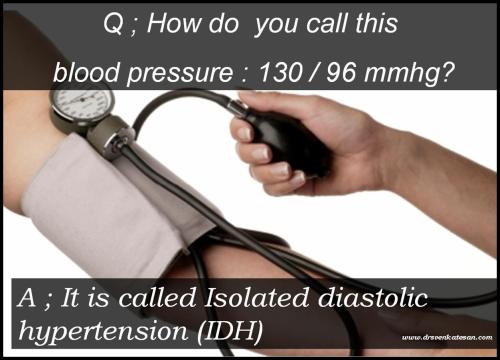
idh

  • Hypertension  is  major determinant of cardiovascular health  of our global population
  • Millions suffer,   hundreds of societies ,  and as many guidelines , and drugs are still struggling  to control the menace.
  • An important sub group of HT , (ie IDH ) population has been neglected and never received the scientific interest , which it deserves !
  • In our study it occured in 7.2% of all HT  patients.
  • JNC,  the world authority on HT never considered  IDH as a separate entity, and as of now there is no specific guidelines.
  • And the irony is complete . There is not  a  major study available to analyse the differential effects of anti hypertensive drugs on systolic and diastolic blood pressure.

If  a patient with the BP of 120/96 asks you , “Doctor , will the drug,   you have prescribed , selectively lower my diastolic blood pressure ” what will be your answer ?

A clear ,  I don”t know !

The following paper was presented in the World congress of cardiology Sydney  2002

Isolated  Diastolic Hypertension

S.Venkatesan,S.D.Jayaraj.Gnanavelu, Madras Medical College. Madras, India.

Abstract : Systemic  hypertension  continues to  be a major determinant of cardiovascular  morbidity. While isolated systolic hypertension(ISH) has been identified as a specific clinical entity, isolated  diastolic  hypertension(IDH) has not been reported as a separate group. When we analysed our data from our hypertension   clinic  we found  a distinct subgroup of patients who had  elevated  diastolic blood pressure   with  normal systolic pressure. We report the clinical profile of these patients. 440 newly registered hypertensive  patients between the year 1998-99  formed the study population. All  patients with secondary hypertension  were excluded.. IDH  was defined as  diastolic BP more than 90mmhg and systolic BP less than 140mmhg.

IDH was present in 32(7.2%) patients.  The male female ratio was 3:1, mean age was 42(Range32-56) The mean diastolic pressure was 96 mm (Range 90-110).The mean systolic pressure was 136mm(Range 128-140). LVH was observed in 4 patients(12.5%). Diastolic dysfunction was detected by echocardiography   in 20patients.(62%)

We conclude that isolated diastolic hypertension  constitute a  significant subset among  hypertensive  patients and they need further study regarding the pathogenesis, clinical  presentation and  therapeutic implication.

Link to PPT  will be available soon .

Read Full Post »

                                         Ventricular  tachycardia is considered as a dangerous electrical rhythm abnormality .It can immediately degenrate into ventricular fibrillation and result in SCD in many.Ironically, it is also a fact , a patient with VT can  present silently  without any symptom  .Some VTs are slow and recurrent without much affecting The hemodyanmics.


In chronic recurrent, beningn VT (Some may consider it , ” height of  absurdity ” to call a VT beningn ! but it  is a reality , the term beningn denotes –  very remote chance of converting into VF) ” Is there any other therapeutic option other than convertng into sinus rhythm. “(  Read related topics)


The following paper was presented in the Annual scientific sessions of  Cardiological society of India,  Kochi , seven years ago in  2002


VENTRICULAR RATE CONTROL  IN  VENTRICULAR TACHYCARDIA 

S.Venkatesan,,. Madras Medical College. Chennai


                           Mangement of  hemodynamically  stable  recurrent   ventricular tachycardia  remains a  delicate clinical problem. Reverting to  sinus rhythm  is  considered as  the only aim  of  treating  VT.While rate control is accepted as a therapeutic  option  in atrial fibrillation,  it is not  so,  for  ventricular tachycardia.In this  context  we attempted to analyse  the effect of  Amiodarone on   ventricular  rate  in stable ventricular tachycardia  which fail to convert  to sinus rhythm.


                            The  study cohort consisted of 49 patients with stable VT  who were admitted in the coronary care unit  of  Govt. General Hospital  between 1998 to 2002.The criteria for inclusion   were systolic BP>100mmHg and absence of  hypoperfusion of vital organs  The mean age was 52 years (range 26-68)  with a male female ratio  of 4:1.   Of the study group 36 patients  were either reverted with  IV lignocaine , Amiodarone ( 150-300mg   bolus )  or  DC  cardioversion . 13  patients  who did not respond to   either of these   were  followed up  with  Amiodaroneinfusion(1000mg)  for 24 hours.  The baseline  diagnosis were old MI (6)) DCM (3)  Arrhythmogenic RV displasia(2). Idiopathic VT was diagnosed in  2 patients.All these patients had  VT  during  most part of  the   24 hour  follow up.


                         The pre Amiodarone mean  ventricular rate was  152  (124 –196).  Post amiadaorne (at 24hrs) mean ventricular rate was 128(88-142). The time taken for   50% heart  rate reduction was  6.6h (4-24h).  The average  systolic blood pressure  improved from  100   to  112mmhg . These patients were  discharged  in stable clinical status with oral Amiodarone and  were  referred for  EP study.


                          It is concluded that Amiodarone, apart from it’s cardioverting ability , has a distinct ventricular  rate controlling  effect  which  can be of therapeutic value in  at least certain subset of chronic recurrent VT.

Final message


Some of  the patients  with VT carry a very low risk of VF  and SCD .In these  patients , the only  other major  aim is to prevent tachycardiac cardiomyopathy  that can be done with drugs which  controls  the ventricular rate whenever  VT occurs !

Corrrecting the primary cause like cardiac failire , revascularisation ,detailed EP study  ,tachycardia mapping , followed by RF ablation and ICD implantation is  the state of the art approch in the management of VTs.But this small clinical observation was made to  impress rate control could also be an option  in patients  in whom these procedures are  contraindicated  or not  available . 


Read Full Post »

« Newer Posts - Older Posts »