Feeds:
Posts
Comments

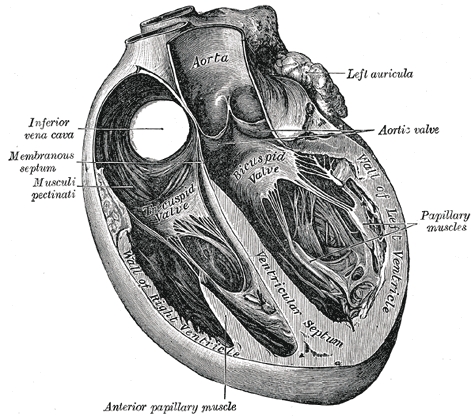
Moderator band is a ubiquitous structure  found inside right ventricular   cavity , often overl0oked by cardiologists. God has created no structure  without any purpose ! Moderator band has important role to play  both in physiology and pathology .

Image credit and courtesey : Whoever has created

The table attempts to summarise  the features  of moderator band. The  structural and functional behavior of moderator band  in , RV cardiomyopathy , RV non compaction and arrhythmogenic  RV dysplasia is not fully studied yet  . Reference :Content is taken from various sources and with a personal input in few places.  The anatomical data is largely taken from the pioneering  work of cardiac  pathologist and morphologist  RH Anderson of  United kingdom.

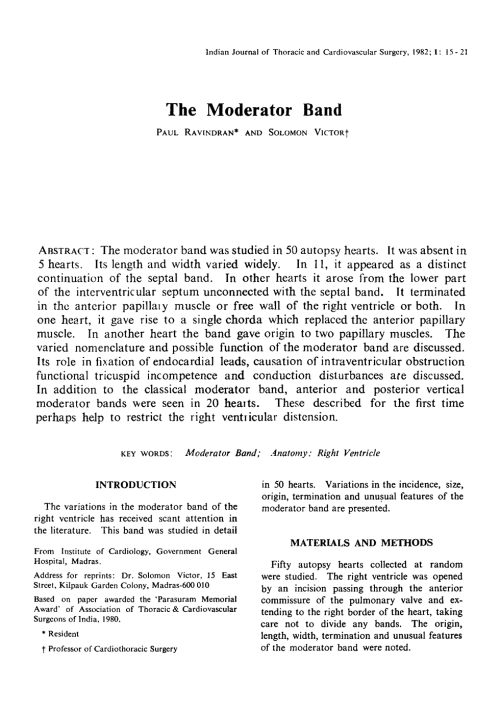
Here is an article  from my institute Madras medical college  published in Indian journal of Thoracic and Cardiovascualr surgery in 1982.

An autopsy study  on moderator band   by Paul Ravindran and   Solomon victor

http://www.springerlink.com/content/g35616v662976g1r/

http://circ.ahajournals.org/content/67/6/1268.full.pdf+html http://www.ncbi.nlm.nih.gov/pubmed/20235167

//

Pectinate muscles are specialized Intracardiac  muscle

  • Pectinate muscles are located mainly in the right atrium  , more  in right atrial  appendage , sparse in left atrium
  • Has muscle fibers arranged in a  comb like fashion.
  • Has less mechanical activity, no significant contribution to atrial contractility.
  • Can stretch and improve the voluminous nature of right atrium
  • The pectinate muscle  folds act as RA volume reserve  during adverse loading conditions . It helps RA dilate with out much wall stress.
  • Rarely it can be a cell of origin for focal atrial tachycardia

Image Source : Greys anatomy

The concertina like effect of pectinate muscle .

The atrial infolding increases the surface area of atrial chamber at times of dilatation , like  the music instrument .So,  these macro  folds ( like intestinal villi )  help overcome the  constantly changing volume status of right atrium.Since the  variation  left atrial blood flow is  not that much ,  the pectinate muscles  are not well developed  in the left atrium.

The same rules would apply for  why  there is excess  trabeculations  in right  ventricle  than  left  ventricle .

This  happened  in one  of the cardiology  work shops  I  recently attended ,  which  beamed  live cath lab procedures from across the  country.

An   interventional   cardiology  team  in a  bright sky  blue  suit was preparing a  patient for   graft angioplasty  in  a degenerated  SVG graft to left circumflex  . The patient had apparently had  CABG  few years ago  (LIMA to LAD still functional   )   . His LV  EF  was reported   to be  40 %.  The procedure was about to begin. The femoral artery was  being  cannulated . . .

As the audience  were encouraged  to ask questions.  A young cardiologist wanted to know what was the indication to open up the graft  / And what was  his symptom ?

“Do not ask such silly question”  . Prompt came the reply from  one  of a   senior interventional cardiologist from within the cath  lab. He further said  such questions can  not be entertained  as the   forum is meant for tips and tricks to cross a degenerated vessel graft .  When he insisted for an  answer , the entire panel  joined the  ridicule and  the questioner  quietly went out of the hall !

What  do you infer from such reaction?

What makes this question silly ? Why the cardiologist got annoyed and amused ?

This odd  reaction  implies  ,  the  cardiologist  has  something to hide or has guilt of   doing inappropriate procedure.

Such is the transparency in  cardiology workshops  transmitted  live all  over the  country  imagine   what  one can  expect in regular cath labs .

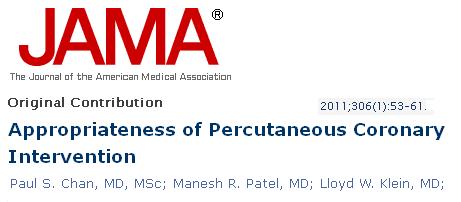
No doubt  JAMA has come out with most  important article  for us. http://jama.ama-assn.org/content/306/1/53.abstract

Live  workshops are not simply to train our hands . It is supposed to teach  us   the “what is right” and “what  is wrong” ,  “what is good” and “what is bad”  for our ailing patients. The senior  cardiologists who administer these workshops  should realise this fact. Very often a bad example is set .   When asking for  patient’s  true symptoms   looks  silly  for us  . .  .  guess where our profession is  heading for !

Left atrial clot is a  traditional contraindication for performing PTMC.  This rule was formed in the early days of PTMC.

PTMC  recently celebrated  its 25th birth day .  In India  it was  first  done by   GB Pant hospital by  Kallilulah in early 1980s.

Now most  centers  do it  routinely   like a diagnostic angiogram.  Even fellows can do it  with ease. (If allowed !)

We have learnt  the nuances  of septal puncture , maneuvering the transpetal needle and  the balloon  catheter  within the LA in the last two decades.it is also becoming clear  how the IAS anatomy  behaves in various LA and RA sizes  and pressures . So , the experts (Read again         . .  .experts !)  have relaxed the rule of the PTMC game !

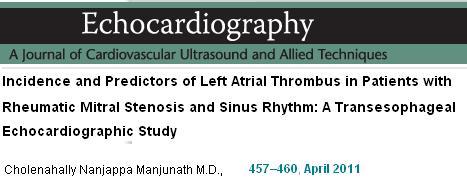
PTMC  can safely be  done  if the LA   clot is confined to  the appendage  .Even clots  abutting just  out of LAA appendage  may  be tried if you have the expertise  akin to  Dr Manjunath and  his team  from the garden city of India .(Jayadev  institute ,  Bangalore probably has the largest  talent  pool for PTMC , In fact  they have  classified the LA clot according to size and location .)  Read the reference below.

If a cardiologist  is allowed to meddle the LA  filled with clot ,  why not a surgeon  do  a CMC   in the presence of LA clot ?

I believe old generation surgeons did it. I am told few surgeons  have specail talents to deliver LA clot off pump and complete a successful CMC   with lateral thoracotomy .  Fresh un organised clot can be flushed out of LA .
But currently doing a CMC  with LA clot is considered unscientific . Further  surgeons  often consider CMC as an inferior Job .They love to go on pump  and replace mitral valve with a  slightest provocation .  It need  be realised a half functional native  valve  is at any time   better than an artificial valve . In  developing countries    CMC  would make lot of sense when we confront with small LAA clots . One can do 5 CMCs at the cost of one mitral valve . Surgeons comments are welcome.


What  will happen  if LA cot gets accidentally dislodged ?

A stroke  or a systemic vascular event may occur  , but it depends upon the embolus size .Up to 2mm clot  debri can easily cross the cerebral  microcirculation and escape a major stroke.Showers of micro emboli can cause a lacunar infarct or vascular dementia.

By the way ,  I am curious to know what will happen to  these  clots after successfully  opening the mitral valve by         PTMC*  ?

PTMC can not be claimed as a cure  as long as the patient harbors the clot in a precarious location . So it  needs intensive oral anticoagualtion (or even heparin ) and many times we have observed these small clots disappear .

*Logic would  suggest an LA clot  with a  closed  mitral  valve  could be  much safer ! many times we have seen large LA clots struggle to get past the mitral valve because of critical stenosis.

A video of mobile LV clot from our institute . http://www.youtube.com/user/venkatesanreddi#p/u/40/zHdPtm32YZQ

Here there is no chance of PTMC ,  however good you are !

Future innovations

  • Distally  protected PTMC
  • Either you should trap it and remove it or desiccate it into minor particles.
  • Basket in root of aorta to capture  the clot in transit   may be a good  concept to try.

What  happens to LA clot following long term oral anticoagulations ?

Most disappear according to a study from JIPMER , Pondicherry , India .

http://www.ncbi.nlm.nih.gov/pubmed/14686666

Excellent PTMC  data   from Pakistan and Sudan

If you want to learn about PTMC  please note  the experts are not  in Cleveland clinic  or  from Great ormond  street

they are from the remote third world locations .

http://www.sudjms.net

http://www.ayubmed.edu.pk

A stent missing a  lesion after a PCI  is referred to as geographical miss.

It can be metal missing a lesion ( in BMS )or a drug missing a lesion  with DES.

Geographical miss is  obviously  more important with DES ,   as both metal and drug can miss a lesion ! (A double miss !)

Read a related article in this site. Geographical Miss : Difficult coronary Runways . . .

What are the types of  geographical miss ?

A.Longitudinal

B.Axial

Longitudinal miss is more of a technical failure (Interventionist error ) While  axial miss  is  often a  design or concept failure .

Longitudinal  miss results in edge lesions ( either  stent inflow or outflow lesions) .Axial miss result in discreet  in-stent lesions .

Please remember ,  axial GM  is  much more common .

What is definition of  axial geographical miss ?

Inadequate inhibition of intimal hyperplasia within the region of stent .

Mechanisms of  geographic miss in DES era

  1. Stent  vessel diameter mismatch  (Less drug vessel contact)
  2. Low drug dose -Pharmacological error
  3. Stent radial strength more than the desired force per unit area . This excess  stress  effect  might interfere with drug release.
  4. Some degree of vessel injury is needed for drugs to percolate. (A very smooth deployment may not release the drug  properly )*

*A modern day cardiologist  is expected not only to deploy the stent properly , he has to make sure drugs reach the target cells . What an  irony  cardiology can be  .  . . a  too gentle  PCI  can show up a  negative face ! when we want to poison selectively  the atherosclerotic plaques .

What is the incidence of GM ?

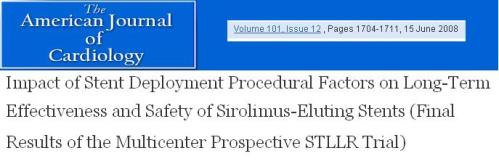
In  STLLR trial which looked specifically the issue of GM  the incidence was very high ,  an astonishing 65 %

How to recognise it ?

Longitudinal miss can be identified by conventional angiography.

Axial miss is very difficult to diagnose . IVUS,ICT will  help.

Many times it is an after thought  when patient presents with  an event.

What can we do once we recognise it ?

Unfortunately nothing much can be done to reverse the miss especially the axial ones.

longitudinal miss can be corrected by a over lapping stent .(Still ,  we do not know the implication of double metal doses  dragging an edge of lesion !)

Can  “Geographic miss”   be termed as  a failed PCI ?

Clinically , technically , logically and morally  Yes .

But  practically  “No” ,  as GM  takes much longer time to manifest as a clinical event  ,  by then , no one   would  really attribute  the event as  procedure  related  . And of course ,  we have numerous other  excuses to convince our patients.

The link to STLLR  trial which gave us the startling data about GM .


http://www.ajconline.org/article/S0002-9149%2808%2900350-0/abstract

Medical science is  nothing ,  but trying hard all possibilities. Most innovations die .Only a fraction will survive .

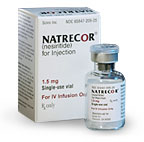
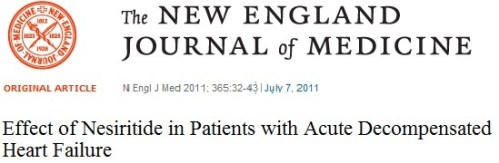
That does not mean we should not try ! The greatness is in accepting the failure.  The wonder drug which was an analogue of human atrial  naturetic peptide    (BNP)  Nesiritide   , died a peacful death on July 7th 2011 .

Long before , in year 2005 ,  Eric Topal in a hard hitting  Editorial  of  NEJM  wanted to hang this drug .

But it was a case of prolonged  death sentance .

http://www.nejm.org/doi/full/10.1056/NEJMp058139

Should we  pity with the drug companies  and forgive them for delaying it’s  exit ,  enable them  recover the  cost involved  .

Meanwhile , Nesiritide might have died ,  the  concept of  BNP analogues may need to be explored further.

Here is a  video recipe  !

Please click here to  see more videos from my you tube site

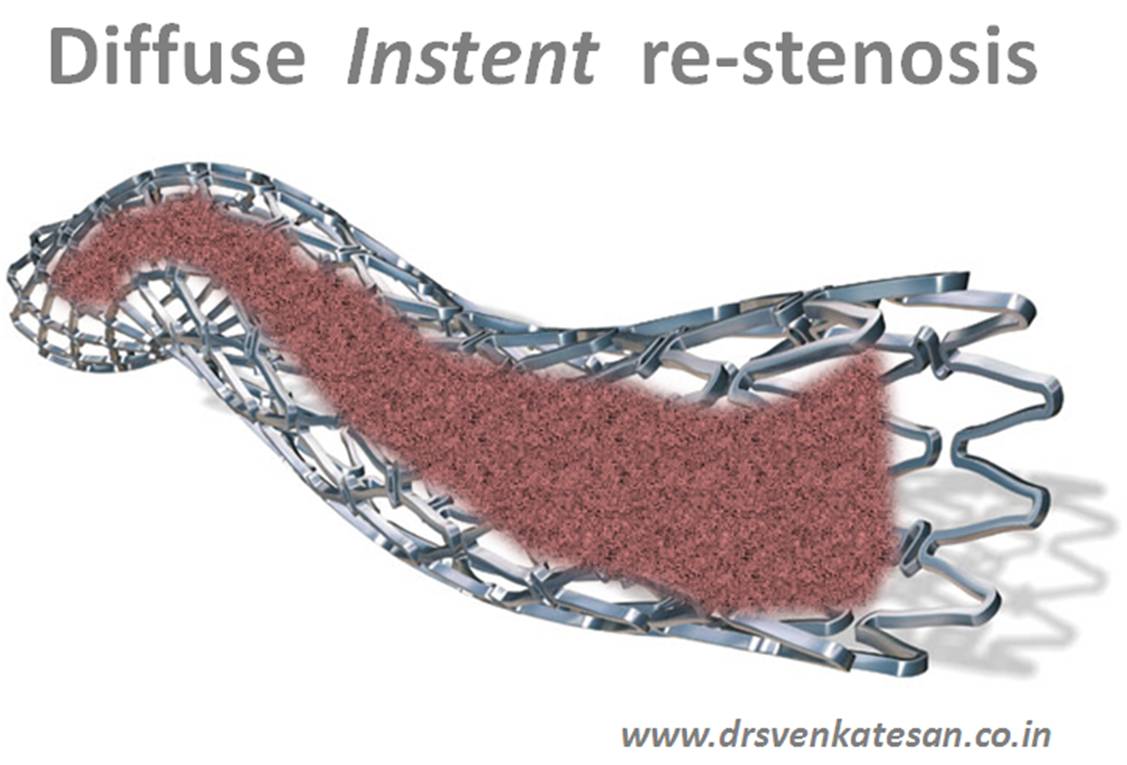
How do you tackle  In-stent restenosis  (ISR) ?

  1. Deploy another BMS
  2. Use a third generation  DES
  3. No . . . first  generation DES(Paclitaxel )
  4. Consider Plain balloon angioplasty.(POBA)
  5. Refer for CABG.
  6. Fall back on medical management.(Ingloriously  referred to  as  “No option” patient !)

Answer:  Please  note , there is no single response answer for this question .

Instent restenosis (ISR) is   commonly seen with BMS .This is primarily because  we are busy blaming DES  for stent thrombosis  and we do not want to give a double blow to DES .There is a  significant population  roaming with ISR  involving  DES .  BMS is in vogue for nearly 2 decades, hence it is natural to see more of it.  In due course ,  DES  is expected to catch up with BMS  and would lead in ISR as well .

The issues in PCI for ISR

Though any of the above 6 strategies may be appropriate ,the urge to put another stent within the IRS ,  prevails over all other options in most centers. This is more off an Interventionist talent  show off  !

Please remember , the common  principles  must apply in all patients before an PCI  . Simply stated , this  principle involves  assessing  symptoms, residual  resting  ischemia, myocardium at risk  during stress, viable muscle mass etc .Lesion characteristics  should come last in the work up. ( A cardiologist  should not  report  a coronary angiogram  , if   does not  not know  basic clinical parameters.)

It is  good  to have a  rule  that  “reserves  intervention”  for ISR  only if the  patient  has refractory angina. 

Can you promise  relief from dyspnea

Contemplating  PCI for  patients with dyspnea as the main symptom is really tricky one.Unlike angina ,  dyspnoea  can be attributed to so many factors other than coronary blood flow.(Apart from LV EF , Iscehmic MR,  A transient diastolic dysfunction , lung function , volume status, renal function , physical conditioning etc)

Opening  ISR in the belief it would improve LV function is highly questionable even if viability is documented.

What is the most important step in the decision making prior to PCI for ISR ?

* Most important step  in ISR management is  probably  spending  sufficient time ,  involving  experts ,  ” democratically  debating”  the indication and techniques  in your institutional cath conference.

Once you document the necessity of intervention* The following things  are possible .

  1. If  the patient has diffuse in-stent stenosis , especially  the  proximal ones or that  involves  branch points,  it is wiser to refer  them for CABG.
  2. Discreet and focal ISRs can safely be attempted for repeat PCI.
  3. BMS or DES  ?  This  is  debated. Current preference is to use  a DES. (Many feel ,first generation DES -(Paclitaxel)  scores over Everolimus in this situation )
  4. Is POBA  possible for IRS ? Can a balloon do a job where a stent has failed ? . No  body is trying it .Many Feel guilty to  do it .  POBA for IRS is a failed concept without even trying it !  One  way of reasoning  is IRS occurred  only  because stent was  never indicated in the first place  in that  location  and a POBA would have been the choice in the initial attempt itself .So let us not make the second error !  ( May be , if  Gruientzig is alive today ,  might have  used  POBA  for ISR very effectively ! )

Issues for which  we will never ever know the answer !

In future any of the following combination of  stents  will occur in tackling ISR.

  • DES covered  BMS
  • BMS covered DES
  • Two BMSs
  • Two DESs
  • Paclitaxel covered Everolimus
  • Everolimus covered Cypher.
  • Overlapped DES and BMS
  • DES covered beta irradiated IRS
  • Rotablated BMS (Yeh metal crushing !)  followed with  DES jacket !

How does the two metals ,  two drugs in various combinations interact with  the tender coronary  endothelium ?

Endothelium is an endocrine organ. It has  to secrete as  many pro and anti homeostatic molecules (Nitric oxide, endothelin etc).This has to be  kept in mind when we develop newer and exotic devices. Of course ,  we claim our  aim is primarily  to provide  relief  to  our ailing patients , but, as things stand today  , there is a distinct risk of  converting human coronary arteries into corporate playgrounds !

Reference :
http://circ.ahajournals.org/content/100/18/1872.full.pdf+html

Surprisingly it is common !

A .Abandon the procedure call the surgeon for an emergency CABG

B. Open the most critical lesion.*

C.Attempt to open and stent all possible lesions.

D.Send the patient back to CCU for a conventional  thrombolysis or attempt a intracoronary thrombolysis.

Answer : All  can be a right response depending upon the available expertise ,  time window, associated complication and hemodynamic stability etc .

* Please note ,the most tight lesion may not be the culprit artery. Though there is high chance for that  being the culprit , it  can be very deceiving   especially when  there is multi-vessel  CAD with  chaotic collaterals.

The site of lesion and site of infarct can unimaginably remote.  (A traffic snarl at remote flyover  can have its impact  right on the busy commercial street due to diversions ! ).

What will happen if you open  a non culprit artery first mistaking it for a culprit ?

This could lead to  dangerous turn of events as whatever little perfusion the patient was getting through the ill-fated  IRA will be challenged by the fresh diversion  facilitated by non IRA angioplasty. Extreme caution is required.

Emergency CABG  within 3 hours  of MI even though advocated  by few ,  is still considered a risky  way to reperfuse  the heart.(In India  there  is  nothing called primary CABG!)

An energetic interventional  cardiologist would vouch for opening all lesions . Only thing  , he has  to  make sure is  , the patient also has enough energy to withstand  his  onslaught. Never   non culprit lesion if a patient is stable . 0ur aim is not that.If the patient  is in shock or impending LVF one can justify opening  few more lesions  that improve total muscle function which can be vital.

What about fall back on thrombolysis?

This may be seen a defeatist attitudebut  when the aim is  in the  well being of patient ,  there is no defeat or success. If severe  CAD is encountered and both  CABG / PCI  or not an option,  the cardiologist need not feel guilty or  humiliated to refer him back for thrombolysis. (Of course , Intracoronary thrombolysis  is  an option !)

Final message

Primary  PCI  is often made  to  appear ” As  a  kids play”  by many modern  day cardiologists . It is not so.  It requires a team effort. It is  race against time.   Feasibility depends largely on the coronary anatomy. The failure rate of  primary  PCI is often camouflaged .(Currently Success of pPCI is boasted at 95%)   Logically it should include pPCI ineligible anatomy as well . Many still do not understand the real purpose of pPCI.   The aim is to salvage the myocardium  at risk , sure and fast. Never attempt for total revascularisation in an emergency situation however tempting it is !

In young persons with discrete single vessel disease  the procedure is simple and outcome is straight forward. In elderly , diabetic , STEMI on  preexisting CAD,  diffuse  multivessel disease  ,   complex main left,  bifurcation lesions , one requires  lot of brain sense  to provide optimal outcome . Many times that sense includes abandoning the procedure !

Please read a related article in this site  Primary CABG

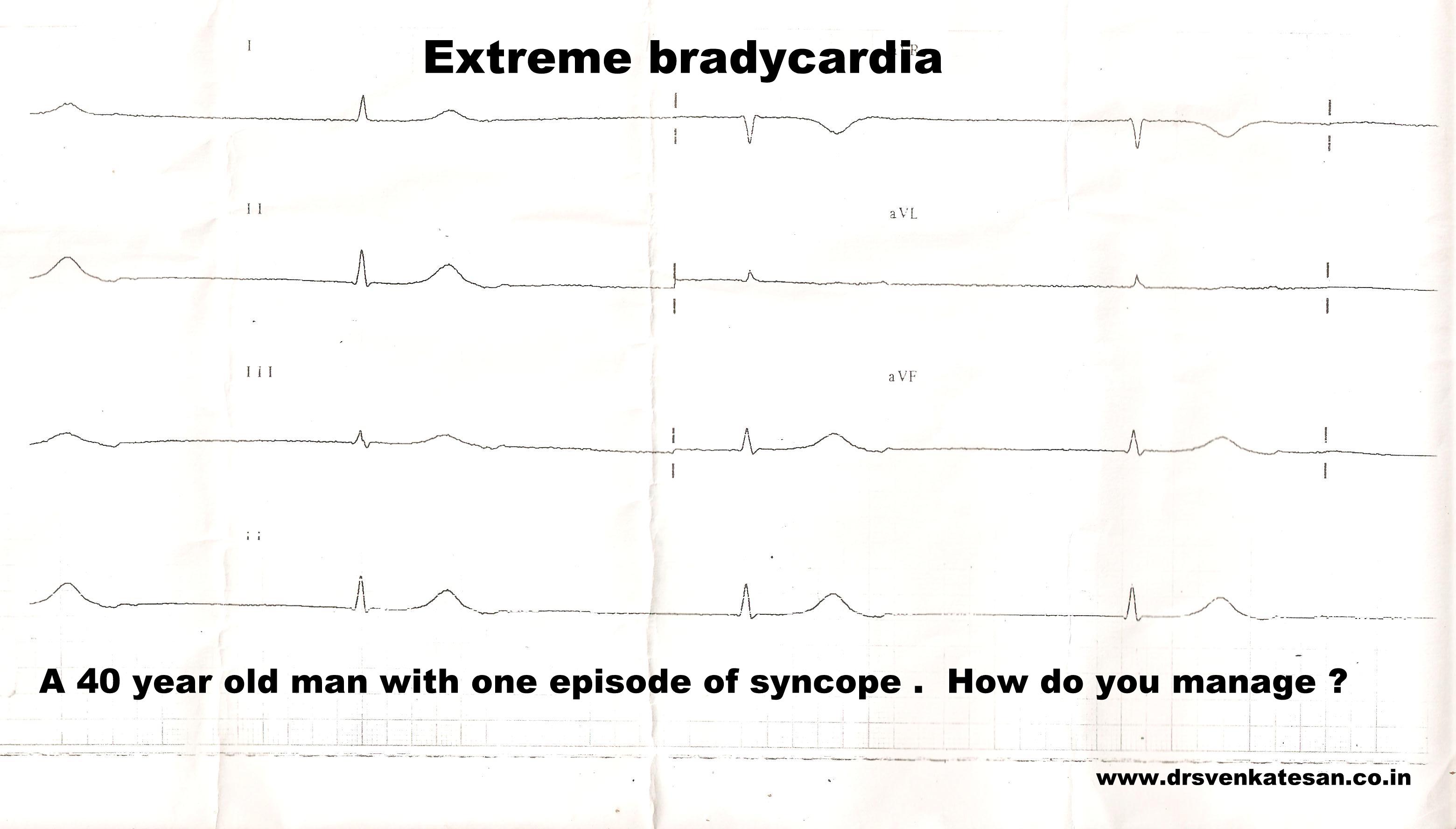
A man  in his 40s presented with an episode of syncope and followed by recurrent episodes of near syncope.

His ECG showed (See image)

  • ECG shows absolutely no evidence of sinus activity . That is  sinus arrest.
  • He lives by the mercy of his AV node.(“Great  escape” junctional rhythm  ! ) . Please note ,  It  fires at less than its intrinsic rate indicating AV nodal sickness as well.
  • The Heart rate is around 18/mt.

SA node is dead(Sinus arrest ) as evidenced by absent p waves. AV node is sick(Depressed) because the junctional rate is less than 20 /mt.

At what  heart rate a person  would develop syncope and near syncope ?

There is no fixed cut off rate for  syncope. It all depends upon the baseline LV function, his exercise capacity, vascular tone etc.

Most will develop some symptoms at  a heart rate less than  40/mt .

Dizziness occur and 30, syncope is sure  when hear rate  dwindles  less than 20 /mt.

A heart rate of 10-15 circulation tends to stall. But still few men are found alive at this rate.

What is the  risk of this patient dying suddenly ?

Contrary to the expectation SCD is not common in  isolated sinus node dysfunction .

It is more common with AV block. The reason being as long as the AV node is fine it will support the rhythm at least at about 30 or s0.

The cause of death in SND is extreme bradycardia induced phase dependent VT /VF.

Will you do a  EP study for him  ?

No. He  does not require it. He is symptomatic ,  and his  ECG shows  tell- tale evidence for SND with AV node depression.

So the there is not even the  necessity to assess  AV nodal status. But .one should  be aware  , there is a battery of tests for SND evaluation (SNRT, cSNRT SACT, etc*) .These are  done only when diagnosis is in doubt or for an academic purpose in teaching hospital.

What pacemaker will you use ?

  • DDDR
  • AAIR
  • VVIR

AAIR can not be used as we have evidence for AV nodal  slowing .

DDDR may be ideal.  In India we still  use VVI mode extensively . Ventricular pacing always safe when you have no EP facilities.  It makes EP study to assess AV nodal function  redundant.

* In all patients with severe bradycardia , a complete workup for systemic diseases like hypothyroidism and other chronic inflammatory pathology must be ruled out. Drug induced bradycardias can exactly mimic pathological  SND. Recognizing these entities could avoid  inappropriate pace maker implantation for  transient reversible bradycardias.

* SNRT – Sinus node recovery time. cSNRT -Corrected sinus node recovery time .SACT-Sino atrial conduction time.