Feeds:
Posts
Comments

Posts Tagged ‘jacc’

pci-ptca-ebm-stent

Scientifically ,  the  indication for coronary revascularisation   should be  based on following

  1. Patient’s  symptom ( more specifically angina , dyspnea is less important !)
  2. Prov0kable  ischemia  ( A significantly positive stress test )
  3. Signifcant LV dysfunction with  documented  viable myocardium &  residual ischemia
  4. A revascularisation eligible coronary anatomy * TVD/Left main/Proximal LAD etc ( *Either 1, 2 or 3 should be  present  in addition )
  5. All emergency PCI during STEMI /High risk NSTEMI

Practically ,

A CAD  patient  may fulfill  “Any of the above 5 or  “None of the above 5” ,  but ,  if   a coronary obstruction  was  revealed  by coronary angiogram  and if he  fulfils The 6th criteria , he becomes  eligible for  revascualrisation

6th criteria

If the patient has  enough monetary   resources (by self  ) or by  an  insurance company  to take care of PCI /CABG *

*The sixth  criteria overrides all other criteria in many of the cath labs .Of course , there are few genuine ones still  fighting hard , to keep the commerce out ,  from contaminating cardiology !

Read Full Post »

Coronary artery  perforation is a dreaded complication of PCI. Perforations are the Interventional cardiologists ultimate worry   as they need to  manipulate their  hardware for  long periods in many complex lesions.  Especially  it is a  real threat in chronic total occlusions.

Still , an important fact is ,  many of the coronary perforations are not life threatening ?

How is this possible ?  (Type 1 Ellis has zero mortality Read below)

As the guide wire injures and perforates the cor0nary vessel,  it results in  small puffs of dye extravasating  into peri coronary space .

The coronary artery , which is located   within the  atrioventricular groove  (LAD), or AV groove (LCX, RCA) have  two distinct anatomical relationship with reference to epicardium and pericardial space.

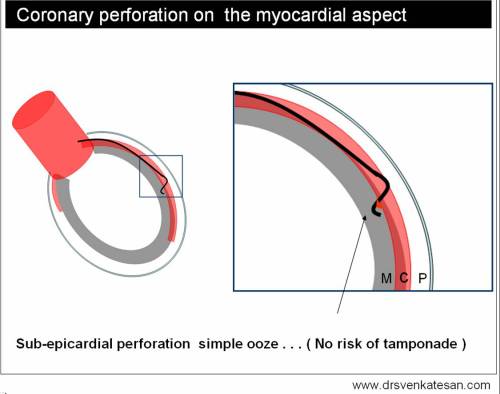
50 % 0f circumference of the coronary artery is  hugged  by the myocardium  another 50% or so is related directly to the pericardial aspect.

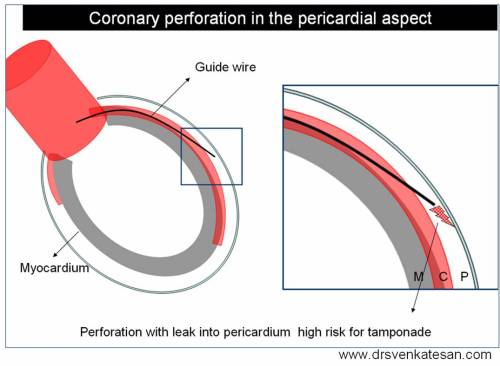
Guide wires hitting on the myocardial aspects face a stiff resistance than the pericardial aspect. So , generally the risk of perforating pericardial aspect is more than myocardial aspect

Even if , the coronary artery is punctured on myocardial aspect , no great danger occur as there is no potential space for the blood to drain and further,  the  elastic nature of myocardial muscle plane effectively seals the leak. At the most , mild myocardial staining is noted .

coronary-perforation-2

While ,  perforations  into  the pericardial space  , often threaten with a tamponade. The fact that pericardial space has negative pressure and  the mean  coronary arterial pressure around 40mmhg ,  it is  , all the more likely blood is sucked into the pericardial  space. Of course , very minute  perforations  even into the pericardial space ,  could  be self limited and  benign.

coronary-perforation

What is unrecognised coronary perforation?

Many times , the guidewire goes in a false track in the tissue plane.This is  nothing,  but perforation without hemodynamic implication. Most often , these are the instances of guide wire entering the epicardium.They mimic , false lumen entry , dissections, etc. There are occasion , where false lumen of the  coronary artery were  stented.

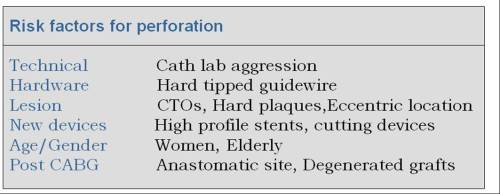
What are the  factors which increase risk of perforation ?

perforation-6

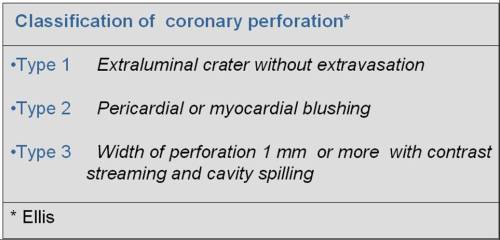
 How do you classify coronary perforations ?

perforation-3

*Ellis SG, Ajluni S, Arnold AZ,  Increased coronary perforation in the new device era. Incidence, classification, management, and outcomeCirculation. 1994;90:2725–2730


How do you manage coronary perforation?

Simple guide wire induced perforations are less trouble some unless we have crossed it with balloon without realising the fact the wire has entered the pericardial space. So, caution is required and always watch for guide wire tip movement which is often funny looking wihtin false lumens or very freely moving within pericardial space. Anticipate the complication especially so when you do CTOs and venous graft PCI.  Keep one cath lab  tamponade crash  bin  in ready mode before embarking upon a complex PCI

  • Neutralise the heparin action with protamine is the first step
  • Most are self limited, no intervention is required  but requires close observation for next 24 hours.
  • Temporary balloon occlusion may be suffice in many cases
  • Tamponade requires immediate tapping. Small collection without fall in BP can be observed.
  • keep doing the echocardiogram liberally to assess the leak and watch for any new collection.
  • PTFE covered stents if prolonged leak.
  • Emergency surgery may required in few.

2018 update 

This is  nearly 10 years old article. Now, we have gained much experience and hardware utilisation have rapidly expanded. While expertise has minimised this complication , more PCIs in complex lesion subset tend to keep the incidence static , if not higher.(Its around .5% )

Tips to use balloon occlusion during perforation

Perforations which are active and flowing should be immediately occluded with a balloon either at the site of leak or just proximal to it. Doing a proximal occlusion is easier in emergency , as often times its technically difficult to reach the site of leak especially in CTOs where the leaky site is not defined clearly or forward looking (Local balloon inflation across the leaky site is not feasible )


How long to occlude , Intermittent /complete, proximal ? or at the site of perforation ? These queries are answered in Ref 4

Reference

1.Largest report (1762 cases) of perforation from British Cardiovascular Intervention  Society Database Circ Cardiovasc Interv. 2016;9:e003449.

2.Al-Lamee R, Ielasi A, Latib A,. Incidence, predictors, management, immediate and long-term outcomes following grade III coronary perforation. JACC Cardiovasc Interv. 2011;4:87–95.

3Xiangfei Wang and Junbo Ge Balloon Occlusion Types in the Treatment of Coronary Perforation during Percutaneous Coronary Intervention   Cardiology Research and Practice Volume 2014, Article ID 784018,

4.A very good review comes from Royal Hospital, Muscat, Sultanate of Oman


iFAQs in coronary perforations

1.Does the plane of the coronary artery (Sub epicardial within the fat layers)  determine the likely hood of tamponade ?

While myocardial tissue can resist flow we are not sure about sub-epicardial fat on the pericardial aspect.

2.How common is Intra-cavitory perforation ?

Perforations into chamber is invariably associated with septal branches (PCI to septal branch itself is less common )

Read Full Post »

Why PCI  in   left main CAD is considered  an inferior modality than CABG ?

CABG is superior to PCI for the  simple reason it provides complete revascularisation virtually in all  patients with LMCAD , while PCI is possible only in a fraction of patients with LMCAD.

If  we take 100 patients  with left main  disease may be ten (At best !)   would be  suitable for PCI ! In other words PCI is contraindicated in vast majority of LMCAD  by technical criteria alone , while there can never be a contraindication for CABG in patients with LMCAD.(Except  when , comorbidity precludes surgery )

Why  PCI in  LMCAD difficult ?

It is  dependent on  technicalities

CABG does not tackle a lesion,  it simply avoids it  and by passes it ” No great brains required”

while PCI takes on the plaque frontally ,  in the dangerous  terrain of  left main artery  itself !

so,  much caution,  planing ,  logistics are required . Further ,  if there is a complication there is a potential

for catastrophe  as the only  supply line is cut off . This is the reason , cardiologists were worried to try this on

unprotected left main. (Protected LMCAD refers to left main disease following CABG  wherein atleast   LAD or LCX is  grafted )

Points to ponder in LMCAD

  • PCI is suited for isolated discrete LM disease.In realty  this is seen in less  than 5-8 % CAD.
  • LMCAD is very often associated  with  critical and multivessel distal CAD . So these patients will be candidates for CABG.
  • Left main ostium or LAD ostial  involvement makes PCI a tougher exercise
  • Calcification is more common in LMCAD that  again makes PCI difficult.

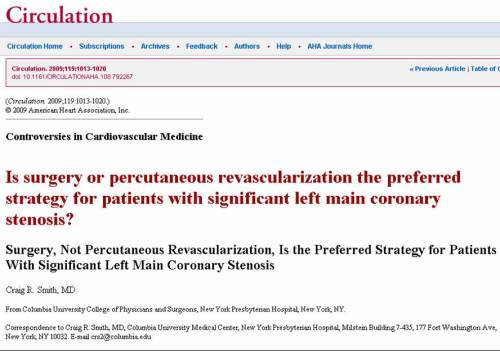
The following article in Feb 2009 is a major blow for proponents of  PCI for left main

http://circ.ahajournals.org/cgi/content/extract/119/7/1013

left-main

http://content.onlinejacc.org/cgi/content/abstract/51/5/538?ijkey=84c977d189e84327c3abbd4c1228de17dd99048a&keytype2=tf_ipsecsha

Final message

  • Conquering left main disease is an interventionist’s  ultimate dream.
  • But, before that they have  to tackle the bifurcation lesions .This is of vital importance, because 2/3 rd of left main  patients have  some form of bifurcation lesions. Current techniques , hardware  and outcomes are far below the idealistic solutions in bifurcation lesions.
  • Till that time ,  CABG would  remain the only choice for all , but for  a small fraction of isolated  left main disease where PCI may be possible.

Read Full Post »

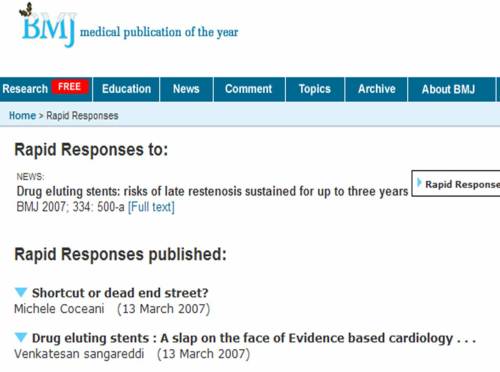
Drug eluting stents : A slap on the face of Evidence based cardiology . . .

Click the BMJ link or read below


venkat-bmj

It is often said science is sacred and unfortunately we forget ,  science is not a heavenly creation and it is the creation of scientist of varying grades of integrity fueled by the vested interest of medical industry . It has been a almost a daily affair , some of the devices and drugs are recalled or found to be unsafe on patients.

Now the big cat has come out .The Drug eluting stent has fallen from Hero to Zero in a short span of 5 years. It was projected to have zero percent restenosis in 2002 . And now we realize it is Zero percent truth.

What has started as anecdotal reports of late stent thrombosis has indeed become an epidemic in all DES patients. The five studies that has been published in the NEJM this month (March 2007) has convincingly proved how unsafe these stents are in most of the coronary population .

Millions of patients in whom this stent was implanted will carry an impending stent thrombosis and possibly an SCD . Who is to take care of them ?

The DES story is a clear cut case of getting premature approval for a dangerous form of treatment inside human coronary arteries.

It is amazing how the scientist’s eyes are shut by the illusion of knowledge and lure of wealth. How foolish they were to think drug which was administered via the stent will selectively prevent vascularisation and leave the normal endothelium intact . Now they realized , one should not suppress the endothelial growth around the stent and got the fundamental point wrong. Which was the key reason for the astonishing episodes of late stent thrombosis. When we play with biology of nature we have to be little more careful .God has created man and his heart for over a million years . One can not alter it by a 6 month follow up study of DES .

When ICDs were exposed last year , of similar disastrous outcome they were recalled and explanted . How are we going to unstent the millions of coronary arteries ?

Somewhere along the line the medical professionals have lost the battle against the Wall street and NASDAQ . Or how else we can explain repetition of similar events.

The wages for the modern technology , the patients have to pay a heavy price.

Let us all hope common man with common sense will reign supreme over the sixth sense of the uncommon man . . .

“Ignorance is better than illusion of knowledge”

Dr Venkatesan Sangareddi MD , Assistant Professor of cardiology , Madras medical college Chennai, India

Read Full Post »

Anginal pain is a type of visceral pain.It is carried by type  C  unmylinated  nerve fibres.The perception of angina is a complex process.It is a combination of visceral and cutaneous referral pain.

How often is angina silent in diabetes mellitus ?

Presence of  diabetes per se does not make an angina silent. In fact,  if  one takes 100 patients with diabetes  , if angina occur in them , it is more often  , manifest than silent. So , only few of  the  diabetic patients who develop diabetic autonomic neuropathy fail to have angina.The exact incidence is not known.It could be around 20%.

If angina can be silent in diabteics , can they have anginal equivalents ?

This again is not answered in literature. Among the anginal equivalents , the most common is  dyspnea , which  can occur in diabetics.But now , we know dyspnea also needs thoracic nerve signals  from the intercostal muscle spindle and colgi organs.This can also be impaired in diabetics.

Can silent and mainfest episodes occur in a same  patient  ?

Yes.

Once silent does not mean always silent, and similarly once angina is felt it  does not mean he is going to feel the next episode as well !

This  strongly reminds us medical science  is  much a complex  subject and what we know is very little in pain perception.

How is silent ischmia different from silent angina ?

There is considerable  overlap  between  silent ischemia and silent angina

The questions to be answered are 

Which is silent  ?  Is it the angina or is it the ischemia or both ?

Silent ischemia can occur in any individual ,  this is also called as silent CAD . When  ischemia occurs  but  fails  to generate pain it is silent ischemia .Undiagnosed  CAD in asymptomatic individuals is also called silent ischemia or CAD.In this population  Exercise stress testing detects  CAD which was otherwise silent and masked.These patients may develop angina during EST.

During exercise stress testing many times patient has significant ST depression  more than 2mm but still chest pain may not occur.These episodes may either be silent ischemia or  ngina. Many times the EST is terminated before angina is manifest .( Chest pain is the last to occur in the chain of events following ischemia- Concept of ischemic cascade )

What are the other situations where angina can be silent ?

  • Pain perception  and threshold  level is  high ,  so patient indeed has anginal  signals but fails to feel it .
  • Patients on  antianginal medication , fail to feel the angina.
  • Chronic betablocker therapy can exactly mimic  autonomic neuropathy

Is it a blessing for the patient  to have painless episodes of angina ? 

When their  ischemic colleagues , suffer a lot with chest pain it is tempting to think these diabetic patients  are blessed!

Scientifically , this could be true in at least in  some  especially in a patients  who’s coronary anatomy is known  and devoid of any critical proximal lesions. For example a small PDA  lesion can produce  severe angina  , but may be silent  in diabetic and be comfortable .This lesion is  insignificant other wise * !

It should  also be recalled , pain relief has been an important goal for treatment  of CAD .In olden days,  thoracic sympathectomy was done for angina . In fact ,  even in  CABG  , one of the the  mechanisms  for  angina  relief  is attributed  to cardiac denervation.

Caution: Even a small  episode of ischemia can trigger an electrical event .But it is rare.

 How common is silent infarct (STEMI) in diabetic patients ?

In a simple questionnaire we asked the diabetic patients in our CCU how they felt their pain during MI.Most felt it normally as do other non diabetic .  Diabetes  does not make  all anginal episodes  silent. Severe episodes of ischemia may be painful while less severe episodes may be painless. Diabetic autonomic neuropathy  is a  least recognized and  poorly understood complication of diabetes.Diabetes , involves  the vasanervorum of the autonomic nerves.

 The other mechanisms postulated in diabetic neuropathy are

  • Reduction in neurotrophic growth factors.
  • deficiency of essential fatty acids .
  • Reduced endoneurial blood flow and
  • Nerve hypoxia .

Is diabetic autonomic neuropathy treatable ?

Very difficult problem indeed.Controlling diabetes may partially correct  the neural dysfunction.Many add on neuro vitamins and aminoacids are having a good market !

If you successfully treat diabetic autonomic neuropathy will my patient  start feeling the  hitherto silent episodes of angina ?

We don’t know.Logic would answer ” YES”

What is the ultimate effect of cardiac autonomic neuropathy.

Cardiac denervation.  The manifestations  are

  • Tachycardia, exercise intolerance
  • Orthostatic hypotension


Silent Myocardial Infarction : A complete list


Read Full Post »

Let us not forget the basics !

  • HT management has been made  easier with the availability of  many  good drugs , at the same time it has become a complex  issue with as many classification and guidelines.
  • The management of HT has evolved over the decades. Now we have realised  HT  is not a simple number game . Reducing the blood pressure to target levels is not  sufficient and is not the primary aim !.
  • In fact we now know controlling the numbers alone is never going to work  , combined risk factor reduction is of paramount importance.
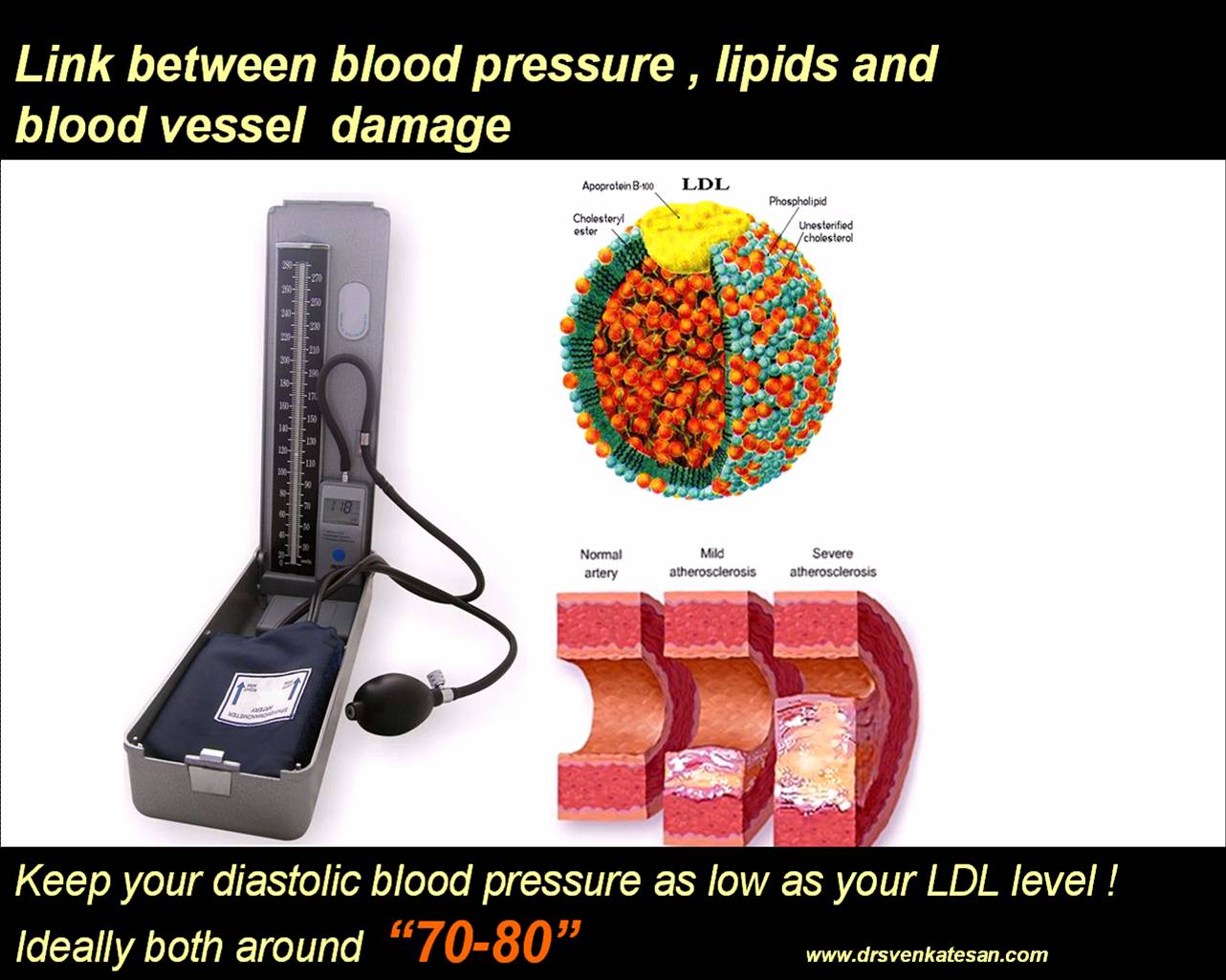
  • HT per se is less lethal but when it combines with hyperlipidemia and diabetes or smoking  it becomes  aggressive.The blood lipids  especially the LDL molecule  enjoy the high pressure environment  ,   penetrate and invade the vascular endothelium.
  • ASCOT  LLA  study has taught us,   for blood pressure reduction to  be effective and reduce CAD  events one has to reduce thier  lipid levels also.So , for every patient with HT there is not only a target BP but also a target LDL level .

picture1


Final message

The tip for better vascular  health is  , all  hypertensive patients should keep their lipids to optimal levels and all hyperlipidemia patients should keep their BP as low as possible .

“Keep your LDL  as low as  your diastolic blood pressure  and  let us  keep it around 70 -80

Read Full Post »

                    circulatory                                                                            A normally  functioning  circulatory system is vital for our survival . We have about 6000 ml of  blood, circulating  all over the  body in an  approximate time of 15-20 seconds.The pressure at which this blood moves across the body is called the blood pressure . Hypertension  or simply , high blood pressure is an undesirable  hemodynamic disturbance  in human circulatory system.Systemic hypertension is the most common type of hypertension. The blood pressure is primarily  dependent  on the status of the blood vessel(vascular resistance)  and cardiac contractility. This regulation is under  many neural and hormonal factors.Further  the blood pressure varies depending  upon the blood vessel calibre, and the local milieu.There is a progressive drop in blood pressure from major arteries to the small arteries .The pressure drop is maximum  across the arterioles to reach the venules .The venous circulation has the lowest pressure, it ends up at right atrium with a mean pressure of 0- 5mmhg.

Importance of regional variation of blood pressure.

It should be realised  ,  each organ has it’s own regulated blood pressure.The brain  perfuses by the  intracerebral pressure .The lungs decide how much should be the pulmonary arterial pressure.The kidney not only controls it’s own pressure but also  has a major regulatory role in  systemic pressure by rennin angiotensin system.The examples are numerous, portal system has it’s unique pressure controlling hepatic hemodynamics. The  retinal blood vessels regulate  intra ocular pressure. While the human  circulatory system has a wide variation of blood pressure  across the breadth and length of vascular system,  it is ironical a single snap shot BP with a brachial cuff is used  to define the normality and if it is normal every thing is thought to be  hunky dory !


It is widely acknowledged now , aging of humanity  is nothing but aging of our vascular system

                                    So we should have new parameters to assess individual organ’s vascular health as well as the currently popular systemic vascular health.The single important factor that determine coronary endothelial damage is the intra coronary pressure.It is never taken into account in any of the cardivascular mortality studies. This is the prime reason for  the widely prevalent conflict in the cardiology literature , namely : Controlling systemic  blood pressure has poor correlation with  cardiovascular outcome. Many of the so called normotensive individuals  have serious hemodynamic injury in their  coronary arteries.This was made apparent in the  ASCOT LLA  study , in which patients with  near normal blood pressure also benefited from statin therapy , implying  endothelial damage could occur at any level of systemic blood pressure.

What is the normal intracoronary pressure  ? When do you diagnose intracoonary hypertension?

The normal intracoronary pressure is around 40mmhg . Intra coronary hypertension as a clinical entity  is yet to be  recognised . There is no defintion available for intracoronary HT  , intracerebral hypertension as well. 

It’s still a  long way to  go , for the cardiology and neurology  community to assess non invasively  intracoronary pressures and  intra cerebral arterial pressure to prevent  coronary events ant strokes.

Final message

Simple risk prediction using brachial cuff blood pressure is a grossly unscientific method (Sorry, i really mean it ) to assess one’s vascular health.There has been  few attempts like vascular endothelial health assessment by fore arm blood  flow , central aortic pressure (Instead of brachial cuff pressure) as an  index for risk predictment and  assessment for hypertension is suggested.

Read Full Post »

                                        Angina pectoris , classically occur on exertion and gets relieved on rest .This is called typical chronic stable angina as described by Heberden (CSA ) .  Unstable angina(UA), the term originally described by Noble O Fowler in early 1970s. ( Also being referred as  intermediate coronary syndrome , preinfarction angina etc).The definition for unstable angina has evolved  over the years  and currently  refers to .

 1.All new onset angina of any degree* Some include severe angina only ! New onset angina of very mild degree on exertion could be the onset of the first episode of  stable  angina. 

 2.Rest angina of more than >30 mts not relieved by taking sublingual nitroglycerine.

 3.All Post MI angina

 4.Any angina in patients who have been stented by PCI.

How to recognise a patient  who is shifting from  stable angina to  UA ? 
UA is  to be suspected when  a patient develops. 
5.More frequent episodes than usual
6.Angina occurring at lesser level of exertion than before 
7.Angina radiating to new site ( Example : Chest pain radiating  to jaw rather than to the usual left arm or vice versa)

Why the first episode of angina is given a special status and often considered critica ?

Angina is the  clinical expression of   myocardial ischemia.The course of  the  first  episode of angina , can not be predicted.It could be a the beginning of a chronic disease process, or it could be a progressive coronary occlusion as in unstable angina /NSTMEI , or the onset of even a STEMI.
In contrast a patient with chronic stable angina  has a predictable chest pain , at a particular level of exertion, radiation to same site, same character, and the patient knows for sure the pain  would promptly dissappear  when he takes rest or nitroglycerine  tablets.

What is the underlying pathology in UA ?  

Generally it is very rare for  a stable plaque to produce a  serious episode of unstable angina .It  requires  an unstable plaque* to  precipitate an unstable angina !
Unstable plaque refers to any plaque which is eroded, fissured, ruptured or  hanging  eccentrically ,  with
an active thrombus.

What is the significance of post PCI angina?

It is an irony, any angina following PCI is to be considered unstable as sudden occlusion of stent is quiet common.This is a paradox of sorts as one would wonder in a patient  with CSA who undergoes PCI with stenting  of left anterior descending coronary artery  (LAD)  all his subsequent episodes of angina  will be labelled as UA  even if a stable angina occur in his other coronary artery.And these patients would go for early invasive approach and potentially inappropriate interventions even if they are at low risk !

Is all angina at rest can be termed as unstable angina ?

No, but many times ,  rather most of the times  cardiologist believe all rest angina to be unstable.

What are the situations where stable angina can occur at rest?

An episode of angina during mental stress, or post prandial* state are very common in patients with CSA. This gets relieved after the stress. Some times  patients with CSA during episodes of fever may get angina at rest .These are considered variants of stable angina.
Post prandial angina , may be considered by some as unstable

How often a diagnostic confusion occur between CSA and UA ?

Generally, this issue is rarely addressed in cardiology literature , for the  simple reason it is never considered an  issue at all !
According to Canadian cardiovascular society grade 4 stable angina  is almost similar to unstable angina , as it denotes angina occurs with minimal effort or even at rest. In fact CCSC grade 4 should be termed as UA.

Can ECG be useful to identify stable angina from unstable angina ?

                                    ECG will some times  come to our rescue when one is confused between stable and unstable angina even though resting ST depression can occur in both stable and unstable angina . Statistically , if ST depression is noted during an episode of angina it is more likely to be UA rather than CSA. . Apart  from ECG , Troponin T or I levels may be elevated in some of the patients with unstable angina. Rarely stable angina can also show elevated troponin.

In patients with systemic hypertension and LVH or cardiomyopathy resting ST depression may not indicate UA 

So differentiation between, stable and unstable angina even though appear simple and  straight forward, it requires a diligent appraisal of history , physical examination (Aortic stenosis /HCM  may cause stable angina)  and ECG, enzyme evaluation.

Final message

In any coronary care unit ,  admissions with initial diagnosis of  ACS/UA/NSTEMI , subsequently turn out to be simple stable coronary artery disese . This error happens because the chest pain  or ECG changes  are aggravated by non cardiac factors like a mental stress or a post operative stress  or fever etc.
There could  be another school of thought, that is to err on the side of  safety, and manage all  rest angina as UA  .But the hazards of unwarranted therapy might exceed the risks of leaving these patients alone.
In this context ,there is a need for a new definition for unstable angina .
One ideal version could be . . .
  • Any angina , of any degree  which is caused  mainly by the supply side defect (By a acute thrombotic /disruptive plaque   occluding the  coronary lumen  with a imminent danger of myocardial infarction is to termed as real UA.
  •  All post MI and post PCI angina are unstable angina
  •  Rest angina which occurs due to increased demand situations need not be  labelled  as unstable angina for the simple reason  there is neither an active plaque nor a  fresh thrombus likely  in these patients. They rarely develop  recurrent angina or MI . The mechanism of angina at rest here is most often due to a tachycardia and resultant increase in MVO2 .(myocardial oxygen consumption) .Currently they are called as secondary unstable angina.In fact , anti thrombotic drugs are misused in these situations as they satisfy the criteria of UA/NSTEMI.

Read Full Post »


Is it true , once a patient is labelled as a hypertensive he remains  hypertensive life long ? Is it possible to withdraw antihypertensive drugs  permanently ?

  • Systemic  hypertension is the most common clinical entity and it forms the bulk of the physician consultations world over.
  • The anti hypertensive drugs are  one of the most commonly  prescribed medication  by the medical professionals .
  •  It is estimated , the major chunk of  revenue to pharma industry is contributed by antihypertensive  drugs.
  •  SHT , is being maintained  as a  major , global cardiovascular risk factor , by  periodically refixing the target blood pressure  to lower levels  by various committees.
  • The terminology of pre hypertension for blood pressure between 120-140 was hugely controversial    and some societies refused  to accept this entity.

Is there a case for withdrawal of anti hypertensive agents  among our patients ?

Yes , in fact there is a strong case for it.

While on the one hand there is a sustained effort ( By whom !)  to increase the drug usage , very early in the course of hypertension , there is also a silent progress in our knowledge ,  regarding withdrawl of anti hypertensive agents in all those undeserving patients .

It is estimated 42% *of the so called hypertensives especially elderly can be successfully weaned of anti hypertensive drugs with out any adverse effect.( Mark R Nelson BMJ. 2002 October 12; 325(7368): 815.)

What are the situations where we can successfully with draw anti hypertensive drugs?

  • The most common group of patients  are the ones, where  the anti hypertensive drugs are  started prematurely , with out giving an option for non drug life style  approach.These patients and their physicians continue to believe , anti HT drugs are sacred and essential !
  • There is another  major group of patients who have had a temporary  elevation of BP due to a stressful environment.These patients  get drugs permanently for a temporary problem . These patients need  to be reassessed.
  • Some of the elderly  patients,  with the onset of  age  related autonomic dysfunction ,these  drugs are poorly tolerated and  even have  disastrous effects .In this population  it is desirable , to wean off the anti HT drugs  and switched over to life style  medication whenever possible.

Final message

Essential or primary hypertension is not a permanent  disease, in bulk of our population. It reflects the  state of  the  blood pressure on a day to day basis  and is a continuous variable. All patients who have been labelled as hypertensives( Either by us or others) should be constantly reviewed  and considered for withdrawal of the drugs if possible.

* Note this rule does not apply in all secondary hypertensions, during  emergencies, uncontrolled hyper tension with co existing CAD /diabetes /dyslipidemias etc .

Please refer to these forgotten Landmark articles

Does Withdrawl of Anti hypertensive Medication 

Increase the Risk of Cardiovascular Events?

The TONE study

Source: The American Journal of Cardiology, Volume 82, Number 12, 15 December 1998 , pp. 1501-1508(8)

http://www.ncbi.nlm.nih.gov/pubmed/9874055

Conclusion of TONE study

The study shows that antihypertensive medication can be safely withdrawn in older persons without clinical evidence of cardiovascular disease who do not have diastolic pressure > or = 150/90 mm Hg at withdrawal, providing that good BP control can be maintained with nonpharmacologic therapy


Some of the references for successful withdrawl of antihypertenive drugs

1.Nelson, M; Reid, C; Krum, H; McNeil, J. A systematic review of predictors of maintenance of normotension after withdrawal of antihypertensive drugs. Am J Hypertens. 2001;14:98–105. [PubMed]
2.
Wing, LMH; Reid, CM; Ryan, P; Beilin, LJ; Brown, MA; Jennings, GLR, et al. Second Australian nationalbloodpressure study (ANBP2): Australian comparative outcome trial of ACE inhibitor- and diuretic-based treatment of hypertension in the elderly. Clin Exp Pharmacol Physiol. 1997;19:779–791.
3.
Lee, J. Odds ratio or relative risk for cross-sectional data. Int J Epidemiol. 1994;723:201–203. [PubMed]
4.
Lin, D; Wei, L. The robust inference for the Cox proportional hazards model. J Am Stat Assoc. 1989;84:1074–1079.
5.
Veterans Administration Cooperative Study Group on Antihypertensive Drugs. Return of elevated blood pressure after withdrawal of antihypertensive drugs. Circulation. 1975;51:1107–1113. [PubMed]
6.
Medical Research Council Working Party on the Management of Hypertension. Course of blood pressure in mild hypertensives after withdrawal of long term antihypertensive treatment. BMJ. 1986;293:988–992. [PubMed]
7.
Alderman, MH; Davis, TK; Gerber, LM; Robb, M. Antihypertensive drug therapy withdrawalin a general population. Arch Intern Med. 1986;146:1309–1311. [PubMed]
8.
Blaufox, MD; Langford, HG; Oberman, A; Hawkins, CM; Wassertheil-Smoller, S; Cutter, GR. Effect of dietary change on the return of hypertension after withdrawal of prolonged antihypertensive therapy (DISH). J Hypertension. 1984;2(suppl 3):179–181.
9.
Mitchell, A; Haynes, RB; Adsett, CA; Bellissimo, A; Wilczynski, N. The likelihood of remaining normotensive following antihypertensive drug withdrawal. J Gen Intern Med. 1989;4:221–225. [PubMed]
10.
Myers, MG; Reeves, RA; Oh, PI; Joyner, CD. Overtreatment of hypertension in the community? Am J Hypertens. 1996;9:419–425. [PubMed]
11.
Stamler, R; Stamler, J; Grimm, R; Gosch, F; Dyer, R; Berman, R, et al. Trial of control of hypertension by nutritional means: three year results. J Hypertens. 1984;2(suppl 3):167–170.
12.
Takata, Y; Yoshizumi, T; Ito, Y; Ueno, M; Tsukashima, A; Iwase, M, et al. Comparison of withdrawing antihypertensivetherapy between diuretics and angiotensinconverting enzyme inhibitors in essential hypertensives. Am Heart J. 1992;124:1574–1580. [PubMed]
13.
Whelton, PK; Appel, LJ; Espeland, MA; Applegate, WB; Ettinger, WH; Kostis, JB, et al. Sodium reduction and weight loss in the treatment of hypertension in older persons: a randomised controlled trial of nonpharmacological interventions in the elderly (TONE). JAMA. 1998;279:839–846. [PubMed]
14.
Heart Outcomes Prevention Evaluation Study Investigators. Effects of an angiotensin-converting-enzyme inhibitor, ramipril, on death from cardiovascular causes, myocardial infarction, and stroke in high-risk patients. N Engl J Med. 2000;342:145–153. [PubMed]
15.
Howes, L; Krum, H. Withdrawing antihypertensive treatment. Curr Therapeutics. 1988;November:15–20.
16.
Fotherby, MD; Harper, GD; Potter, JF. General practitioners’ management of hypertension in elderly patients. BMJ. 1992;305:750–752. [PubMed]
17.
Jennings, GL; Reid, CM; Sudhir, K; Laufer, E; Korner, PI. Factors influencing the success of withdrawal of antihypertensive drug therapy. Blood Press Suppl. 1995;2:99–107. [PubMed]

Read Full Post »

Which is  the most important factor that determines thrombolysis failure in STEMI  ?

  1. Thrombus load .
  2. Drug efficiency
  3. Time delay
  4. Presence of a mechanical lesion
  5. Hemodynamic instability

Answer : 3 .(Though all 5 factors operate )

Failed thrmbolysis occur in about 40-50% after streptokinase and slightly less with TPA   and TNK-TPA . Delayed arrival and late thrombolysis are  most common cause of failed thrombolysis. As the time flies , the  myocardium gets damaged and the intra coronary  thrombus gets organised .Both these processes make delayed thrombolysis a futile exercise.

               Not all STEMI patients have large thrombus burden. There need to be a critical load of thrombus for thrombolytic to be effective

Some may have a major mechanical lesion in the form of plaque fissure, prolapse and it simply blocks the coronary artery mechanically like a boulder on the road  . The poor  streptokinse  or the rich Tenekteplace !  nothing can move this boulder .The only option here is emergency PCI .

How will you know when the patient  arrives in ER with STEMI whether his/ her coronary artery is blocked with soft thrombus or hard mechanical boulder ?

It is impossible to know.That’s why primary PCI has a huge advantage.  But still thrombolysis is useful as some amount of thrombus will be there in all patients with STEMI.Lysing this will provide at least a  trickle of  blood flow that will jeep the myocardium viable and enable us to take for early PCI.

Final message

The commonest cause for thrombolytic failure is the time of administration and the degree of underlying mechanical lesion  . So  it does not make sense  to blame  streptokinase always !

Read Full Post »

« Newer Posts - Older Posts »