Feeds:
Posts
Comments

Posts Tagged ‘ethics in medicine’

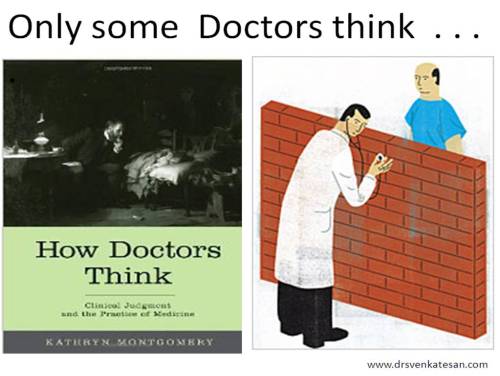
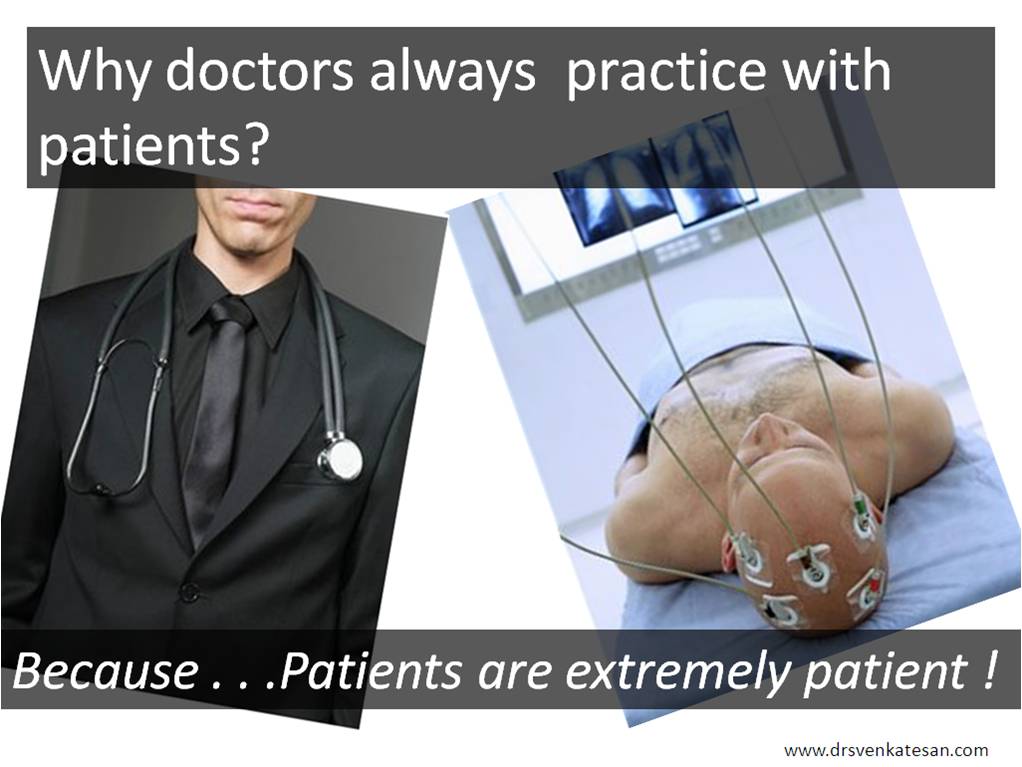
It is  often  quoted  “Practice makes  every one  perfect”  . . .  Doctors continue to practice for ever  . . .If practice is only  a rehearsal  , when do they perform  for real ?

And , we know  a doctor spends his entire life time practicing  . . . In other words  doctors are only experimenting .

So , do not get fooled by his errors . Errors are bound to  happen  during their  practicing sessions !

The problem  with general public  is , they never understand this basic fact – medical  science  is nothing but  a , on going research on human body .If only  we understand this  we can accept  the millions of medical  mistakes*  that occur  every day in  the global  medical  profession . The major  aim of modern medical science  is to reduce that .

* Of course, negligence is a punishable offense . But,  we should also realise , non- negligent medical  mistakes are many fold higher than negligent ones .

While  a careful doctor will avoid negligent mistakes a thinking doctor will avoid   non -negligent mistakes also.

This puts onus back on doctors. We need to critically analyse , every

treatment modality we follow .

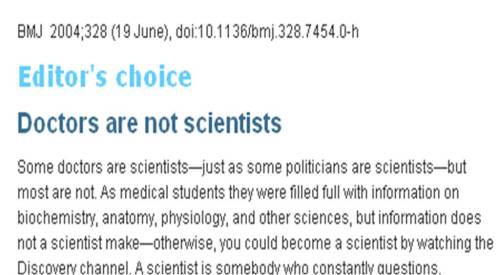
If you are a strong believer of   “Medicine is indeed  a  science and doctors are scientists ” , please read this article from British medical  journal and conclude  yourself.

http://www.bmj.com/cgi/content/full/328/7454/0-h

Further reading

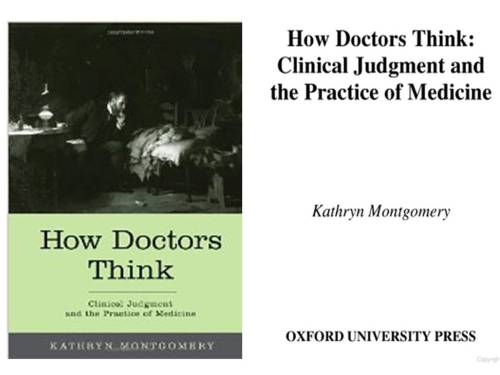
The bestseller  How doctors think

Picture courtesy : Jupeter stock Images

Read Full Post »

Medicine is an art , evolving art to be precise .We need to use our sixth , if not , the  seventh sense !  constantly to  improve the quality of life our clients  -The human beings.

If only we learn to think right  . . . Always right . . . we can bring the heaven of health to the earth

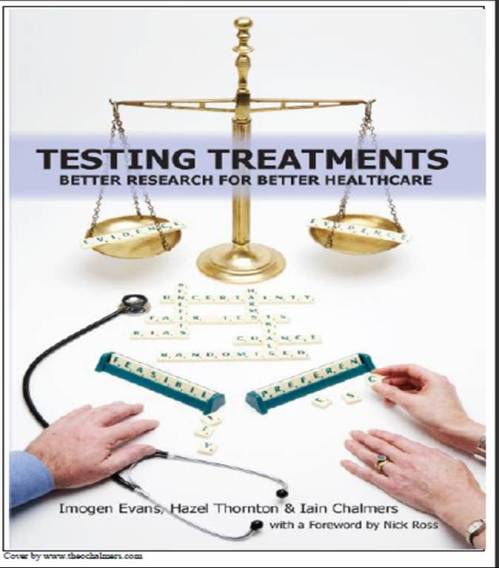
This book  fascinates .

Click for a  preview in Google.com

Books.google.co.in

Read Full Post »

Pessimism, from the Latin pessimus (worst), is a state of mind which negatively colors the perception of life, especially with regard to future events.

Understanding pessimism is not that simple  . Some people argue  optimism   represents a strong mind while  a pessimism  is the domain of the weak . But it is not necessarily true.  Both pessimist and optimist are unreal , and playing the dangerous game of predicting the future. So realism is the answer .

In this era of information highways , commercial exploitation of science ,  our thought process is grossly determined by our perception of events.We hardly have an intention or time to analyse our thought process.

  • An optimist  ( Rather , unregulated optimist ! ) is a person who welcomes  any growth good or bad.*
  • A pessimist  is  a  person who welcomes only good growth.*

So how to identify good growth ? That is the million dollar question!

  • Many of the  optimists may not  bother about the final outcome of a treatment *
  • A pessimist bothers only about that .
  • An optimist  rarely asks questions, blindly accepts every thing !
  • A pessimist never believes any thing !

Actually the fundamental principle of scientific medicine lies in proving the null hypothesis null and void.Any treatment is useless until proved other wise .  So pessimist can be argued to follow true science , while  many of  the hardcore  optimists are blind believers ..

*It may be  a harsh   way of  interpreting an optimist  but  uncontrolled optimism  has played havoc in our  patients like many of the failed treatments (Some of them released prematurely into patient domain   has  killed many lives  . Power of positive thinking should be within the  realms of scientific feasibility !

So in  our  journey   to  conquer human health ,   we   may  proceed with  an optimistic mind and  a pessimistic eyes !

This understanding is all the more important in this era of contaminated science .It is a well known fact ,  now last 50 years of  planet earth has inflicted the maximum damage  to ourselves  than our ancestors did in 5000 years. That’s why we are compelled to meet at Copenhagen .(We never learn from our mistakes, that’s a different story !) .

There is definite and urgent  need for world summit  on  cleansing the medical science from  the clutches  of commerce  and ignorance . A medical green house effect, with dangerous holes in health care  is imposing on us (Another pessimistic thought . . . of course in the interest of human kind !)

World health organization ,  a sleeping giant has to be awakened on this issue


Final message:

Mankind has evolved over many millenniums ,  probably with a sole  purpose of living ,  that is reproduction and propagation of our genre without harming the environment and other species.

Unrestricted  and unregulated growth of any kind is dangerous we call it as malignancy in pathology .In science , we tend to call it a” great future ”

Our  sixth sense*  has  outgrown  miserably  out of  reality  , as have we decided to take on the nature and GOD .Now , many developing country men do not believe in death .They are fighting a losing battle against the God. And they suffer with escalating health costs of keeping the elderly ,  alive who are  knocking at the doors of heaven or hell . The same countries,  which deny funds for curable illnesses of the poor is a different story altogether !

The principle of modern medicine  would ideally  be

  • Reduce human suffering irrespective of economic status
  • Curing a illness if there is a cure
  • Prolonging life if there is useful purpose
  • Allow a good quality death if there is no cure.
  • Most importantly  , prey to god give us strength and capacity to identify which is good and which is bad for our patients  .

Read and learn for a  complete guide on optimism and pessimism

* It  is  important to recognise , the same sixth sense  has   made it possible to share our views through a great tool of  Internet  . So we should not be against the growth of science but against the misuses and wrong interpretations of it .

Pessimism

Optimism

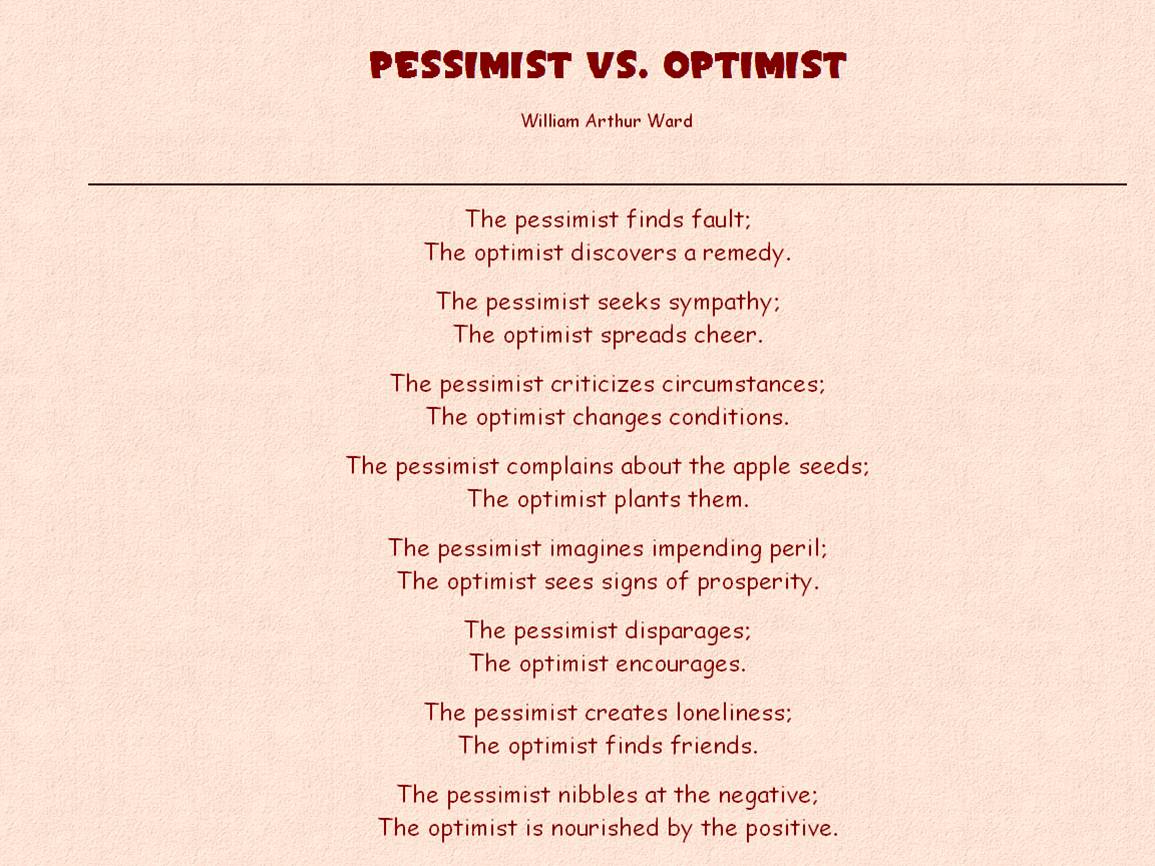
The traditional characters  of  a pessimist

//

Read Full Post »

Modern era of cardiology aims to treat ACS  as and when it develops .That is , as soon as the vulnerable plaque ruptures or a thrombus  blocks the victim’s coronary artery.

But this can be achieved only if the patient reacts to this event.We know 20% of ACS can be totally silent. Some produce very vague symptoms especially in elderly and diabetics. ECG and enzyme changes may help us in patients who do not have clear symptoms.There are variety of markers available for STEMI & UNSTEMI.(CPK-MB, Troponin T , myoglobin etc) Now we are working at finding a marker for ischemia without necrosis. Ischemia modified albumin is one such molecule that is showing promise.

The ER department world over have vigorous screening protocols to diagnose ACS  for  the patients with chest pain. There are thousands of triaging protocol in the  emergency management of chest pain.In spite of  the highest awareness and availability of  scientific expertise , knowledge base the error rate of diagnosing  ACS  stands at an astonishing 58%.  This may seem odd , but this is what  this land mark article in NEJM tell us  (Data from Boston , Milwaukee etc).

Out of 10500 patients with suspected ACS. Only 17 % had real ACS.  55% were admitted initially as ACS  later turned out to be non cardiac .This may seem  acceptable for many  even if it is  an act of unnecessary admission and investigation. It gives us , a sense of satisfaction for not missing a diagnosis of ACS. But it has it’s own risk of complication arising out of unnecessary investigations.It is a chain reaction of  suspicion that  may end up in a coronary angiogram in many ! .It is also a well recognised fact these patients    spend  atleast an average of  2 days  to get rid of the ACS tag over their  necks .

Experience has taught us  simple presence of a human being as a patient within an  ICU ( however short the stay  may be ) can be a health hazard and risk .  This  55 % error ,  which does exactly  this to  our  patients with chest pain  who reach the ER  never bothers us  This is because  we feel credited both academically as well as financially .

In the same study 2.3 %  (About 25 patients) with true ACS  were sent home  after a missed  diagnosis . Paradoxically  this 2.3%  has worried the medical professionals too much . . . This happens  ,  even as we  do not have proper data on  how many of them had a real adverse event after a missed  ACS.

So the message here is even in best centres both missed and wrong diagnosis are  rampant. while wrong diagnosis (25 fold more here  )  is easily accepted by the medical community .We can justify  this as a screening camp for ACS  ,  akin to arresting  a group of suspected  criminals in a  preventive raid ,  later releasing for want of evidence.

In the morals of  criminal judiciary  , it is often said one can afford to  lose  a real offender from the clutches of law  , but a  innocent should  never be punished in any circumstance .

In medical parlance this  goes something like this  . . . Thousand patients shall die because of his or her illness but not even a single healthy person should die due to unnecessary treatment.

The above thoughts  were in response to  the excellent original article on missed diagnosis  of ACS from NEJM.  http://content.nejm.org/cgi/content/full/342/16/1163?ijkey=652d8337709a8bf84c813f4c9d685863ee053162

Final message : (Sorry for the  lengthy message !)

Can we afford to miss an  ACS in emergency room ?

“Definitely not” . . .but do we succeed in that ?  The answer is same “definitely not “

When we are able to accept with pride every time  we make  a  wrong diagnosis of  ACS  in perfectly normal people , It may to provocative to say  we can  also  afford  to do  the same  when we occasionally   miss a  diagnosis of ACS  as well .  Law of statistics dictates for every correct diagnosis made there is many fold number of wrong or missed diagnosis takes place. May be , reducing that is the only aim of medicine.

We need to realise  with even with a 55% of false positive initial  diagnosis  2%  real ACS  escape net !The only  fool proof method  for  not missing  ,  even a single case of ACS   is to label every patient with chest pain as ACS .

In this vexing  issue , we should realise  , in field of  medical decision  making ,  errors  due to acts of commission  ( Making an  inappropriate drug/procedure /surgery  is easily accepted by medical professionals as well as   the court of law !) . But acts of omission ,   like missing a diagnosis or failure to prescribe  a  drug or perform a procedure  is rarely accepted   and  is  considered   a great negligence and  bring intense guilty feeling among the physicians .

This  perception is definitely  not warranted in this  greatest profession  of glorious uncertainties ! Both acts of commission and omission  cause significant damage to  patients . In this modern era  ,  we have clear  statistics  that   reveal ,  acts of commission  leads far ahead over it’ s counterpart in injuring our people .

Hippocrates got it right over 2000 years  ago .  First let us do no harm  . . .

Read Full Post »
For  all those youngsters , who are into the mystery world of medical research  , please begin your journey with this great book.  The greatness lies in it’s  simplicity in expression & search of truth !

Download this 1 MB  marvel  ,  free from  http://www.jameslindlibrary.com  in less than a minute

Read Full Post »

  1. Do 64slice MDCT  in all patients who has  a coronary event and follow it up with catheter based CAG.
  2. Use liberally the new biochemical marker ,  serum  B-naturetic peptide (BNP) to diagnose cardiac failure in lieu of basal auscultation.
  3. Advice  cardiac resynchronisation therapy in all patients  who are in class 4 cardiac failure with a wide qrs complex .
  4. As it is may be considered a  crime to administer empirical  heparin, do ventilation perfusion scan in all cases with suspected pulmonary embolism.
  5. Do serial CPK MB and troponin levels in all patients with well  established  STEMI .
  6. Open up all occluded coronary arteries irrespective  of symptoms and muscle viability.
  7. Consider  ablation of pulmonary veins as an  initial strategy in  patients with recurrent idiopathic AF. If it is not feasible  atleast occlude their left atrial appendage with watch man  device.
  8. Never tell  your patients   the  truths  about the  diet , exercise &  lifestyle modification (That can  cure most of the early hypertension) . Instead encourage the  use of  newest ARBs  or even  try direct renin antoagonists   to treat all those patients in  stage 1 hypertension.
  9. Avoid regular heparin in acute coronary syndromes   as  it  is a disgrace to use it  in today’s world. Replace all prescription of heparin with  enoxaparine  or  still better ,  fondaparinux  whenever  possible.
  10. Finally never discharge  a  heftily  insured patient   until  he completes all the  cardiology investigations  that are available in your hospital  .

Coming soon :  10 more ways to  increase cost of cardiology care . . .beyond common man’s reach

Read Full Post »

                                            The growth of medical science has been phenomenal .It is estimated , the quantum of break throughs  and development  in the  last  50 years  is   nearly equal  to  2000 years of evolution of our  knowledge  put together.  Along with this growth , came the  unavoidable misuse , and abuse of medical science. This  is mainly due to contamination of medicine with commerce . Federal drug authority (FDA) and it’s variants  were formed in all countries to monitor the proper usage of  these technologies for the benefit of mankind. It has an authority to ban a drug or device  , if it is found to bring more injury or side effects  than benefit !

But , unfortunately there is no legal authority to ban an  an  investigation  which is  potentially  or (really  harmful )

or  used  extensively without any valid purpose .

The list of such investigation is increasing in every speciality 

In  cardiology

  • Doing a Troponin assay in patients wuth classical STEMI
  • MDCT in general population
  • Pro BNP in all suspected cardiac  failure
  • Routine C reactive protein for CAD
  • Central venous catheters for all pateints with shock.

Is there a case for banning an investigation (Like banning a drug) for the benefit of  our patients ?

Looking superficially , it  may seem  ironical. But we realise many seemingly  innocuous investigations are responsible for uncontrolled misery for many patients.

This especially true in people who throng the wellness clinic (Also called master health check up)

A incidentally high C – reactive protein   can lead on to forearm blood flow assessment of endothelial dysfunction and carotid intimal plaque  that could  lead onto carotid stents ! and life long anticoagulation , and an  excess INR and sudden cerebral bleed and death !

This is one sample story  in one particular speciality

There is a definite case for banning ( Either total or partial)  some of the questionable investigations  which are done routinely !

Just because these investigation do not have any  physical , visible , adverse reactions like a drug , it should not be allowed to be abused  .The consequence of  false positive results of these investigations could be terrible and worse than the real disese itself !

Read Full Post »

What is herd behavior ?

It is a behavioral pattern where in animals and humans in large numbers , tend to behave in the same way at the same time without application of mind .


Herd behavior in human societies

Herd behaviour describes how individuals in a group can act together without planned direction. The term pertains to the behaviour of animals in herds, flocks, and schools, and to human conduct during activities such as stock market bubbles and crashes, street demonstrations, sporting events, episodes of mob violence and even everyday decision making, judgement and opinion forming. This is very much applicable to medical profession also.(Ref:Wikipedia)

Herd behaviour in animals and human how they are different ?

“surprise ! surprise ! There is  very little difference  noted , according to Hamilton”

A group of animals fleeing a predator shows the nature of herd behavior. In the often cited article “Geometry For The Selfish Herd,” evolutionary biologist W. D. Hamilton said each individual group member reduces the danger to itself by moving as close as possible to the center of the fleeing group. Thus the herd appears to act as a unit in moving together, but its function emerges from the uncoordinated behavior of self-seeking individuals.

Among humans for example when panicked individuals confined to a room with two equal and equidistant exits, a majority will favor one exit while the minority will favor the other.

Medical professionals as a herd


The practicing habits of  medical professionals  move , symmetrically as a herd . When a top journal or a opinion leader utters something every one tend to move in that direction .

If a herd leader says a particular treatment is great, every one will say yes . If he says nay every one will say nay !

No one will really question the direction they move ? Unless the correction occurs from within the herd. No external forces usually are effective.Herding is also benefitial many times as rapid propogation of scientific facts needs such behavior ,but it needs constant scrutiny.


Herd behavior example 1 : The most  typical example is the drug prescribing pattern of anti hypertensive agents over the past half century.The movement  from diuretics to beta blocker , from beta blockers to calcium blockers and to ACE inhibitor and again to diuretic  , then to ARBs and currently shying strongly away from beta blockers, in between  have a brief encounter with alpha blockers and finally  back to diuretics.

If a  particular physician by his insight , had clinged onto  diuretics ( Away from the herd ) for over three decades he is a real exemption , although branded old timed  and unscientific , he has been the most scientific medical professional indeed !

Herd mentality example 2 : Every one says so !  so it must be true ! Hormone replacement therapy good or bad goes with the leader of the herd . 

Herd mentality example 3: Very few cardiologists will be ready to agree the fact that , simple digoxin and diuretic ,ACEI, beta blocker,  administration could be as effective as  the costly cardiac resynchronisation therapy in atleast some of patients with wide QRS cardiac failure ( As we know up to 30 %  wide QRS CHF population do not respond to CRT) 

Defying Herd mentality resulted in major break throughs in medicine

               When every one was  saying beta blocker was harmful in CHF one person from Briton defied it ( Wagenstein, and now beta blockers are the mainstay in the management of CHF! )

There are hundreds of treatment modalities popularised by such herd behavior

Who is the watch dog  , whether science is moving in the correct direction ?


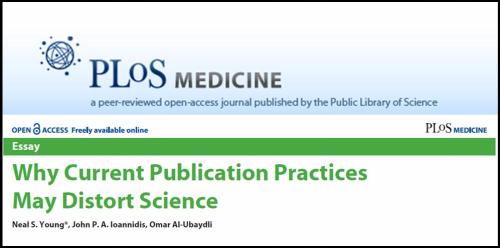
Read this land mark article  how medical research can be distorted by such learned behavior  and how scientific research should not be done .

Click on the image .

 This post is not intended to hurt anyone . It  reflects , human beings are not  fully evolved  yet , in the onging  process of evolutionary biology.

Read Full Post »

Interventional cardiology as a speciality is in cross roads.

The number of coronary interventions (PCI) has increased exponentially world over. With increasing  Cath labs and growing  expertise ,  access to PCI has enormously increased  even in underdeveloped countries.  Meanwhile ,  public lack  specific technical information about the appropriateness  of these costly procedures. It is our duty to do self audit on this issue.  .

                           In this context,  the evaluation  following a PCI  should look beyond  lumen oriented  endpoints.  Many  land mark trials on DES report 3 months are 6 months angiographic outcome and better luminal appearance . Many   tend to worry  more about the status of the stent rather than the patient !  This is primarily because the device companies have repeatedly stressed the technical end points rather than clinical end points .

It is a  well recognised fact  that ,stented coronary artery never guarantees against future  coronary events (ACS) either within the stent or away from it .It is an explict fact that , a patient  after getting a coronary stent , especially a drug eluting stent carries a life long risk of acute stent obstruction and possibly SCD .This information is rarely passed on to the patient in  and hence they are not able to take “learned consent”

It is true ,  one gets  a gratifying feeling  when  opening up a obstructed artery , but we also need  to answer this simple question   What is it’s impact on  patient’s  life  ?

COURAGE & OAT trials have put a break on the  prevailing precondtioned behaviour in the labs, namely any obstruction must be relieved if  technically feasible .

One should recall  the Gruentzig’s legacy  . Whaterver,  we do inside  a  patient’s coronary artery must have some useful purpose . We should not use patient’s  coronary artery to show our expertise and skills !

Dr.S.Venkatesan, Madras Medical College, Chennai, India

Read Full Post »

« Newer Posts