Feeds:
Posts
Comments

Posts Tagged ‘evidence based medicine’

  1. Do 64slice MDCT  in all patients who has  a coronary event and follow it up with catheter based CAG.
  2. Use liberally the new biochemical marker ,  serum  B-naturetic peptide (BNP) to diagnose cardiac failure in lieu of basal auscultation.
  3. Advice  cardiac resynchronisation therapy in all patients  who are in class 4 cardiac failure with a wide qrs complex .
  4. As it is may be considered a  crime to administer empirical  heparin, do ventilation perfusion scan in all cases with suspected pulmonary embolism.
  5. Do serial CPK MB and troponin levels in all patients with well  established  STEMI .
  6. Open up all occluded coronary arteries irrespective  of symptoms and muscle viability.
  7. Consider  ablation of pulmonary veins as an  initial strategy in  patients with recurrent idiopathic AF. If it is not feasible  atleast occlude their left atrial appendage with watch man  device.
  8. Never tell  your patients   the  truths  about the  diet , exercise &  lifestyle modification (That can  cure most of the early hypertension) . Instead encourage the  use of  newest ARBs  or even  try direct renin antoagonists   to treat all those patients in  stage 1 hypertension.
  9. Avoid regular heparin in acute coronary syndromes   as  it  is a disgrace to use it  in today’s world. Replace all prescription of heparin with  enoxaparine  or  still better ,  fondaparinux  whenever  possible.
  10. Finally never discharge  a  heftily  insured patient   until  he completes all the  cardiology investigations  that are available in your hospital  .

Coming soon :  10 more ways to  increase cost of cardiology care . . .beyond common man’s reach

Read Full Post »

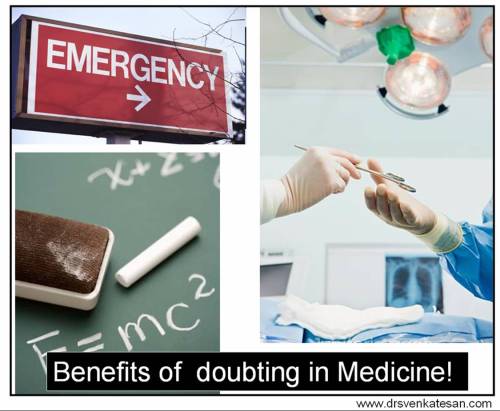
When  a doctor is confronted by serious  doubt  ,  what will be the outcome for the patient  ?

Can  doubting  be beneficial for a patient ?  . It seems so ,  according to  EBM which  stresses   about statistical outcome at every turn of events in a  patient who  is critically  ill .

Is  something ,  always  better than  nothing   ?   Our  limbic  system tends to think so .  It  may not be true. But  in  dire situations ,   many  things  (Proven , unproven)  need to  be tried  however doubtful it ‘s  efficacy  may be  .This is  akin to an  emergency in an  airplane. Even here there need to be a logic.

Then ,this question  arises . How do we make  sure ,  we have a  dire situation on hand  ?

This is the key issue ,  in  the  decision making  for the   critically ill patients .  It  needs  experience ,  only experience !  Though the principle of uncertainty  is the fundamental rule in medicine ,   EBM  aims to bring some degree of certainty in medical therapeutics.

ebm evidence pci coronary

Benefits of doubting in coronary care unit.

In  a  sinking patient  with cardiogenic  shock  , try  the maximum treatment . Even if , the patient is  in severe shock  , take him to the  cath lab ,  try  open the coronary artery . Give the benefit of doubt  to him even though the chances of reviving him is less than 10%.

Risk of doubting in Coronary care unit.

A.Elderly STEMI  with SHT,(Arriving late ,  with  an unknown time  window  after an MI ) To thrombolyse or not ?  . There is  no benefit of doubt here.  Do not thrombolyse. Here , apply  the benefit of doubt against thrombolysis .

B. Chest pain with  LBBB (Thought to be new onset LBBB ) don’t ever rush to thrombolyse.  Wait for the enzyme result . Don’t try to thrombolyse your doubt , instead  thrombolyse the  confirmed thrombus !

C. Patient with persistent ST elevation following thrombolysis ,in an  otherwise asymptomatic and stable patient. Don’t  pass on  ” your doubt ” of salvaging   at least  some myocardium  by rescue PCI .Rescue  should be done before death. You can not resuscitate  dead myocytes.

Final message

The concept of   giving  the  benefits of doubt  to the patient   is a widely prevalent practice  in medicine .This concept is alive  and popular , not because it has proved effective, but because of the primitive   human perception and cognition  , namely “Something is better than nothing ” !

Common sense and logic would suggest , whenever  there is  a benefit  for doubting there would be a  equal (  or  even  more ) unmeasured  hazards and risks . This  becomes  especially  true ,  when   a   physician makes  a therapeutic move  based on doubting than on conviction .

Read Full Post »

Drug eluting stents : A slap on the face of Evidence based cardiology . . .

Click the BMJ link or read below


venkat-bmj

It is often said science is sacred and unfortunately we forget ,  science is not a heavenly creation and it is the creation of scientist of varying grades of integrity fueled by the vested interest of medical industry . It has been a almost a daily affair , some of the devices and drugs are recalled or found to be unsafe on patients.

Now the big cat has come out .The Drug eluting stent has fallen from Hero to Zero in a short span of 5 years. It was projected to have zero percent restenosis in 2002 . And now we realize it is Zero percent truth.

What has started as anecdotal reports of late stent thrombosis has indeed become an epidemic in all DES patients. The five studies that has been published in the NEJM this month (March 2007) has convincingly proved how unsafe these stents are in most of the coronary population .

Millions of patients in whom this stent was implanted will carry an impending stent thrombosis and possibly an SCD . Who is to take care of them ?

The DES story is a clear cut case of getting premature approval for a dangerous form of treatment inside human coronary arteries.

It is amazing how the scientist’s eyes are shut by the illusion of knowledge and lure of wealth. How foolish they were to think drug which was administered via the stent will selectively prevent vascularisation and leave the normal endothelium intact . Now they realized , one should not suppress the endothelial growth around the stent and got the fundamental point wrong. Which was the key reason for the astonishing episodes of late stent thrombosis. When we play with biology of nature we have to be little more careful .God has created man and his heart for over a million years . One can not alter it by a 6 month follow up study of DES .

When ICDs were exposed last year , of similar disastrous outcome they were recalled and explanted . How are we going to unstent the millions of coronary arteries ?

Somewhere along the line the medical professionals have lost the battle against the Wall street and NASDAQ . Or how else we can explain repetition of similar events.

The wages for the modern technology , the patients have to pay a heavy price.

Let us all hope common man with common sense will reign supreme over the sixth sense of the uncommon man . . .

“Ignorance is better than illusion of knowledge”

Dr Venkatesan Sangareddi MD , Assistant Professor of cardiology , Madras medical college Chennai, India

Read Full Post »

                Human civilisation has met so many challenges.Man kind has enjoyed the benefits of modern medicine for over a century.Now comes the new threat.Threat from within.The onslaught of marketing force has contaminated the medical science .

              It is widely  recognised  commerce is masquereading as science , from stem cell research to futile and costly  drugs, and  questionable  devices and procedures . 

How is the medical  community responding to this  issue ? 

Silence  is the response !  Why silent ? Are we the part of the problem ?  Occasional articles in the  Annals of medicine, Lancet, BMJ, or JAMA talk about these issues and nothing happens next .

Click below  to read one such article from the recent issue of Annals !


Let us hope the world financial crisis currently we are witnessing , would be good for human health as all futile market driven  , enforced medical expenditure goes bust !

Read Full Post »

CURRENT   CARDIOLOGY  PRACTICE: EVIDENCE  OR  EXPERIENCE  BASED ?    AN  ANALYSIS OF  ACC/AHA  GUIDELINES.

S. Venkatesan,  Madras Medical College. Chennai


If  a  major therapeutic procedure is adviced based on simply by experience or expert opinion  how can we say evidence based medicine is practiced !


                                    Evidence based cardiology  is  the  buzz word  in global cardiovascular  health care  organizations. All diagnostic  and therapeutic  interventions are  undergoing  rigorous randomized  trials  for  proof of  efficacy  and  safety. ACC/AHA   have published  management guidelines and it  has been accepted  as de-facto standard of clinical cardiology practice world wide.  In these guidelines  class  1  indication  is defined as Conditions for which there is evidence for and/or general agreement that the procedure is useful and effective. These indications are supported by three levels of evidence.(A,B,C) .It has been observed,   many of the recommendations  in  class 1  were supported by only level  C  evidence. (Expert consensus or  agreement  ). We  analysed how much of todays guidelines is  agreement based  and  how much is evidence based. The  latest  practice  guidelines  of  ACC/AHA   for  Acute myocardial infarction , Unstable Angina and Non–ST-Segment Elevation Myocardial Infarction , chronic  stable angina  ,coronary angiography  were analysed. The  no  of  class 1  indications  were counted  in each set of guidelines  and  each  of the indication were  sub grouped with reference to the  levels of  evidence  to which it was supported. There  were a total  of 210  class 1  indications.


Class  1

Level A

Class   1

Level  B

Class  1

Level  C

P value

1A vs 1C

AMI(54)

7

25

22

<.0001

UA  (66)

11

26

29

<.0001

CSA(59)

8

29

22

<.0001

CAG(31)

3

12

16

<.0001

Total(210)

29(13.9%)

92(43.8%)

89(42.4%)

<.001

 13.9%   of class 1  indications were based on  level  A evidence.  42.4%  of class 1 indication were based  on Level C  ( agreement  of experts).Though evidence based cardiology   is   considered  to  define  the  standards in  Cardiology  practice  in reality  we lack evidence in most of the situations. 

                                       We  conclude  that  consensus or  agreement  based cardiology  practice is the dominant theme in current   ACC/AHA 

Read Full Post »

All is not well,  that ends well !

                                       Treatment guidelines in cardiology  practice  are periodically published by ACC/AHA/ESC.These guidelines  represent the current scientific practice. They are called some times as recommendations. Medical professionals tend to adhere to this guidelines whenever possible.They are not legally binding in most of the countries.In USA some states believe it, to be legally binding.


The problem with these guidelines  are , they are classified as class 1 ,class 2 , class 3 recommendations.


Class 1, A  drug , device  or a procedure  Is definitely useful and must be prescribed.

Class 3,   A  drug , device  or a procedure  Is not useful and should not be used .

Class 2*, A  drug , device  or a procedure  may be useful  or may be harmful , and hence may be used or may not be used . (Vaguest possible guideline!)

 *Altered to convey the meaning

What are the  guideline violations that can be sued in court of law  ?

A person with established  CAD who is not been prescribed a  statin (Cholesterol lowering drug)  can be sued straight away,  even if the patient has no adverse outcome due to the nonprescription of that drug. The issue here is , the doctor  has not prescribed  a drug which has  proven benefit .The law is clear on that .Most will  agree that,  the  doctor is at fault ,  and he  is never protected  even by their  colleagues .He  can’t defend his action.

What are the medical errors that can never* be sued in court of law !

But the same doctor who opens up a totally occluding coronary artery in an asymptomatic patient(CTO -chronic total occlusion) and lands up  in a complication and the  patient dies. This could be  major guideline violation as opening a CTO in an incidentally detected , asymptomatic patient is a class 3 recommendation. Neither the physician, patient , institution  nor  the regulatory authorities bother about this even though there is strong case for censure , in reality it never happens. Number  of  experts from leading hospitals do this procedure in live work shop all over the world with full media glare, It is an irony the same  experts are only  writing  in their  guidelines  that  these procedures should not be done inappropriately.

And this medical  error ( Should we call it a  crime if it is knowingly done ! )   keeps growing as the physician never feels guilty about it .

The message here is

 A physician of a state of the art hospital,  in a scientifically advanced  country  goes scott free and guilt free  even if he openly violate the scientific guidelines and do a inappropriate procedure that result in a patient death. Mean while a small time physician in a remote place in the same country can be taken to task  for not prescribing a officially  recommended drug (By standard guidelines) .He will be labelled unscientific and unethical even if his non prescription , had not caused any untoward health outcome .

In short , in today’s modern medical practice 

 Even a  ” Minor error of  ommision”   attracts guilt and perceived fear among the physicians. Meanwhile  many  of the ” Major errors of commission”  done by professionals are rarely frowned upon and thus these  mistakes continue to perpetuate !

*There should be a strong provision in medical law to address the issue of inappropriate procedures even if the procedure has not resulted any untoward effect to the patient.

Read Full Post »
« Newer Posts