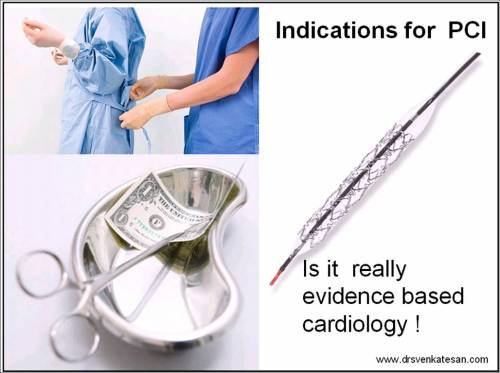
Scientifically , the indication for coronary revascularisation should be based on following
Patient’s symptom ( more specifically angina , dyspnea is less important !)
Prov0kable ischemia ( A significantly positive stress test )
Signifcant LV dysfunction with documented viable myocardium & residual ischemia
A revascularisation eligible coronary anatomy * TVD/Left main/Proximal LAD etc ( *Either 1, 2 or 3 should be present in addition )
All emergency PCI during STEMI /High risk NSTEMI
Practically ,
A CAD patient may fulfill “Any of the above 5 “ or “None of the above 5” , but , if a coronary obstruction was revealed by coronary angiogram and if he fulfils The 6th criteria , he becomes eligible for revascualrisation
6th criteria
If the patient has enough monetary resources (by self ) or by an insurance company to take care of PCI /CABG *
*The sixth criteria overrides all other criteria in many of the cath labs .Of course , there are few genuine ones still fighting hard , to keep the commerce out , from contaminating cardiology !
Why PCI in left main CAD is considered an inferior modality than CABG ?
CABG is superior to PCI for the simple reason it provides complete revascularisation virtually in all patients with LMCAD , while PCI is possible only in a fraction of patients with LMCAD.
If we take 100 patients with left main disease may be ten (At best !) would be suitable for PCI ! In other words PCI is contraindicated in vast majority of LMCAD by technical criteria alone , while there can never be a contraindication for CABG in patients with LMCAD.(Except when , comorbidity precludes surgery )
Why PCI in LMCAD difficult ?
It is dependent on technicalities
CABG does not tackle a lesion, it simply avoids it and by passes it ” No great brains required”
while PCI takes on the plaque frontally , in the dangerous terrain of left main artery itself !
so, much caution, planing , logistics are required . Further , if there is a complication there is a potential
for catastrophe as the only supply line is cut off . This is the reason , cardiologists were worried to try this on
unprotected left main. (Protected LMCAD refers to left main disease following CABG wherein atleast LAD or LCX is grafted )
Points to ponder in LMCAD
PCI is suited for isolated discrete LM disease.In realty this is seen in less than 5-8 % CAD.
LMCAD is very often associated with critical and multivessel distal CAD . So these patients will be candidates for CABG.
Left main ostium or LAD ostial involvement makes PCI a tougher exercise
Calcification is more common in LMCAD that again makes PCI difficult.
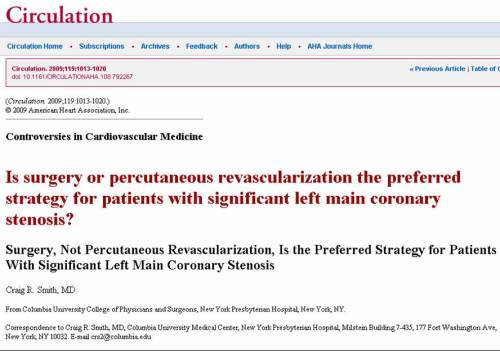
The following article in Feb 2009 is a major blow for proponents of PCI for left main
Conquering left main disease is an interventionist’s ultimate dream.
But, before that they have to tackle the bifurcation lesions .This is of vital importance, because 2/3 rd of left main patients have some form of bifurcation lesions. Current techniques , hardware and outcomes are far below the idealistic solutions in bifurcation lesions.
Till that time , CABG would remain the only choice for all , but for a small fraction of isolated left main disease where PCI may be possible.
Drugs are poisons , whenever it is administered without valid purpose. it can enter human body in many ways (Oral, intravenous, percutaneous etc ) And now we have another route namely intracoronary !
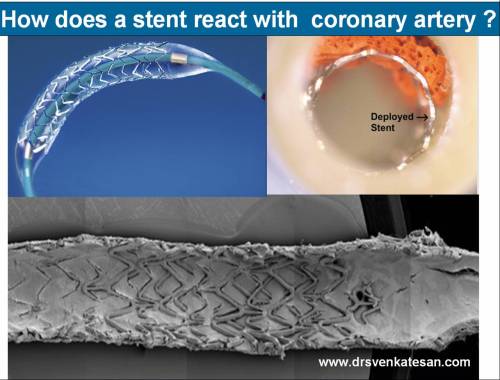
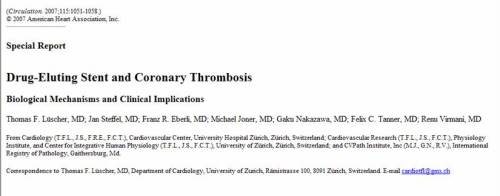
In quest for prevention of restenosis, many of the anti cancer drugs are now delivered directly inside the coronary arteries .These drugs are secreted like a sustained release tablet from the drug coated stents.These drugs are expected to prevent restenosis within the stented segment.But, after years of intense debate and research , we realised that , drugs eluted from the stent could damage the distal coronary vascular bed and coronary microcirculation.( And thus came the epidemic of acute stent thrombosis ! )
The tender and sensitive coronary microvasculature is constantly exposed to these powerful anticancer and immmunosuppresive drugs .It is a great surprise , no body thought of this dangerous drug -coronary artery interaction ! It required the genius of Renu virmani and others to point out this.
But still , the cardiology community by and large , fails to consider this an important issue.This is proven by the fact, usage of DES is still increasing and used mainly as an off label indication.
What is the long term effects of drugging a coronary artery ?
Is no reflow or slow flow more common after DES , because of the adverse drug reaction in the distal vascular bed ?
If a patient with DES undergoes a CABG later what would be the impact of the drug on the graft ? Will the functional vasodilatation affected ?
Final message
A drug , to get a legal clearance it has to undergo hundreds of rigorous tests . Finally it is cleared for that specific indication for which it is tested .Just because a drug is cleared for one purpose ( Paclitaxel for malignancy ) it does not mean it is safe to use for any other purpose for which it is deemed to be useful . Exactly the opposite is happening in the the field of interventional cardiology . No body wondered to think what would be the effect of these drugs on the normal coronary endothelial cells and vasculature.Is it not a crime , without analysing this particular issue , dozens of drug eluting stents have been released in the market . And now, sounds of crying foul is heard world wide !
Let us thank , the so called negative forces in cardiology for making this an issue . In science , the watch dogs should bark at times of danger not wag the tail !
Anginal pain is a type of visceral pain.It is carried by type C unmylinated nerve fibres.The perception of angina is a complex process.It is a combination of visceral and cutaneous referral pain.
How often is angina silent in diabetes mellitus ?
Presence of diabetes per se does not make an angina silent. In fact, if one takes 100 patients with diabetes , if angina occur in them , it is more often , manifest than silent. So , only few of the diabetic patients who develop diabetic autonomic neuropathy fail to have angina.The exact incidence is not known.It could be around 20%.
If angina can be silent in diabteics , can they have anginal equivalents ?
This again is not answered in literature. Among the anginal equivalents , the most common is dyspnea , which can occur in diabetics.But now , we know dyspnea also needs thoracic nerve signals from the intercostal muscle spindle and colgi organs.This can also be impaired in diabetics.
Can silent and mainfest episodes occur in a same patient ?
Yes.
Once silent does not mean always silent, and similarly once angina is felt it does not mean he is going to feel the next episode as well !
This strongly reminds us medical science is much a complex subject and what we know is very little in pain perception.
How is silent ischmia different from silent angina ?
There is considerable overlap between silent ischemia and silent angina
The questions to be answered are
Which is silent ? Is it the angina or is it the ischemia or both ?
Silent ischemia can occur in any individual , this is also called as silent CAD . When ischemia occurs but fails to generate pain it is silent ischemia .Undiagnosed CAD in asymptomatic individuals is also called silent ischemia or CAD.In this population Exercise stress testing detects CAD which was otherwise silent and masked.These patients may develop angina during EST.
During exercise stress testing many times patient has significant ST depression more than 2mm but still chest pain may not occur.These episodes may either be silent ischemia or ngina. Many times the EST is terminated before angina is manifest .( Chest pain is the last to occur in the chain of events following ischemia- Concept of ischemic cascade )
What are the other situations where angina can be silent ?
Pain perception and threshold level is high , so patient indeed has anginal signals but fails to feel it .
Patients on antianginal medication , fail to feel the angina.
Chronic betablocker therapy can exactly mimic autonomic neuropathy
Is it a blessing for the patient to have painless episodes of angina ?
When their ischemic colleagues , suffer a lot with chest pain it is tempting to think these diabetic patients are blessed!
Scientifically , this could be true in at least in some especially in a patients who’s coronary anatomy is known and devoid of any critical proximal lesions. For example a small PDA lesion can produce severe angina , but may be silent in diabetic and be comfortable .This lesion is insignificant other wise * !
It should also be recalled , pain relief has been an important goal for treatment of CAD .In olden days, thoracic sympathectomy was done for angina . In fact , even in CABG , one of the the mechanisms for angina relief is attributed to cardiac denervation.
Caution: Even a small episode of ischemia can trigger an electrical event .But it is rare.
How common is silent infarct (STEMI) in diabetic patients ?
In a simple questionnaire we asked the diabetic patients in our CCU how they felt their pain during MI.Most felt it normally as do other non diabetic . Diabetes does not make all anginal episodes silent. Severe episodes of ischemia may be painful while less severe episodes may be painless. Diabetic autonomic neuropathy is a least recognized and poorly understood complication of diabetes.Diabetes , involves the vasanervorum of the autonomic nerves.
The other mechanisms postulated in diabetic neuropathy are
Reduction in neurotrophic growth factors.
deficiency of essential fatty acids .
Reduced endoneurial blood flow and
Nerve hypoxia .
Is diabetic autonomic neuropathy treatable ?
Very difficult problem indeed.Controlling diabetes may partially correct the neural dysfunction.Many add on neuro vitamins and aminoacids are having a good market !
If you successfully treat diabetic autonomic neuropathy will my patient start feeling the hitherto silent episodes of angina ?
We don’t know.Logic would answer ” YES”
What is the ultimate effect of cardiac autonomic neuropathy.
The growth of medical science has been phenomenal .It is estimated , the quantum of break throughs and development in the last 50 years is nearly equal to 2000 years of evolution of our knowledge put together. Along with this growth , came the unavoidable misuse , and abuse of medical science. This is mainly due to contamination of medicine with commerce . Federal drug authority (FDA) and it’s variants were formed in all countries to monitor the proper usage of these technologies for the benefit of mankind. It has an authority to ban a drug or device , if it is found to bring more injury or side effects than benefit !
But , unfortunately there is no legal authority to ban an an investigation which is potentially or (really harmful )
or used extensively without any valid purpose .
The list of such investigation is increasing in every speciality
In cardiology
Doing a Troponin assay in patients wuth classical STEMI
MDCT in general population
Pro BNP in all suspected cardiac failure
Routine C reactive protein for CAD
Central venous catheters for all pateints with shock.
Is there a case for banning an investigation (Like banning a drug) for the benefit of our patients ?
Looking superficially , it may seem ironical. But we realise many seemingly innocuous investigations are responsible for uncontrolled misery for many patients.
This especially true in people who throng the wellness clinic (Also called master health check up)
A incidentally high C – reactive protein can lead on to forearm blood flow assessment of endothelial dysfunction and carotid intimal plaque that could lead onto carotid stents ! and life long anticoagulation , and an excess INR and sudden cerebral bleed and death !
This is one sample story in one particular speciality
There is a definite case for banning ( Either total or partial) some of the questionable investigations which are done routinely !
Just because these investigation do not have any physical , visible , adverse reactions like a drug , it should not be allowed to be abused .The consequence of false positive results of these investigations could be terrible and worse than the real disese itself !
The irony of medicine is unlimited ! 100 years of active clinical research failed to find a specific cure for the rhino virus mediated common cold.In fact US Govt stopped funding for this .
While , complete cure is possible for many of the cancers, especially hematological ones !
Message
In medicine there are thousands of disorder which have no cure !
HT management has been made easier with the availability of many good drugs , at the same time it has become a complex issue with as many classification and guidelines.
The management of HT has evolved over the decades. Now we have realised HT is not a simple number game. Reducing the blood pressure to target levels is not sufficient and is not the primary aim !.
In fact we now know controlling the numbers alone is never going to work , combined risk factor reduction is of paramount importance.
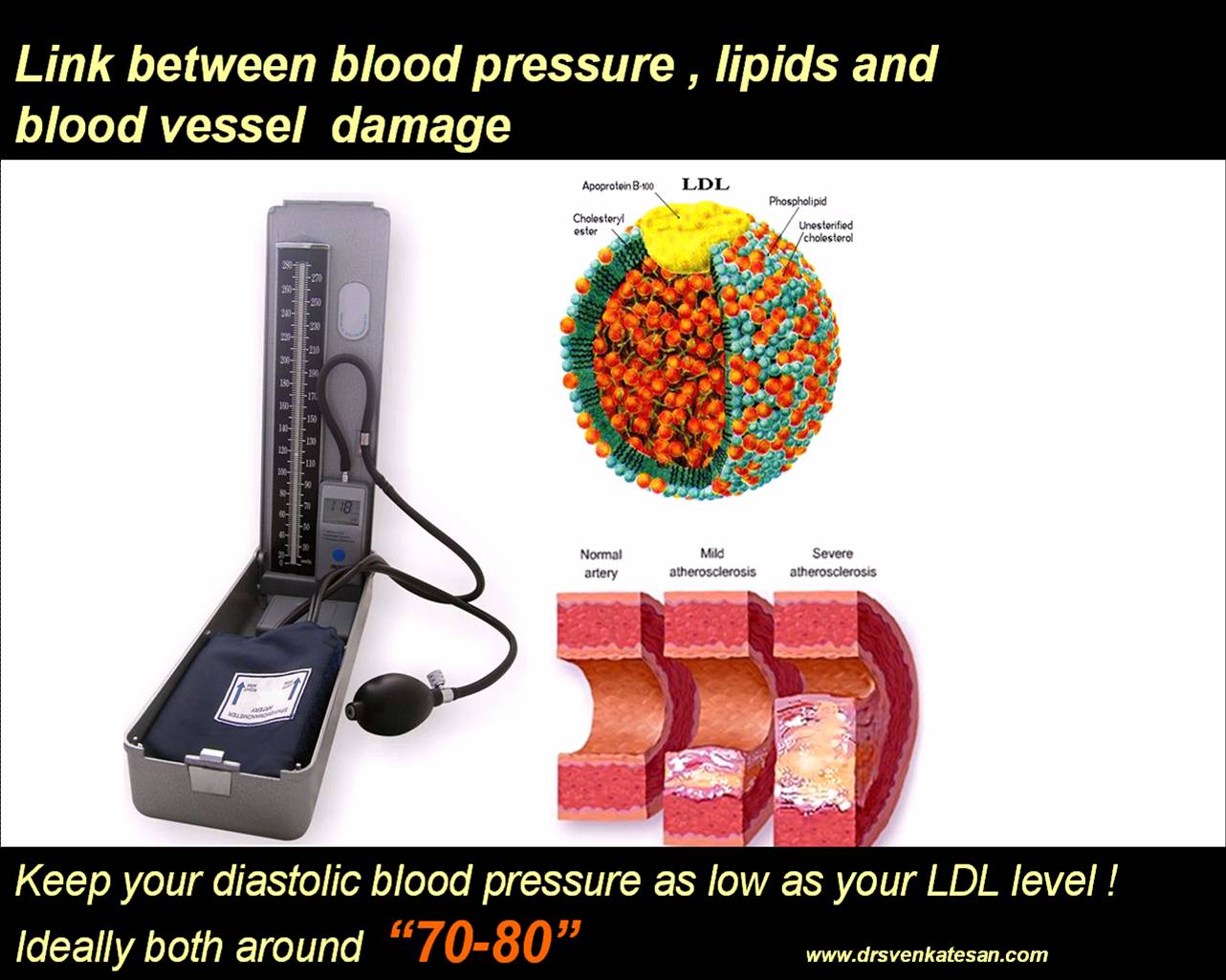
HT per se is less lethal but when it combines with hyperlipidemia and diabetes or smoking it becomes aggressive.The blood lipids especially the LDL molecule enjoy the high pressure environment , penetrate and invade the vascular endothelium.
ASCOT LLA study has taught us, for blood pressure reduction to be effective and reduce CAD events one has to reduce thier lipid levels also.So , for every patient with HT there is not only a target BP but also a target LDL level .
Final message
The tip for better vascular health is, all hypertensive patients should keep their lipids to optimal levels and all hyperlipidemia patients should keep their BP as low as possible .
“Keep your LDL as low as your diastolic blood pressure and let us keep it around 70 -80
It is now mandatory for all journals to declare the conflict of interest by the authors who are involved in medical research .The purpose apparently is to make all transactions or links between the researchers and their funding agencies transparent .Even major journals do not go beyond this . Some ensure it , to appear in the first page of the article.
What does the the journals tend to convey to the reader by publishing the conflicts of interest ?
Does it mean the article in question may have a bias or indeedhave a bias ? and readers are warned hereby !
Do they send across a message that the article may not be really a genuine one and the judgement is left to the the consumers of the articles ?
How often a journal article is rejected purely on the basis of conflicts of interest ?
Most of journal articles are rejected for poor methodology, statistical analysis and so forth .We don’t know how often a paper is rejected due to a conflict issue per se.If this could happen ,bulk of drug trials would face a torrid time from the editors.
Why , even the leading scientific journals never indulge in grading the significance of the conflict ?
Here is an example .
The much hyped drug trial on Hypertension “ACCOMPLISH” was published in the world’s most prestigious medical journal recently .It left it to the readers to have their own assessment on the conflict issue.
The consequence of not , grading and investigating about the conflicts could have serious global health implications both financially and academically .
This study was designed, formulated, completed and published with a single hidden aim of neutralising the land mark trial of ALLHAT which recommended diuretics as a first line drug in HT.Apparently diuretics are very cheap , effective generic drugs.
Is it a scientific rule that the latest evidence , should always prevail over the older evidence ?
No.Science can never have such a rule ! The question is how good and genuine is the evidence.Just because an evidence is current , it does not attain a scientific sanctity !
One of the important principles of medicine is “Diagnosis should always precede treatment”
This quote , though appear reasonable , can not be practiced always especially in emergencies, where we have to first stabilise the patient without a prior diagnosis .(Like administering IV fluids in hypotension , acetaminophen for fever , etc)
Modern medicine considers treating a patient without a diagnosis as unscientific.
But, it is a well recognised fact , millions of decision in everyday medical practice is not based on scientific diagnosis but on clinical acumen and empirical therapy . There are many instances wherein , we are never near the diagnosis even after exhaustive investigations.
Ironically , in this era of evidence based medicine , when we are unable to conclude , we are forced to do the most funniest thing , namely converting patient’s symptom itself as disease entity and be happy in labelling them. Like , Motion sickness , poly-arthritis, , chronic fatigue syndrome, adult respiratory distress syndrome , pre mature ejaculation, fever of unknown origin , attention deficit disorder , etc (The list is endless . . .)
This happens because physicians always feel guilty if they are unable to label a patient with a disease entity.
Is the guilt justified ? Not necessarily so ! Symptomatic treatment without diagnosis is the most dominant theme even today (Fever, pain etc ).So don’t feel unduly negative* when one is not able to fit a patent’s symptom into a disease entity but ensure he gets relief from his symptom.
*Except of course , one has to rule out a serious disorder.
Hypertension is the most common clinical cardiovascular entity.Left ventricular hypertrophy (LVH) is an important consequence of HT.In fact, it is considered as a end organ effect or damage. Others being brain, kidney, and peripheral vascular disease.Knowing about LVH is important because it has been linked to increased cardiovascular events.
Though LVH is considered as a close companion of HT it is surprising only a minority (15-30%) show evidence of LVH .Some experienced clinicians (Level C evidence) quote even lower < 10 % .Traditionally LVH was detected by ECG and now it is replaced by echocardiography.
What determines the LVH ?
It will be suprising to note , answer to this question is still not clear .
Is it the duration of elevated blood pressure ?
Is it the absolute level of blood pressure ?
If so , is it the systolic BP , diastolic BP or the mean BP ?
Or is it related to the etiology of HT ?
There has been no significant correlation between the above parameters
When we don’t know the answer to a question in medicine , the answer will generally will be inside the genes !
So in HT also the major determinant of LVH is in the genes that determine the myosin heavy chain response .
and also ACE gene polymorphism.ACE genes are involved in the expression of growth factors within the myocardium.
It implicates , gender, age, race etc in the genesis of LVH
Final message
So , the myocardium does not respond with LVH in all patients with HT.It happens only in a minority* .Duration of HT can be an important determinant , but the major factor is the alteration of genetic switches within the myocytes How this switches are going to behave , is largely inherited .Regression of LVH is also not uniform again implying lesser role for hemodynamics. (Some studies revealed ACEI have maximum regression of LVH , later disputed )
*LVH is more consistently seen in hypertension due to reno vascular or parenchymal disorders .It is also an observed fact , a combination of diabetes and HT is more likely to result in LVH.
The other major issue that needs explanation in HT/LVH is , how much of LVH is due to myocyte hypertrophy perse and how much is contributed by interstitial cell hypertrophy(Non myocytic hypertrophy)
The contents of the this blog is being published as Kindle E book , as per the request of many of the readers. Every article will continue to be open source in this site. Again I shall reiterate the book format is not aimed at any commercial intent. It is only to facilitate learning in a single book format Here is the link to book https://amzn.in/d/euhL5vu
Click below to see who is watching this website live !
This site will never aim for profit. Still ,this donation link is added at the request of few visitors who wanted to contribute and of-course that will help make it sustainable .
Please Note
The author acknowledges all the queries posted by the readers and wishes to answer them .Due to logistic reasons only few could be responded. Inconvenience caused is regretted.