Feeds:
Posts
Comments

Posts Tagged ‘nejm’

                                  Indication for thrombolysis in ST elevation MI  is mainly determined by clinical and ECG features. ST elevation of more than 1mm in two consecutive leads with a clinical suspicion of acute coronary event demands immediate thrombolysis.

                                 Early repolarisation syndrome(ERS) is a  is typical mimicker of STEMI . In ERS , ST segment elevation occurs in many leads especially precardial .This entity is estimated to occur in nearly 3-5% of population where a genetic variation in the potassium channel activation is reported.

                              If they  land in ER with some sort of chest pain , chances are high for labelling  them as ACS . It is not uncommon for  CCU physicians  to  witness  an  ERS being lysed . Even in many of the land mark trials (ISIS ) there has been many inappropriate thrombolysis , recognised later on.

What can really happen if you thromolyse them inadvertently ?

Generally nothing happens . But they are exposed to the risk of thromolysis. The ECG changes persist. And troponin will be negative and  echocardiogram will not reveal any wall motion defect.

Are we legally liable if a patient  with ERS was thrombolysed and he ends up with a bleeding complication like stroke ?

                        While the physician may feel guilty , there is no reasons for him to feel so.The guidelines are kept little lineant  for  the indication for thromolysis. When we are promoting  a strategy of early  thrombolyis  on a population based approach  in STEMI ,  there is bound to have a overlap with normality .The benefits out of early thrombolysis for eligible  patients for outweigh the few inappropriate thromolysis.

When you want to catch  a   real criminal  it is unavoidable,  one gets hold of all suspected criminals before letting them free . Unfortunately  in this exercise , some of the innocent  might experience   intimidation or even a injury  at the hands of law enforcers.

                               Similarly if a patient with ERS develop a severe esophageal spasm and typical  angina like chest pain he is absolutely certain to receive thrombolysis. (Troponin, CPK come later , and the results never veto the clinical and ECG criteria ,except probably in LBBB) .Many times critical  time dependent decisions are prone for errors in CCU.   So it may be  unscientific to ask why an ERS was  thrombolysed !

 How can one prevent inadvertent thrombolysis in ERS ?

                            Always ask for the previously recorded ECGs .If it is available and  look exactly similar to the current ECG  chances are unlikely  for ACS. In ERS ST segment is generally concavity upwards . ACC/AHA  guideline for STEMI  ,is  aware of this fact , but still  advices thrombolysis for all ST elevation irrespective of the morphology of ST segment elevation. This is propably intentional,   not  to incorporate morphology cirteria of ST elevation  for thromolysis .It would potentially  make many true STEMIs  diagnosed falsely  as ERS and deny thrombolysis.


What is the latest news about ERS ?

                       Now data are coming up, ERS is not entirely benign condition.Some of them ( Even a fraction of ERS population could be a significant number) can have a overlap between Brugada syndrome and they  could be prone for dangerous ventricular arrhythmia when challanged with ischemic or other stress.

Read Full Post »

                                       Left atrium is the posterior most chamber of the heart.  It is almost a mid line structure.  The normal size of left atrium is about 4 / 4 cm. Normal left atrial volume is 46ml in men and 38 ml in women .(Atrial volume in a normal adult population by two-dimensional echocardiography Y Wang, Chest, Vol 86, 595-601.)  Left atrium  is not an easy chamber to identify in the  X ray chest as it does not form  the cardiac border.( Except a small circumference of left atrial appendage.(LAA)

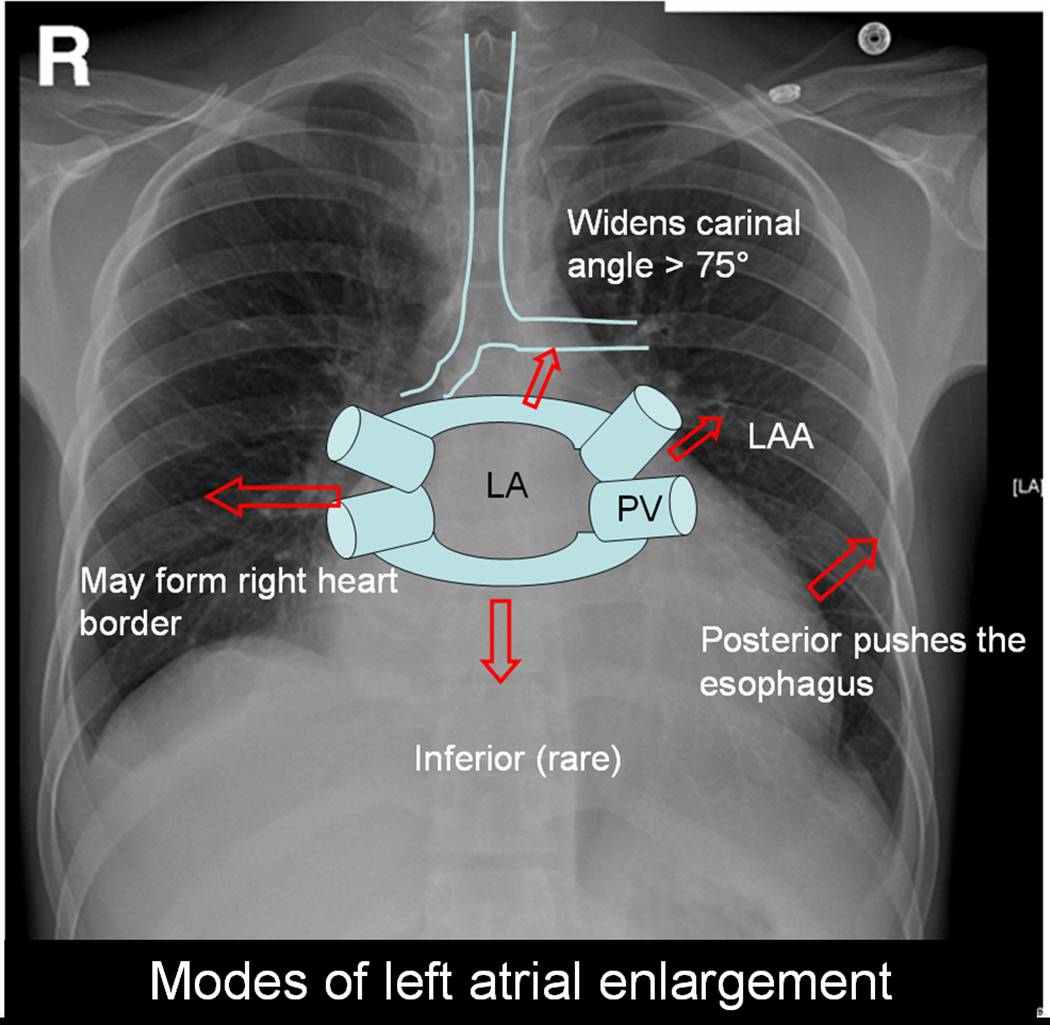
Left atrium can enlarge in multiple directions.Generally it dilates in the path of least resistance.


  • It is believed left atrial appendage  enlargement occur early .  LAA enlargemnet seen as a fullness beneath the pulmonary artery shadow. It may be the earliest finding of LAE in X ray. ( This may appear as straight left heart border , as in classical  mitral stenosis where MPA is also enlarged). The LAA enlargement is not necessarily in  in proportion  with LAE.
  • LA could  also enlarge posteriorly by pushing the esophagus towards the spine.This is visible only in barium swallow.
  • Then LA can enlarge either to left or right ( Usually towards right) and  reach the right heart border or over shoot it and form the right heart border by itself.This occurs very late in the course.
  • The other direction  LA goes on to enlarge is superiorly. When LA enlarges superiorly it hits on the left main  bronchus and lifts it.This is measured by the widened subcarinal angle which is normally less than 75 degrees.
  • LA can enlarge anteriorly  sometimes , but it is resisted by right ventricle but rarely right ventricle yields to the LA push and produce a left parasternal lift which could be mistaken  for RV enlargement.
  • Inferior enlargement can not happen in a significant way as it is limited by the AV groove and strong fibrous skeleton. 

With the advent of echocardiography X ray assessment of LA is redundant .(Academic value and in fellows training programs).The upper limit of normal LA size is around 4.5cm.

LA enlargement is commonly seen in

  • Rheumatic mitral stenosis, regurgitation. Gross enlargement up to 10 cms are common.
  • Hypertensive heart disese.
  • Cardiomyopathy, especially restrictive where both atria enlarge.

In all these conditions if  atrial fibrillation occurs  LA size increases further.

Read Full Post »

Chest pain is one  of the commonest presenting symptom  in any  hospital both as  an emergency  or non emergency. Reaching an accurate diagnosis is very important. The main  purpose of evaluation of chest pain is to recognise it as cardiac or non cardiac origin . Cardiac chest pain almost always means ischemic chest pain . That is called angina. (Of course there are few important causes for non ischemic cardiac chest pain which Will be discussed later).

Standard features of typical angina.

Chest pain which falls short of typical features are called atypical chest pain . Some recommend at least three typical features to label it as angina.
After the clinical examination patients  should be categorised in one of the following .

  • Typical angina
  • Atypical chest pain
  • Non cardiac chest pain** Non cardiac chest pain is not a diagnosis. Any physician (or a specialist)  should take some effort to localise it. (Muscle, nerve , pleura , anxiety  etc) . But  generally once these patients are ruled out of cardiac pain  they become less special and are simply referred back to their  family physician, only to return back  with  another cardiac  pseudo-emergency  in a different hospital .

    Why we are diagnosing atypical chest pain liberally ?

    Currently   more number of  patients as well as  the physicians  are   aware of the looming epidemic of CAD. The other major reason is the  lack of application of mind during  foirst clinical appraisal  and examination. Many of the patients with non cardiac chest pain  (Muscle, nerve , pleura )  are termed as atypical chest pain. Though some of the popular texts use atypical  chest pain  and non cardiac chest pain interchangeably , it is not  correct to do so. For example don’t ever label a  patient with chest pain with chest wall tenderness as atypical chest pain and order a cardiac work up .It  is a poor model to  emulate , that consumes time and resources!.Instead they should be diagnosed a confident non cardiac chest pain and dealt properly.

Once a patient is diagnosed  atypical chest pain what’s next ?

They should get a  complete physical examination,ECG, and  undergo exercise stress test.   In the  screening of CAD , angina can be termed a hard sign,  atypical chest pain is a soft sign,  resting ECG is surprisingly  a soft sign again (unless you record it during chest pain). Exercise stress testing is  the ideal  investigation in evaluation of  chestpain.( 70-80% accuracy). This can be improved upon by Thallium, SPECT, stress echo etc. As of now coronary angiogram is considered the ultimate gold standard (Not pure gold !) to rule out  CAD.

It is also worthwhile to remember non anginal  chest pain can also be an emergency and life threatening

  • Pulmonary embolism
  • Pneumothorax
  • Thoracic tumors
  • Aortic aneurysm (Dissection and non dissection)  The list is not  exclusive

Final message

What do we really mean by  atypical chest pain ?

In reality we don’t mean any thing !

When a  cardiac  physician is confused or rather , unable to  rule out angina , at the same time he is not confident of calling it as non cardiac chest pain,  he has the luxury of using this terminology . It is obvious  this terminology  should  minimally  be used.  Once diagnosed  these patients  can’t carry on with this tag  for long. They should be reinvestigated , (Right from history  and clinical ex) .They should either enter the cardiac work up  protocol  or  a non cardiac source for pain should be fixed  immediately.

Read Full Post »

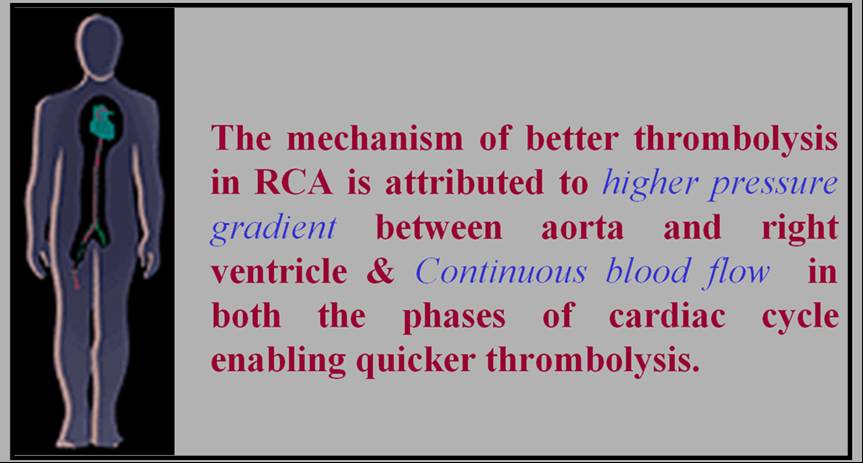
              Intra coronary thrombosis is the sine qua non of acute coronary syndrome ( Both STEMI and NSTEMI.) But thrombolysis is the specific therapy in STEMI and is contraindicated in NSTEMI/UA.

Why is this apparent paradox ? What is basic differnce between UA and AMI ?

In STEMI there is a sudden & total occlusion of a coronary artery usually by a thrombus with or without a plaque .The immediate aim is to open up the blood vessel . Every minute is important as myocardium undergoes  a continuous process ischemic necrosis. So thrombolysis (or more specifically fibrinolysis should be attempted immediately) .The other option is primary angioplasty,  which will not be discussed here.

The thrombus in STEMI  is RBC &  fibrin rich and often called a red clot. Number of fibrinolytic agents like streptokinase, Tissue palsminogen activator,(TPA) Reteplace, Tenekteplace etc have been tested and  form the cornerstone of STEMI management.The untoward effect of stroke  during  thrombolysis  is well recognised , but usully the risk benefit ratio favors thrombolyis in most situations except in very elderly and previous history of stroke or bleeding disorder.

Unstable angina is a  close companion of STEMI . Many times it precedes STEMI often called preinfarction angina. During this phase blood flow in the coronary artery  becomes sluggish gradually,and patients develop  angina at rest .But unlike STEMI there is never a total occlusion and myocardium  is viable but ischemic,  and emergency salvaging of myocardium is not a therapeutic aim but prevention of MI becomes an aim. It is a paradox of sorts ,  even though thrombus is present in  UA ,  It has been learnt by experience thrombolytic agents are not useful in preventing an MI .


Why  thrombolysis is not useful in UA ?

1.In unstable angina  mechanical obstruction in the form of plaque fissure/rupture is more common than completely occluding thrombus. So lysis becomes less important.

2. Even if the thrombus is present , it is often intra plaque  or intra lesional and the  luminal  projection of thrombus is reduced  and hence thromolytic agents have limited area to act.

3.Further in UA/NSTEMI since it is a slow and gradual occlusion (Unlike sudden & total occlusion in STEMI) the platelets  get marginalised and trapped within the plaque .Hence in UA  thrombus is predominantly  white  . Often, a central platelet core  is  seen over which fibrin clot may also be  formed.

4.All available  thrombolytic agents act basically as a fibrinolytic agents,  and   so it finds   difficult to lyse the platelet rich clot.There is also a small risk of these agents lysing the fibrin cap and exposing underlying platelet  core and trigger a fresh thrombus.This has been documented in many trials( TIMI 3b to be specific) So if we thrombolyse in UA , there could be a risk of recurrent ACS episodes in the post thrombolytic phase.

5. UA is a semi emergency where  there is no race against time to salvage myocardium .Administering a  stroke prone thrombolytic agent tilts the risk benefit ratio against it.

6. Among UA, there is a significant group of secondary /perioperative UA   due to increased demand situations. Here there is absolutely no role for any thromolytic agents,  the  simple reason is , there is  no thrombus to get lysed. 

7.Many of the UA patient have multivessel CAD and might require surgical revascualarisation directly .


So fibrinolytic  agents are contraindicated in UA so what is the next step ?

The emergence of  intensive and aggressive platelet-lytic agents.

A combination of aspirin, clopidogrel, heparin, glycoprotien 2b 3a antagonist formed the major therapeutic protocol in these patients.Even though these are called antiplalet agents some of them  like 2b/3a antagonist eptifibatide, tirofiban, and many times even heparin has a potential to dissolve a thrombus. So technically one can call these agents  as thrombolytic agents.

What are the unresolved issues

                                       Even though clinical trials have convincingly shown thrombolytic agents  have no use in UA .There is a nagging belief  THAT  there could  be group of patients  with UA , still might benefit from thrombolysis as total occlusions have been documented  in some cases with UA.This is  especially true in peri-infarction unstable angina (Pre & post) as there is a fluctuation  between total and subtotal occlusions ) .But bed side recognition of this population is very difficult.

Many would consider this issue as redundant now,  since  most of  these patients  are taken up for emergency revascularisations

Read Full Post »


Chronic renal failure and CAD are common companions.Severe CAD  in patients with renal failure  pose an imposing task on the treating physicians.CABG  and kidney transplantation  both are major interventions.When a patient  requires both the decision making becomes much more difficult.

The possible  choices are

A. Do CABG first follow it with renal transplant .

B. Do  renal transplant first follow it with CABG.

C. Do CABG first  and  defer transplant &  advice life long dilaysis

D.Do  renal transplant and offer medical management / PCI for CAD if feasible.

E.Simultaneous CABG & renal transplant is a remote possibility .

F.In terminally ill , combined cardiac and renal transplantation is the ultimate option. (Possible in very few centres in the world)   

G.In severe co-morbid condtions avoid both and support life. Success is not in completing   the procdeures but in providing useful life !

Among the options the most prefered worldwide is option no 1. This has a caveat. If angina is dominant  CABG should precede transplant. If cardiac failure is dominant the issue need further scrutiny.

Given a situation ( DCM & End stage renal disese) , your patient could  undergo only one procedure,  which will you prefer ?

              This again is highly emprical but logic could still be applied. Never do  CABG with a sole  aim of improving severe LV dysfunction in ischemic DCM .It happens only in  journal articles & major clincal trials!.Of course mitral valve correction and LV reduction surgery might help.But in a patient with  renal failure prolonging the CABG on table time , with add on surgery is highly risky. So it would be logical to think intensively  for  postponement of  the CABG in a patient with class 4 cardiac failure and renal failure. Do only the transplant .

 What is the impact of end stage renal failure  on LV dysfunction ?

 End stage renal failure has a great adverse impact on LV function. Many times it is reversible.We will never ever know, if you do a CABG first on them. So always think twice or even thrice before voting  on this vital issue . Correction of renal impairment can improve the cardiac status dramatically in some.

Read Full Post »

CURRENT   CARDIOLOGY  PRACTICE: EVIDENCE  OR  EXPERIENCE  BASED ?    AN  ANALYSIS OF  ACC/AHA  GUIDELINES.

S. Venkatesan,  Madras Medical College. Chennai


If  a  major therapeutic procedure is adviced based on simply by experience or expert opinion  how can we say evidence based medicine is practiced !


                                    Evidence based cardiology  is  the  buzz word  in global cardiovascular  health care  organizations. All diagnostic  and therapeutic  interventions are  undergoing  rigorous randomized  trials  for  proof of  efficacy  and  safety. ACC/AHA   have published  management guidelines and it  has been accepted  as de-facto standard of clinical cardiology practice world wide.  In these guidelines  class  1  indication  is defined as Conditions for which there is evidence for and/or general agreement that the procedure is useful and effective. These indications are supported by three levels of evidence.(A,B,C) .It has been observed,   many of the recommendations  in  class 1  were supported by only level  C  evidence. (Expert consensus or  agreement  ). We  analysed how much of todays guidelines is  agreement based  and  how much is evidence based. The  latest  practice  guidelines  of  ACC/AHA   for  Acute myocardial infarction , Unstable Angina and Non–ST-Segment Elevation Myocardial Infarction , chronic  stable angina  ,coronary angiography  were analysed. The  no  of  class 1  indications  were counted  in each set of guidelines  and  each  of the indication were  sub grouped with reference to the  levels of  evidence  to which it was supported. There  were a total  of 210  class 1  indications.


Class  1

Level A

Class   1

Level  B

Class  1

Level  C

P value

1A vs 1C

AMI(54)

7

25

22

<.0001

UA  (66)

11

26

29

<.0001

CSA(59)

8

29

22

<.0001

CAG(31)

3

12

16

<.0001

Total(210)

29(13.9%)

92(43.8%)

89(42.4%)

<.001

 13.9%   of class 1  indications were based on  level  A evidence.  42.4%  of class 1 indication were based  on Level C  ( agreement  of experts).Though evidence based cardiology   is   considered  to  define  the  standards in  Cardiology  practice  in reality  we lack evidence in most of the situations. 

                                       We  conclude  that  consensus or  agreement  based cardiology  practice is the dominant theme in current   ACC/AHA 

Read Full Post »

There are numerous complex grading for bifurcation lesions available.

The one proposed by Medina is simple and most useful.

In this grading three segments

  • Proximal main vessel
  • Distal main vessel
  • Branch vessel

Are given a code 0, and 1 if  lesion is present or absent .

This grading gives simple and fast method to label a bifurcatiuon lesion and to asssess the response to PCI. The only issue here is the individual  lesions are not graded , for example branch vessel ostium just involved about 20 % is not addressed . Further TIMI flow in these vessels may also be incorporated

How medina grading can be used to assess effectiveness of

angioplasty  ?

A patient with 1.1.1  after the treatment should revert back to 0.0.0.  if converted into 0.0.(.5) may indicate a residual side branch lesion  .5 shall indicate 50% residual lesion, .3 , 30% etc


What is the best management strategy for bifurcation lesions?

The topic has been discussed extensively for over a decade in various forums.

Though the lesions and intervention techniques  appear complex the basic concept is simple.

Following is the 8 point algorithm

1. Assess the bifurcation lesion accurately.

2. Apply the general rule and ask the first question whether PCI is neccessary at all ? if decided for PCI

3. Stent the main vessel.Protect the side branch.  

4. Dilate the side branch with a balloon.(KIss or through the struts) 

5. Very rarely,  if the side vessel is more significant and large  stent it and balloon the main vessel.

6. Use drug eluting stents with caution .

7. Resist the temptation of using two stents unless the situation demands and is absolutely required.

8. Never attempt to do bifurcation angioplasty during ACS as apart of primary angioplasty.( Unless you’re extremely competent, even then aim of primary PCI is to salvage myocarium quickly , not to provide TIMI 3 flow in non IRA vessel.)

Dr.S.Venkatesan.Madras medical college.Chennai.

Read Full Post »


The debate of rate control verses rhythm control in atrial fibrillation  goes on and on. The AFFIRM, RACE,PIAF, STAF the HOT CAFE all went against sinus rhythm in the last 10 years . This was one of the settled contoversies in cardiology . The conclusion was ventricular  rate control was no way inferior to rhythm control in patients with SHT, CAD population .This made the electrophyiologists wonder how can a natural rhythm fare bad ! . But the findings  were consistent .Rhythm control neither improved the quality of life nor  it reduced the incidence of stroke. The later finding was very surprising but the explanation was convincing as stroke in elderly was more related to SHT, CAD, DM etc than  AF itself. The source of emboli in ischemic stroke could come any where distal to LA .The big assumtion that all strokes in elderly  should come from LA appendage or the body  of LA was  premature and  wrong. What prevented stroke in AF was not restoration of SR but administration of oral anticoagulants with adequate INR.(2-3)

Having failed to document superiority in elderly  population   , the  logic machine  strongly suggested restoring SR  in patients with CHF,  will atleast provide hemodynamic and also survival  benefit .

And thus came the AF-CHF trial  published in NEJM 2008

Alas !  AF-CHF  also found there is no useful purpose of restoring sinus rhythm in patients  with atrial fibrillation and cardiac failure. In fact patients in SR fared little worse !

 Why . . .  why . . . why ?

Should we ask the seemingly absurd question !

Is sinus rhythm poorly tolerated by cardiac failure  patients ?

It is some times possible atrial fibrillation by itself could be a mechanism to amplify the  cardiac reserve by which it provides a  relatively high ventricular rate to improve the cardiac index  . Even though the optimal ventricular rate in AF is around 80-90 at times of need it has to increase to 120-130. Patients in class 3 CHF and AF often achieve this in times of demand .This is not possible in patients who are getting rhythm control drugs and further patients in SR can  not increase the HR suddenly from 80 -130  .

So is this a  wild imagination !   AF could be a safety valve mechanism in CHF to increase the HR . Where the atria come to the rescue of ventricle like a rate adaptive pacemaker .

The other logical* ! argument is that  there  is nothing wrong with restoring  SR , but the  methods to achieve and  maintain SR  is too cumbersome and results in adverse outcome .The currently available  drugs are too toxic for the purpose  .

If we have a simple and safe way to restore SR in these patients it should always be superior to AF .

But it is a well  known fact  that , whatever be the rhythm or rate the ultimate outcome will be dictated by the LV function, mitral valve function etc.

 Read abstract of AF-CHF

Rhythm Control versus Rate Control for Atrial Fibrillation and Heart Failure

Denis Roy, M.D., Mario Talajic, M.D., Stanley Nattel, M.D., ., for the Atrial Fibrillation and Congestive Heart Failure Investigators

<!–

Rhythm Control versus Rate Control for Atrial Fibrillation and Heart Failure

Denis Roy, M.D., Mario Talajic, M.D., Stanley Nattel, M.D.,  the Atrial Fibrillation and Congestive Heart Failure Investigators* –>ABSTRACT

Background It is common practice to restore and maintain sinus rhythm in patients with atrial fibrillation and heart failure. This approach is based in part on data indicating that atrial fibrillation is a predictor of death in patients with heart failure and suggesting that the suppression of atrial fibrillation may favorably affect the outcome. However, the benefits and risks of this approach have not been adequately studied. Methods We conducted a multicenter, randomized trial comparing the maintenance of sinus rhythm (rhythm control) with control of the ventricular rate (rate control) in patients with a left ventricular ejection fraction of 35% or less, symptoms of congestive heart failure, and a history of atrial fibrillation. The primary outcome was the time to death from cardiovascular causes.
Results A total of 1376 patients were enrolled (682 in the rhythm-control group and 694 in the rate-control group) and were followed for a mean of 37 months. Of these patients, 182 (27%) in the rhythm-control group died from cardiovascular causes, as compared with 175 (25%) in the rate-control group (hazard ratio in the rhythm-control group, 1.06; 95% confidence interval, 0.86 to 1.30; P=0.59 by the log-rank test). Secondary outcomes were similar in the two groups, including death from any cause (32% in the rhythm-control group and 33% in the rate-control group), stroke (3% and 4%, respectively), worsening heart failure (28% and 31%), and the composite of death from cardiovascular causes, stroke, or worsening heart failure (43% and 46%). There were also no significant differences favoring either strategy in any predefined subgroup.
Conclusions In patients with atrial fibrillation and congestive heart failure, a routine strategy of rhythm control does not reduce the rate of death from cardiovascular causes, as compared with a rate-control strategy.


Read Full Post »

Pulse deficit is a clinical sign wherein , one is able to find a difference in count between heart beat (Apical beat or Heart sounds ) and  peripheral pulse .This occurs even as the heart is  contracting , the pulse is not reaching the periphery.This can occur in few clinical situations .

1 . Atrial fibrillation.

2. Very early diastolic  ventricular  ectopic beats

3. Some patients with Pacemaker.

The mechanism is  , the ventricular contractions are  too weak and unable to open the aortic valve  (Or opens feebly*)  , but at the same time they are good enough to close the mitral valve. To open the aortic valve it has to generate atleast 60-80 mmhg pressure , while mitral valve closes even  as LV generates  8-14mmhg  .(LV/LA pressure cross over). So intermitently the  second heart sound  is missed while S1 is retained,  producing more heart sounds and less pulse count in the periphery. The S1 is either felt or heard at the apex but the corresponding pulse is missing . Further , this intermittent absence of  S2  results in totally irregular S1 /S 2 relation.


Why some of the contractions of LV is too weak to open the aortic valve ?

Because the RR interval varies , the ventricular filling also varies , diastole duration is constantly changing some of the diastole are too short  and LV hardly gets filled , as the LV force of contraction is directly decided by the LVEDV and LV  fibre length these contractions are too weak.

Other published studies

There has been some doppler observations ,where there is a midventricular LV blood flow reversal in atrial fibrillation that could  explain the pulse deficit . Mechanism of production of pulse deficit in atrial fibrillation: assessment by blood flow dynamics

Second Department of Internal Medicine, Kagoshima University School of Medicine.

 http://www.ncbi.nlm.nih.gov/pubmed/3221309

What is the clinical significance of pulse deficit ?

Currently there is no great clinical significance of this phenomenon. But an astute clinician will pick up this sign and it may indicate underlying LV dysfunction. In patients with PPM,  pulse deficit  suggests  pacemaker malfunction .Some patients with cardiac tamponade &  pulsus paradoxus  systolic  blood pressure falls too low to make the pulse feeble or not palpable in the periphery .This situation may mimic a pulse deficit if not recognised.

Dr.S.Venkatesan ,Madras Medical College , Chennai, India

* What is the evidence for intermittent absence or feeble Aortic valve opening in Atrial fibrillation ? I could find this from the book written by Harvey Feigenbaum. whom we consider Father of Echocardiography


Read Full Post »

The long standing controversy about diastolic heart failure is settled !

The perception that diastolic heart failure ( Now renamed as heart failure with preserved EF ) is less dangerous than systolic HF has been exposed by this land mark study by Owan TE, in 2006 (nejm) But unfortunately this information is not yet fully disseminated among the physician community. Hence this post, with due acknowledgment to NEJM & Owan et all.

Experts from the article

“The nosology of heart failure has been the
subject of much current debate, and some extreme
positions have been taken. The observation
that 22 to 29 percent of patients with diastolic
heart failure die within one year of hospital
discharge, and 65 percent die within five years,
is a reminder that we are facing a lethal condition,
regardless of its name. Owan et al. also
show that, in recent years, there has been little
improvement in survival rate among patients with
diastolic heart failure, in contrast to the improvement
in survival rate over time among patients
with systolic heart failure”

Have a look at the survival curve below, almost similar , surprise surprise ! DHF survival is not only worse ( in many ), than systolic CHF and further they respond poorly to treatment, compared to conventional systolic CHF .

Click below for the link to full text article

Short abstract :

Trends in prevalence and outcome of heart failure with preserved ejection fraction.

Cardiorenal Research Laboratory, Mayo Clinic College of Medicine, Rochester, Minn 55905, USA.

BACKGROUND: The prevalence of heart failure with preserved ejection fraction may be changing as a result of changes in population demographics and in the prevalence and treatment of risk factors for heart failure. Changes in the prevalence of heart failure with preserved ejection fraction may contribute to changes in the natural history of heart failure. We performed a study to define secular trends in the prevalence of heart failure with preserved ejection fraction among patients at a single institution over a 15-year period. METHODS: We studied all consecutive patients hospitalized with decompensated heart failure at Mayo Clinic Hospitals in Olmsted County, Minnesota, from 1987 through 2001. We classified patients as having either preserved or reduced ejection fraction. The patients were also classified as community patients (Olmsted County residents) or referral patients. Secular trends in the type of heart failure, associated cardiovascular disease, and survival were defined. RESULTS: A total of 6076 patients with heart failure were discharged over the 15-year period; data on ejection fraction were available for 4596 of these patients (76 percent). Of these, 53 percent had a reduced ejection fraction and 47 percent had a preserved ejection fraction. The proportion of patients with the diagnosis of heart failure with preserved ejection fraction increased over time and was significantly higher among community patients than among referral patients (55 percent vs. 45 percent). The prevalence rates of hypertension, atrial fibrillation, and diabetes among patients with heart failure increased significantly over time. Survival was slightly better among patients with preserved ejection fraction (adjusted hazard ratio for death, 0.96; P=0.01). Survival improved over time for those with reduced ejection fraction but not for those with preserved ejection fraction. CONCLUSIONS: The prevalence of heart failure with preserved ejection fraction increased over a 15-year period, while the rate of death from this disorder remained unchanged. These trends underscore the importance of this growing public health problem. Copyright 2006 Massachusetts Medical Society.

Other interesting article

Heart failure with preserved ejection fraction: dangerous, elusive, and difficult.

Eur Heart J. 2008 Feb;29(3):339-47. Nielsen OW, Køber L, Torp-Pedersen C.

BMJ editorail 2009

http://www.bmj.com/cgi/content/full/338/jan27_1/b52?ijkey=c7a29d35dc9d9dddf7d0e75c5b8d05014315c564

Read Full Post »

« Newer Posts - Older Posts »