Is he a person who puts a metal coil coated with a synthetic fungus in a incidentally detected block inside a small coronary artery and sends the bill to the Insurance company ?
Is he a person in a cosmopolitan hospital who opens up a chronically closed coronary artery , in an asymptomatic patient and live telecasts his achievement trans continentally ?
Is he a person who checks in by the early morning flight and puts multiple wires in an aged patient with class 3 heart failure and make him walk 20 meters extra at a cost of 1000$ / Meter ?
Is he a person living in Wall street , who looks for variety of holes In the heart and trying to occlude it with exotic devices
Is he the unknown physician who Intervenes in the natural history of Rheumatic heart disease and arrests immune mediated valve damage by giving the monthly injections penicillin in remote parts of our country ?
Is he the person who Intervenes to prevent young persons from smoking and help maintain their coronary endothelium enriched with nitric oxide & arrest the coronary epidemic ?
Is he the small town doctor who Intervenes to treat a breathless cardiac failure patient with digoxin and frusemide and dramatically alleviate the symptoms and prolong the life of our poor country men?
Is she the village health nurse from an inaccessible health centre located in a hilly terrain , Intervening successfully, by pulling out live babies from severely anemic pregnant mothers with failing hearts ?
Fundamental principle of human biological system is to live in harmony with nature and environment.Each cell has a unique reaction when it comes into contact with external material. This reaction can be acute or chronic , local or systemic. The most severe form of allergy is called anaphylaxis that can result in instantaneous loss of life. There is a whole gamut of disorders that resulted in a separate speciality called allergic medicine .
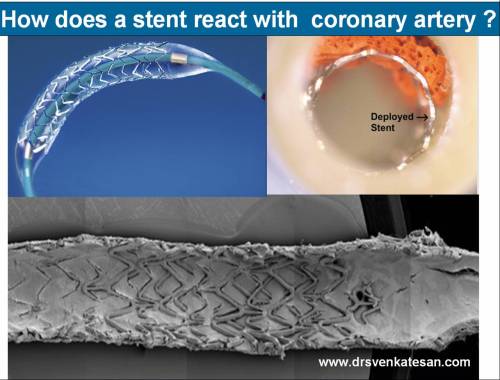
Further ,the transplantation science have taught us an organ or cell can be rejected at any point of time after implantation (Hyperacute -chronic) .With advancement of science we have started implanting a variety of devices with complex metallurgy ,inside human body, metal clips, prosthesis, valves, wires, etc .How the body handles them .The consequences can be a mild reaction to major ones occasionally.
Consider ,a local allergy due to a orthopedic prosthesis in one of the leg bones is far less serious than a metal within a coronary artery irritating the intima .
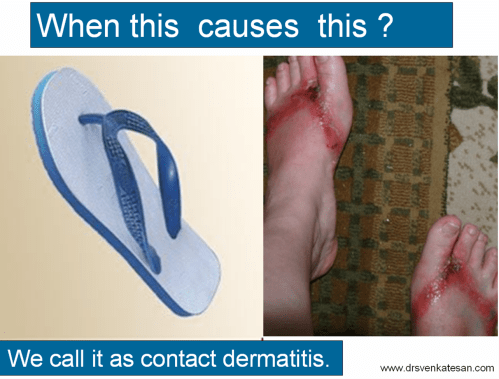
Remember hypersensitivity reactions can be severe . This lady reacted like this to a sandal slipper -A fiery red infiltration
Imagine if a stented coronary artery react like this what would be the possible consequence ?
In susceptible individuals , can a metal cause
Intimal hyperemia
Intimal induration
Intimo-medial edema following stent deployment
Why drug eluting stents are more prone for hypersensitivity ?
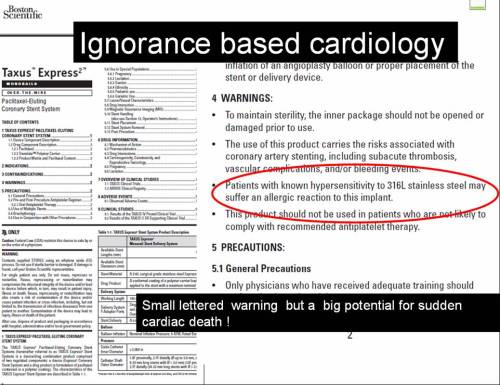
The answer is simple , while metal allergy is a comparatively rare phenomenon, the drugs we coat and the polymers used are many fold likely to result in hypersensitivity reaction.
While the world is worried more about penicillin , sulpha allergy which occurs in 1 in 100000 , we tend to ignore the metal and drug reactions within the tender coronary arteries.
What is the clinical expression of stent hypersensitivity ?
It is often a coronary event in the acute phase and restenosis in chronic phase.
How much of acute stent thrombosis is related to stent allergy mediated reaction ?
The exact incidence will never be known. It could be high. Whenever a sudden unexpected early stent occlusion can be a suspect .
Is stent allergy a local reaction or systemic reaction ?
It is most often local .The drugs the stent elute can elicit a systemic reaction occasionally.
So what can be done to prevent this complication ?
Drug companies in it’s package regularly include the warning message !What does it imply to have a caution on the covers ? .This warning simply represent about our ignorance in this issue. We presume it is a minor problem.
Questions unanswered
How does a cardiac patient knows whether he is hypersensitive to stainless steel or nickel ?
Is it practical to have a stent allergic test in every patient before PCI ?
Is routine administration of corticosteroids for few days after PCI an answer ?
Total coronary artery occlusion is a common finding in CAD especially in chronic stable angina. Normal coronary blood flow is 5 % of cardiac output that amounts to 250-300ml/mt.At an average heart rate of 70/mt , each beat injects about 5cc blood into the coronary circulation.This is shared between two coronary arteries. This means , only few CC (2-3cc) of blood enters each coronary artery with each cardiac cycle .
When one of coronary artery is totally occluded what happens to the coronary
blood flow ?
A.Total coronary blood flow can be be maintained normal at rest as it forms only about 5% of cardiac output (or it is only slightly reduced )
B. It is believed , the unobstructed coronary artery could receive the blood meant for the contralateral coronary artery. This possibly explains the increased coronary artery diameter in the non obstructed artery.
C. It’s nature’s wish , that the contralateral coronary artery shall share 50% of it’s blood through collaterals if available.
D.If collaterals are not formed it , the unobstructed coronary artery may be over perfused with double the amount of blood flow.
E. Some times , the collaterals steal much more than what the obstructed coronary artery deserves and make the feeding coronary artery ischemic. This is many times observed in total RCA occlusion with well formed collaterals from LAD/LCX.
F.The collateral flow in CTO also depend on whether flow is directed from LAD system to RCA or from RCA -LAD system. The LAD is better placed to assist RCA than vice versa.This is for two reasons.1.LAD blood flow is higher than RCA so it can share it.2.The driving pressure is more from LAD -RCA , as RCA can receive blood flow even during diastole .
F.During exertion , the coronary hemodynamics become further complex.The collateral’s are traditionally thought to be less than adequate during times of exercise.But it is more of a perception than solid scientific data.This rule may be applicable in only certain group of patients. We know CTO patients with very good exercise tolerance who have documented collateral’s.
G.Collaterals can be either visible or invisible by CAG. The strength of collateral circulation is not in it’s visibility but it’s capacity to dilate and respond to neuro humoral mediators at times of demand. Currently , there is lot to be desired regarding our knowledge about the physiology of visible collaterals , no need to mention about invisible collaterals !
Final message
The above statements are based on logics and observations .
Is it not a irony in cardiac literature , where thousands of articles are coming out every month to tackle totally occluded coronary artery(CTOs) , there is very little data regarding the coronary hemodynamics in chronic total occlusion . How does a patient with CTO can manage a active life with only one functioning coronary artery ?
When a doctor is confronted by serious doubt , what will be the outcome for the patient ?
Can doubting be beneficial for a patient ? . It seems so , according to EBM which stresses about statistical outcome at every turn of events in a patient who is critically ill .
Is something , always better than nothing ? Our limbic system tends to think so . It may not be true. But in dire situations , many things (Proven , unproven) need to be tried however doubtful it ‘s efficacy may be .This is akin to an emergency in an airplane. Even here there need to be a logic.
Then ,this question arises . How do we make sure , we have a dire situation on hand ?
This is the key issue , in the decision making for the critically ill patients . It needs experience , only experience ! Though the principle of uncertainty is the fundamental rule in medicine , EBM aims to bring some degree of certainty in medical therapeutics.
Benefits of doubting in coronary care unit.
In a sinking patient with cardiogenic shock , try the maximum treatment . Even if , the patient is in severe shock , take him to the cath lab , try open the coronary artery . Give the benefit of doubt to him even though the chances of reviving him is less than 10%.
Risk of doubting in Coronary care unit.
A.Elderly STEMI with SHT,(Arriving late , with an unknown time window after an MI ) To thrombolyse or not ? . There is no benefit of doubt here. Do not thrombolyse. Here , apply the benefit of doubt against thrombolysis .
B. Chest pain with LBBB (Thought to be new onset LBBB ) don’t ever rush to thrombolyse. Wait for the enzyme result . Don’t try to thrombolyse your doubt , instead thrombolyse the confirmed thrombus !
C. Patient with persistent ST elevation following thrombolysis ,in an otherwise asymptomatic and stable patient. Don’t pass on ” your doubt ” of salvaging at least some myocardium by rescue PCI .Rescue should be done before death. You can not resuscitate dead myocytes.
Final message
The concept of giving the benefits of doubt to the patient is a widely prevalent practice in medicine .This concept is alive and popular , not because it has proved effective, but because of the primitive human perception and cognition , namely “Something is better than nothing ” !
Common sense and logic would suggest , whenever there is a benefit for doubting there would be a equal ( or even more ) unmeasured hazards and risks . This becomes especially true , when a physician makes a therapeutic move based on doubting than on conviction .
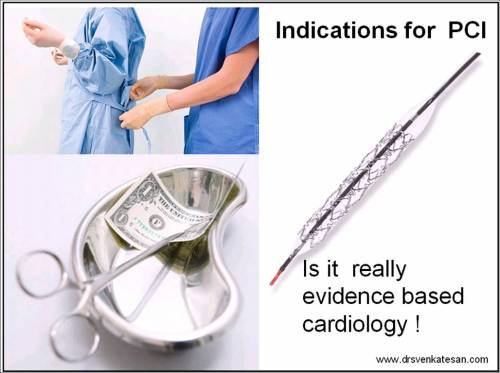
Scientifically , the indication for coronary revascularisation should be based on following
Patient’s symptom ( more specifically angina , dyspnea is less important !)
Prov0kable ischemia ( A significantly positive stress test )
Signifcant LV dysfunction with documented viable myocardium & residual ischemia
A revascularisation eligible coronary anatomy * TVD/Left main/Proximal LAD etc ( *Either 1, 2 or 3 should be present in addition )
All emergency PCI during STEMI /High risk NSTEMI
Practically ,
A CAD patient may fulfill “Any of the above 5 “ or “None of the above 5” , but , if a coronary obstruction was revealed by coronary angiogram and if he fulfils The 6th criteria , he becomes eligible for revascualrisation
6th criteria
If the patient has enough monetary resources (by self ) or by an insurance company to take care of PCI /CABG *
*The sixth criteria overrides all other criteria in many of the cath labs .Of course , there are few genuine ones still fighting hard , to keep the commerce out , from contaminating cardiology !
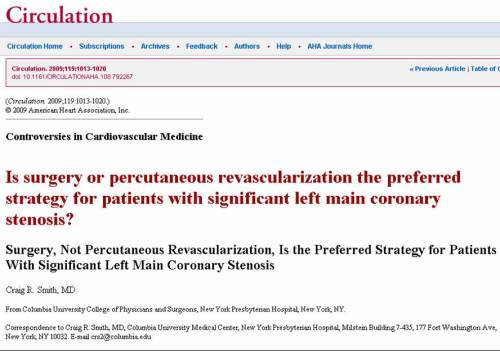
Why PCI in left main CAD is considered an inferior modality than CABG ?
CABG is superior to PCI for the simple reason it provides complete revascularisation virtually in all patients with LMCAD , while PCI is possible only in a fraction of patients with LMCAD.
If we take 100 patients with left main disease may be ten (At best !) would be suitable for PCI ! In other words PCI is contraindicated in vast majority of LMCAD by technical criteria alone , while there can never be a contraindication for CABG in patients with LMCAD.(Except when , comorbidity precludes surgery )
Why PCI in LMCAD difficult ?
It is dependent on technicalities
CABG does not tackle a lesion, it simply avoids it and by passes it ” No great brains required”
while PCI takes on the plaque frontally , in the dangerous terrain of left main artery itself !
so, much caution, planing , logistics are required . Further , if there is a complication there is a potential
for catastrophe as the only supply line is cut off . This is the reason , cardiologists were worried to try this on
unprotected left main. (Protected LMCAD refers to left main disease following CABG wherein atleast LAD or LCX is grafted )
Points to ponder in LMCAD
PCI is suited for isolated discrete LM disease.In realty this is seen in less than 5-8 % CAD.
LMCAD is very often associated with critical and multivessel distal CAD . So these patients will be candidates for CABG.
Left main ostium or LAD ostial involvement makes PCI a tougher exercise
Calcification is more common in LMCAD that again makes PCI difficult.
The following article in Feb 2009 is a major blow for proponents of PCI for left main
Conquering left main disease is an interventionist’s ultimate dream.
But, before that they have to tackle the bifurcation lesions .This is of vital importance, because 2/3 rd of left main patients have some form of bifurcation lesions. Current techniques , hardware and outcomes are far below the idealistic solutions in bifurcation lesions.
Till that time , CABG would remain the only choice for all , but for a small fraction of isolated left main disease where PCI may be possible.
Drugs are poisons , whenever it is administered without valid purpose. it can enter human body in many ways (Oral, intravenous, percutaneous etc ) And now we have another route namely intracoronary !
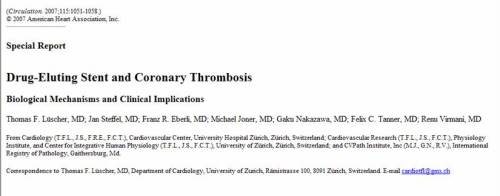
In quest for prevention of restenosis, many of the anti cancer drugs are now delivered directly inside the coronary arteries .These drugs are secreted like a sustained release tablet from the drug coated stents.These drugs are expected to prevent restenosis within the stented segment.But, after years of intense debate and research , we realised that , drugs eluted from the stent could damage the distal coronary vascular bed and coronary microcirculation.( And thus came the epidemic of acute stent thrombosis ! )
The tender and sensitive coronary microvasculature is constantly exposed to these powerful anticancer and immmunosuppresive drugs .It is a great surprise , no body thought of this dangerous drug -coronary artery interaction ! It required the genius of Renu virmani and others to point out this.
But still , the cardiology community by and large , fails to consider this an important issue.This is proven by the fact, usage of DES is still increasing and used mainly as an off label indication.
What is the long term effects of drugging a coronary artery ?
Is no reflow or slow flow more common after DES , because of the adverse drug reaction in the distal vascular bed ?
If a patient with DES undergoes a CABG later what would be the impact of the drug on the graft ? Will the functional vasodilatation affected ?
Final message
A drug , to get a legal clearance it has to undergo hundreds of rigorous tests . Finally it is cleared for that specific indication for which it is tested .Just because a drug is cleared for one purpose ( Paclitaxel for malignancy ) it does not mean it is safe to use for any other purpose for which it is deemed to be useful . Exactly the opposite is happening in the the field of interventional cardiology . No body wondered to think what would be the effect of these drugs on the normal coronary endothelial cells and vasculature.Is it not a crime , without analysing this particular issue , dozens of drug eluting stents have been released in the market . And now, sounds of crying foul is heard world wide !
Let us thank , the so called negative forces in cardiology for making this an issue . In science , the watch dogs should bark at times of danger not wag the tail !
Anginal pain is a type of visceral pain.It is carried by type C unmylinated nerve fibres.The perception of angina is a complex process.It is a combination of visceral and cutaneous referral pain.
How often is angina silent in diabetes mellitus ?
Presence of diabetes per se does not make an angina silent. In fact, if one takes 100 patients with diabetes , if angina occur in them , it is more often , manifest than silent. So , only few of the diabetic patients who develop diabetic autonomic neuropathy fail to have angina.The exact incidence is not known.It could be around 20%.
If angina can be silent in diabteics , can they have anginal equivalents ?
This again is not answered in literature. Among the anginal equivalents , the most common is dyspnea , which can occur in diabetics.But now , we know dyspnea also needs thoracic nerve signals from the intercostal muscle spindle and colgi organs.This can also be impaired in diabetics.
Can silent and mainfest episodes occur in a same patient ?
Yes.
Once silent does not mean always silent, and similarly once angina is felt it does not mean he is going to feel the next episode as well !
This strongly reminds us medical science is much a complex subject and what we know is very little in pain perception.
How is silent ischmia different from silent angina ?
There is considerable overlap between silent ischemia and silent angina
The questions to be answered are
Which is silent ? Is it the angina or is it the ischemia or both ?
Silent ischemia can occur in any individual , this is also called as silent CAD . When ischemia occurs but fails to generate pain it is silent ischemia .Undiagnosed CAD in asymptomatic individuals is also called silent ischemia or CAD.In this population Exercise stress testing detects CAD which was otherwise silent and masked.These patients may develop angina during EST.
During exercise stress testing many times patient has significant ST depression more than 2mm but still chest pain may not occur.These episodes may either be silent ischemia or ngina. Many times the EST is terminated before angina is manifest .( Chest pain is the last to occur in the chain of events following ischemia- Concept of ischemic cascade )
What are the other situations where angina can be silent ?
Pain perception and threshold level is high , so patient indeed has anginal signals but fails to feel it .
Patients on antianginal medication , fail to feel the angina.
Chronic betablocker therapy can exactly mimic autonomic neuropathy
Is it a blessing for the patient to have painless episodes of angina ?
When their ischemic colleagues , suffer a lot with chest pain it is tempting to think these diabetic patients are blessed!
Scientifically , this could be true in at least in some especially in a patients who’s coronary anatomy is known and devoid of any critical proximal lesions. For example a small PDA lesion can produce severe angina , but may be silent in diabetic and be comfortable .This lesion is insignificant other wise * !
It should also be recalled , pain relief has been an important goal for treatment of CAD .In olden days, thoracic sympathectomy was done for angina . In fact , even in CABG , one of the the mechanisms for angina relief is attributed to cardiac denervation.
Caution: Even a small episode of ischemia can trigger an electrical event .But it is rare.
How common is silent infarct (STEMI) in diabetic patients ?
In a simple questionnaire we asked the diabetic patients in our CCU how they felt their pain during MI.Most felt it normally as do other non diabetic . Diabetes does not make all anginal episodes silent. Severe episodes of ischemia may be painful while less severe episodes may be painless. Diabetic autonomic neuropathy is a least recognized and poorly understood complication of diabetes.Diabetes , involves the vasanervorum of the autonomic nerves.
The other mechanisms postulated in diabetic neuropathy are
Reduction in neurotrophic growth factors.
deficiency of essential fatty acids .
Reduced endoneurial blood flow and
Nerve hypoxia .
Is diabetic autonomic neuropathy treatable ?
Very difficult problem indeed.Controlling diabetes may partially correct the neural dysfunction.Many add on neuro vitamins and aminoacids are having a good market !
If you successfully treat diabetic autonomic neuropathy will my patient start feeling the hitherto silent episodes of angina ?
We don’t know.Logic would answer ” YES”
What is the ultimate effect of cardiac autonomic neuropathy.
The growth of medical science has been phenomenal .It is estimated , the quantum of break throughs and development in the last 50 years is nearly equal to 2000 years of evolution of our knowledge put together. Along with this growth , came the unavoidable misuse , and abuse of medical science. This is mainly due to contamination of medicine with commerce . Federal drug authority (FDA) and it’s variants were formed in all countries to monitor the proper usage of these technologies for the benefit of mankind. It has an authority to ban a drug or device , if it is found to bring more injury or side effects than benefit !
But , unfortunately there is no legal authority to ban an an investigation which is potentially or (really harmful )
or used extensively without any valid purpose .
The list of such investigation is increasing in every speciality
In cardiology
Doing a Troponin assay in patients wuth classical STEMI
MDCT in general population
Pro BNP in all suspected cardiac failure
Routine C reactive protein for CAD
Central venous catheters for all pateints with shock.
Is there a case for banning an investigation (Like banning a drug) for the benefit of our patients ?
Looking superficially , it may seem ironical. But we realise many seemingly innocuous investigations are responsible for uncontrolled misery for many patients.
This especially true in people who throng the wellness clinic (Also called master health check up)
A incidentally high C – reactive protein can lead on to forearm blood flow assessment of endothelial dysfunction and carotid intimal plaque that could lead onto carotid stents ! and life long anticoagulation , and an excess INR and sudden cerebral bleed and death !
This is one sample story in one particular speciality
There is a definite case for banning ( Either total or partial) some of the questionable investigations which are done routinely !
Just because these investigation do not have any physical , visible , adverse reactions like a drug , it should not be allowed to be abused .The consequence of false positive results of these investigations could be terrible and worse than the real disese itself !
The irony of medicine is unlimited ! 100 years of active clinical research failed to find a specific cure for the rhino virus mediated common cold.In fact US Govt stopped funding for this .
While , complete cure is possible for many of the cancers, especially hematological ones !
Message
In medicine there are thousands of disorder which have no cure !
The contents of the this blog is being published as Kindle E book , as per the request of many of the readers. Every article will continue to be open source in this site. Again I shall reiterate the book format is not aimed at any commercial intent. It is only to facilitate learning in a single book format Here is the link to book https://amzn.in/d/euhL5vu
Click below to see who is watching this website live !
This site will never aim for profit. Still ,this donation link is added at the request of few visitors who wanted to contribute and of-course that will help make it sustainable .
Please Note
The author acknowledges all the queries posted by the readers and wishes to answer them .Due to logistic reasons only few could be responded. Inconvenience caused is regretted.
 Is he a person who puts a metal coil coated with a synthetic fungus in a incidentally detected block inside a small coronary artery and sends the bill to the Insurance company ?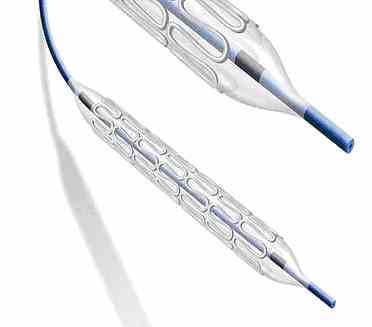




 Dr.S.Venkatesan MD