Feeds:
Posts
Comments

Archive for the ‘Cardiology-Coronary artery disese’ Category

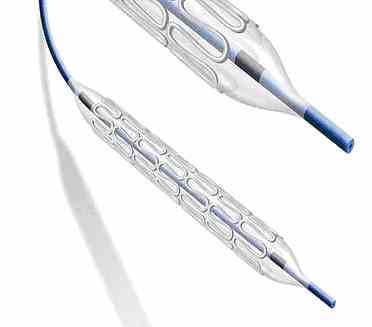
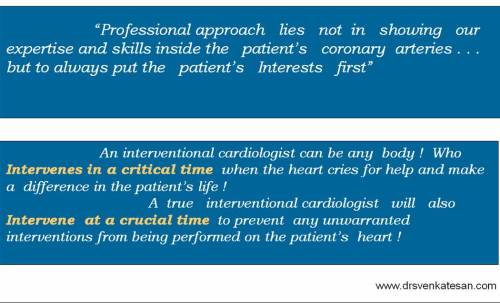
cardiologist Is he a person who puts  a   metal coil  coated with a synthetic fungus   in  a   incidentally  detected  block  inside a  small coronary artery and sends the bill to the Insurance company ?

Is he a person in a  cosmopolitan  hospital  who opens up a    chronically   closed  coronary artery , in an asymptomatic patient  and  live telecasts  his achievement trans continentally ?

Is he a person who   checks in by  the early morning flight and  puts multiple wires in  an  aged   patient   with  class 3 heart failure and  make  him walk  20 meters extra at a cost of  1000$ / Meter ?

Is he a person living in   Wall   street  ,   who   looks  for variety of holes In  the heart and trying to occlude  it  with   exotic   devicespci ptca stent

Is he the unknown   physician   who Intervenes in the natural history of Rheumatic heart disease   and arrests   immune mediated   valve damage by giving the  monthly injections  penicillin in remote parts of our country ?

Is he the person   who   Intervenes to prevent young   persons   from  smoking and help maintain  their  coronary endothelium  enriched with nitric oxide  & arrest  the coronary epidemic ?

cardiologist 2

Is he the small town doctor  who  Intervenes  to treat a breathless cardiac failure patient  with  digoxin and frusemide  and  dramatically alleviate the  symptoms and  prolong the  life of our poor country men?

Is she the village health nurse from an inaccessible health  centre  located in a  hilly terrain ,  Intervening  successfully, by   pulling out  live babies  from  severely anemic pregnant  mothers with failing hearts ?

pci ptca cardiologist coronary angiograms

Read Full Post »

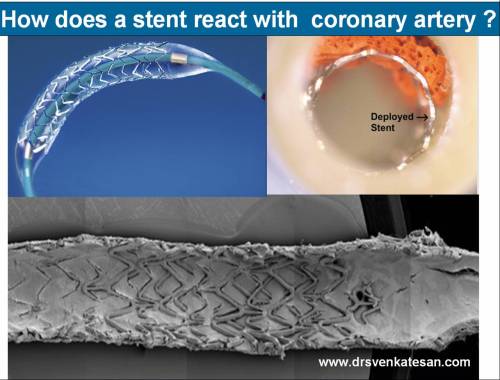
Fundamental principle  of  human biological system is to live in harmony with nature and environment.Each cell  has a unique reaction  when it comes into contact with  external  material. This reaction can be acute or chronic  ,   local or systemic. The most severe form of allergy is called anaphylaxis  that can result in instantaneous loss of life. There  is a whole gamut of disorders  that  resulted  in a  separate  speciality called allergic medicine .

Further ,the transplantation  science have   taught us  an  organ or cell can be rejected at any point of time after implantation (Hyperacute -chronic) .With advancement of science we have started implanting a variety of devices  with complex metallurgy ,inside human body, metal clips, prosthesis, valves, wires, etc .How the body handles them .The consequences can be a mild reaction to major ones occasionally.

Consider ,a local allergy due to a orthopedic prosthesis  in one of the leg bones  is far less serious than a metal within a coronary artery  irritating the intima .

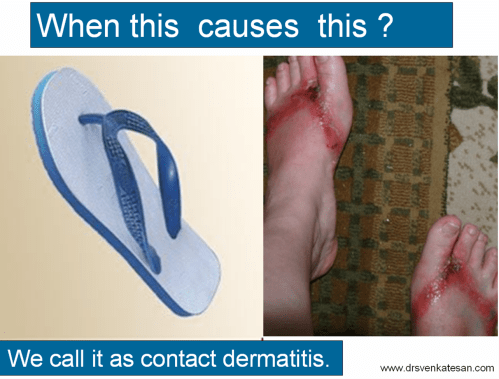
Remember hypersensitivity reactions can be severe . This lady reacted  like this to a sandal slipper -A  fiery red  infiltration

contact dermatits stent allergy pci coronary

Imagine  if a stented coronary artery react like this what would be the possible consequence ?

In susceptible  individuals  , can a metal cause

  • Intimal hyperemia
  • Intimal induration
  • Intimo-medial edema  following stent deployment

pci stent coronary angiogram thrombosis des

Why drug eluting stents are more prone for hypersensitivity ?

The answer is simple , while metal allergy is a comparatively rare phenomenon, the drugs we  coat and the polymers used are  many fold likely to result in hypersensitivity reaction.

While  the world is worried  more  about penicillin , sulpha allergy which occurs in 1 in 100000 ,  we tend to ignore the metal and drug  reactions within  the tender coronary arteries.

stent des rejection virmani  pci

What is  the clinical expression of  stent hypersensitivity ?

It is  often a coronary event in the acute phase and restenosis in chronic phase.

How much of acute stent thrombosis is related to stent allergy mediated reaction ?

The exact incidence  will  never be known. It could be high. Whenever a sudden unexpected early stent occlusion can be a suspect .

Is stent allergy a local reaction or systemic reaction ?

It is most often local .The drugs the stent elute can elicit a systemic reaction occasionally.

So what can be done to prevent this complication ?

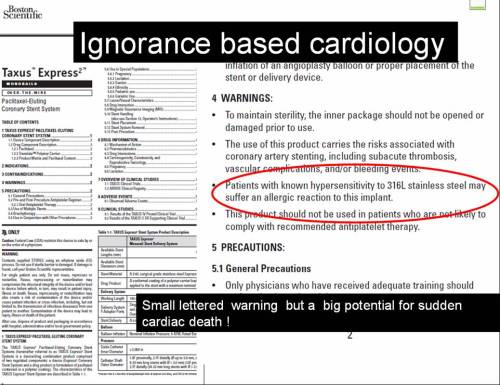
Drug companies in it’s  package regularly  include the warning  message ! What does it imply to have a caution  on the covers ? .This warning simply represent about our ignorance in this issue. We presume it is a minor problem.

pci stent thrombosis stent allergy metal

Questions unanswered

  1. How does a cardiac patient knows whether he is hypersensitive to stainless steel or nickel ?
  2. Is it practical to have a stent allergic test in every patient before PCI ?
  3. Is routine administration of corticosteroids for few days after PCI an answer ?

Reference

R.Virmani , circulation 2004

http://circ.ahajournals.org/cgi/content/full/109/6/701?maxtoshow=&HITS=10&hits=10&RESULTFORMAT=&fulltext=stent+%27allergy%22+&searchid=1&FIRSTINDEX=0&resourcetype=HWCIT

Read Full Post »

NSTEMI constitutes a very heterogeneous population .The cardiac risk can vary between very low to very high . In contrast , STEMI patients carry a high risk for electro mechanical complication including sudden death .They all need immediate treatment either with thrombolysis or PCI to open up the blood vessel and salvage the myocardium.

The above concept , may be true in many situations , but what we fail to recognize is that , STEMI also is a heterogeneous clinico pathological with varying risks and outcome !
Let us see briefly , why this is very important in the management of STEMI

Management of STEMI has undergone great change over the past 50 years and it is the standing example of evidence based coronary care in the modern era ! The mortality , in the early era was around 30-40% . The advent of coronary care units, defibrillators, reduced the mortality to around 10-15% in 1960 /70s . Early use of heparin , aspirin further improved the outcome .The inhospital mortality was greatly reduced to a level of 7-8% in the thrombolytic era. And , then came the interventional approach, namely primary PCI , which is now considered the best form of reperfusion when done early by an experienced team.

Inspite of this wealth of evidence for the superiority of PCI , it is only a fraction of STEMI patients get primary PCI even in some of the well equipped centers ( Could be as low as 15 %)

Why ? this paradox

Primary PCI has struggled to establish itself as a global therapeutic concept for STEMI , even after 20 years of it’s introduction (PAMI trial) . If we attribute , lack of infrastructure , expertise are responsible for this low utility of primary PCI , we are mistaken ! There are so many institutions , at least in developing world , reluctant to do primary PCI for varied reasons.( Affordability , support system , odd hours ,and finally perceived fear of untoward complication !)

Primary PCI may be a great treatment modality , but it comes with a inherent risk related to the procedure.

In fact the early hazard could exceed the potential benefit in many of the low risk STEMI patients !

All STEMI’s are not same , so all does not require same treatment !

Common sense and logic would tell us any medical condition should be risk stratified before applying the management protocol. This will enable us to avoid applying “high risk – high benefit” treatments in low risk patients . It is a great surprise, the cardiology community has extensively researched to risk stratify NSTEMI/UA , it has rarely considered risk stratification of STEMI before starting the treatment.

In this context , it should be emphasized most of the clinical trails on primary PCI do not address the clinical relevance and the differential outcomes in various subsets of STEMI .

Consider the following two cases.

Two young men with STEMI , both present within 3 hours after onset of symptoms

  1. ST elevation in V1 -V6 , 1 , AVL , Low blood pressure , with severe chest pain.
  2. ST elevation in 2 ,3, AVF , hemodynamically stable , with minimal or no discomfort .

In the above example, a small inferior MI by a distal RCA occlusion , and a proximal LAD lesion jeopardising entire anterior wall , both are categorized as STEMI !
Do you want to advocate same treatment for both ? or Will you risk stratify the STEMI and treat individually ? (As we do in NSTEMI !)

Current guidelines , would suggest PCI for both situations. But , logistic , and real world experience would clearly favor thrombolysis for the second patient .
Does that mean, the second patient is getting an inferior modality of treatment ?

Not at all . In fact there is a strong case for PCI being inferior in these patients as the risk of the procedure may far outweigh the benefit especially if it is done on a random basis by not so well experienced cath lab team.
(Note : Streptokinase or TPA does not vary it’s action , whether given by an ambulance drive or a staff nurse or even a cardiologist ! .In contrast , the infrastructure and expertise have the greatest impact on the success and failure of PCI )
Final message

So , it is argued the world cardiology societies(ACC/ESC etc) need to risk stratify STEMI (Like we do in NSTEMI ) into low risk, intermediate risk and high risk categories and advice primary PCI only for high risk patients.

Reference

https://jamanetwork.com/journals/jamainternalmedicine/fullarticle/226907

Read Full Post »

Coronary collateral circulation is the God’s gift to mankind.It has potential  benefits  ( and  of course real benefit !)  both during acute and chronic coronary syndrome.

Collaterals in CCS

The classical role of coronary collateral is in patients with chronic stable angina.It is quiet common to see patients with totally occluded  LAD or RCA with normal  LV function maintained  by extensive collaterals .

Collaterals during ACS.

An intact and functional  collateral circulation can prevent an NSTEMI  from converting into STEMI.In fact many of the patients with unstable angina patients carry on with viable myocardium just because thaey have good collaterals.It gives us a time window to intervene .Some times the col laterals are good enough and help us avoid a revascularisation in toto.

Collateral’s in  STEMI.

This is not well understood. Some  researchers  reported opening up of collateral channels very early after a STEMI. Logic would suggest , anatomically patent functionally closed collateral channels are  always available at time of crisis. But not every one is blessed with such rescue mechanism.

What determines  the native collateral channel development in human cor0nary circulation ?

When  the answer is unknown , it moves to  the  genetic domain also called  – God’s domain .

Our ignorance in decoding coronary collaterals is vast.

The chief cause of this ignorance is we always  tend , not believe things which we don’t see.

Coronary collaterals channels need to atleast 1mm  to be visualised by CAG.There could be a vast network of micro collaterals out there within the myocardium invisible to current imaging methods. (In fact , this has a link with outcome  of the COURAGE study )

Is coronary collaterals have all the three layers of an artery ?

Yes .But the media lacks muscle.

Is coronary collateral less prone for spasm ?

May be.

The drugs we give , Calcium blockers , betablockers, and nitrates have same  hemodyanmic effects  as in native coronary circulation ?

We don,t know as yet. Nitrates are supposed to improve collateralisation

How common is atherosclerosis to involve the coronary collaterals ?

How often is an ACS precipitated by an collateral occlusion ?

May be more common than we think.

Can we stent a  2mm wide  collateral to maintain  the patency in case of a CTO  ?

A question need to be answered by current generation interventional cardiologists.

Is coronary collateral gives protection against primary VF ?

In one sense ,  the number one killer of mankind is  in fact not STEMI but the VF that follows it .

Why only a few develop a VF following an MI ? What determines the arrhythmic response to ischemia ?

Some anecdotal observation  of     suggest a role for early coronary collateral  opening in the prevention of VF .

Read Full Post »

Diagnostic issues in cardiac failure : A  febrile pleural effusion in a patient with LV dysfunction .

Is it a transudate or exudate ?  How to confirm the pleural effusion is primarily cardiac failure related ?

When the classical protein criteria is inadequate or prone for errors

Try this more specific marker  within the pleural fluid

N-Terminal Brain naruretic peptide

Pleural fluid NT-proBNP is very useful in establishing the diagnosis of HF-associated effusions, and it confirms this diagnosis . The measurement of NT-proBNP rather than serum to pleural protein gradient is recommended for identifying mislabeled cardiac transudates.

Reff :Biomarkers of Heart Failure in Pleural Fluid. Chest. 2009 Apr 10.

Read Full Post »

To further understand women's heart click on the title

SCD  continues to be  the major mode of  death of  our  population . Millions of men die every year instantly .The commonest mechanism is due to primary ventricular fibrillation following an abrupt closure of coronary artery due to a thrombus.Most die , within few minutes of the event, some  before reaching the hospital , few within the ambulance  and an  unlucky few die on the CCU bed  or cath lab table even after getting the best treatment.

If we analyse the data, there is a  surprising fact !  Men form the bulk of these SCD victims.In our experience , out of 100 cases of consecutive  in hospital primary VF only  6 were females , indicating  an important  biological phenomenon to be studied.The data for out of hospital primary VF is more difficult to get , but the  log records of EMRI and emergency rescue team consistently confirm the male preponderance of primary VF .

How  does the female heart enjoys this relative immunity from primary VF even as the blood supply is acutely compromised ?

The answer  is  not known . If we are able to  decode this , one can replicate the same  model in male .

The QT paradox and incidence of primary VF

QT interval represents a combination of  electrical depolarisation and repolarisation .It is a well established   scientific  fact  that  women have   relatively  prolonged QT interval .This  is determined by evolutionary biology and  inherited characteristics of  potassium channels  during myocardial repolarisation

In simple terms, the female heart  knows how to relax slowly and prolong the electrical relaxation time.(Not mechanical)

It is also a well known  fact ischemia mediated a prolonged  QT interval is a trigger for dangerous ventricular arrhythmia.This ischemia induced QT prolongation is less pronounced in females than males as the baseline QT itself is slightly longer in women.The percentage increment of QT interval during acute ischemia is significantly higher in male .This could be one reason for the preponderance of VF in men

The billion dolor question and a real challenge for the cardiologists is

How to make a heart electrically inert during ongoing ischemia ?

  • Pain is also trigger for primary VF due to high adrenergic tone.Prompt control of chest pain make VF less likely.
  • Lignoacaine a myocardial anesthetic if administered quickly can prevent many of the primary VF.

And now , shall we  think little wildly !

What if , if  we administer lignocaine spray straight over the (or sublingually ) in every patient with  chest pain

as like a sport injury and try calm down the heart electrically !

Also read

1.Lignocaine  the forgotten hero .

2.View this video -Ignorance based cardiology !

Reference

Arrhythmias and sex hormones


Read Full Post »

Post myocardial infarction revascularistation either by PCI or CABG forms the bulk of the coronary interventions world wide.There has been considerable controversy in selecting the patients for the procedure.

Certain basic rules are to be applied.

  • Never do any thing on a totally asymptomatic and fully functional patient.(Functional , means good exercise capacity of atleast( 10Mets).Just medical treatment with good doses of statins, beta blockers will do.
  • If a patient has persistent angina  following MI  ,the issue is relatively simple as  they are  candidates  for CAG  and intervention .
  • The issue becomes little complex when the primary complaint is breathlessness and echo showing  LV dysfunction.

This dilemma is due to a  simple fact

coronary revascularisation has a  great impact in relieving angina but has  less impact in reversing

left ventricular  dysfunction

So,  how do you approach a patient with LV dysfunction and exertional  breathlessness and absolutely no chest pain ?

  1. Do a  CAG
  2. Assess the lesions if any (Some times,  to our surprise there may not be any critical lesions at all ! )
  3. If there is / there are critical lesions try to corroborate with infarct segments.(Use Echo for this correlation)
  4. Don’t bother much,  if a  vessel has a lesion  that is supplying a scarred myocardium.
  5. If there is gross LV dilatation, mitral regurgitation and LV clot refer these pateints  may benefit  from surgical management

One of the rules written by the cardiology community over the past few decades has been

We must document viable myocardium before doing a revascularisation procedures on them.

This rule was self imposed ,  to prevent inappropriate revascularisation in  post MI population.

So , a  gamut of investigations (Both invasive and non invasive came into vogue) to identify viable myocardium in post MI population. Stress echo, Thallium-sesta MIBI, PET  to name a few .

Even after liberal usage of these invesitgations , we realised ,  the confusion in the  optimal selection of candidates for revascularisation has not settled.

In fact,  the correlation between viabilty and subsequent interventional benefit is  inconsistent .Not withstanding this  issue  ,cardiologists inspite of the negative results of OAT and TOAT trials ,  started  opening or by passing any occluded vessel irrespective of viability status.

Unanswered  &  Unasked questions in myocardial revascularisation ?

1.Why viable myocardium is viable even in the adverse compromised vascular  environment ?

It  is viable for the simple reason it has some capacity to be alive . By it’s inherent survival capacity (Survival of the fittest ) or it somehow gets the nutrients by cell to cell perfusion.

2. It is viable allright  ,  why it is not contracting ?

Because ,  it is biochemically and metabolically alive (Can be documented by FDG PET scan mismatch ) but it can not synthesise adequate ATPs to make the muscle contractile.

3.”Viable myocardium is viable ” what more you want from it   ?

Simple viability is not suffice . How to make it mechanically active and contractile ?

4.Is viable  myocardium    synonymous with ischemic myocardium ?.

No,  it is not (Contrary to the popular perception ) .

5. Is it not  common to find dysfunctional segments with good TIMI 3 flow ?. So what is the purpose to document viability ?

It is not suffice to simply document viable myocardium but it is an absolute necessity to prove this viable segment is also  critically ischemic .

7.If angina is  a sign of viabilty why most of viable myocardium is painless ?

This again confirms the fact , much of the viable myocardium in the post MI phase is not ischemic but” still dysfunctional” waiting for healing time. This concept  was  introduced with great fanfare* as  stunned myocardium ,  20 years ago , which was subsequently rejected my mainstream cardiologists , as this concept tend to  restrict the  freedom of interventionists. * Even though ,the concept was genuine and proven scientifically !

6.Are we  certain , the  viable ,  non contractile myocardium  (Which we painstakingly document )  will get back the contractility once the  segment is    revascularised?

Absolutely not. (With lot of PET study doumentation )  This,  we can not guarantee even in ischemic, viable segments  ,  while in the  non ischemic, viable segment it is all the more unlikely.

7. What are the chances of these viable but  non contractile myocardium  regain the contractility  by natural course ?
Very significant chances .In fact every patient recover some LV  function spontaneously over time .

Final message.

  • Revascularisation is non controversial in patients with angina
  • In patients with  primary symptoms of dyspnea  ,  it is less effective and documentation of myocardial viabilty per se will not guarantee successful outcome following revascularisation.Out come depends on  multiple factors .

Read Full Post »

Left main coronary artery disease (LMCAD) often evokes  a panic reaction  among cardiologists .Not every LMD deserve that re. To  label  it as  significant, we have a criteria ,  that is 50% diameter stenosis.  So what you do , for a tapering  or narrowed left main with 40% stenosis. Isolated insignificant left main is rare *, but real incidence is not known.  LMCAD  is  most often due to  , atherosclerosis of left main coronary artery without limiting the flow.

What are the options ?

  • Leave it alone, with intensive medical management assisted by high dose statin(80mg)
  • Elective PCI with stenting , even though the lesion is not significant.

*If associated LAD  or LCX is there decision making is easier .

How  significant is a coronary stenosis ?

The significance of a coronary lesion with reference to “lumen diameter obstruction” is basically flawed. The significance of a coronary stenosis, by tradition is  based on it’s hemodynamic impact ,right from the  CASS days in early seventies.Unfortunately our mind set has not changed even after realising    non obstructive – sub critical lesion is more prone for acute coronary syndrome.  Is it not ironical to call a  40% lesion a non significant one !

So, the  significance of coronary stenosis is two fold.

  1. Hemodynamic  significance
  2. Clinical and  pathologic significance

The former predisposes to often chronic stable angina, later likely to result in ACS.

How will you approach a apparently insignificant left main disease ?

A 40 % lesion in left main is hemodynamically not significant , but pathologically very significant.It needs intensive treatment. Plaque passification with medical approach is first choice.If the lesion morphology is eccentric,  has irregular margins or involves  LAD  or LCX ostium doing a PCI or even a CABG is to be considered in spite of the lesion is  hemodynamically insignificant .

Why , PCI is   considered  “not appropriate”  for   less tighter lesions , even though these lesions  have great clinical significance ?

The answer is simple, The risks  and the  potential cost are more than the benefit !

And further ,  stents are  not innocuous devices  either  , they  always carry a risk of sudden occlusion as like  a sub critical lesion  !

Answer to the title question

True incidence is not known . Our experince (Class 1 c evidence) would suggest Left main disease constitutes up to 10 % of CAD.Among this one third would be hemodynamically insignificant

Suggested reading

Handbook of Left Main Stem Disease


edited by Seung-Jung Park

hbleftmn

//

Read Full Post »

Lignocaine , probably has saved more lifes  world over  than any other cardiac drug .

It was the only choice for ventricular tachycardia  till 1990s, both in pre and post  thrombolytic era.Every coornary care unit has reverted tens of thousands of  unstable VTs with this simple and cheap intravenous drug.the utility value of lignocaine is not limited to ischemic VT alone it is effective in in almost all forms of VT.It was classically administered in two or more boluses followed by an infusion.

What happened to this wonder drug  with great performance record ?

The  power of   statistics , and inappropriate interpretation by the scientific community  has left a serious blow to this wonder drug .Now the drug has been made redundant, and mainstream cardiac literature has made everyone feel  guilty , if  anybody  uses this drug for VT .

Why did lignocaine lose the battle ?  The reason is three fold

  1. The advent of  much fancied Amiodarone
  2. One negative study  for antiarrhythmic drugs in post MI period (CAST) 
  3. And two so called  positive studies  for Amiodarone (ALIVE & ARREST) has sounded the death bell for this drug  which has resuscitated millions of life !

CAST study http://content.nejm.org/cgi/content/abstract/321/6/406 

All , CAST  said was routine suppression of  asymptomatic ventricular arrhythmias  in the post MI period is unwarranted. But you know , how this  world interpreted it  “Lignocaine  has no role in ventricular arrhythmias in post MI setting ”  The most funny thing  was  lignocine was never used in CAST study .

The  studies involving one to one comparison  of Lignocaine and Amiodarone (ALIVE and ARREST study) was also not interpreted  properly.These studied only shock resistant VTs. What about the role of lignocaine where defibrillator was not available ?

Link to ALIVE and ARREST  read and make your own conclusion.

http://content.nejm.org/cgi/content/abstract/346/12/884

http://content.nejm.org/cgi/content/full/341/12/871?ijkey=8fa241f3cebb86a177632ec6ccadfb5a3ded7bc2

 Final message

  • Lignocaine is not  only a topical anesthetic  , it is powerful and gentle myocardial anesthetic when administered in post MI period.
  • With this property it  successfully cardioverts and prevents dangerous ventricular arrhythmias.
  • Time tested and worthiness proven.
  • While , we are made to believe  the success rate of  Amiodarone in VT is far superior than ligncaine .It is a falsehood.
  • Any experienced cardiologists will recognise ,  many times even  Amiodarone resistant VTs often respond to Lignocaine .
  • The fact of the matter is , without a good quality  one to one study  , lignocaine was ditched. One reason for this could be  Lignocaine ,  is a generic drug and has no market value.

Let us take home , the message (scientific or unscientific ! ) Lignocaine still has a great role to play in the management of dangerous ventricular arrhythmias .The only caution is ,  it should not be used routinely and indiscriminately in all asymptomatic patients with  VPDs or nonsustained VT . (Acknowledging CAST conclusion.)

Read Full Post »

coronary-artery1

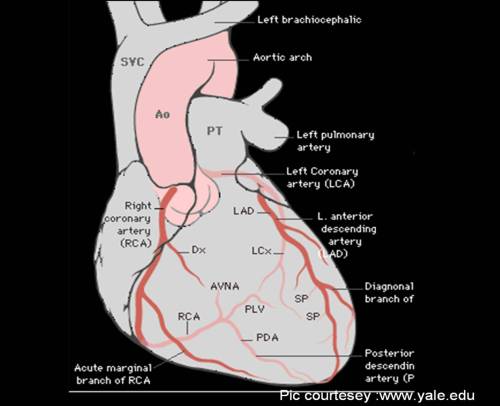
                                                      Coronary arterial circulation is the life line for  the human heart  and it’s survival.Typically it is supplied by two coronary arteries,  left and right coronary artery.Both, together carry about  250ml of blood every minute.( Approxinately  equal to a  cup of  coke !  ).These coronary arteries  generally divide in a predetermined  fashion , and have multiple branches . It is a  mystery , what  decides this  branching pattern

Is it like a our palmar crease  ? or the cerebral gyri ?

However , it does follow a certain rule,  one major coronary artery  will follow the  four  important grooves of heart. In the left side ,  left main coronary artery (LM) originates in the left coronary sinus (Size varying between 1mm -20mm)  and usually bifurcates into LAD and LCX. The left anterior descending artery (LAD) runs in anterior interventricular  groove while ,  the right atrio ventriculo groove carries the right coronary artery(RCA) .Left  circumflex artery (LCX) traverses the  left atrio ventricular groove.The most inconstant branch is the posterior descending artery (PDA) which runs in the posterior interventricular  groove.PDA  can arise from either RCA, LCX or both or even from LAD.

The major branches of LAD are called diagonal and septal  while the branches of LCX are called obtuse marginal(OM).There can be two to three diagonal and OMs. 

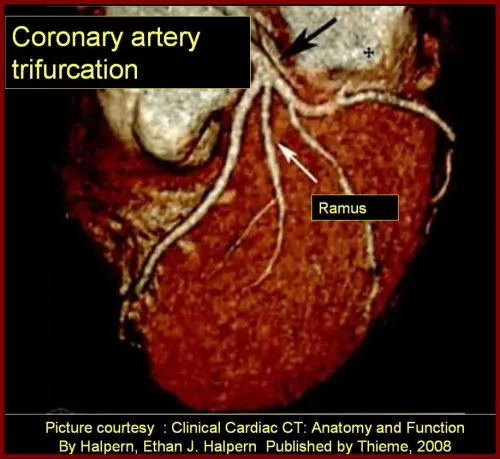
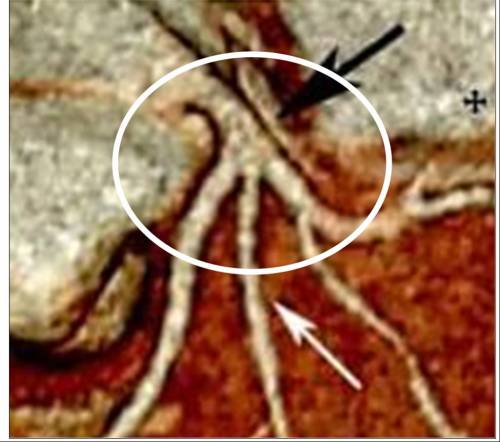
What is ramus intermedius coronary artery ? What is the incidence of Ramus ?

The left main coronary artery  instead of bifurcating into two ,  it trifurcates into three vessels.(LAD, LCX, Ramus)

The real incidence could vary betweenn (10% to 30%) depending upon the series.

ramus

What course it takes ?

It generally goes in the angle between the LAD and the LCX.It may either behave like a large OM or a diagonal branch.It supplies the lateral free wall of the LV many times.The peculiarity of this vessel is it does not run in a anatomical groove .It simply slides over the free surface of LV.Rarely, a  very abnormal course of ramus,  criss cross the aorta and pulmonary artery .

How common is atherosclerosis within  Ramus ?

We don’t know yet. But it is very likely since it is an early branch from left main, it  might  have a  predilection for atherosclerosis  as like LAD or LCX ostium.In fact now we recognise more of  trifurcation lesions involving  three branches of left main .

What would be the ECG finding if a large ramus is the culpirit vessel during STEMI ?

This scenario could be rare.

ACS in ramus could  present as ST elevation in 1/Avl /V5,V6

  • Lateral MI
  • Apical MI
  • High lateral MI

But it is realised , whenever the ECG changes are not fitting with typical ASMI or a lateral MI one should suspect a ramus lesion

 What is the significance of ramus for an interventional cardiologist ?

ramus-2

                                                   PCI in ramus is a rare opportunity for a cardiologist .The issue here  is,  if ramus is involved  adjacent LAD and LCX is also likely to be involved .So it would logically be a multivessel , complex angioplasty.Isolated ramus lesion could be tackled easily.Another issue here could  be ,since this vessel is not within  any anatomical groove  stent deployment would have a poor  support and prone for mobilisation and migration .

Read Full Post »

« Newer Posts - Older Posts »